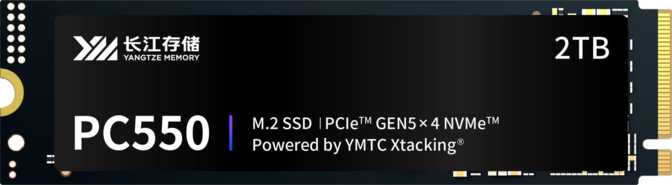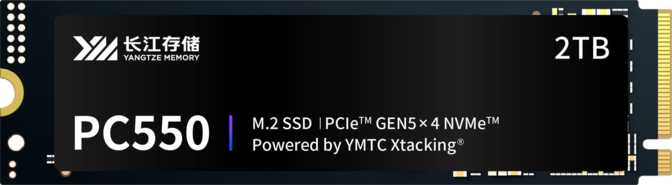
YMTC PC550 1TB Review: Top-Tier PCIe 5.0 NVMe Performance Tested
SSDsThe storage market has reached a point where most buyers no longer need to compromise. The YMTC PC550 1TB arrives at the top tier of consumer SSD performance, built around the latest PCIe 5.0 interface standard and engineered to push sequential speeds that would have seemed implausible just a few years ago. Whether you're building a high-end workstation, futureproofing a gaming rig, or simply demanding the fastest possible storage your platform can support, the PC550 is positioned squarely at that conversation.
This is not an entry-level drive dressed up in fast-sounding numbers. The specifications demand a compatible platform to unlock their full potential, and the drive rewards that investment with performance that stands at the very front of the consumer SSD class.
Design and Physical Form Factor
Build quality, form factor, and physical installation considerations
Clean, Purposeful Hardware
The YMTC PC550 1TB follows the standard M.2 2280 form factor — the long, gum-stick-shaped card that fits into the dedicated SSD slot found on most modern motherboards, laptops with high-performance configurations, and compatible add-in cards. This is the universal standard for high-performance NVMe drives, and it means installation is straightforward for anyone who has handled a modern build.
The drive ships without an integrated heatsink and without RGB lighting. For enthusiasts who want a clean aesthetic or who are working inside a case with limited airflow management, this is a practical advantage — you decide on the thermal solution, whether that's the motherboard's own heatsink cover, a third-party cooler, or simply letting your case airflow handle it. The absence of a factory heatsink also keeps the physical height minimal, which matters in tighter chassis or laptop installations where clearance is measured in millimeters.
Performance: What These Numbers Actually Mean
Sequential speed, random IOPS, controller architecture, and interface analysis
Sequential Read Speed — Generation Comparison
Sequential Speed — The Big Picture
The PC550 delivers sequential read speeds of 10,500 MB/s and sequential write speeds of 9,500 MB/s. To give that context: a typical PCIe 4.0 drive peaks around 7,000 MB/s reads, and a PCIe 3.0 drive sits around 3,500 MB/s. The PC550's read speed is essentially triple what most systems shipped with just a few years ago.
In practical terms, sequential speed governs how fast large, contiguous data moves — think transferring a 50GB video project, loading a large game that streams assets from disk, or copying a virtual machine image. At 10,500 MB/s, a 10GB file transfers in roughly one second. A 100GB game install completes in under 12 seconds of raw drive-to-drive throughput. These are not theoretical numbers to impress spec sheets; they represent genuine time savings in content creation pipelines and large-file workflows.
Random Performance — The Daily Reality
Sequential speed tells one story. Random IOPS — how fast the drive handles thousands of small, unpredictable read and write requests simultaneously — tells the more important story for everyday computing.
The PC550 achieves 1,300,000 IOPS in both random reads and writes. For reference, a mid-range PCIe 4.0 drive typically lands between 700,000 and 1,000,000 IOPS. That 1.3 million IOPS figure means the drive handles application launches, operating system operations, browser cache reads, multitasking across many open programs, and game asset streaming with exceptional responsiveness.
The symmetry between read and write random performance is also notable — most drives favor read IOPS over writes, and having parity here means write-intensive workloads such as databases, frequent save operations, and real-time logging are handled just as fluidly.
The Cacheless Architecture
The PC550 operates without a dedicated DRAM cache. This is worth understanding rather than dismissing. Traditional high-end drives use a small pool of fast DRAM as a map to locate data on the NAND chips — the PC550 relies instead on a host-memory buffer (HMB) approach, using a small allocation of your system RAM for this mapping task.
HMB Advantage
On a system with adequate RAM (16GB or more), the performance difference versus DRAM-cached drives is negligible for most real-world workloads. The cacheless design simplifies the controller, reduces power draw slightly, and eliminates a potential component failure point.
When It Matters
Under extreme memory pressure or in server-adjacent environments running continuous mixed workloads, a DRAM-cached drive may maintain more consistent latency. For desktop and enthusiast laptop use, the cacheless design is a non-issue in practice.
NVMe 2.0 and PCIe 5.0 — What the Interface Upgrade Delivers
NVMe 2.0 is the communication protocol revision governing how the drive talks to your system. Alongside the raw bandwidth of PCIe 5.0 — which doubles per-lane throughput compared to PCIe 4.0 — NVMe 2.0 brings improved queue management and more efficient handling of mixed workloads. Together, these contribute to the low-latency, high-throughput profile the PC550 delivers.
Storage Capacity and Endurance
Practical capacity planning, write endurance ratings, and long-term reliability
1TB — Enough, or Just Enough?
One terabyte is the practical sweet spot for a primary drive in most modern builds. A fresh Windows installation with core software and drivers consumes roughly 30–40GB. A typical AAA game runs 50–100GB. A professional creative application suite adds another 20–50GB. You have meaningful headroom for active projects, frequently played titles, and a working dataset without immediately running into a wall.
For users who shoot raw photos, work with uncompressed video, or maintain large sample libraries, 1TB functions best as the primary OS and applications drive paired with secondary high-capacity storage for archives and bulk data. Keep the fast SSD performing at its peak by avoiding filling it above 80% capacity.
Long-Term Reliability
The mean time between failures figure is a statistical metric used to characterize reliability engineering — it indicates a very low calculated failure rate across the production population, not a literal runtime target for individual units. The five-year warranty is where confidence becomes contractual.
TLC NAND — What It Means for You
Understanding the storage architecture behind the PC550's performance profile
TLC (Triple-Level Cell) NAND stores three bits of data per cell, making it the dominant choice for consumer SSDs at this performance tier. It offers a strong balance of storage density, write endurance, and cost efficiency compared to older and more expensive MLC (two bits per cell) technology.
At the speeds the PC550 operates, the TLC architecture is paired with a capable 4-channel controller. Four controller channels allow the drive to parallelize read and write operations across multiple NAND die simultaneously — this parallel access pattern is a significant contributor to hitting and sustaining the high sequential and random figures cited above. More channels generally mean better sustained performance under heavy loads rather than just short burst peaks that deflate under continuous use.
Who Should Buy the YMTC PC550 1TB
Matching the right drive to the right buyer and platform
- High-end PC builders with a PCIe 5.0-capable platform — current-generation AMD AM5 or Intel platforms carrying a PCIe 5.0 M.2 slot — who want the fastest storage tier available today.
- Content creators working with large video files, raw image editing, or 3D rendering where frequent read and write access to large project files eats directly into productive time.
- Enthusiasts and power users who want a primary drive that is a genuine performance ceiling rather than a bottleneck — the kind of setup where storage is never the limiting factor.
- Workstation users handling virtualization, software compilation, large dataset processing, or any workflow where random IOPS translate directly into measurably reduced wait times.
- Budget-conscious builders on PCIe 3.0 or 4.0 platforms — the PC550's performance advantage is fully capped at the interface ceiling, and a PCIe 4.0 drive at a fraction of the cost will perform identically in that environment.
- Laptop upgraders unless your specific model explicitly supports PCIe 5.0 M.2 — most current laptops do not carry this interface in their expansion slots.
- Passive media consumers who primarily store content archives or stream locally — sequential write speed doesn't meaningfully improve playback or casual browsing, and the investment is better applied elsewhere.
Competitive Positioning
How the PC550 1TB stacks up against the current generation of NVMe drives
| Drive | Seq. Read | Seq. Write | Random IOPS (R / W) | TBW | Heatsink | Warranty |
|---|---|---|---|---|---|---|
| YMTC PC550 1TB | 10,500 MB/s | 9,500 MB/s | 1,300K / 1,300K | 600 TB | No | 5 years |
| Typical PCIe 5.0 Competitor | ~12,400 MB/s | ~11,800 MB/s | ~1,400K / ~1,400K | ~600 TB | Often included | 5 years |
| Typical PCIe 4.0 Flagship | ~7,000 MB/s | ~6,500 MB/s | ~1,000K / ~1,000K | ~600 TB | Some models | 5 years |
| Typical PCIe 3.0 Mid-Range | ~3,500 MB/s | ~3,000 MB/s | ~600K / ~550K | ~300 TB | No | 3–5 years |
PCIe 5.0 competitor and category figures represent segment norms and are not drawn from specific tested products.
The PC550 lands comfortably within the PCIe 5.0 tier. Some competing models push past 12,000 MB/s sequential reads, but the difference between 10,500 and 12,400 MB/s is imperceptible in any real-world consumer task — it only registers in synthetic benchmarks. The PC550's symmetric random IOPS profile, 600 TBW endurance, and five-year warranty represent a complete and competitive package at this tier rather than a spec-inflated outlier chasing a single headline number.
Honest Assessment: Strengths and Weaknesses
A balanced view of what the PC550 delivers and what it asks of the buyer
Where It Excels
The PC550's strengths start with its position on the right side of the PCIe 5.0 transition. Anyone building on a compatible modern platform gets genuine future-relevance here — this is not a drive that will feel outdated within two years as software and operating systems increasingly assume fast NVMe storage as a baseline.
The symmetric random IOPS profile stands out particularly; write-side random performance being equal to read performance is unusual at this tier and genuinely beneficial for write-intensive professional workflows that most drives quietly compromise on.
The five-year warranty backed by 600 TBW is a concrete expression of endurance confidence rather than a marketing afterthought. TLC NAND at this capacity and endurance level indicates mature, well-binned flash that YMTC is willing to stand behind for half a decade.
Where It Asks Something of You
The weaknesses are structural rather than defects. The absence of a heatsink is not a quality omission — it's a deliberate design choice — but it places the thermal responsibility entirely on the buyer, which requires awareness going in, particularly for builds with limited internal airflow.
The cacheless design, while fine for most use cases, is a technical concession worth understanding for anyone running server-adjacent workloads on their desktop. Under sustained extreme write loads or significant memory pressure, a DRAM-cached drive may deliver more consistent latency.
The hard platform requirement for PCIe 5.0 is non-negotiable: this drive delivers its value proposition entirely on compatible hardware. That's not a flaw in the drive itself, but it is a constraint every buyer must verify before committing.
Questions Buyers Are Actually Asking
Direct answers to the most common pre-purchase concerns about the PC550
Final Verdict
Our complete purchase recommendation for the YMTC PC550 1TB
The YMTC PC550 1TB is a serious, well-engineered PCIe 5.0 NVMe drive that delivers at the top tier of consumer storage performance without unnecessary additions — no RGB, no bundled heatsink inflating cost, no DRAM cache complexity. What remains is a compact, capable drive with exceptional sequential and random performance, strong endurance ratings, and a five-year warranty backing it up.
The purchase verdict is clear: if you have a PCIe 5.0-compatible platform and want a primary drive that will never be the performance bottleneck in your system, the PC550 1TB earns its place without reservation. If you are not yet on a compatible platform, hold this purchase until you are — the performance delta does not exist until the interface can support it, and the investment is genuinely wasted in that scenario.
For content creators, power users, and enthusiast builders operating on current-generation hardware, the YMTC PC550 1TB is a straightforward recommendation.