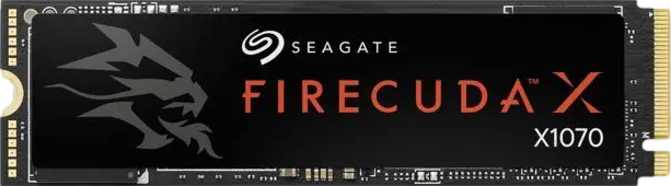
What the Seagate FireCuda X1070 1TB Actually Delivers
The FireCuda name has long carried a specific promise: performance that punches above its price class. With the X1070, Seagate targets the upper tier of PCIe Gen 4 storage — a space where the gap between the best and the rest has narrowed considerably. The X1070 arrives with headline speeds that rival the fastest drives in its generation, but a few specification choices underneath those numbers deserve a closer look before you commit.
This review unpacks what the X1070 does well, where it makes compromises, and whether those compromises matter for the way you actually use your PC.
Overall Rating
-
Performance4.5 / 5
-
Reliability4.5 / 5
-
Value for Money4.0 / 5
-
Build & Design3.8 / 5
Key Specifications
| Specification | Value |
|---|---|
| Capacity | 1 TB |
| Form Factor | M.2 2280 |
| Interface | PCIe Gen 4 x4 — NVMe 1.4 |
| Controller | TenaFE TC2201 (4-channel) |
| NAND Type | QLC |
| Cache Architecture | HMB (Host Memory Buffer) |
| Sequential Read | 7,200 MB/s |
| Sequential Write | 6,000 MB/s |
| Random Read | 850,000 IOPS |
| Random Write | 900,000 IOPS |
| Endurance Rating | 600 TBW |
| MTBF | 1.8 Million Hours |
| Heatsink Included | No |
| Warranty | 5 Years |
Design and Physical Profile
Form factor, heatsink considerations, and what to expect from the hardware itself.
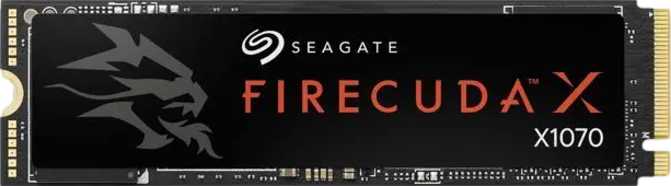
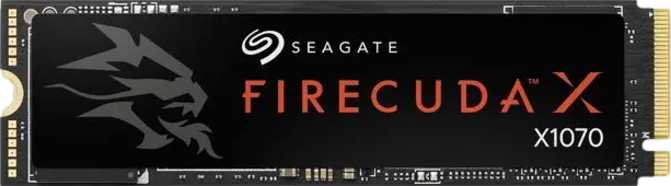
The FireCuda X1070 1TB follows the standard M.2 2280 form factor — the long, thin stick shape that fits into the dedicated SSD slot on virtually every modern motherboard, laptop upgrade bay, and PlayStation 5. If you have installed an M.2 drive before, the X1070 will feel immediately familiar.
What is absent is notable: there is no integrated heatsink, and there is no RGB lighting. For builders whose motherboards already include an M.2 thermal shield — which most mid-range and high-end boards provide as standard — the bare PCB is actually preferable. You get a cleaner fit under the motherboard's own heatsink without worrying about height clearance conflicts.
For those installing into a motherboard without thermal coverage, or into a laptop, monitoring temperatures under sustained workloads is advisable. The absence of RGB keeps the drive positioned as a performance tool rather than a showpiece — a sensible call for hardware that will spend its life hidden inside a chassis.
Physical Highlights
-
M.2 2280 — Universal FitCompatible with desktops, most laptops, and PlayStation 5 PCIe Gen 4 slots
-
Heatsink-Ready Bare PCBFits cleanly under motherboard M.2 shields without height clearance conflicts
-
No RGB — No ClutterClean, professional aesthetic suited to all build styles and chassis types
-
No Heatsink IncludedThermal coverage from a motherboard shield or aftermarket heatsink is recommended
Performance Analysis
What the speed numbers actually mean for gaming, content creation, and daily computing.
Sequential Speed in Plain Terms
The X1070 reaches sequential read speeds that place it firmly at the top of what PCIe Gen 4 can realistically deliver. To make that concrete: transferring a 50GB game installation takes roughly seven seconds. Moving a folder of 4K video footage that would have taken over a minute on a SATA SSD completes in well under ten seconds.
Sequential write speed is similarly strong. Large file operations — video exports, disk image creation, bulk media transfers — feel nearly instantaneous compared to anything that is not a top-tier Gen 4 or Gen 5 drive.
Random Access: Where Daily Computing Lives
Sequential speeds make for impressive spec sheets, but most of what your operating system does — launching apps, loading game levels, reading configuration files — involves tiny bursts of data scattered across the drive. This is measured in IOPS, and the X1070's figures here are genuinely strong.
Both read and write random IOPS land in the range that makes Windows and Linux feel responsive under multitasking pressure. Application launch times, boot sequences, and in-game asset streaming all benefit directly. The X1070's random performance is competitive with drives that cost meaningfully more.
Controller and Cache Architecture
The X1070 is powered by a TenaFE TC2201 controller operating across four channels. Rather than including dedicated DRAM chips on the PCB, it uses Host Memory Buffer (HMB) technology — borrowing a small portion of your system's RAM to store the drive's internal mapping table.
In normal desktop and gaming workloads, the performance difference between HMB and full DRAM-equipped drives is small enough that most users will not notice it.
QLC NAND: An Honest Assessment
The storage cells inside the X1070 use QLC NAND, meaning each cell stores four bits of data. This allows more storage per chip and keeps costs competitive, but carries two practical implications worth understanding.
First, the 600 TBW endurance rating. A user who writes 100 gigabytes per day — a very heavy workload — would reach that limit in approximately 16 years. For gaming and general computing, this is more than adequate.
Second, QLC drives use a portion of NAND as a faster SLC write cache. Within that cache, speeds are at their fastest. For the overwhelming majority of consumer workloads, the cache is large enough that native QLC write rates are never encountered in practice.
Reliability and Long-Term Confidence
Warranty coverage, failure statistics, and platform compatibility.
Matches or exceeds most competitors at this tier. Seagate's warranty support is well-established with a decades-long track record in storage.
Enterprise-grade statistical reliability testing applied to a consumer drive — reflects serious quality control standards rarely seen at this price tier.
A fully mature, widely supported specification with improved power management and host-controlled thermal features. Supported on all current platforms without exception.
Who Should Buy the FireCuda X1070 1TB
Matching the right drive to the right buyer saves money and prevents regret.
Strong Fit For
-
PC GamersFast load times, quick shader compilation, and smooth open-world streaming without paying a premium for capabilities rarely used
-
Content Creators Working Up to 4KVideo editing and high-resolution photography workflows where import and export speed directly reduces waiting time
-
Builders Upgrading from SATA or Older NVMeA substantial, immediately perceptible improvement over previous-generation storage
-
Laptop UpgradersFits any PCIe Gen 4 M.2 slot and can dramatically restore responsiveness to an aging machine
-
Home Workstations and Fast Cache RolesReliable, warranted, and well-suited to secondary fast-cache duty in creative workstation builds
Not the Best Choice For
-
Write-Intensive Professional WorkloadsVideo surveillance, database servers, or continuous large-write pipelines — TLC-based drives with higher sustained write consistency are better suited
-
PCIe Gen 3 SystemsThe drive works but its capabilities are capped at Gen 3 speeds — a Gen 3 drive at a lower price point makes more financial sense
-
Workloads That Require DRAM CacheFor maximum consistency during heavy, sustained mixed workloads in production environments, a DRAM-equipped drive is preferable
-
Heatsink-Free Builds Without a PlanThermal management responsibility falls on the builder — budget for heatsink coverage before purchasing, especially in compact or laptop builds
How the X1070 Stacks Up Against the Competition
Positioned against direct PCIe Gen 4 alternatives and next-generation Gen 5 entry drives.
| Feature | Seagate FireCuda X1070 1TB This Drive | Gen 4 TLC Competitor | Gen 5 Entry Drive |
|---|---|---|---|
| Interface | PCIe Gen 4 | PCIe Gen 4 | PCIe Gen 5 |
| NAND Type | QLC | TLC | TLC |
| Cache Architecture | HMB | DRAM or HMB | DRAM |
| Sequential Read | Top of Gen 4 | Mid-to-top Gen 4 | Substantially faster |
| Sequential Write | Strong for QLC | Comparable or faster | Substantially faster |
| Endurance (1TB) | 600 TBW | 600–700 TBW | 700+ TBW |
| Warranty | 5 Years | 5 Years | 5 Years |
| Heatsink Included | No | Varies | Often Yes |
| Relative Price | Competitive | Comparable | Higher |
Comparison reflects general segment characteristics, not specific third-party products. Gen 5 drives require a compatible PCIe Gen 5 motherboard to reach their full performance potential.
Honest Strengths and Trade-offs
A balanced view of where the X1070 excels and where it makes deliberate compromises.
What Works Well
The X1070 1TB is a genuinely fast drive for what it is. Its sequential read performance sits at the ceiling of its generation, and its random access figures are strong enough that no bottleneck will be felt during gaming or standard creative work. The five-year warranty and high reliability rating from a brand with decades of storage history add legitimate peace of mind.
The QLC NAND and HMB cache are not flaws — they are deliberate design decisions that make this level of performance accessible at a competitive price point. For the usage patterns of the vast majority of consumer buyers, these choices are entirely appropriate and largely invisible in daily use.
Where It Makes Compromises
The QLC NAND and HMB cache architecture mean this drive is optimized for consumer usage patterns rather than sustained, high-volume write scenarios. Professionals whose workflows regularly push continuous heavy writes will find TLC-based alternatives offer better speed consistency under pressure.
The TenaFE TC2201 controller is less established in independent long-term reliability data than competing controllers found in popular alternatives. The specifications and warranty are credible, but buyers who strongly prefer a controller with a longer track record in the market may prefer other options.
Questions Real Buyers Ask
Answers to the most common concerns before purchasing the FireCuda X1070 1TB.
A Confident Choice for Gaming and Everyday High-Speed Storage
The Seagate FireCuda X1070 1TB earns its place as a compelling option in the PCIe Gen 4 SSD market for gamers, system builders, and everyday power users. Its sequential read performance is as fast as the generation allows, random access is strong, the warranty is generous, and the FireCuda brand carries genuine reliability credentials.
If you are upgrading a gaming rig, building a new system on a PCIe Gen 4 platform, or restoring speed to an older machine via a laptop M.2 slot, the FireCuda X1070 1TB makes a confident, well-supported choice. If your workload involves continuous heavy writes, look toward TLC-based alternatives with higher sustained write consistency. For everyone else, this drive will feel fast from the first boot and stay that way.
Excellent for gaming & everyday builds