Xiaomi Poco C81x Review: An Honest Look at a Budget 120Hz Phone
SmartphonesAt a Glance
A quick snapshot before the full breakdown
Overall Score / 5
Category Ratings
First Impressions: A Big Phone That Doesn’t Apologize for Its Price
Budget smartphones have a reputation problem. They promise a lot in marketing language, then quietly disappoint the moment you open the box. The Xiaomi Poco C81x takes a different approach — it makes very specific, honest promises and, for the right buyer, keeps most of them.
It is a phone built for reliable daily communication, media consumption, and light app use without stretching the budget. Understanding exactly what that means — and what it does not — is the whole point of this review.
Design and Build: Larger Than You Expect, More Comfortable Than You’d Think
Pick up the Poco C81x and the first thing you notice is the sheer footprint. At nearly 172mm tall and just under 78mm wide, this phone sits firmly in large-screen territory. It won’t disappear into a jeans pocket, and one-handed use across the full screen takes some deliberate effort. For buyers coming from smaller handsets, the adjustment period is real.
The 193g weight is on the heavier side for this class, but it doesn’t feel unpleasant — the mass is distributed evenly enough that extended holds don’t cause strain. At 8.3mm thick, the profile is slim enough to feel modern without the awkward thinness that makes budget phones feel fragile.
Build materials are plastic throughout, which is expected at this price point, but Xiaomi has given the back a finish that resists fingerprints reasonably well. More importantly, the phone carries a degree of water resistance — adequate for splash and light rain tolerance that provides practical durability in everyday situations.
Physical Specifications
| Height | 171.8 mm |
| Width | 77.8 mm |
| Thickness | 8.3 mm |
| Weight | 193 g |
| Body | Plastic |
| Water Resistance | Splash Resistant |
The Display: 120Hz at This Price — Read the Fine Print
Screen Size and Refresh Rate
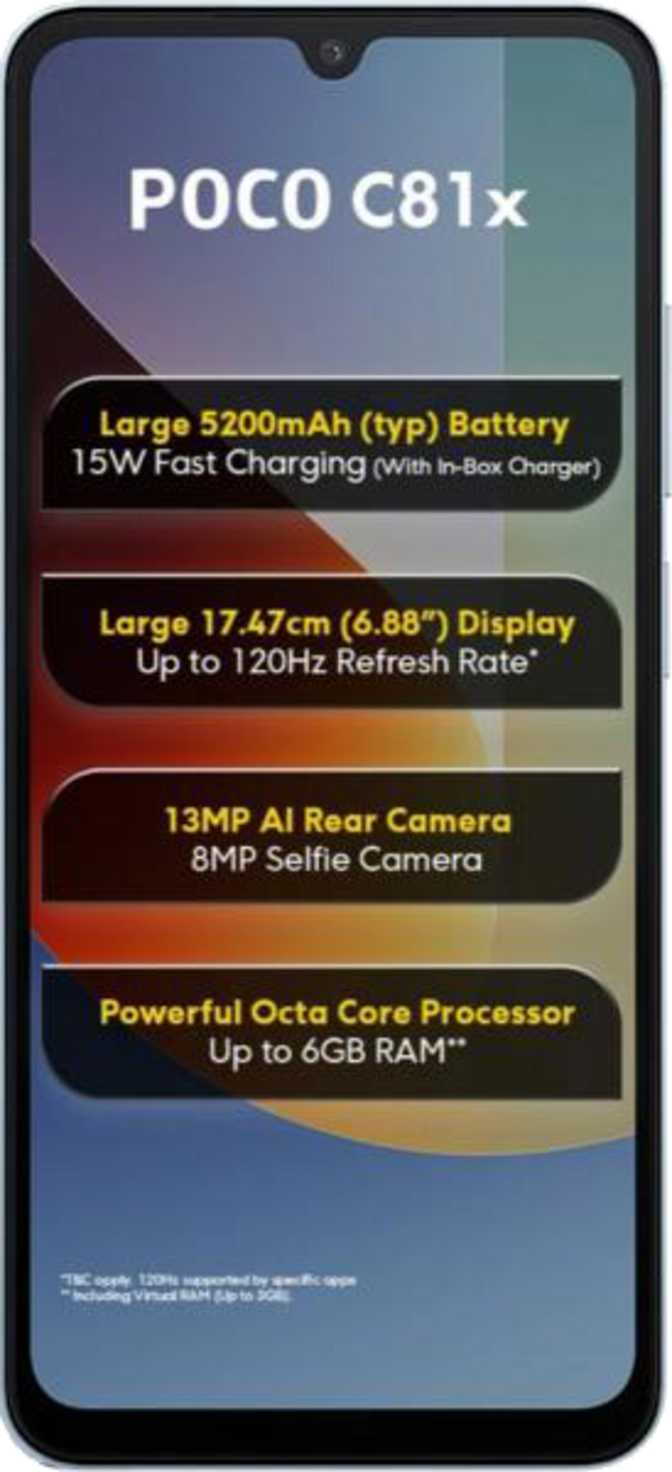
A 6.88-inch screen with a 120Hz refresh rate on a budget phone sounds almost too good to be true — and the full picture is more nuanced. The 120Hz smooth scrolling is real and genuinely noticeable. Switching between apps, swiping through social media, and navigating menus all feel fluid in a way that older 60Hz budget phones simply cannot match. That is a tangible quality-of-life improvement that most users will feel every single day.
Resolution Reality Check
Where the display steps back is resolution. The panel runs at HD+ quality — fine for the screen’s physical size, but not particularly sharp. At roughly 260 pixels per inch, text is readable and video looks acceptable, but holding the phone close or watching high-quality content will reveal individual pixels on thin text and detailed images. Compared to Full HD displays on competing phones at similar prices, this is a visible trade-off worth knowing before purchase.
Color, Brightness, and HDR Limitations
The IPS LCD panel produces accurate-enough colors for everyday viewing, but there is no HDR support of any kind. Streaming services that offer enhanced contrast and richer highlights won’t display that content in its intended form on this screen. For YouTube, social media, and standard video calls, this is entirely irrelevant. For anyone who treats their phone as a primary device for premium streaming content, it matters. The flat panel has no always-on functionality, keeping battery consumption predictable.
Performance: Reliable for Daily Tasks, Honest About Its Limits
The Processor Behind the Experience
The Poco C81x is powered by the Unisoc T7250, a chip built on a 12-nanometer manufacturing process — a mature, proven node that prioritizes efficiency within its class rather than competing with mid-range architectures. The processor uses an eight-core layout with two performance-focused cores supported by six efficiency cores, a design that favors battery-friendly multitasking over raw peak output.
Geekbench 6 Benchmark Scores
What These Scores Mean Day-to-Day
- Messaging, calls, maps, and social apps run without issue
- Document editing and email handle comfortably
- Standard streaming and video playback pose no challenge
- Demanding 3D games will reveal the chip’s ceiling quickly
- Heavy simultaneous multitasking produces noticeable slowdowns
RAM and Storage: The Bottleneck to Watch
Three gigabytes of RAM is the specification to scrutinize most carefully. Modern Android apps are memory-hungry, and 3GB means the phone will more aggressively close background apps to free resources. If you habitually switch between many apps — hopping from navigation to a browser to messaging and back — you will occasionally return to find an app has fully reloaded rather than resumed. This is not a dealbreaker for light users; it is a real friction point for multitaskers.
The 64GB of built-in storage is an adequate starter configuration, and the dedicated microSD slot allows straightforward expansion for photos, videos, and media. A software-based RAM expansion feature uses a portion of storage as virtual memory to ease pressure — though virtual RAM is considerably slower than physical RAM and should not be treated as a true substitute.
GPU and Gaming
The Mali G57 GPU handles casual gaming — puzzle games, 2D titles, and lighter 3D games — without drama. Popular graphically intense titles will require reduced quality settings, and frame drops are expected in complex scenes. Graphics API compatibility ensures support for nearly all current Android games even when maximum visual fidelity is not achievable.
Camera System: Capable Shooter for the Basics
Main Camera
The dual-lens rear camera is headlined by a 13-megapixel main sensor — more than sufficient for social media posts, casual photography, and everyday documentation. Photos are large enough to crop without losing usable detail, and for sharing on screens the resolution is genuinely fine.
Phase-detection autofocus is a meaningful inclusion at this price. Rather than hunting for focus the way older contrast-detect systems do, PDAF locks onto subjects quickly — particularly useful for moving subjects like children or pets. Continuous autofocus during video recording keeps subjects sharp as they or the phone move.
Manual controls — including adjustable ISO, white balance, focus, and exposure — give photographers more creative control than typical budget cameras offer. Outdoor shooting in good light produces pleasing results; low-light performance is limited without optical image stabilization or an HDR shooting mode.
- Phase-detection autofocus (PDAF) for fast subject lock
- Manual ISO, white balance, exposure, and focus controls
- Burst mode, panorama, and slow-motion video supported
- Full HD 1080p video recording at 30fps
- No optical image stabilization (OIS)
- No in-camera HDR mode
- No 4K video recording capability
Front Camera and Video
The 8-megapixel front camera is solid for selfies and video calls. It lacks a front-facing flash, so dim environments require good ambient light for self-portraits. The single-lens setup offers no secondary depth sensor for portrait bokeh effects.
Video capability tops out at 1080p at 30 frames per second — perfectly adequate for everyday clips and documentation. Slow-motion recording is supported. There is no 4K recording capability on either camera.
Camera Specifications
| Main Sensor | 13 MP, CMOS, PDAF |
| Front Camera | 8 MP |
| Max Video | 1080p at 30fps |
| Autofocus | PDAF + Touch AF + Continuous AF |
| Stabilization | None |
| HDR Mode | Not Available |
| Flash | Single LED (rear only) |
Battery Life: The Phone’s Most Compelling Argument
Capacity That Lasts
The Poco C81x houses a battery large enough to comfortably power a full day of use for most people — and frequently stretch into a second day with moderate usage. The combination of a power-efficient chipset, an LCD display that consumes less energy than OLED panels, and the phone’s modest resolution all work together to keep battery drain manageable throughout the day.
Heavy users — those streaming video for hours, gaming, and staying constantly connected — will likely need a top-up by evening. Light-to-moderate users can realistically expect to charge every day and a half to two days.
Charging Speed and Box Contents
The included 15W charger gets the phone from critically low to ready-to-go within a reasonable window — not the speed of premium fast charging, but meaningfully faster than the basic 5W or 10W chargers still common on older budget devices. Crucially, the charger is included in the box, which is increasingly not the case among competing brands. There is no wireless charging or reverse wireless charging, which is standard for this price segment. USB-C handles both charging and data transfer.
Battery Snapshot
Software and Ecosystem: Android 15 With a Feature-Packed Skin
The Operating System Advantage
Running Android 15 is a genuine strength at this price. The phone ships with a current, modern operating system rather than a version lagging behind on security patches and features. This matters directly for app compatibility, privacy controls, and the device’s overall useful lifespan.
Privacy and Security Controls
Privacy features are more thorough than typical at this tier. The OS includes granular controls for camera and microphone access per app, location privacy options, app tracking blocking, and clipboard access warnings — all aligned with modern Android’s privacy direction. Cross-site tracking blocking is absent, but the overall suite is respectable for a budget device.
Daily-Use Software Highlights
Split-screen multitasking, picture-in-picture mode, and full-page screenshots are all present and functional. Dynamic theming adapts the system color palette to your wallpaper. Widgets, dark mode, customizable notifications, offline voice recognition, and live text selection from images round out a feature set that punches above the phone’s price category. Update cadence should be researched against Xiaomi’s current support commitments, as updates are routed through Xiaomi rather than directly from the Android team.
Software Feature Highlights
- Android 15 — current OS at launch
- Dark mode support
- Split-screen multitasking
- Picture-in-picture mode
- Offline voice recognition
- Per-app camera and microphone controls
- App tracking blocking
- Clipboard access warnings
- Dynamic theming and home screen widgets
- Full-page scrolling screenshots
- Battery health monitoring
- No direct Android OS updates (via Xiaomi)
- No focus / scheduled DND modes
Connectivity: Solid Fundamentals, One Major Omission
Network Support
The Poco C81x is a 4G LTE device with no 5G support. In areas where 5G is widely available and meaningfully faster, this is a genuine long-term consideration — the phone cannot take advantage of next-generation network speeds and never will. In areas where 4G coverage is strong and 5G penetration is limited, it matters far less in day-to-day use. Peak LTE download capability supports smooth streaming, fast page loads, and comfortable video calls.
Wi-Fi and Bluetooth
Wi-Fi support covers both the 2.4GHz and faster 5GHz bands, so the phone connects to modern home and office routers without compromise. Bluetooth 5.2 handles wireless audio, peripherals, and file transfers efficiently. However, there is no aptX, LDAC, or any high-resolution audio codec support — wireless audio is standard quality rather than audiophile-grade.
What Is Missing
No NFC means no contactless payments through Google Pay or similar services. For buyers who tap to pay daily, this is a hard stop. No gyroscope means augmented reality apps and some motion-based games will not function as designed. The fingerprint scanner handles biometric authentication reliably. GPS with Galileo constellation support delivers accurate location tracking.
Connectivity Summary
| Mobile Network | 4G LTE — No 5G |
| Wi-Fi | Wi-Fi 4 + Wi-Fi 5 (5GHz) |
| Bluetooth | 5.2 |
| NFC | Not Available |
| USB | USB-C (USB 2.0 speed) |
| SIM Cards | Dual SIM (separate microSD) |
| GPS | GPS + Galileo |
| Fingerprint | Included |
| Headphone Jack | 3.5mm Present |
| FM Radio | Included |
Who This Phone Is For — and Who Should Keep Looking
The Poco C81x is a focused device. It does not try to be everything to everyone. Here is precisely where it fits and where it falls short.
A Great Fit For:
- First-time smartphone users or buyers choosing for family members
- Users whose daily needs are calls, texts, social media, and light streaming
- Anyone wanting a large, smooth screen for media at a low cost
- Buyers in 4G-dominant regions where 5G infrastructure is years away
- People who need a reliable second or travel phone
- Users who require a 3.5mm headphone jack and FM radio
Look Elsewhere If You:
- Play graphically demanding mobile games and expect smooth performance
- Depend on contactless payments — NFC is entirely absent
- Regularly multitask across many apps simultaneously
- Live in a 5G city and want long-term network future-proofing
- Are a photography enthusiast needing low-light capability or OIS
- Prioritize a sharp, high-resolution display experience
Competitive Context: Where It Stands in the Budget Field
The Poco C81x sits in a crowded entry-level market. Here is how its key specs and features compare with typical alternatives at a similar price.
| Feature | Xiaomi Poco C81x | Budget Rival A | Budget Rival B |
|---|---|---|---|
| Display Size | 6.88" | 6.5" | 6.7" |
| Refresh Rate | 120Hz | 60Hz | 90Hz |
| Resolution | HD+ | HD+ | HD+ |
| RAM | 3GB | 3–4GB | 4GB |
| Storage Expansion | |||
| Android Version | 15 (Current) | 13–14 | 14 |
| Battery Capacity | 5,200 mAh | Comparable | Comparable |
| NFC | Varies | Sometimes | |
| 5G | Sometimes | ||
| Headphone Jack | Sometimes | Sometimes | |
| Charger in Box | Varies |
Rival specifications represent typical alternatives at a similar price. Individual models may vary.
Honest Assessment: What It Gets Right and Where It Doesn’t
A balanced look at the Poco C81x — its genuine advantages and the trade-offs every buyer must accept.
What It Gets Right
The Poco C81x’s strengths are real and consequential for its intended audience. A 120Hz display at this price is unusual and genuinely enjoyable for daily scrolling — this is the feature that sets it apart from most direct competitors still shipping 60Hz panels.
Battery capacity provides staying power that budget phones often sacrifice. The efficient chipset and LCD display keep drain manageable, making this one of the most enduring phones in its class.
Android 15 out of the box means better security, privacy controls, and longer software viability. The inclusion of a charger, a headphone jack, FM radio, and a microSD slot reflects a genuine understanding of what budget buyers actually need.
- 120Hz refresh rate — rare at this price point
- Large battery with genuine multi-day potential
- Android 15 — current, fully featured OS
- Charger included in the box
- 3.5mm headphone jack and FM radio present
- Dedicated microSD slot alongside dual SIM
- Splash resistance for everyday protection
Where It Falls Short
Three gigabytes of RAM is tight by current standards, and the user experience reflects that when multitasking. The HD+ resolution on a nearly seven-inch screen is noticeable — not painful, but clearly not sharp for the display size.
The absence of NFC is a genuine functionality gap for anyone in the tap-to-pay ecosystem. Committing to this phone means committing to a 4G future on mobile networks, which matters based on location and how long you keep the device.
The camera performs acceptably in good light and struggles in low light — a fair summary of where most budget cameras land. None of these weaknesses are hidden; they are the predictable trade-offs of building a phone at this price point.
- 3GB RAM limits multitasking noticeably
- HD+ looks soft across the 6.88" panel
- No NFC — contactless payments impossible
- No 5G — limited future network access
- Camera lacks OIS and in-camera HDR
- Single mono speaker only
- No gyroscope limits AR apps and some games
Common Questions Before You Buy
Answers to what real buyers search for before purchasing the Poco C81x.
Final Verdict: A Focused Budget Phone That Knows Its Lane
The Xiaomi Poco C81x is a well-considered entry-level device that delivers where it matters most for daily life — screen smoothness, battery endurance, software freshness, and core connectivity. It does not pretend to compete with mid-range devices on camera, RAM, or network capability, and buyers who approach it with clear expectations will find it a reliable, frustration-free daily companion.
The recommendation is straightforward: if your priorities are a large, smooth display, long battery life, a current Android experience, and core communication tasks — and if the absence of NFC and 5G does not conflict with your lifestyle — the Poco C81x delivers genuine value. If you need tap-to-pay, plan to game seriously, or live in a city where 5G is your daily network, invest more and look at a step-up device. The C81x knows exactly what it is, and it does it honestly.
out of 5.0
Best suited for light users and first-time buyers