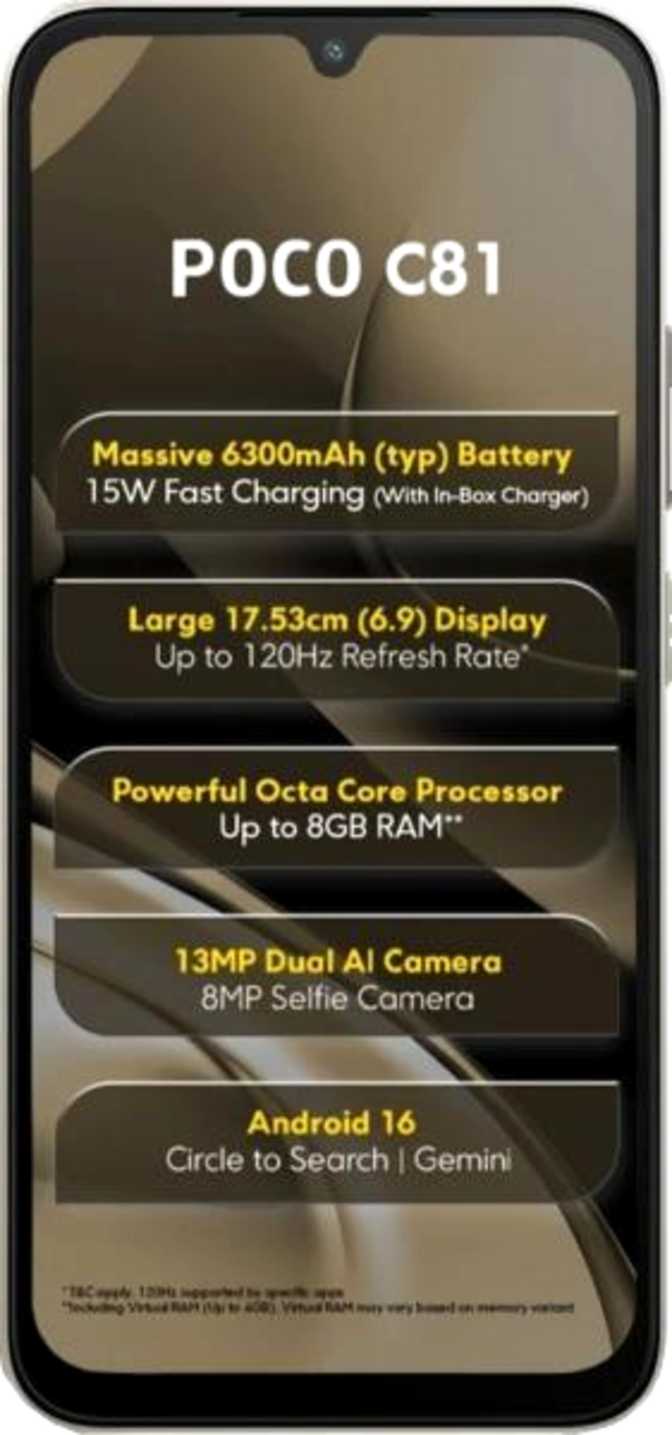
Xiaomi Poco C81 Review: Massive Battery, Honest Trade-Offs
SmartphonesBudget smartphones have a credibility problem. Most promise everything and deliver a compromised version of all of it. The Xiaomi Poco C81 takes a different approach — concentrating its engineering budget where entry-level buyers feel the pinch most: screen size, battery endurance, and software freshness. Whether those priorities match yours is the question this review answers completely.
Design and Build: Big by Choice, Not by Accident
At 171.6mm tall and nearly 80mm wide, the Poco C81 is not a small phone. That large footprint exists to house the enormous battery and expansive screen discussed below. At 8.2mm thick, it remains surprisingly slim for a device carrying this much power capacity, avoiding the "brick" sensation that similarly specced rivals often deliver.
The 208g weight is noticeable. Held one-handed for extended periods, you will feel it. Two-handed use is the natural grip for a phone this wide, and the ergonomics are designed around that assumption. If your pockets are shallow or you prefer ultra-light handsets, this is worth considering before purchase.
The phone carries a water-resistant designation — meaning it can survive splashes, rain, and the occasional sink incident. This is not the same as a formal IP-rated waterproof certification, so don't treat it as submersion-proof. Think of it as a reasonable safeguard for everyday life rather than adventure use.
- Height: 171.6 mm
- Width: 79.5 mm
- Thickness: 8.2 mm — admirably slim
- Weight: 208 g — noticeable, not heavy
- Water Resistance: Splash-proof (non-IP)
Display: Where Size and Smoothness Outperform Resolution
The Screen Real Estate Argument
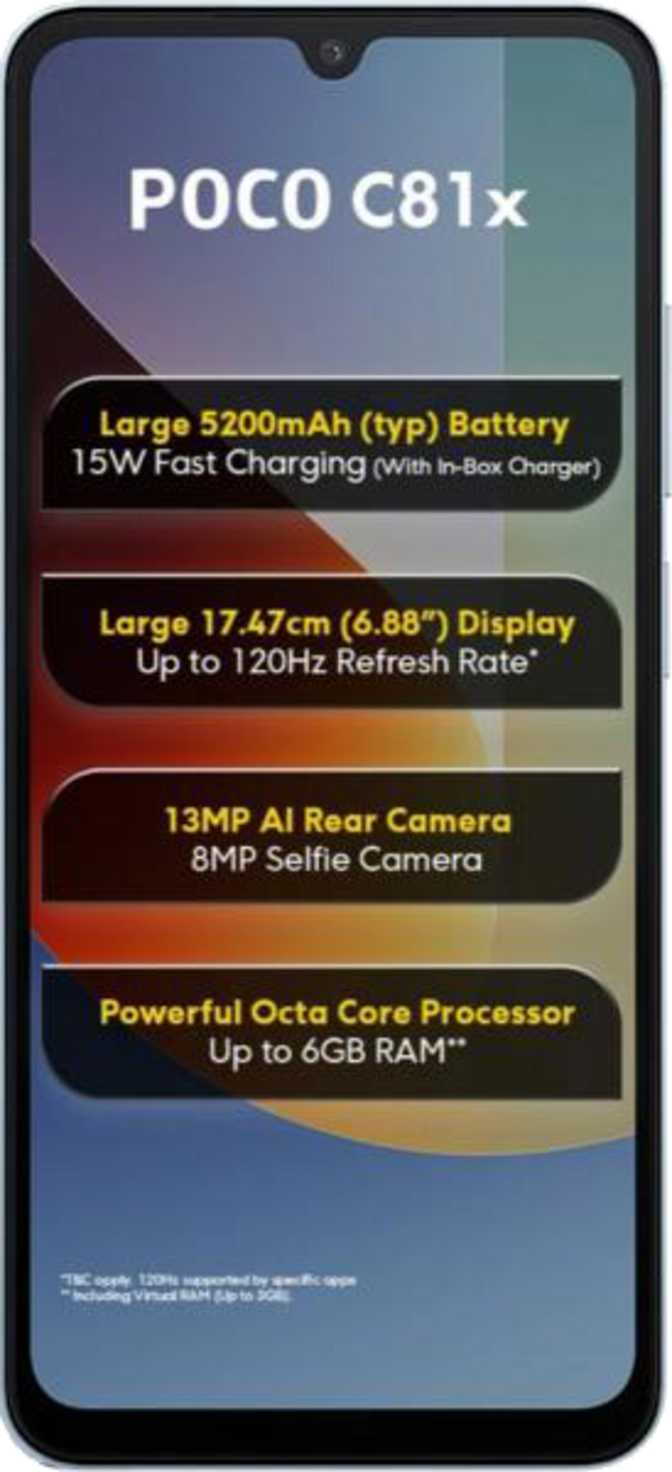
A 6.9-inch IPS LCD panel is the headline here. This is larger than most mid-range phones and comparable in footprint to devices that cost significantly more. Watching videos, reading, browsing social media — all feel genuinely expansive on this canvas. IPS LCD technology means colors are accurate and consistent, and the panel holds up well when viewed from angles, which matters when sharing content with someone beside you.
120Hz Refresh Rate — What It Actually Means
A higher refresh rate means the screen redraws itself more frequently each second, making scrolling through feeds, swiping between apps, and navigating menus feel noticeably smoother than the standard 60Hz found on most phones at this price tier. This is one of the rarer features found at this price point, and the difference is immediately apparent — it doesn't require a trained eye to notice.
The 720x1600 pixel count spread across a 6.9-inch surface produces approximately 254 pixels per inch — below the threshold where text looks crisply sharp. Text in smaller font sizes has a slightly soft edge. Photos lack the micro-detail clarity of higher-resolution panels. This is the clearest visual trade-off on the phone.
The display does not support HDR10 or Dolby Vision. Streaming services that offer HDR versions of content will serve standard dynamic range here. There is no Always-On Display functionality — the screen goes fully dark when the phone is idle.
| Display Attribute | Detail | What It Means for You |
|---|---|---|
| Panel Type | IPS LCD | Accurate colors, consistent at wide viewing angles |
| Screen Size | 6.9 inches | Larger than most mid-range rivals at this price |
| Refresh Rate | 120Hz | Uncommon at entry-level; scrolling feels premium |
| Pixel Density | ~254 ppi | Below typical sharpness threshold for this screen size |
| HDR Support | None | Standard dynamic range streaming only |
| Gorilla Glass | None | Screen protector strongly recommended |
Performance: Honest Assessment of the Unisoc T7250
What This Chip Does Well
The Unisoc T7250 is an eight-core processor built on a 12-nanometer manufacturing process. Twelve nanometers is an older node by current standards — meaning the chip doesn't achieve the energy efficiency of more modern architectures — but it is well-understood and mature, which translates to consistent, predictable behavior rather than erratic thermal spikes.
The processor uses a split-core architecture: two performance-oriented cores handle demanding tasks, while six efficiency-focused cores manage background work and lighter duties. In practice, the phone handles everyday multitasking — switching between WhatsApp, Chrome, YouTube, and the camera — without frustration. App launches feel adequately responsive. Social media feeds scroll smoothly, with the 120Hz display doing the heavy visual lifting.
Where Expectations Need Calibration
Four gigabytes of RAM is the working memory available for active apps and processes. The phone manages a reasonable number of simultaneously open apps before it begins quietly closing background ones to free space. Heavy multitaskers — people who keep many browser tabs, navigation, streaming, and messaging apps all running — will notice the phone occasionally reloading apps rather than resuming them instantly.
The 64GB internal storage fills faster than most buyers anticipate. System reserves and pre-installed apps consume a meaningful share from the start. The microSD card slot addresses this directly — expanding storage via an affordable memory card removes this concern almost entirely.
Storage speed uses an eMMC 5.1 standard — a step below the UFS storage found in mid-range and premium devices. Large file transfers and app installations are measurably slower, though the difference in daily use — opening apps, browsing photos — is less dramatic than raw numbers suggest.
- ChipsetUnisoc T7250
- Process Node12nm
- CPU Config2×1.8 + 6×1.6 GHz
- RAM4GB DDR4
- Storage64GB eMMC 5.1
- GPUMali G57
- Architecture64-bit, big.LITTLE
Casual gaming — puzzle games, card games, lighter 2D and 3D titles at reduced settings — runs well. Graphically demanding titles with complex shaders will require settings reductions.
Camera System: Capable Daylight Shooter, Limited at Night
Main Camera: Phase Detection Saves the Experience
The rear camera pair is headlined by a 13-megapixel primary sensor with phase-detection autofocus for stills and continuous autofocus during video. Phase-detection AF locks focus quickly and confidently — particularly on subjects in motion, where contrast-based autofocus alternatives frequently hunt and miss.
In well-lit conditions, the camera produces clean, detailed shots suitable for social sharing, messaging, and everyday documentation. Colors lean accurate rather than aggressively processed, which some users prefer and others find underwhelming compared to the punchy output of heavily processed competitors.
The manual controls — including ISO adjustment, white balance selection, manual focus, and exposure compensation — give experienced photographers meaningful control that most budget phones don't extend to users. For someone who understands how to use these tools, the camera punches slightly above its pixel count.
What the camera does not have is optical image stabilization. Hand tremors translate directly to image blur in low light where shutter speeds lengthen. Night photography requires a steady hand or a surface to rest against. There is no built-in HDR mode, which limits the camera's ability to balance bright and dark areas within a single frame.
There is no optical zoom capability — digital zoom degrades image quality progressively. Video recording reaches 1080p at 30 frames per second, with slow-motion support for creative flexibility.
Front Camera
The 8-megapixel front camera covers selfies and video calls competently. It lacks a front flash, so low-light selfies depend entirely on ambient lighting. For video calls in normally lit rooms, it performs its function without complaint.
- Main Sensor13 MP
- Front Camera8 MP
- Video Recording1080p @ 30fps
- Phase-Detection AF
- Continuous AF (Video)
- Slow-Motion Video
- Manual Controls (ISO, WB, EV)
- Panorama Mode
- Optical Stabilization
- HDR Photo Mode
- Optical Zoom
- Front Flash
Battery Life: The Defining Strength of This Phone
The Poco C81 carries a battery capacity that exceeds nearly everything at its price tier — and a substantial portion of phones costing considerably more. Most users with typical usage patterns — browsing, messaging, streaming video, some camera use — will comfortably reach the end of a full day with power to spare. Users with lighter habits should expect to charge every two or even three days before the battery warning appears.
This endurance comes with one caveat: the 15W wired charging speed is modest relative to the battery size. Filling the tank from fully depleted takes several hours. The phone is not suited to users who depend on quick top-up charges between meetings or during short breaks. That said, if you charge overnight — as the majority of smartphone users still do — the charging speed is a non-issue.
Software: Android 16 Is a Genuine Advantage
Running Android 16 is perhaps the most underappreciated aspect of the Poco C81. At entry-level pricing, Android version currency is frequently sacrificed — older builds mean missing security patches, absent privacy features, and an increasingly outdated experience as time passes. Shipping with Android 16 means this phone starts its life with one of the most current builds available.
- Per-app location controls with granular permissions
- Camera and microphone access management
- Clipboard usage notifications
- App tracking restriction controls
- Battery health monitoring transparency
- Full-page scrolling screenshots
- Split-screen multitasking
- Picture-in-picture mode for video
- Dark mode and extra dim mode for night use
- Offline voice recognition
- Multi-user system support
- Customizable widgets and dynamic theming
Connectivity: The Practical Checklist
| Feature | Status | Practical Meaning |
|---|---|---|
| 5G | Not Supported | LTE only; a future-proofing limitation in expanding 5G markets |
| Wi-Fi | Wi-Fi 5 (802.11ac) | Fast home and office Wi-Fi fully supported |
| Bluetooth | 5.2 | Current-generation; pairs reliably with modern accessories |
| NFC | Not Present | No contactless payments — Google Pay and similar apps will not function |
| USB Port | USB-C | Universal cable compatibility — no proprietary connector |
| MicroSD Slot | Supported | Affordable storage expansion — strongly recommended |
| Fingerprint Scanner | Present | Fast, reliable biometric unlock |
| GPS | GPS + Galileo | Accurate navigation using multiple satellite systems |
| 3.5mm Jack | Present | Wired headphones work without any adapter |
| FM Radio | Present | Free over-the-air broadcast radio without data consumption |
| SIM Cards | Dual SIM | Two active numbers or carriers simultaneously |
Who This Phone Is For — and Who It Is Not
- Battery endurance is your top priority and you regularly finish days with single-digit percentages on other phones
- You consume significant video content and want the largest possible screen in this price bracket
- You want a current, modern version of Android with real privacy controls from day one
- Wired headphones are part of your daily setup and you're tired of carrying adapters
- You want the feel of a 120Hz display without paying mid-range prices
- Contactless payments are part of your daily routine — the absence of NFC is a hard, binary limitation
- You're a mobile gamer who plays graphically demanding titles or games requiring gyroscope input
- Sharp, pixel-dense text and image detail matter to you — the screen size and resolution pairing is its most visible weakness
- You need a phone to go from depleted to usable within 30 minutes via fast charging
- 5G connectivity is relevant in your area and you want a device that lasts through the network transition
- Low-light photography is a priority — night shots require a very steady hand and limited ambition
How It Stands Against the Alternatives
| Comparison Point | Poco C81 | Typical LTE Budget Rival | Typical 5G Budget Entry |
|---|---|---|---|
| Screen Size | 6.9" | 6.5–6.7" | 6.5–6.7" |
| Refresh Rate | 120Hz | 60–90Hz | 90Hz |
| Battery Capacity | Very Large | Moderate | Moderate |
| Android Version | Android 16 (current) | Often 1–2 versions behind | Often 1 version behind |
| NFC | Absent | Sometimes present | Often present |
| 5G | Absent | Absent | Present |
| Headphone Jack | Present | Often absent | Often absent |
| Gyroscope | Absent | Sometimes present | Sometimes present |
Competitor data represents typical category positioning, not specific device comparisons.
Honest Strengths and Genuine Weaknesses
The Poco C81's engineering priorities are coherent and honestly executed. The battery is genuinely exceptional for the category — not a marginal improvement over rivals, but a substantive endurance lead that changes how you relate to the charging cable.
Paired with the 120Hz display, the phone delivers a tactile fluidity in daily navigation that most budget phones simply don't offer. Running Android 16 from launch means buyers aren't starting with outdated software, and the privacy toolkit is meaningfully comprehensive.
The 3.5mm jack and FM radio are genuine utility features increasingly stripped from phones at every price point. Their presence reflects priorities aligned with buyers who use their phone as a practical tool rather than a status object.
The display's pixel density is the most visible shortcoming — the screen is beautiful in size and smooth in motion, but not sharp in detail. This is particularly noticeable at reading distance with small text and is this phone's clearest compromise.
The camera is honest and capable in daylight but limited at night. The absence of hardware stabilization means video footage requires a careful hand, and the single microphone means recorded audio is mono only.
The lack of NFC is a binary constraint — either it matters to your life or it doesn't. The 15W charging speed means enormous endurance comes with the trade-off of slow recovery when the battery is truly depleted.
Answers to the Questions Real Buyers Search For
Final Verdict
A clear, specific purchase recommendation
The Poco C81 earns a clear, specific recommendation: buy it if battery life and display size are your top two priorities, and none of your personal dealbreakers appear in the weaknesses column above.
This is a phone that solves real problems for a specific buyer: the person who runs low on battery by noon, who watches content on a phone screen daily, who wants modern software without paying mid-range prices. For that buyer, the Poco C81 over-delivers relative to its cost.
For the buyer who taps their phone to pay, plays graphically intense games, or needs pixel-sharp text, there are better-suited options at similar or modestly higher prices. The Poco C81 doesn't pretend otherwise — its trade-offs are deliberate, and they hold up under scrutiny.
Entry-level Android is full of phones that feel outdated the moment you unbox them. The Poco C81 is not one of them.