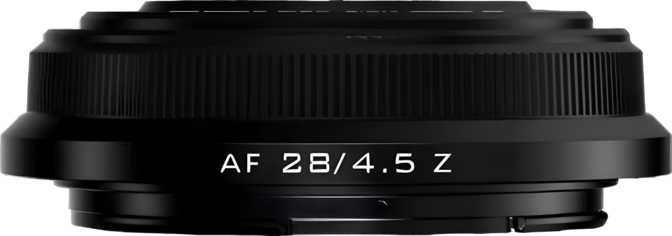
Viltrox AF 28mm f/4.5 Z: The Ultralight Nikon Z Wide-Angle Reviewed
Camera LensesA Featherweight Wide-Angle That Challenges Expectations
There is a certain type of photographer who has mentally filed away the 28mm focal length as a second-choice wide angle — too narrow for dramatic landscapes, not quite wide enough to feel cinematic, and perpetually overshadowed by the more fashionable 35mm. The Viltrox AF 28mm f/4.5 Z is going to complicate that mental filing system.
This is not a lens built around aperture bragging rights. At f/4.5, Viltrox is making a deliberate trade — one that buys you something far rarer in the Nikon Z ecosystem: a genuinely pocketable, featherweight wide-angle prime that feels almost like an afterthought on your camera body, in the best possible way. Whether that trade works for you depends entirely on what kind of photographer you are, and this review will tell you exactly where the line falls.
- Weight80 g — Ultralight
- Weather SealedYes
- Focal Length28 mm Prime
- Max Aperturef/4.5
- Aperture Blades14 Rounded
- Silent AutofocusYes
- Min Focus Dist.35 cm
- Filter Thread65.3 mm
- Metal MountYes
Build Quality and Physical Design
What it feels like to carry and use every day
A Lens That Weighs Less Than Your Phone
The first thing you notice when you pick up the Viltrox AF 28mm f/4.5 Z is what isn't there. At just 80 grams, this lens is so light that it initially feels like a prototype rather than a finished product. That's roughly the weight of a large egg — a figure that sounds trivial until you consider that most comparable wide-angle primes for full-frame mirrorless systems weigh two to four times as much.
This isn't weight reduction through corner-cutting. The mount connecting this lens to your Nikon Z camera body is machined metal, which matters because the lens-to-camera junction is the highest-stress point on any lens in regular use. A plastic mount flexes, wears, and eventually introduces wobble. The metal mount here stays tight and precise over years of use.
One practical note: the 65.3mm filter thread is a non-standard size — not the ubiquitous 67mm or 77mm that most photographers already own filters for. Budget for new glass filters if filtration is part of your workflow.
Weather Sealing and Field-Ready Details
Viltrox has included weather sealing at this price point and size, which is not something to gloss over. Internal gaskets protect the optical and electronic components from rain, mist, dust, and humid condensation that appears when you move between temperature extremes. It will not survive submersion, but it handles the conditions that actually ruin photography sessions: an unexpected drizzle, a dusty trail, shooting near ocean spray.
The included lens hood is reversible, snapping on backwards for storage and sitting flush against the lens barrel rather than doubling its packed length. This confirms that Viltrox understands how this lens will actually be used — traveling light, moving fast, with minimal fuss.
The front element does not rotate during focusing, which preserves any polarizing filter orientation you've dialed in. Anyone who has watched a carefully adjusted polarizer spin out of position during autofocus will appreciate this quietly.
Optical Character and Focal Length in Practice
Understanding what 28mm and f/4.5 actually mean for your photography
What 28mm Actually Looks Like
A 28mm lens on a full-frame Nikon Z body captures approximately 73 degrees of the scene in front of you. In practical terms, standing in a kitchen, you can capture most of the room without pressing your back against the wall. On a city street, you can photograph a shopfront and include meaningful context from the surrounding block.
This is a focal length with a strong documentary tradition — wide enough to include environment and context, narrow enough to maintain a sense of subject priority. It sits in a useful middle ground between the extreme character of ultra-wide lenses, which distort perspective noticeably at close range, and the intimate compression of 35mm and beyond.
The Aperture Question: f/4.5 Explained Honestly
The f/4.5 maximum aperture will be the most discussed specification for most buyers, so it deserves a direct treatment. This is not a low-light lens. In dim environments — restaurants, bars, indoor concerts — you will reach for higher ISO values on your camera body to compensate for the limited light the lens gathers.
What f/4.5 does well is keep the lens small, light, and optically balanced. Wide-aperture lenses require significantly more glass and more complex correction to manage aberrations at their maximum opening. By setting the aperture at f/4.5, Viltrox has removed that engineering burden — a decision that almost certainly contributes to consistent sharpness across the frame. In outdoor daylight, f/4.5 is a non-issue entirely.
Bokeh at f/4.5: The 14-Blade Advantage
Background separation at f/4.5 on a 28mm lens is modest — this focal length and aperture combination produces gently softened backgrounds rather than the aggressive blur of a fast portrait lens. But when out-of-focus elements do appear, the 14 rounded aperture blades ensure background highlights render as smooth, circular shapes rather than the angular polygons that cheaper lenses produce.
For a lens in this class, 14 rounded blades is notably generous. Even at moderate subject distances, the background rendering is refined and pleasing rather than mechanical.
Close-Focus Capability
The 35-centimeter minimum focus distance is genuinely useful for a wide-angle prime. At this distance, you can fill a meaningful portion of the frame with a small subject — a food dish, a flower, a piece of street detail — while still retaining the environmental context that makes wide-angle close-focus shots interesting.
This close-focus capability won't replace a dedicated macro lens, but it meaningfully extends the creative range of the lens beyond simple environmental shooting. Wide-angle close-focus shots retain the surrounding scene in a way that a macro lens, by definition, cannot.
Autofocus Performance and Manual Control
Built for photographers who also shoot video
Silent Autofocus Motor
In a mirrorless camera shooting video, autofocus noise from the lens is captured directly by the microphone alongside your audio. A silent motor eliminates this problem entirely. For hybrid shooters, this is a meaningful practical advantage that many lenses in this size category fail to deliver.
Full-Time Manual Override
Full-time manual focus override means you can fine-tune focus by hand at any point without switching the lens to a manual-only mode. Standard practice during video focus pulls, for precise control in challenging conditions, or for the tactile satisfaction of setting focus manually on a still shot.
Infinity Focus Confirmed
This lens correctly focuses on distant subjects — mountains, cityscapes, stars — without hunting past its focus range. Particularly relevant for landscape and astrophotography use cases where the subject is effectively at maximum distance from the camera.
Who Should Buy the Viltrox AF 28mm f/4.5 Z
This lens has a clear and specific ideal owner — understanding that helps everyone make the right decision
This Lens Is Well Suited For
- Travel photographers who prioritize a minimal kit and want a wide-angle option that adds almost nothing to bag weight or bulk
- Street photographers who want a discreet, unobtrusive lens that doesn't draw attention on the camera
- Landscape and architecture shooters working primarily in daylight who want a compact wide-angle with weather protection
- Hybrid photo-video creators who need silent autofocus and steady performance in controlled lighting
- Nikon Z body owners with IBIS, since the lack of optical stabilization in the lens is fully compensated by in-body stabilization
This Lens Is Not the Right Choice For
- Event photographers who need to shoot in dim reception halls, candlelit venues, or indoor spaces without supplemental lighting
- Photographers whose primary use case is separating subjects from backgrounds with blurred, shallow depth of field
- Users with non-IBIS bodies who regularly shoot handheld in low light, where camera shake compensation cannot come from the body
- Video operators who need precise, cinema-style manual focus rings with hard stops and calibrated focus scales
How It Compares to the Alternatives
The Viltrox AF 28mm f/4.5 Z occupies an unusual space — no exact competitor matches its size and focal length combination in the Nikon Z native ecosystem
| Feature | Viltrox AF 28mm f/4.5 Z | Typical 28mm Wide-Angle | Compact f/2.8 Alternative |
|---|---|---|---|
| Weight | ~80 g | 200–400 g | 150–250 g |
| Max Aperture | f/4.5 | f/2.8 | f/2.8 |
| Weather Sealed | Yes | Varies | Varies |
| Aperture Blades | 14 Rounded | 7–9 | 7–9 |
| Silent Autofocus | Yes | Varies | Varies |
| Best Suited For | Travel, Street, Daylight | General Purpose | Low Light, Indoor |
The 14-blade rounded aperture is genuinely unusual in any category and represents a meaningful optical quality advantage in background rendering that competitors do not match at comparable sizes.
Honest Strengths and Weaknesses
A fair assessment — credibility comes from balance
Where It Excels
The case for this lens starts and ends with portability. At 80 grams, this is the wide-angle prime that disappears into your kit. The weather sealing, metal mount, and reversible hood compound that advantage — a fully protected, well-finished tool that happens to weigh almost nothing.
The 14 rounded aperture blades are a genuine luxury detail. This spec directly affects how your images feel — smooth, circular background highlights are a visible indicator of optical refinement that most lenses at this size and price point simply do not offer.
Silent autofocus and full-time manual override together make this a credible hybrid lens. The non-rotating front element ensures polarizer positions stay locked. These are quality-of-life details that matter in actual field use, not just on paper.
Where It Falls Short
The f/4.5 aperture is a real and meaningful limitation. In mixed or low lighting — which covers a significant proportion of everyday shooting scenarios — you will need a camera body with strong high-ISO performance to compensate. The lens cannot carry that load by itself.
There is no optical stabilization. On a Nikon Z body with effective IBIS, this may not matter at all. On older or lower-tier bodies without it, the absence introduces real risk of motion blur at slower shutter speeds — the lens cannot self-stabilize.
The 65.3mm filter thread is a practical inconvenience. If you have an existing filter collection built around standard diameters, you will need step-up rings or new filters. The modest close-focus magnification is also not a substitute for a dedicated macro lens if that's a core priority.
Common Questions Before Buying
Answers to what photographers actually search for before purchase
Final Verdict
Our purchase recommendation for the Viltrox AF 28mm f/4.5 Z
The Viltrox AF 28mm f/4.5 Z is a lens with a sharply defined purpose, executed with genuine care. It is not trying to be the fastest, the most versatile, or the most optically complex lens in the Nikon Z ecosystem. It is trying to be the one you actually bring with you.
For the travel photographer who wants a capable, weather-protected wide-angle that disappears into a jacket pocket. For the street shooter who values discretion and speed over maximum low-light reach. For the landscape photographer who wants to walk farther because the camera bag is lighter. For any hybrid creator who shoots video and needs silent, reliable autofocus: this lens delivers on every count it actually promises.
If your photography demands f/2.8 or faster — if dim venues, indoor events, or aggressive subject separation define your work — look elsewhere and accept the additional size and cost that comes with it. That is not a criticism of this lens; it is a reminder that every lens is a set of choices, and the Viltrox AF 28mm f/4.5 Z has made its choices clearly and confidently.
Recommended For
Travel, street, landscape, and hybrid photo-video photographers working primarily in daylight on Nikon Z full-frame bodies — especially those shooting with IBIS-equipped cameras. For photographers whose priorities align with what it offers, the Viltrox AF 28mm f/4.5 Z is a thoughtfully built, practically priced, genuinely carry-everywhere wide-angle prime that earns a firm place in the Nikon Z system.