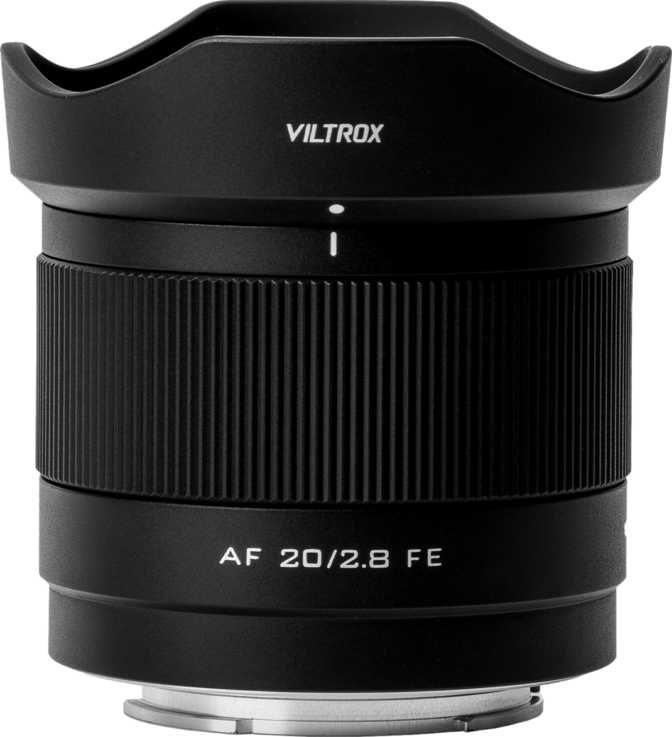
Viltrox AF 20mm f/2.8 Full Review: Sony's Best Value Ultrawide Prime

Viltrox AF 20mm f/2.8 Full Review: Sony's Best Value Ultrawide Prime

Camera Lenses
Focal Length20mm Prime
Max Aperturef/2.8
Weight157 g
Min. Focus19 cm
Weather SealSplashproof
Filter Thread52 mm

The 20mm focal length sits in a peculiar sweet spot. Wide enough to capture sweeping landscapes, environmental portraits, and tight interiors — but not so extreme that straight lines warp into dramatic curves and every composition becomes a puzzle. On a Sony full-frame mirrorless body, a 20mm prime can quietly become a daily companion you didn't know you needed.

Viltrox has spent several years earning credibility in the third-party lens market, building autofocus primes that compete seriously with Sony's own G and Zeiss-branded glass. The AF 20mm f/2.8 enters the ultrawide prime segment — where competing options frequently cost two to three times as much. At the weight of a small orange, with weather sealing, silent autofocus, and a modern optical design, it makes a compelling case before you even mount it. This review breaks down exactly what you're getting, who it serves best, and where the genuine limitations lie.

Build Quality and Physical Experience

Design, materials, and what daily handling actually feels like

Size & Weight

Genuinely Pocketable at 157g

Exceptionally light for a full-frame ultrawide prime — paired with Sony's compact A7C-series or smaller APS-C cameras, the lens keeps the whole kit nimble and unobtrusive. Street photographers and travel shooters will notice significantly less fatigue over a full shooting day.

The 52mm filter thread is physically small, which makes filters themselves cheaper. Over a lifetime of purchases — circular polarizers, ND glass — the cost difference between 52mm and 77mm options adds up to a meaningful saving.

Mount & Sealing

Metal Mount with Splashproof Sealing

The metal mount handles repeated attachment cycles better than plastic, resists deformation under stress, and holds tighter tolerances over time — a difference you'll feel most after two years of regular use.

The weather sealing is splashproof, adequate for light rain, sea spray, mist, and dusty outdoor environments. It is not an invitation to shoot in a downpour. Think of it as protection for real-world outdoor shooting, not a professional-grade environmental seal.

Front Element

Non-Rotating Element and Reversible Hood

The front element does not rotate during autofocus — which makes circular polarizing filters fully practical. A rotating front element would require re-adjusting the polarizer every time focus changes, rendering it unusable in the field.

The included lens hood reverses for storage without needing to be detached and pocketed separately — a small ergonomic detail that experienced photographers notice and appreciate consistently.

Optics and Perspective: Life at 91 Degrees

Understanding what the specifications mean for your actual images

A Genuinely Wide View of the World

A field of view approaching 92 degrees is expansive. For context: a 50mm lens sees roughly 47 degrees, and a 35mm covers around 63 degrees. At 20mm, you're capturing nearly a right angle — making architectural interiors feel open, allowing landscapes to include rich foreground detail, and letting environmental portraits breathe with natural context. The compositional demands are higher than at moderate focal lengths, but the creative possibilities are proportionally greater.

What f/2.8 Actually Delivers on a Wide Lens

An f/2.8 aperture behaves differently on a 20mm than on a portrait focal length. The inherently deep depth of field of short lenses means f/2.8 here does not produce background-melting subject separation. What it actually delivers is low-light capability — enough light for clean handheld exposures at dusk, in dimly lit interiors, and under overcast skies where a slower lens would force unacceptable compromises.

Photographers upgrading from a slow kit zoom should understand this clearly: the improvement is about what's possible when the light drops, not about bokeh.

Eleven Rounded Aperture Blades

Most budget-tier lenses use seven blades. Eleven individually rounded blades produce two visible results: specular highlights render as smooth circular discs rather than geometric polygons when stopped down, and sunstars from direct light sources display twenty-two fine rays — detailed and elegant. For video, rounded blades also mean aperture changes mid-scene don't produce a jarring geometric shift in out-of-focus background elements.

An Unusually Close Minimum Focus

The lens focuses as close as 19 centimetres from the front element — shorter than many competitors in this focal range. Getting this close with a 20mm perspective creates a distinctive visual signature: exaggerated foreground size against a sweeping, compressed background. This cannot be replicated at other focal lengths. Food photographers, documentary shooters, and travel photographers will find this opens compositional angles a more conventionally-limited wide lens simply cannot produce.

Autofocus and Handling

How the lens behaves in real shooting situations

Silent Focus Motor

The focus motor operates without audible mechanical sound — a necessary quality for video production, where on-camera or external microphones would capture any lens noise. The same characteristic makes this lens appropriate for ceremonies, wildlife observation, and theatre where autofocus noise is disruptive. The native E-mount electronic connection also provides the communication pathway for Sony's subject-detection and eye-tracking autofocus systems on compatible bodies.
Full-Time Manual Override

Rotating the focus ring manually overrides autofocus without exiting AF mode or pressing additional controls. For photographers who use autofocus to acquire a subject and then refine manually, this keeps the workflow uninterrupted. The lens also focuses to optical infinity — relevant for astrophotographers and landscape shooters who need to set focus precisely for distant subjects in low-contrast conditions where autofocus may not reliably acquire.

Who This Lens Actually Serves

Matching the lens to the right photographer — and recognising when it's the wrong fit

This Lens Is Built For

  • Travel and street photographers who want a wide, versatile prime that adds negligible weight to a bag and handles varied outdoor light conditions.
  • Landscape and architecture photographers seeking an affordable full-frame ultrawide with reliable autofocus and a non-rotating front element for filter work.
  • Video creators on Sony bodies who need silent autofocus, a wide perspective, and a lightweight lens for handheld or gimbal-mounted shooting.
  • Sony shooters transitioning from kit zooms who want to understand what a dedicated ultrawide prime offers without committing to first-party pricing.
  • Filter photographers who need a non-rotating front element and appreciate the cost advantage of a compact 52mm thread.

This Lens Is the Wrong Choice For

  • Portrait photographers prioritising subject isolation — the focal length and depth of field at f/2.8 are not designed for background separation.
  • Astrophotographers requiring maximum light transmission — an f/1.8 or f/1.4 ultrawide captures meaningfully more light for star photography and faster exposure times.
  • Photographers without in-body stabilisation who shoot handheld in very low light — there is no optical stabilisation in the lens to compensate.
  • Close-up and macro specialists — the close focus capability is a creative asset, but this is not a substitute for a dedicated macro lens.

How It Compares to the Alternatives

The realistic comparison set for this lens and price tier

The realistic comparison set includes the Tamron 20mm f/2.8 Di III as a direct rival and the Sony FE 20mm f/1.8 G as the premium step-up option. Each represents a genuinely different value proposition, and understanding the differences determines which one belongs in your bag.

Feature Viltrox AF 20mm f/2.8
This Review
Tamron 20mm f/2.8 Di III Sony FE 20mm f/1.8 G
Maximum Aperture f/2.8 f/2.8 f/1.8
Approx. Weight 157g ~220g ~370g
Filter Diameter 52mm 67mm 67mm
Weather Sealing
Optical Stabilisation
Minimum Focus Distance ~19cm ~11cm ~19cm
Max Magnification 0.17x 1:2 macro ~0.19x
Price Tier Budget Mid Premium
Competitor specifications sourced from published manufacturer data. Verify independently before purchase.

vs. Tamron 20mm f/2.8 Di III

The Tamron's defining advantage is its 1:2 magnification — a near-macro ultrawide, which is a rare and useful combination. If very close-up work is a priority, the Tamron specifically targets that use case and does it better. The Viltrox is noticeably lighter and uses a far less expensive filter diameter, making it the stronger choice for photographers who don't need that close-focus capability.

vs. Sony FE 20mm f/1.8 G

The Sony represents a full additional stop of aperture — meaningful for astrophotography and demanding handheld low-light work. It is also significantly heavier and in a higher price category. For the majority of wide-angle use cases, the light-gathering difference is real but not decisive. Photographers whose shooting style genuinely benefits from that extra stop will find the premium justified; most others will not.

Honest Assessment

What this lens genuinely gets right, and where it falls short

Where It Genuinely Stands Out

Weight and Portability

Very few full-frame ultrawide autofocus primes approach 157 grams. Most are meaningfully heavier. At this weight, with weather sealing, a non-rotating front element, a reversible hood, and a silent focus motor all included, the feature density is difficult to match at this price tier. Each of those features is something photographers specifically seek and sometimes pay extra for.

Eleven-Blade Aperture

Seven-blade apertures — the standard in budget glass — produce heptagonal highlight shapes when stopped down. Eleven rounded blades produce circular highlights and more refined sunstars. For photographers who care about the quality of out-of-focus rendering and light sources in their frames, this is a tangible, visible difference that typically costs more to obtain.

Close Focus Creativity

The 19cm minimum focus regularly surprises photographers new to ultrawide primes. The perspective created by combining extreme proximity with a wide angle is compositionally unique — it costs nothing extra but opens images that a more limited lens simply cannot produce.

Where It Has Limitations

No Optical Stabilisation

The most functionally significant gap. Sony's in-body stabilisation on compatible bodies compensates substantially for modern full-frame shooters. For photographers on older bodies or APS-C cameras without effective stabilisation, handheld low-light work will require more deliberate attention to shutter speed discipline.

f/2.8 Ceiling Limits Night Work

Night-sky photography specifically benefits from the fastest possible aperture. The Viltrox is a capable low-light lens, but it's not optimised for astrophotography where shooting windows are narrow and every half-stop of aperture meaningfully changes what's possible.

No Independent Optical Lab Data

Sharpness across the frame, geometric distortion, vignetting, and chromatic aberration cannot be evaluated from specification data alone. Photographers for whom corner-to-corner full-frame sharpness at wide apertures is non-negotiable should consult independent optical lab testing before committing.

Questions Real Buyers Ask

Answers to what photographers search for before purchasing

Yes — the Sony E mount is shared across both full-frame and APS-C mirrorless systems. On an APS-C body, the 1.5x crop factor transforms the effective field of view to approximately 30mm equivalent — still a useful wide angle, but not the sweeping 91-degree ultrawide perspective this lens delivers on full-frame. If the ultrawide view is the primary reason you want this lens, it performs as designed on full-frame bodies.

For conditions most outdoor photographers encounter — light rain, sea spray, blowing dust, misty conditions — the splashproof rating provides reasonable confidence. It is not waterproof and does not match professional-grade environmental sealing. For severe conditions or high-stakes shoots where gear damage would be costly, a higher-rated option or additional protection is worth considering.

Yes. The non-rotating front element is specifically what makes polarizing filters practical — you position the polarizer, and it stays exactly where you put it as the lens focuses. The 52mm thread is also an inexpensive filter diameter, so the cost of a quality circular polarizer for this lens is lower than on lenses with larger front elements.

The lens uses a native E-mount electronic connection, which provides the communication pathway for Sony's subject-detection autofocus. Compatibility is expected on modern Sony bodies, but real-world tracking performance in demanding conditions varies across body generations. Confirm through user reports for your specific camera model before relying on it for critical work.

The silent focus motor makes it a genuine option for video — no mechanical noise to contaminate an audio recording. The 20mm field of view suits environmental, documentary, and vlog-style shooting well. The absence of optical stabilisation means handheld video on bodies without effective in-body stabilisation will show visible camera movement; for those setups, a gimbal is advisable.
Final Verdict

Our Recommendation

Recommended

The Viltrox AF 20mm f/2.8 delivers a genuinely well-featured ultrawide prime at a price point where well-featured options are uncommon. The weight advantage over comparable lenses is real and practically significant. The weather sealing, non-rotating front element, silent autofocus, reversible hood, and eleven-blade aperture are not marketing talking points — they affect the shooting experience in direct, daily ways.

The compromises are equally real: no optical stabilisation, an aperture ceiling that limits astrophotography utility, and the absence of the near-macro focus capability the Tamron provides. These are the trade-offs that make the price positioning possible, and buyers should weigh them against their actual shooting priorities.

Best For

Sony photographers who want a capable, lightweight, well-built ultrawide prime for travel, street, landscape, architecture, and video work — and who value a lower purchase price over top-tier optical benchmarks or maximum aperture. Within its intended use cases, there are few better options at this price.