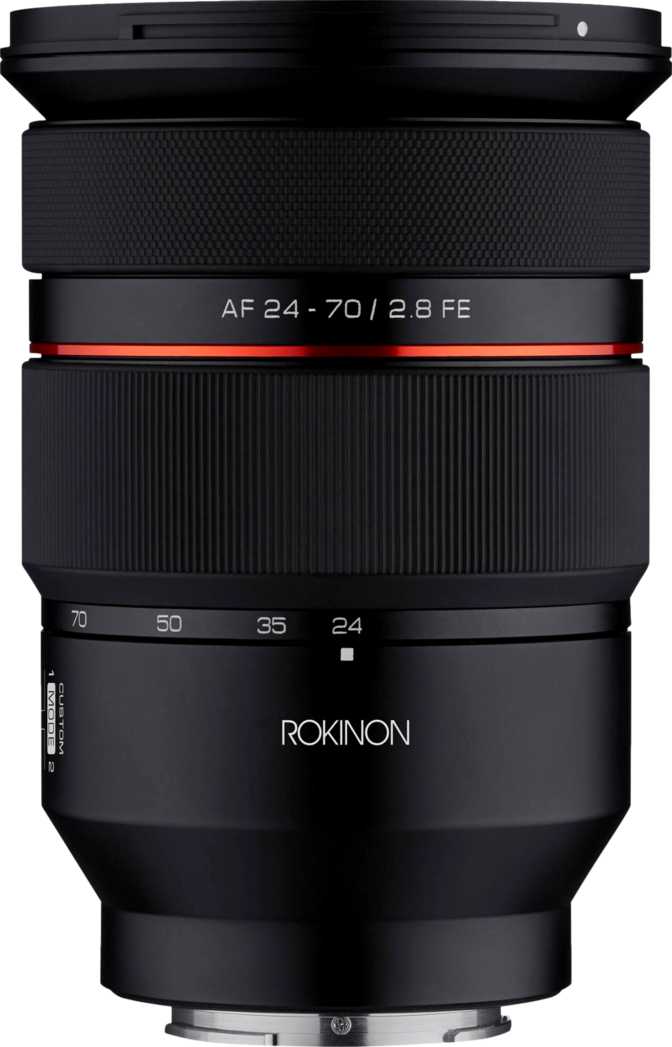
Rokinon 24-70mm f/2.8 AF Zoom Review: Worth the Weight?
Camera LensesThe 24–70mm f/2.8: Photography's Most Productive Focal Range
There is a reason the 24–70mm f/2.8 zoom is considered the backbone of professional camera bags worldwide. It is not glamorous, not extreme, and not specialized — it is simply the range where most of life's important moments actually happen. Weddings, portraits, events, travel, architecture, street scenes: all of them land squarely within what this focal range does naturally. Rokinon's autofocus version for Sony E-mount enters a category historically dominated by first-party glass and a few highly respected third-party names. The question is not whether a 24–70mm f/2.8 can be useful — that answer is already settled. The question is what this particular one delivers for the price, and where the line between its ambitions and its limitations falls.
Build Quality and Physical Design
Metal Where It Counts
The lens uses a metal mount — and while that sounds like a minor engineering choice, it has real consequences over time. The mount is the mechanical interface between lens and camera body, bearing the stress of every attachment, removal, and moment of accidental leverage from a lens that tips front-heavy when placed on a surface. Metal mounts resist the micro-deformation that softer materials accumulate, keeping optical alignment consistent across years of heavy use. For a lens positioned for professional workflows, this durability signal matters.
A lens hood ships in the box — a detail that feels like table stakes but is not always included at comparable price points. Beyond controlling flare when light sources hit the front element at odd angles, the hood adds a meaningful layer of protection during active shooting where minor accidents happen constantly.
Sony mirrorless bodies typically weigh 500–700g. This lens outweighs your camera body. Extended handheld shooting — overhead at events or all-day travel — will make this felt by hour five.
This is not a casual street lens. It earns its place on a neck strap or in a dedicated bag — the accepted cost of constant-aperture professional performance.
The Constant f/2.8 Aperture: Why It Changes Everything
Every focal length. Every time.
Most consumer zoom lenses use a variable maximum aperture — as you zoom in from wide to telephoto, the lens becomes progressively more restrictive. A typical kit lens might allow its widest opening at 24mm but become significantly more limiting at 70mm. That shift reduces the light reaching the sensor dramatically: f/5.6 lets in four times less light than f/2.8. In a dimly lit reception hall, what exposed cleanly at the wide end becomes underexposed, blurry, or noise-ridden at the telephoto end.
The Rokinon 24-70mm f/2.8 AF holds its widest aperture at every focal length without exception. Exposure settings do not shift as you zoom. Depth of field behavior stays consistent. The lens also stops down to f/22 at the wide end for situations — landscapes, architecture — where maximum depth of field matters more than light gathering. For event photographers and videographers working in unpredictable conditions, constant f/2.8 is not a luxury. It is the difference between usable images and missed moments.
| Focal Length | Rokinon 24-70mm f/2.8 AF | Typical Variable Aperture Kit Lens |
|---|---|---|
| 24mm (wide) | f/2.8 | f/3.5 |
| 50mm (mid) | f/2.8 | f/4.5 |
| 70mm (tele) | f/2.8 | f/5.6 |
Variable aperture values shown are typical for consumer kit lenses and are provided for general illustration only.
Autofocus and Focus Performance
Native Sony Autofocus
Rokinon built its reputation on manual-focus lenses. Native autofocus for Sony E-mount is a meaningful evolution. The lens communicates through the E-mount's full electronic interface, enabling phase-detection autofocus — the same system pathway that Sony's own lenses use. This is not an adapted workaround; it is native integration.
Full-Time Manual Override
Grab the focus ring at any time to manually adjust focus without switching out of autofocus mode. Essential for fine-tuning portrait focus after AF settles, pulling focus deliberately during video recording, or correcting autofocus hunting in difficult lighting — all without a mode switch.
Minimum Focus Distance
The lens focuses down to 0.35 meters — roughly 14 inches. At 70mm and this close distance, you can fill a meaningful portion of the frame with a face, product, or food plating. The 0.27x maximum magnification places this firmly in general close-up territory rather than dedicated macro photography.
Nine Aperture Blades and What That Means for Bokeh
When bright points of light appear out of focus in a photograph — a candle across the room, a distant streetlight, sunlight filtering through leaves — their shape is determined by the aperture blades. Angular, fewer blades produce polygon-shaped highlights. Nine rounded blades produce circular out-of-focus highlights that look organic and smooth, much closer to what the human eye perceives as naturally pleasing. This is the visual quality referred to as bokeh, and the nine-blade design here is consistent with what professional lenses in this category typically provide.
A second effect: when shooting landscapes or architecture with point light sources in frame while stopped down to smaller apertures, those sources produce starburst patterns. Nine blades create a nine-pointed star — a slightly distinctive effect compared to the more common six-pointed stars produced by six-blade designs.
At 70mm and f/2.8, background separation is sufficient for professional portrait work. Subject isolation is not as dramatic as a dedicated 85mm f/1.8 prime, but it is well-suited for headshots and environmental portraits where some relationship to the background context is desirable and intentional.
Aperture Blade Summary
- 9 rounded blades produce smooth, circular bokeh highlights
- Pleasing sunstar patterns at stopped-down apertures
- Background separation at 70mm f/2.8 suits professional portraiture
- Less background isolation than a dedicated 85mm portrait prime
No Built-In Stabilization: The Full Picture
Context matters here. The absence of lens-based stabilization does not mean you shoot without stabilization on Sony bodies. The answer depends entirely on which camera you pair this lens with.
These cameras include in-body image stabilization (IBIS) that physically shifts the sensor to compensate for camera movement. This works independently of the lens — even lenses without their own stabilization benefit. For still photography on current-generation Sony full-frame bodies, the absence of lens stabilization is largely manageable. IBIS handles the camera shake that matters most in handheld shooting.
For video, IBIS handles random shake but manages certain movement types differently than optical stabilization built into a lens. Videographers planning extended handheld footage should factor in a gimbal. Sony APS-C camera owners should also verify their specific body's IBIS capabilities before assuming equivalent stabilization performance, as the system varies meaningfully between models.
What the 24–70mm Range Actually Covers
The 86-degree angle of view at 24mm is wide enough to capture an entire room interior, a building façade, or a large group in a tight space — without the extreme distortion that ultra-wide lenses introduce. At 70mm, the 53-degree view creates moderate telephoto compression: background elements appear to sit closer to the subject, and facial features are flattered by the reduced perspective exaggeration that wider focal lengths produce on close subjects.
Between these two ends lies the full creative vocabulary of everyday professional shooting. The 35mm position matches human peripheral vision, producing images that feel immediate without manipulation. The 50mm delivers the standard perspective that photojournalists and cinematographers have relied on for decades. The 3x zoom ratio — the full span from 24mm to 70mm — means this single lens handles nearly every scenario a working photographer encounters on a typical day.
Who This Lens Is Built For — and Who Should Look Elsewhere
- Sony full-frame mirrorless shooters who want constant f/2.8 coverage without paying premium prices for Sony G Master options
- Wedding and event photographers who need one lens that handles dim reception halls and outdoor ceremonies reliably throughout a full shooting day
- Portrait and headshot photographers who shoot varied environments and want zoom flexibility over the constraints of a single prime focal length
- Travel photographers willing to accept the weight in exchange for not carrying multiple primes across a full shooting trip
- Video creators whose bodies carry capable IBIS and who supplement handheld work with a gimbal when needed
- Photographers prioritizing portability above all else — nearly 1.1 kilograms is significant, and lighter alternatives with comparable apertures exist in this mount
- Macro or close-up specialists — the magnification ceiling prevents this lens from filling a frame with small subjects like insects, coins, or jewelry details
- Handheld video creators who need optical stabilization at the lens level for consistently smooth, cinema-quality movement without additional stabilization hardware
- Budget-constrained beginners shooting primarily in daylight who would rarely benefit from constant f/2.8 — a quality variable aperture zoom may deliver better value in that case
How It Compares to the Obvious Alternatives
The Sony E-mount 24–70mm f/2.8 category is genuinely competitive. Any honest review must acknowledge what surrounds this lens in the market.
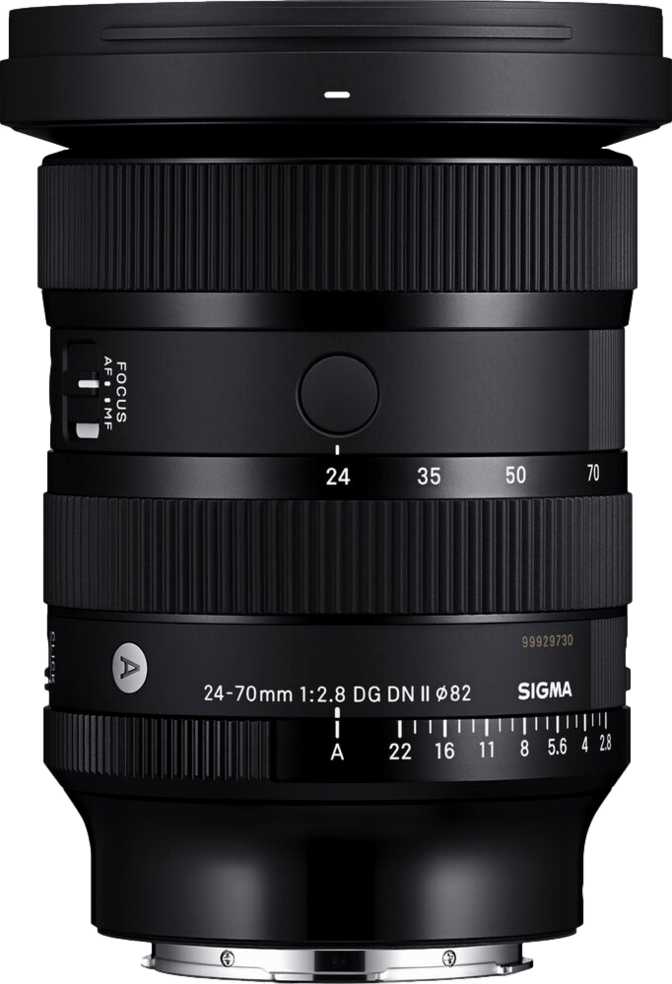
| Feature | Rokinon 24-70mm f/2.8 AF | Sony FE 24-70mm f/2.8 GM II | Tamron 28-75mm f/2.8 G2 | Sigma 24-70mm f/2.8 Art |
|---|---|---|---|---|
| Focal Range | 24–70mm | 24–70mm | 28–75mm | 24–70mm |
| Constant f/2.8 | ||||
| Weight | ~1,096g | ~695g | ~540g | ~830g |
| Aperture Blades | 9, rounded | 11, rounded | 9, rounded | 9, rounded |
| Built-in Stabilization | ||||
| Min. Focus Distance | 0.35m | ~0.21m | ~0.19m | ~0.18m |
| Price Tier | Budget–Mid | Premium | Mid | Mid |
Competitor specifications based on publicly available manufacturer data and may vary. Verify current specs before purchasing.
Sony FE 24-70mm f/2.8 GM II
The class leader — lighter despite its f/2.8 aperture, faster autofocus, and closer minimum focusing. Commands a price that places it out of reach for many photographers.
Tamron 28-75mm f/2.8 G2
Sacrifices 4mm at the wide end but adds optical stabilization, considerably less weight, and much shorter minimum focus distance. Strong for portability-first shooters.
Sigma 24-70mm f/2.8 Art
Sits between the others in weight and has earned strong independent recognition for optical output. A well-established third-party benchmark in this category.
Honest Strengths and Real Limitations
What It Gets Right
The case for this lens begins with what it unambiguously delivers. A constant f/2.8 standard zoom with native Sony autofocus, nine rounded aperture blades, full-time manual focus override, and a metal mount designed for durability constitutes a serious professional tool. These are not marginal specifications — they represent exactly what professional photographers in event, portrait, and travel work need from a standard zoom.
The inclusion of a lens hood and the decision to use a metal mount signal that Rokinon designed this for working photographers, not casual users. At its price point, the fundamental engineering ambition is real. The autofocus evolution from a brand known for manual glass also represents a meaningful step toward a more complete professional product.
Where It Falls Short
The weight is significant and non-negotiable. The photographers most likely to benefit from this lens — event shooters, travel photographers working long days — are often the ones for whom weight compounds into fatigue. The minimum focus distance, while workable for most subjects, trails what competitors offer at similar or higher price points, limiting usefulness for close-detail work.
The absence of optical stabilization is manageable on the right bodies but warrants acknowledgment for video-heavy workflows. And there are performance variables that specifications alone cannot determine: sharpness consistency across the frame, chromatic aberration behavior, and autofocus speed in real tracking scenarios all require hands-on testing that goes beyond what any spec sheet can reveal.
Questions Real Buyers Ask Before Purchasing
Final Verdict
A Credible Entry Into Professional Zoom Territory
The Rokinon 24-70mm f/2.8 AF for Sony E-mount presents a reasoned argument for its existence in a category where it is not the obvious default choice. It delivers the essential characteristics that define professional standard zoom photography: a constant f/2.8 aperture across the full focal range, native Sony autofocus, nine rounded aperture blades, and a metal mount built for professional durability.
These are not concessions or approximations. They are the real capabilities of this lens category, packaged at a price point that makes this focal range accessible to photographers who find Sony's own options financially out of reach.
The trade-offs are equally honest. Nearly 1.1 kilograms is a daily reality, not a footnote. The absence of optical stabilization is manageable on Sony bodies with capable IBIS but requires acknowledgment for video-heavy workflows. The minimum focus distance trails what competitors offer. And there are optical performance questions — sharpness consistency, autofocus precision in real tracking scenarios — that belong to field results rather than specification analysis.
For a Sony E-mount photographer who needs constant-aperture coverage across the most versatile zoom range in photography, and who is willing to verify the real-world optical results through sample imagery and field reports: this lens represents a genuine purchase worth making. It does not win on weight, close-focus distance, or established reputation. It wins, if it wins, on optical results per dollar spent — and that is an argument worth investigating before spending significantly more on the alternatives.
Wedding & Event
Budget–Mid
Weight vs. Value