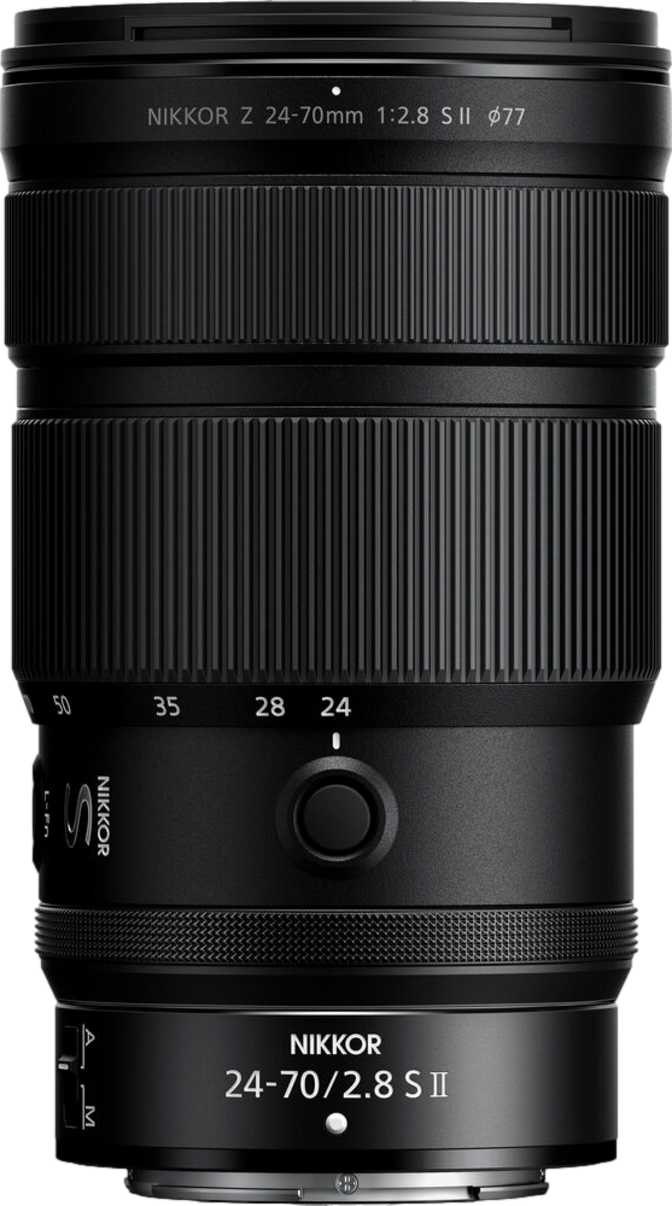
Nikon Nikkor Z 24-70mm f/2.8 S II: An Honest Full Review
Camera LensesProfessional-Grade Standard Zoom, Built to Last
The Nikon Nikkor Z 24-70mm f/2.8 S II earns its place at the top of Nikon's standard zoom lineup through optical excellence, build integrity, and a focusing system that working photographers genuinely depend on. Heavy, expensive, and entirely worth it for the right buyer.
Build Quality and Physical Design
Construction · Durability · Handling in the Field
Construction and Durability
The S II designation in Nikon's naming system is a meaningful signal, not marketing language. S-line lenses are built to a different standard than the rest of the Z-mount lineup — tighter tolerances, higher-grade materials, and sealing that goes well beyond splash resistance in name only.
This lens is weather-sealed at every critical junction: the barrel, the zoom ring, the focus ring, and the mount interface. That is a lens you can trust in light rain, dusty environments, and the unpredictable outdoor conditions that working photographers regularly face. The mount itself is metal — not polymer, not composite — which matters when you are swapping lenses quickly in the field and when the weight of the lens hanging off a camera body puts real stress on that connection point over thousands of shooting days.
- Weather sealing at the barrel, zoom ring, focus ring, and lens mount
- Full metal mount for lasting structural integrity
- S-line manufacturing standards: tighter tolerances, premium materials
Weight, Handling, and Filter Compatibility
At 675 grams, this lens sits in the "substantial but manageable" category — roughly the weight of a large water bottle. If you have not handled a professional f/2.8 zoom before, it may feel heavier than expected. That mass comes directly from the glass elements and metal construction that deliver the image quality and durability professionals pay for.
Paired with a larger Z-series body, the balance works well and the lens does not feel front-heavy in an uncomfortable way. On a smaller Z-mount body, a hand grip is worth considering for extended shooting sessions. This is not a travel-light lens — it is a deliver-the-shot lens.
The 77mm filter thread is a widely adopted professional standard, which means quality circular polarizers and variable ND filters in this size are easy to source and broadly compatible with other professional lenses you may already own. The included lens hood reverses for compact storage and locks firmly into shooting position — a practical detail that matters when moving quickly between scenes.
Filter Compatibility: 77mm is one of the most standardized sizes in professional photography. Existing filters from other lenses in your kit transfer directly — no step-up rings required.
Optical Performance: What the Specifications Actually Mean
Aperture Advantage · Bokeh Quality · Close-Focus Capability · Autofocus System
The Constant f/2.8 Advantage
Many buyers do not fully appreciate what a constant aperture zoom means until they have worked with a variable aperture alternative. This lens maintains f/2.8 from 24mm all the way to 70mm — it never slows down as you zoom in. On lesser lenses, zooming to the long end might drop you to f/5.6 or worse, cutting the light reaching the sensor by a factor of four.
At f/2.8, this lens collects twice as much light as an f/4 counterpart and four times as much as an f/5.6 lens in the same moment. In practical terms, that gap means the difference between a sharp handheld shot and a blurred one in a dimly lit reception hall — or between ISO 1600 and ISO 6400, a difference that shows directly in shadow noise and fine detail retention.
Eleven-Blade Rounded Aperture
The aperture mechanism uses eleven blades, all curved, and this has a specific visual consequence: out-of-focus areas — called bokeh — render specular highlights such as candle flames or city lights as smooth, nearly perfect circles rather than polygonal shapes.
At f/2.8, background separation is already significant across the focal length range, and the quality of that blur is smooth and pleasing rather than distracting or busy. Portrait photographers, food photographers, and anyone who cares about subject isolation will see this difference directly in their images.
Close-Focus Capability
The lens focuses as close as 24 centimeters from the subject — measured from the focal plane, placing the subject approximately 11–12 centimeters from the front element when accounting for body depth. That is close enough to fill the frame with a watch face, a flower, a piece of food, or product details that would otherwise require dedicated macro glass.
The 0.32x magnification ratio is meaningful for a standard zoom. This is not a lens that can only resolve subjects at arm's length — close-focus versatility makes it genuinely useful for product, food, and documentary detail work without reaching for additional glass.
Silent and Continuous Autofocus
The built-in focus motor operates silently — an essential quality for video work and event photography in quiet spaces like ceremonies and auditoria. No clicking, buzzing, or mechanical noise is introduced into audio recordings or ambient environments.
Full-time manual focus override means that with autofocus active, you can reach for the focus ring at any moment and fine-tune or take full control without switching modes. Wedding and event photographers rely on this capability exactly when autofocus locks onto the wrong subject at a critical moment.
The 24–70mm Focal Range in Practice
Understanding What Each Focal Length Actually Gives You
For photographers newer to this range, knowing what each millimeter setting delivers — and when to reach for it — transforms this lens from a blunt instrument into a precision tool. The range covers the majority of what most photographers need in a single day.
| Focal Length | Angle of View | Visual Character | Typical Use Case |
|---|---|---|---|
| 24mm | ~84° | Expansive, wide | Architecture interiors, large group shots, environmental portraits |
| 35mm | ~63° | Natural, candid | Street, documentary, storytelling, natural field-of-view scenes |
| 50mm | ~47° | Classic, neutral | Portraits, product work, editorial — the standard human view |
| 70mm | ~34° | Compressed, intimate | Flattering portraits, subject isolation, fine detail shots |
The 24mm end is wide enough to capture a full room or a large group in a modest space. The 70mm end compresses perspective in a way that is flattering for portraiture, without the exaggerated facial feature distortion that very long telephoto focal lengths can introduce. Between those extremes lies the majority of photojournalism, commercial work, event coverage, travel photography, and portrait work done by professionals worldwide.
Who Should Buy This Lens — and Who Shouldn't
Matching the Right Tool to the Right Photographer
- Wedding and Event PhotographersOne lens covering ceremonies, receptions, speeches, and portraits under variable lighting — without swapping glass between critical moments.
- Commercial and Editorial PhotographersProducts, interiors, headshots, editorial assignments — the focal range covers most professional scenarios where image quality is non-negotiable.
- Videographers and Hybrid ShootersSilent autofocus, full manual override, and available-light performance without compromising shutter speed make this genuinely practical for video production.
- PhotojournalistsSpeed, reliability, and a single lens that works from dim press conferences to bright outdoor scenes without switching glass mid-assignment.
- Weather-Exposed Travel PhotographersWilling to accept the weight in exchange for covering the full standard range with a lens built to handle unpredictable outdoor conditions.
- Lightweight Travel Kit BuildersAt 675g, combined with a mirrorless body, the total system is substantial. If portability is the primary concern, a slower kit zoom or compact prime serves you better.
- Budget-Conscious BuyersThis is a professional-tier lens priced accordingly. Casual photographers shooting primarily in good light have better value options throughout the Z-mount lineup.
- Telephoto SpecialistsSports, wildlife, and anything requiring real reach beyond 70mm — this lens is simply not the right tool. The long end is excellent, but 70mm is where it stops.
- Dedicated Macro PhotographersClose-focus capability is genuinely good for a standard zoom, but dedicated macro lenses achieve 1:1 reproduction ratios this lens cannot match.
The Missing Piece: No Built-In Optical Stabilization
The Most Significant Limitation to Understand Before Purchasing
Key Consideration
This lens does not include built-in optical image stabilization. This is a deliberate design decision — Nikon's Z-series cameras include in-body image stabilization (IBIS) intended to compensate for camera shake across all attached lenses. Whether this matters to you depends entirely on your camera body and shooting style.
If Your Body Has IBIS
For still photography on a Z-body with in-body stabilization, the absence of optical stabilization in the lens is largely a non-issue. The in-body system handles handheld shooting at slower shutter speeds competently, and the combination covers the vast majority of real-world shooting scenarios without meaningful compromise.
If Your Body Lacks IBIS
On a Z-mount body without in-body stabilization, you will need more deliberate attention to shutter speed for static subjects. For video-heavy workflows requiring smooth handheld movement without a gimbal, this warrants careful evaluation — lenses combining optical and in-body stabilization typically deliver better results for moving camera work.
How It Compares to the Logical Alternatives
Competitive Positioning Within the Z-Mount Ecosystem
| Feature | Z 24-70mm f/2.8 S II (This Lens) |
Z 24-70mm f/4 S | Third-Party f/2.8 |
|---|---|---|---|
| Max Aperture | f/2.8 — constant | f/4 — constant | f/2.8 — constant |
| Low-Light Performance | Excellent | Good | Excellent |
| Built-in OIS | No — relies on IBIS | No — relies on IBIS | Often included |
| System Weight | 675g | Noticeably lighter | Varies by brand |
| Aperture Blades | 11 rounded blades | Fewer blades | 9 to 11 blades |
| Filter Thread | 77mm | Smaller diameter | Varies |
| Silent AF | Yes | Yes | Yes |
| Price Tier | Premium professional | Mid-range | Mid to upper range |
| Best Suited For | Events, press, commercial | Enthusiasts, travel | OIS-priority users |
vs. Nikon Z 24-70mm f/4 S
The f/4 version covers the same focal range in a lighter, smaller, less expensive package. If you shoot primarily outdoors in good light or in environments with reliable artificial lighting, the f/4 handles the range competently. The f/2.8 S II earns its premium specifically in two scenarios: low-light available light work where every stop of exposure latitude counts, and creative work where shallow depth of field is a meaningful part of the image. If neither scenario applies to you regularly, the f/4 S is a compelling and lighter alternative.
vs. Third-Party 24-70mm f/2.8
Third-party Z-mount options typically offer lower price points and, in some cases, built-in optical stabilization that this lens lacks. Trade-offs are usually found in autofocus speed consistency, build quality over years of heavy professional use, and the degree of optical aberration correction. For professionals whose income depends on this lens daily, the first-party Nikon holds an advantage in after-service support and predictable long-term reliability.
Strengths and Honest Limitations
A Balanced Editorial Assessment
Where It Excels
The constant f/2.8 aperture across the full zoom range is the lens's defining strength. Most standard zooms sacrifice aperture speed at the long end — this one does not, and that is not a small thing when you are shooting in a venue where light is dim and unpredictable and you cannot control what you are given.
The build quality goes beyond nominal weather sealing. The combination of sealed construction at every junction and a metal mount gives this lens the feel of a professional tool, not a consumer product with professional aspirations. Built to outlast camera bodies, that durability has real economic value over a working photographer's career.
Eleven rounded aperture blades produce bokeh quality that rivals dedicated portrait primes in the way it renders background highlights — smooth and organic rather than geometric and distracting. This shows directly in portrait, product, and event work where background clutter would otherwise compete with your subject.
The 24-centimeter minimum focus distance combined with 0.32x magnification makes this lens genuinely versatile beyond the standard zoom category. Detail shots, product photography, and close documentary work do not require a lens change.
Where It Falls Short
The weight is the most immediately felt limitation. At 675 grams, this lens will never disappear from your awareness during a long shooting day. Combined with a full-size Z-mount body, the total system is one that photographers with joint concerns or a preference for minimalist setups should think carefully about before committing.
The absence of built-in optical stabilization is the other meaningful shortcoming. For photographers on Z-bodies with in-body stabilization, it is a manageable trade-off — the in-body system picks up the slack for still photography effectively. For video shooters requiring very smooth handheld movement without a gimbal, or for those using stabilization-free bodies, it is a real limitation that no workaround fully compensates for.
The price reflects its professional tier honestly, and that honesty cuts both ways. If you do not genuinely need constant f/2.8, professional weather sealing, and the autofocus reliability this lens provides, you are paying for capabilities that will sit unused. The Z-mount ecosystem offers genuine value at lower price points for photographers whose conditions do not demand the full S II specification set.
Common Questions Before Buying
Real Answers to What Buyers Actually Search For
Buy It Because You Need What It Does
A professional tool with a professional purpose — and one of the most complete standard zoom lenses made for the Nikon Z system.
For professionals and serious enthusiasts shooting events, commercial work, or editorial — the f/2.8 capability and build quality justify every penny of the investment.
Hybrid shooters on Z-mount cameras will find the silent AF and full manual override make this a practical, quiet video lens — not just a stills workhorse.
If you shoot primarily in good light, want a lighter kit, or cannot regularly use f/2.8 in ways that change your results — better-value alternatives exist.
The Nikon Nikkor Z 24-70mm f/2.8 S II is not trying to be the smallest, cheapest, or most versatile lens in any given bag — it is trying to be the most reliable, optically excellent, and consistently capable standard zoom available for the Z-mount system. It succeeds at that goal without meaningful compromise in the areas that matter most to working photographers.
Buy it because you need what it does. Do not talk yourself into it because f/2.8 sounds impressive — the lens will only justify that investment if you genuinely shoot in conditions where constant f/2.8 changes your results. For photographers who meet that bar, the Z 24-70mm f/2.8 S II will not disappoint.