Focal Length
12mm
Fixed Prime
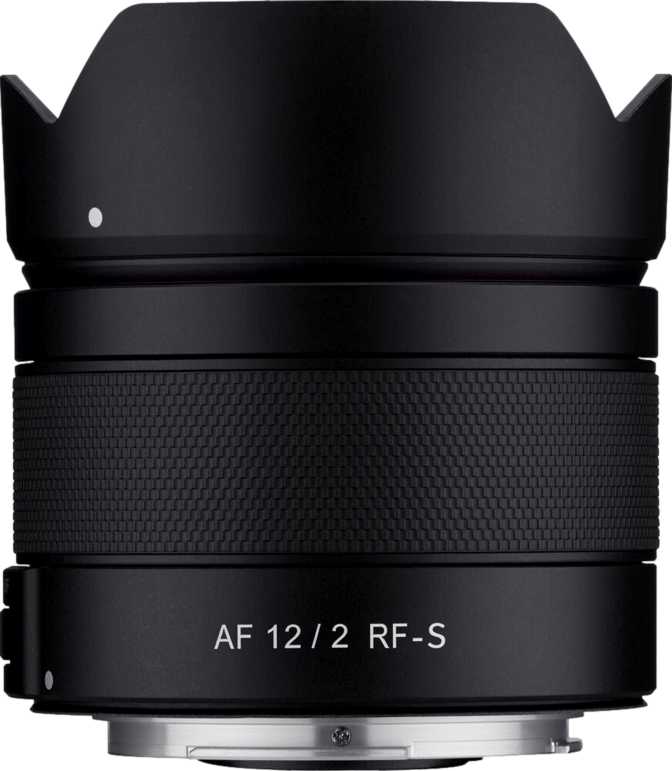
Canon’s RF-S system has matured into a genuinely compelling platform for crop-sensor mirrorless photographers — and for much of that time, the ultra-wide end of the focal length range sat conspicuously underserved. The Samyang 12mm f/2 AF RF-S arrives to fill that gap directly, bringing autofocus capability and a fast maximum aperture to a focal length that is practically essential for landscape, architecture, and astrophotography work. For anyone shooting on a Canon APS-C mirrorless body — an EOS R7, R10, R50, or R100 — this lens deserves serious attention. Here is what it actually delivers.
Focal Length
12mm
Fixed Prime
Max Aperture
f/2
7 Rounded Blades
Field of View
96.8°
Diagonal
Weight
213g
Travel-Friendly
Min Focus
20cm
Close Subjects
Filter Thread
62mm
Non-Rotating
Before talking about images, it is worth understanding what 12mm actually means on an APS-C sensor. Canon’s crop-sensor cameras apply a 1.6x field-of-view multiplier to any lens, so the visual reach of this 12mm prime is roughly equivalent to a 19mm lens on a full-frame camera. That is genuinely wide — wide enough to capture entire building facades from tight urban streets, to fit an expansive mountain range into a single frame, or to photograph the Milky Way arcing across the sky above a foreground subject. The lens delivers just under 97 degrees of diagonal field of view, which is the kind of coverage that forces you to think differently about composition.
The first thing you notice physically is how light this lens is. At 213 grams, it weighs less than most people’s lunch. On compact RF-S bodies like the EOS R50 or R10, this creates a genuinely pocketable travel kit — the lens does not front-load the body or make handheld shooting awkward over long sessions. Build quality feels deliberate rather than premium-flashy: a controlled, matte exterior that communicates purpose over showmanship.
The lens carries weather sealing — a meaningful inclusion at this price and size category. This is protection against the situations real photographers actually encounter: a sudden shower on a hike, shooting near ocean spray, or working through light fog. For a landscape and travel-oriented ultra-wide, this matters considerably. It means you do not have to pack up at the first sign of a drizzle.
Filter Compatibility Note
The 62mm front filter thread accommodates circular polarizers and neutral density filters. Crucially, the front element does not rotate during autofocus, so a polarizing filter stays exactly where you set it regardless of whether the lens is hunting for focus. A lens hood is included in the box for additional flare control from day one — not sold separately.
The f/2 maximum aperture is the specification that most directly separates this lens from the competition. To put it in practical terms: f/2 admits twice as much light as f/2.8, which means you can use a shutter speed twice as fast, or an ISO half as high, under identical lighting conditions. For a wide-angle lens, this matters most in two specific situations.
Stars trail if the shutter stays open too long, and high ISO introduces noise that obscures faint detail. An f/2 aperture allows significantly shorter exposures at lower sensitivities, producing cleaner, sharper Milky Way images. This lens is purpose-built for night sky work.
Interiors, dusk cityscapes, candlelit venues — the extra aperture headroom lets you keep ISO under control in environments where a slower lens would push you into visibly noisy territory. Handheld shooting in challenging light becomes genuinely usable.
At 12mm, depth of field is inherently deep even at wide apertures — the physics of ultra-wide lenses make dramatic background blur essentially impossible. What f/2 provides at this focal length is precise subject separation in close-up situations, combined with improved light-gathering performance. The seven-blade rounded aperture diaphragm means out-of-focus elements render as smooth circular highlights rather than harsh polygonal shapes, and stopped-down point light sources produce a pleasing starburst effect.
The aperture range extends all the way to f/22, giving full creative control for long-exposure work — smooth waterfalls, light trails, deliberate motion blur — without requiring additional ND filtration in all but the brightest conditions.
The inclusion of autofocus in an RF-S ultra-wide at this aperture and focal length is the feature that most significantly expands who this lens is for. Previous ultra-wide options at this price tier were manual focus only, limiting their usefulness for anything moving — street photography, casual travel shots with groups of people, or any scenario where quick, accurate focus is expected.
The lens can focus as close as 20 centimetres from the front element. At 12mm, this creates a characteristic ultra-wide close-focus look — a relatively small subject appears large against a sweeping background that reveals the full 97-degree field of view. This is the technique behind environmental portraits that place a person or object in dramatic context with their surroundings.
The maximum reproduction ratio confirms this is not a macro lens, but the close-focus capability is more than adequate for environmental and context-driven compositions. Think of it as a tool for dramatic storytelling rather than fine detail reproduction.
Genuinely autofocus ultra-wide primes for the Canon RF-S system are rare at this price tier. Here is how the Samyang 12mm f/2 AF RF-S stacks up against the most realistic alternatives a Canon APS-C shooter would actually consider:
| Feature | Samyang 12mm f/2 AF RF-S | MF Ultra-Wides (RF-S) | Canon RF-S Kit Zoom (Wide End) |
|---|---|---|---|
| Autofocus | Yes, silent motor | None | Yes |
| Max Aperture | f/2 | f/2 – f/2.8 (varies) | f/3.5 – f/4.5 (variable) |
| Weather Sealing | Yes | Typically No | Typically No |
| Focal Length Type | Fixed (prime) | Fixed (prime) | Variable (zoom) |
| Front Element Rotation | Non-rotating | Varies | Varies |
| Weight Class | Very Light — 213g | Light | Light |
For photographers who can work with manual focus — particularly for static subjects like landscapes and architecture — MF alternatives remain viable and often less expensive. The Samyang’s premium is largely the autofocus motor, weather sealing, and non-rotating front element. If you need autofocus in any shooting scenario, that premium is justified without much debate.
Final Verdict
The Samyang 12mm f/2 AF RF-S resolves a real gap in the Canon RF-S ecosystem and does so with a feature set that goes beyond the minimum. Autofocus capability transforms this from a specialist manual-focus tool into a general-purpose ultra-wide that landscape photographers, travel shooters, astrophotographers, and video creators can all justify carrying.
The f/2 aperture directly changes what is achievable in low light — and in astrophotography specifically, it is the difference between disappointing noise and publishable results. The weather sealing and non-rotating front element complete a specification set that would be impressive on a lens costing considerably more.
Our Recommendation
This lens earns an unambiguous recommendation for Canon APS-C mirrorless photographers who want the widest, fastest, and most practical prime available for their system. If 12mm is a focal length you reach for — or have been avoiding because your options were too slow or manual-only — this is the lens that changes that calculation.