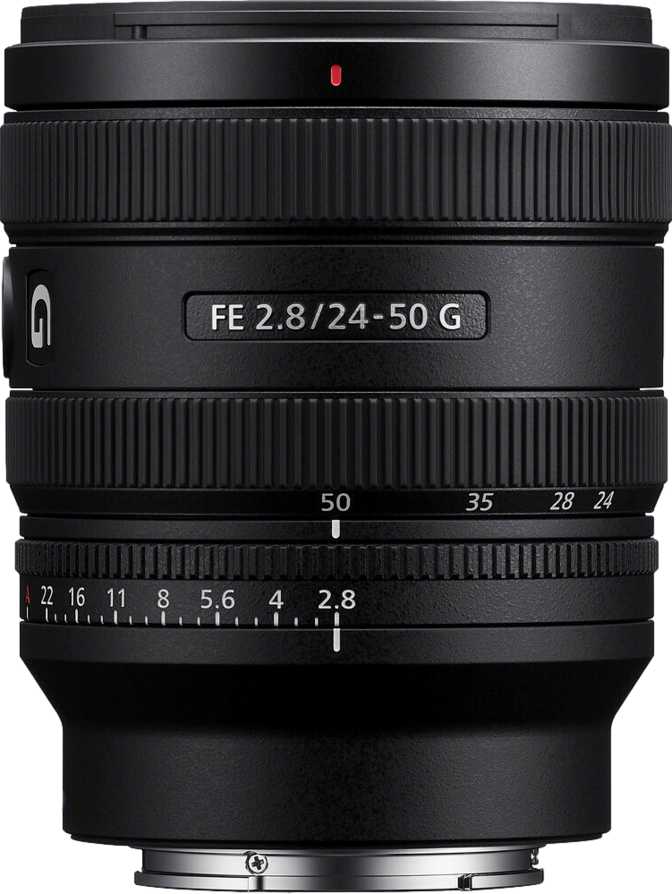
Sony FE 24-50mm f/2.8 G Review: Compact Speed, Real Trade-offs
Camera LensesSony's G-series lenses occupy a carefully defined space: not the flagship GM tier with its premium pricing, but genuine professional-grade glass built for photographers who demand consistent optical performance without compromise. The FE 24-50mm f/2.8 G fits squarely in that philosophy — a compact, constant-aperture standard zoom for Sony's full-frame E-mount system that poses one direct question: do you want a lighter alternative to the traditional 24-70mm workhorse, or do you need those extra millimeters more than you need the weight reduction?
Design and Build Quality
A Compact Form Factor That Still Feels Serious
The first thing you notice picking up the Sony FE 24-50mm f/2.8 G is how much smaller it feels compared to what you'd expect from a constant f/2.8 zoom. At 440 grams, it sits noticeably lighter than most fast standard zooms — enough of a difference you'll feel it after a long day of shooting. Paired with Sony's full-frame mirrorless bodies, the balance is natural and comfortable rather than front-heavy.
The 67mm filter thread is another meaningful advantage. Filters in this diameter — polarizers, ND filters, UV protectors — are among the most commonly stocked and competitively priced on the market. You won't need to hunt down expensive 82mm or 95mm variants, and if you already shoot with other lenses sharing this thread size, your filter collection rotates freely.
Build Details That Matter in the Field
The lens mount is metal — not a cosmetic choice, but a structural one. The connection between lens and camera body takes repeated stress over thousands of lens swaps, and a metal mount holds up far better over years of real use than plastic alternatives.
Weather sealing across the lens barrel means shooting through light rain, mist, or dusty conditions without wrapping your gear in a plastic bag. For the vast majority of outdoor situations — weddings caught in a drizzle, street photography in humid conditions, landscape work in unpredictable weather — it provides genuine peace of mind. The front element does not rotate during focusing, meaning a polarizing filter stays at the angle you set it rather than spinning out of position as the lens focuses — a basic requirement for landscape and architecture work.
-
Metal Lens Mount
Structural durability across thousands of lens swaps -
Weather Sealing
Splash-resistant for outdoor use in challenging conditions -
Non-Rotating Front Element
Polarizing filters stay locked at your chosen angle -
Reversible Lens Hood Included
Flips back for compact storage without removal -
67mm Common Filter Thread
Widely available and cost-effective filter ecosystem
Optical Performance: What the Focal Range Actually Gives You
Understanding 24–50mm in Practice
A focal range from 24mm to 50mm covers what photographers call the "standard" field of view — the range most closely matching human perception, from moderately wide to natural perspective. At 24mm you have a wide-angle view ideal for environmental portraits, interiors, street scenes, and landscapes where showing context matters. At 50mm you're at the classic "nifty fifty" perspective: flattering for portraits, natural-looking for food, architecture details, and documentary work.
What this range does not cover is the compressed telephoto end of a traditional 24-70mm zoom. That missing stretch — from 50mm to 70mm — represents tighter portrait framing, greater background compression, and reach across a table or across a room. Whether those millimeters matter depends entirely on your shooting style, but it is a real limitation, not a theoretical one.
Constant f/2.8 Across the Full Range
The aperture stays at f/2.8 whether you're at 24mm or fully extended to 50mm. Most consumer zoom lenses slow down to f/5.6 or f/6.3 at the long end — a meaningful light penalty in dim conditions. In practical terms: you maintain the same shutter speed, ISO, and depth-of-field rendering regardless of zoom position.
In low-light environments — indoor events, evening golden hour, window-lit portraits — this translates directly into sharper shots at lower ISOs. For subject separation, the 50mm end with f/2.8 delivers creamy out-of-focus backgrounds: the longer focal length compounds the shallow depth-of-field effect for more pronounced subject isolation.
11 Rounded Aperture Blades
Eleven aperture blades, rounded in shape, produce exceptionally smooth bokeh and near-perfect circular out-of-focus highlights even when the aperture is stopped down slightly from wide open. Lenses with fewer blades or non-rounded blades can produce angular, harsh point-light rendering — streetlights, candle flames, catchlights — that many photographers find distracting in backgrounds.
With eleven rounded blades, specular highlights stay smooth across a wide aperture range. This matters most for portrait photographers and anyone shooting in environments with visible light sources in the background. The aperture stops down to f/22, giving full exposure flexibility across all shooting conditions.
Focusing System
Speed and Silence
The built-in silent focus motor operates without audible noise — relevant for video shooters who record with on-camera or on-lens microphones, and for event photographers who need to work discreetly in quiet environments like ceremonies and conferences. Focus tracking during video pulls won't introduce motor noise into your audio track.
The lens covers the full focus range from minimum distance all the way to infinity, making it fully capable for landscape, astrophotography, and architectural work where distant subjects need to render sharp.
Impressive Close Focus for a Zoom
The ability to focus to approximately 19 centimeters is impressively short for a standard zoom. Getting this close at 50mm with f/2.8 opens up tight detail shots — food photography, product photography, flowers, jewelry — that would normally require a dedicated macro lens or close-up filters.
The 0.33× magnification ratio lets you fill a significant portion of the frame with small subjects. It won't replace a true macro lens for 1:1 reproduction, but it handles pseudo-macro work better than most zoom lenses in this focal category — a quietly valuable capability that expands creative range without extra glass.
Full-Time Manual Focus Override: Not Available
This lens does not support full-time manual focus override while in autofocus mode. Switching to manual requires using the AF/MF selector rather than simply reaching for the focus ring mid-shot. For most still photographers this is a non-issue — but for videographers who need to pull focus manually while keeping the camera in AF mode, this is a notable workflow limitation worth factoring in before purchase.
Image Stabilization: Understanding the Absence
The Sony FE 24-50mm f/2.8 G does not include optical image stabilization built into the lens barrel. For Sony full-frame bodies equipped with in-body image stabilization (IBIS), this is not a meaningful limitation — the camera body itself stabilizes the sensor, achieving the same practical benefit across this focal range.
If you're shooting on a body without IBIS, the absence of lens-based stabilization means handholding in low light requires higher shutter speeds to avoid camera shake blur. At 24mm this is manageable; at 50mm the threshold becomes tighter. Video shooters who rely purely on lens stabilization should weigh this carefully — sensor-shift IBIS alone can produce less smooth results in handheld video than dedicated lens-based stabilization.
For most Sony A7-series and A9-series shooters, the absence of in-lens OIS is a non-issue. For Sony bodies without IBIS, it is a genuine practical consideration that should be verified against your specific body's capabilities before purchasing.
Who This Lens Is Built For
- Travel and documentary photographers who need a compact, fast zoom covering the most useful focal lengths without weight penalties
- Event and wedding photographers working in mixed lighting who need consistent f/2.8 performance across the full zoom range
- Portrait photographers who work primarily in the 35–50mm perspective and want to travel light without sacrificing aperture speed
- Street photographers who want a discreet, reasonably sized lens with fast autofocus and weather protection
- Video creators who prioritize silent autofocus and a small physical footprint for handheld or gimbal work
- Photographers upgrading from a kit lens who want professional f/2.8 performance without the bulk of a full 24-70mm
- A sports or wildlife photographer — this focal range stops well short of compressing action at a distance
- A dedicated macro photographer — close focus is impressive for a zoom, but it does not reach true 1:1 reproduction ratios
- A photographer who regularly shoots at 70mm — if moderate telephoto compression is part of your regular workflow, the shorter range will create routine frustrations
- A full-time video producer who frequently pulls focus manually while in AF mode — the lack of full-time manual override adds friction to that workflow
- A budget-conscious buyer — this is professional-tier glass with professional-tier pricing; kit lenses serve beginners at a fraction of the cost
How It Compares to the Logical Alternatives
Three Sony lenses compete for the same purchasing decision. Understanding the actual trade-offs between them is more useful than any single verdict.
| Feature | Sony FE 24-50mm f/2.8 G This Lens |
Sony FE 24-70mm f/2.8 GM II | Sony FE 24-105mm f/4 G OSS |
|---|---|---|---|
| Focal Range | 24–50mm | 24–70mm | 24–105mm |
| Max Aperture | f/2.8 constant | f/2.8 constant | f/4 constant |
| Weight | ~440g | ~695g | ~663g |
| Image Stabilization | IBIS-reliant | IBIS-reliant | Lens + IBIS sync |
| Filter Thread | 67mm | 82mm | 77mm |
| Min Focus Distance | ~19cm | ~21cm | ~38cm |
| Best Suited For | Compact versatility | Peak optical performance | All-round zoom range |
| Key Trade-off | Shorter zoom range | Heavier and larger | Slower aperture |
The 24-70mm f/2.8 GM II is the direct performance comparison — same constant aperture, 20mm extra reach, but significantly heavier. The 24-105mm f/4 G OSS trades one stop of light-gathering for a much broader zoom range and includes dedicated optical stabilization, making it the more versatile single-lens option for bodies without IBIS or shooters who need greater reach in telephoto situations.
Honest Strengths and Real Limitations
What It Gets Right
The Sony FE 24-50mm f/2.8 G makes a genuinely compelling case for photographers who have grown frustrated carrying heavier 24-70mm lenses. The weight reduction is real and meaningful — enough to change how you think about daily carry. The constant f/2.8 aperture is a genuine performance asset: it enables consistent exposure control in changing light, shallower depth-of-field when you want it, and lower ISO penalties when light is scarce.
Construction quality reflects professional-grade thinking throughout. Weather sealing, metal mount, and a non-rotating front element solve real problems photographers encounter repeatedly in the field — these aren't features added to inflate a spec list. The reversible lens hood is a small ergonomic win that makes the lens more livable as an everyday carry option.
The close focus capability stands out as an underappreciated strength. Very few fast standard zooms allow this proximity to a subject, quietly expanding the lens's creative range beyond what its focal numbers suggest on paper. For product, food, and botanical photography, this capability changes what's achievable without reaching for a second lens.
Where Honesty Requires Restraint
The 24-50mm range is genuinely limiting for photographers accustomed to 70mm reach. This isn't a minor quibble — it represents a real category of shots this lens cannot take without physically moving closer. Anyone who relies on moderate telephoto compression for portrait work or candid photography at a distance will notice the missing focal length as a routine frustration, not an occasional inconvenience.
The absence of full-time manual focus is a workflow friction point primarily for video. It won't bother most still photographers, but it's a gap that Sony's higher-end lenses and many competitors fill as standard. For narrative video work where smooth, predictable focus pulls are essential, this limitation has real production consequences.
The lens makes no optical stabilization contribution — entirely acceptable on IBIS-equipped bodies, but a genuine consideration for photographers on older or entry-tier Sony bodies where stabilization coverage is limited or absent. This is worth checking against your specific body's capabilities before committing to a purchase.
Common Buyer Questions Answered
Final Verdict
The Sony FE 24-50mm f/2.8 G is a well-considered lens for a specific type of photographer: one who prioritizes a fast constant aperture and compact form over maximum focal length range.
It doesn't try to replace the 24-70mm f/2.8 — it offers a deliberate alternative to it, accepting a shorter zoom range in exchange for a genuinely more packable, lighter-carrying experience without surrendering the f/2.8 aperture. For travel photographers, event shooters, and everyday carry applications on Sony full-frame bodies with IBIS, this lens earns a clear recommendation. The build quality is professional-grade, the focusing system is quiet and capable, and the close focus performance adds creative flexibility that most competing lenses don't match.
For photographers who need the full 24-70mm range or longer, or who work on bodies without in-body stabilization, the trade-offs don't resolve in this lens's favor. In those cases, the 24-70mm GM II or the 24-105mm f/4 G OSS will serve better — at the cost of either weight or maximum aperture.