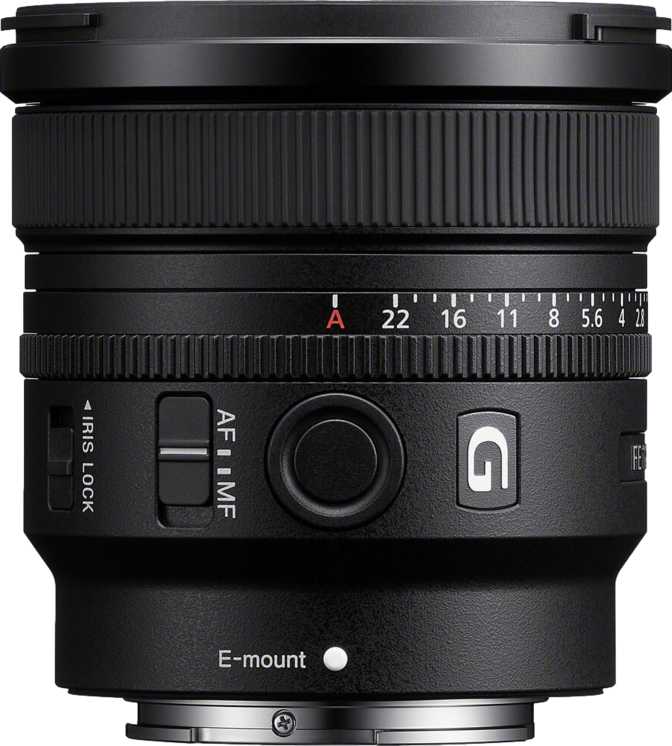
At a Glance
The Sony FE 16mm f/1.8 G fills a genuine gap in Sony's native full-frame lens lineup — pairing ultra-wide coverage with an aperture fast enough to work in serious low light. That combination, housed in a weather-sealed native mount, defines its unique position in the Sony ecosystem.
Design & Build Quality
A lens that earns your confidence before you take the first shot.
Picking up the Sony 16mm f/1.8 G, the first thing you notice is that it is lighter than it looks. At 304 grams, it sits comfortably on any Sony full-frame body without creating the front-heavy imbalance that plagues some ultra-wide designs. This is not a compact lens — 67mm filter threads and the optical formula required for 16mm coverage demand real volume — but Sony's engineers have kept the mass reasonable without compromising structural integrity.
The mount is metal, which matters more than many buyers realize. Over years of lens swapping, a plastic mount wears unevenly, eventually introducing subtle play between lens and body. The metal mount here ensures the optical axis stays exactly where it should, shot after shot, year after year.
Weather sealing runs throughout the barrel under Sony's G-series standard, meaning you can shoot in rain, mist, and dusty conditions without changing plans or covering gear. For photojournalists, event shooters, and landscape photographers working in unpredictable environments, this is a practical necessity rather than a marketing feature.
The front element does not rotate during autofocus — a detail that proves consequential the moment you attach a polarizing filter. Polarizers must stay precisely oriented, and a rotating front element destroys that positioning every time the lens focuses. The included lens hood also reverses for compact bag storage, a small convenience that adds up across thousands of shoots.
Physical Specifications
-
Weather SealingG-series standard — rain, mist, and dust resistant
-
Metal Lens MountLong-term mechanical precision and consistent alignment
-
Non-Rotating Front Element67mm thread stays fixed — polarizers stay aligned during AF
-
Reversible Lens Hood IncludedReverses for compact transport in a camera bag
-
304g Body WeightComfortable, balanced handling on all Sony full-frame bodies
Optical Performance
Two factors define this lens: how wide it sees, and how much light it collects.
What 107° of Coverage Actually Means
At 16mm on a full-frame sensor, this lens captures a 107-degree angle of view. To put that in terms you can feel: standing in a standard hotel room, you can capture the entire space — bed, walls, ceiling — in a single frame without backing into the wall. In a cathedral, you see the full arch span and the floor simultaneously. On a city street, foreground and skyline coexist with dramatic, receding perspective.
That 107-degree view is not just about fitting more into the frame. It actively shapes how images feel. The geometry at 16mm makes near subjects appear large and imposing while distant elements recede sharply, producing depth and environmental scale that longer focal lengths simply cannot create.
Astrophotographers understand this instinctively — a wider angle means more sky, more stars, and longer exposure times before star trails appear. The lens's 15cm minimum focus distance also enables environmental close-up compositions where a nearby subject looms large against a dramatically wide, receding background.
Why f/1.8 Changes Everything at Ultra-Wide
Most ultra-wide lenses stop at f/2.8 as their maximum aperture. The f/1.8 opening on this lens admits roughly two-and-a-half times more light than that standard. In practice, this means shooting at the same shutter speed in a dim scene but at a significantly lower ISO — which translates directly into cleaner, less noisy images.
For interior architecture shot without a tripod, astrophotography requiring short exposures, or documentary work in dim venues, this aperture advantage is not marginal — it is the difference between a usable shot and a missed one.
The eleven rounded aperture blades influence how out-of-focus areas render at wide apertures. Specular highlights in soft background zones appear as smooth circles rather than harsh geometric shapes. The aperture closes fully to f/22, providing complete control from near-total subject isolation to maximum landscape sharpness across the entire scene.
Autofocus System
Fast, quiet, and deeply integrated with Sony's native autofocus ecosystem.
The internal focus motor matches the quiet, high-speed linear design Sony uses across its G and G Master lens families. Focus acquisition is fast enough for demanding video work — important because an ultra-wide prime at f/1.8 is exactly the lens a documentary or run-and-gun shooter would reach for in low light. A noisy focus motor picked up by an on-camera microphone ruins audio; the silent operation here eliminates that problem entirely.
The minimum focus distance of 15 centimeters — roughly the length of your hand from fingertip to wrist — is exceptionally close for a 16mm lens. Combined with a quarter life-size magnification ratio, this enables wide-angle close-up shots where the subject dominates the frame while the background stretches dramatically wide. This compositional technique, sometimes called environmental macro, produces images that neither a dedicated macro lens nor a standard wide-angle can replicate.
Focus Specifications
- Minimum Focus Distance
- 15 cm — approximately hand-length
- Magnification Ratio
- 0.25× (quarter life-size)
- Motor Type
- Internal, silent linear motor
- Full-Time MF Override
- Not available
Who Should Buy the Sony 16mm f/1.8 G?
This is a specialist lens. The clearer your use case aligns with what it offers, the more confidently you can commit to it.
Ideal Buyers
Architecture & Interior Photographers
Wide coverage to capture full rooms, combined with f/1.8 for dim interiors without a tripod. A professional workhorse for real estate and hospitality photography.
Astrophotographers
More sky in every frame, faster light collection, and shorter exposures before star trails form. Ultra-wide plus f/1.8 speed is exactly what night sky imaging demands.
Documentary & Photojournalists
Wide coverage for tight spaces, fast and silent AF for candid work, and G-series weather sealing for outdoor events in any conditions.
Low-Light Video Creators
Cleaner images at lower ISO in dim environments, silent AF for on-camera audio, and dramatic wide perspective for documentary, interview, and travel video.
Not the Right Fit For
Portrait Photographers
At 16mm, placing the camera close enough to a face to fill the frame creates unflattering perspective distortion. This is not a portrait focal length under any circumstances.
Controlled Studio Shooters
In well-lit studio conditions, the fast aperture offers no practical advantage over slower, less expensive alternatives. The G-series premium is difficult to justify.
Zoom-Preferring Photographers
A fixed 16mm requires moving your feet to reframe. Those who prefer compositional flexibility without repositioning should consider an ultra-wide zoom instead.
How It Compares to the Alternatives
The Sony 16mm f/1.8 G occupies a specific niche. Mapping it against realistic alternatives reveals whether its premium is justified for your particular needs.
| Feature | Sony FE 16mm f/1.8 G | f/2.8 Ultra-Wide Zoom | Third-Party UW Primes |
|---|---|---|---|
| Maximum Aperture | f/1.8 | f/2.8 | f/1.8–f/2 (varies) |
| Focal Flexibility | Fixed 16mm | Variable (e.g., 12–24mm) | Fixed |
| Weight | 304g | 300–600g (varies) | Varies widely |
| Weather Sealing | Yes — G-series | Varies by model | Varies by brand |
| Native Sony AF | Full integration | Varies | Adapter-dependent (some) |
| Front Element Rotation | Non-rotating | Varies | Varies |
| Aperture Blades | 11 rounded | 7–9 typical | 9–11 typical |
The most meaningful head-to-head is with a fast ultra-wide zoom covering similar focal lengths. A zoom gives you range flexibility — you can compose at 14mm, 16mm, or 20mm without moving your feet. The trade-off is aperture: most fast ultra-wide zooms reach f/2.8, which is a full stop slower than f/1.8. In scenes where light is the hard constraint, that difference is not subtle.
Third-party primes from manufacturers like Sigma and Tamron offer the most direct optical and price competition. The key trade-off is native mount AF integration — Sony lenses communicate more deeply with camera bodies, affecting tracking reliability and Eye AF performance under pressure. Build quality is also a variable: Sony's G-series sealing is a documented, tested standard that third-party alternatives match inconsistently.
Honest Assessment
Where this lens genuinely excels — and where it asks you to accept a trade-off.
Where It Excels
The Sony FE 16mm f/1.8 G earns its price through a specific and genuine combination of capabilities. The fast aperture, ultra-wide coverage, weather protection, and native mount integration do not exist together at this focal length in any other Sony-native lens. That exclusivity is real — for photographers who need all four simultaneously, there is no direct native alternative.
The build quality reflects professional tools made to last. The metal mount and G-series weather sealing are structural commitments to longevity that cheaper alternatives cannot match. Photographers who work in difficult conditions need gear that does not become a liability when the weather turns.
The silent AF motor and 15cm minimum focus distance are the kind of specifications that read as footnotes but prove essential in real-world shooting. Video creators who need audio-clean footage and photographers who exploit environmental close-up techniques will find both features deeply practical.
Where It Asks for Compromise
The absence of in-lens optical image stabilization is the most significant limitation. Sony's in-body stabilization compensates adequately for still photography — wide-angle lenses amplify camera shake less than telephoto lenses, making body-based stabilization reasonably effective here. For video users without IBIS in their body, however, the gap is real and handheld footage will show it.
The fixed focal length demands deliberate working habits. There is no zooming to refine a composition — you move your feet, or you accept what you have. This produces more intentional images for many photographers, but requires a working style that not every situation accommodates.
Weight is not a complaint, but it is a fact: 304 grams paired with a full-frame body creates a substantial kit for all-day travel. Photographers counting every gram will weigh this against what the specific focal length offers them personally.
Common Buyer Questions
Real questions real buyers search for before committing — answered directly.
Final Verdict
The Sony FE 16mm f/1.8 G is a specialist tool for photographers and videographers who know exactly why they need a fast, ultra-wide, full-frame prime. It is resolutely single-minded in what it offers — and what it offers is genuinely rare in native Sony mount: extreme width at an aperture fast enough to work in serious low light.
For the right photographer — architecture, astrophotography, documentary, or video on Sony full-frame — this is the lens that closes the gap in Sony's native lineup. For everyone else, first confirm the focal length and working style genuinely fit before committing.
Best for: Architecture, Astrophotography, Documentary & Low-Light Video on Sony Full-Frame