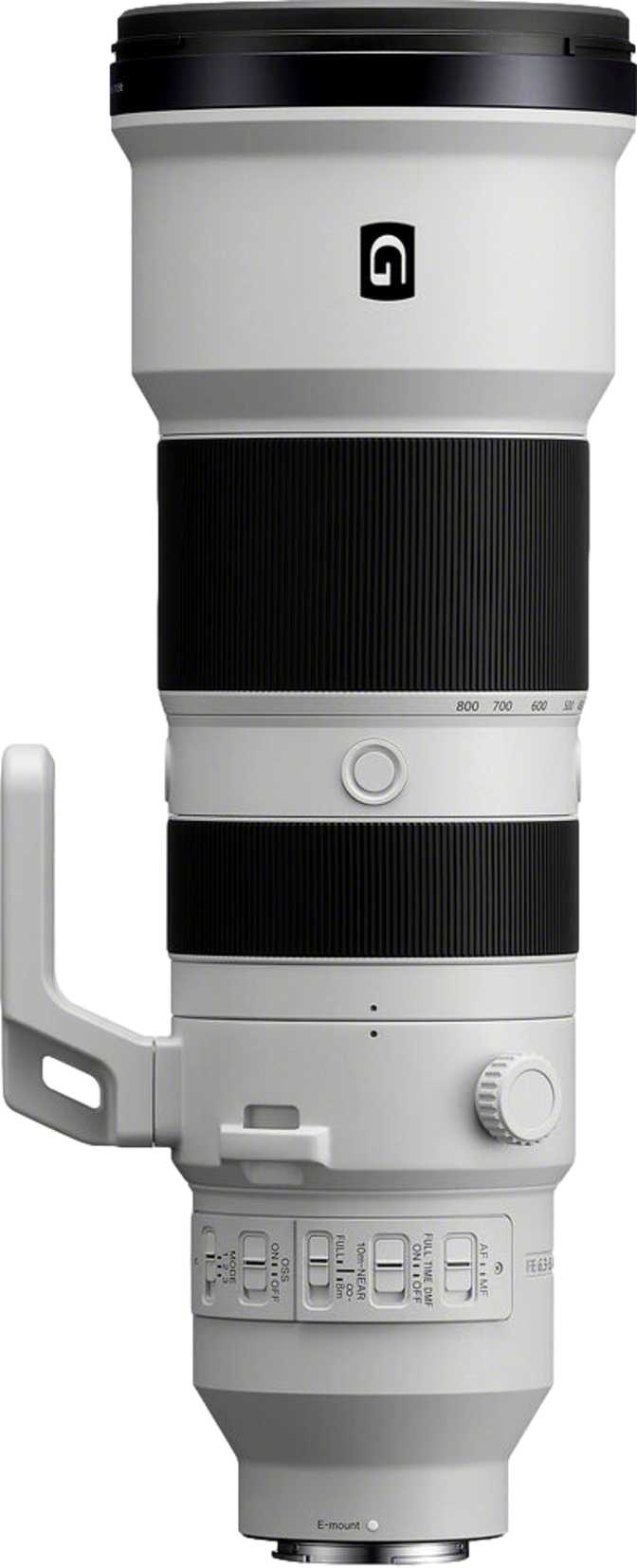
Sony FE 400-800mm f/6.3-8 G OSS: Full Review and Real-World Test
Camera LensesWhat the Sony FE 400-800mm f/6.3-8 G OSS Actually Offers
Super-telephoto zoom lenses have historically forced photographers into an uncomfortable compromise: either carry two heavy primes to cover long focal lengths, or accept the optical penalties that used to come with extreme zoom ratios. The Sony FE 400-800mm f/6.3-8 G OSS is a direct answer to that dilemma. It covers a focal range that few lenses have ever attempted in a single barrel — starting where most telephoto primes end and pushing well beyond what most wildlife and sports photographers ever needed from a zoom.
Whether you are shooting a distant raptor over a marsh or tracking a sprinter down a stadium straight, this lens is built to follow. The question is whether it belongs in your kit — and this review answers that directly.
-
Focal Range400–800mm | 2× optical zoom
-
Max Aperturef/6.3 at 400mm — f/8 at 800mm
-
Weight2,470 g (~2.5 kg)
-
Weather SealingProfessional dust & moisture resistance
-
Min. Focus Distance3.5 m | 0.23× magnification
-
Lens MountSony E — full-frame compatible
-
Filter Thread105 mm non-rotating front element
-
Aperture Blades11 rounded blades for smooth bokeh
Build Quality and Physical Design
Construction and Weather Resistance
This is a professional-grade optic in every material sense. The mount is machined metal — not plastic — which matters more than it sounds. Under the stress of a heavy body mounted on a monopod, or the repeated attach-and-detach cycles of a working photographer, a metal mount maintains precise tolerances and survives far longer than composite alternatives.
The barrel is weather-sealed against moisture and dust ingress, meaning you can shoot in light rain, humid tropical environments, or dusty open plains without babying the lens. This is not an entry-level splash rating — it is the kind of protection expected of G-series Sony glass used professionally in the field.
- Machined metal lens mount for long-term durability
- Professional weather sealing throughout the barrel
- Built to G-series Sony standards for professional field use
Size, Weight, and Handling
At just under two and a half kilograms, this is a lens you need to plan around. That weight is the honest reality of physics: getting 800mm of optical reach in a single portable unit requires a significant amount of glass and engineering. For comparison, most standalone 500mm prime lenses designed for sports and wildlife photography weigh similarly or more — and they give you half the reach.
Carrying this lens for a full day of safari shooting or a long sporting event will be demanding without a monopod or tripod. Photographers who regularly work with super-telephoto glass will be accustomed to this; anyone new to the category should factor grip fatigue into their workflow planning.
The 105mm filter thread is large but non-rotating — the front element stays fixed as you focus or zoom, which is essential when using circular polarizers or graduated neutral density filters. Set your filter orientation once and it stays put throughout shooting.
Reversible Lens Hood Included
A lens hood ships in the box and reverses for storage. On a lens this large, a non-reversible hood would add significant bulk when packed in a bag. The reversible design keeps your kit manageable without sacrificing flare protection in the field — a practical detail experienced telephoto users will appreciate immediately.
Focal Range and Optical Performance
Understanding the 400-800mm Reach
To appreciate what 400mm to 800mm means in practice, consider that a full-frame 50mm lens sees roughly what the human eye sees. At 400mm, you are compressing distance so aggressively that a bird perched 30 meters away fills the frame. At 800mm, you are reaching subjects at distances where other photographers with shorter lenses simply cannot get a usable shot.
This range covers the gap between "impressively telephoto" and "genuinely extreme" — and doing it within a single 2× zoom ratio means you are not sacrificing optical quality to reach the far end. The angle of view narrows from just over 6 degrees at 400mm to just over 3 degrees at 800mm. That 3-degree angle of view is razor-thin: you are looking at a very small slice of the world when fully zoomed, which demands precise subject tracking and a stable shooting platform.
Aperture Behavior Across the Zoom Range
The aperture opens to f/6.3 at 400mm and narrows to f/8 at 800mm. Variable maximum apertures are standard on super-telephoto zooms; this one's range is narrow and entirely expected given the focal lengths involved. Both values are usable in good light, and when paired with Sony's modern high-ISO capable bodies, they open up shooting possibilities that would have been impractical with equivalent glass even a few years ago.
The 11 rounded aperture blades deserve real attention. Bokeh — the aesthetic quality of out-of-focus areas — is directly affected by blade count and shape. Eleven rounded blades produce smooth, near-circular out-of-focus highlights even at intermediate aperture values, which means background separation behind a wildlife subject or athlete will look organic and pleasing rather than harsh or geometric.
Optical Image Stabilization
The built-in OSS (Optical SteadyShot) system is not a nice-to-have at these focal lengths — it is essential. At 800mm, even the slightest vibration — a heartbeat, a breath, footsteps — can cause significant blur in a handheld or monopod-mounted shot. The stabilization system works by physically shifting optical elements to counteract detected movement, letting you shoot at shutter speeds several stops slower than would otherwise be viable.
On Sony's Alpha system, this in-lens OSS communicates with the in-body image stabilization (IBIS) present in many Sony mirrorless cameras, allowing both systems to work in coordination. The combined stabilization effect is meaningfully stronger than either system working alone — a tangible advantage for handheld shooting in lower light or when following slower-moving subjects.
-
Critical at 800mmCompensates for vibration sources including breathing and footsteps that would otherwise cause blur at extreme focal lengths.
-
Dual-System IBIS IntegrationCommunicates with in-body stabilization on compatible Sony mirrorless cameras for a combined effect stronger than either system independently.
-
Multi-Stop Correction Enables shutter speeds several stops slower than would otherwise be viable, meaningfully expanding usable shooting conditions.
Autofocus System
Silent and Precise Operation
The lens uses a built-in focus motor that operates silently. At 800mm while photographing wildlife, any mechanical noise from the lens could disturb skittish subjects. For videographers using this lens for nature documentaries or sports coverage, lens noise bleeding into on-camera audio is a non-issue.
The autofocus system supports full-time manual focus override — you can reach in and adjust focus manually at any point during autofocus operation without switching modes or risking damage to the motor. This is the standard professional workflow: let autofocus do the heavy lifting, then fine-tune by hand when needed.
- Completely silent — safe for wildlife and video work
- Full-time manual focus override without mode switching
- Focuses to infinity with no restriction at maximum reach
Minimum Focus Distance in Practice
The closest this lens will focus is 3.5 meters. At 800mm and that distance, the magnification reaches 0.23× — meaning a small bird or an insect fills a meaningful portion of the frame even without a macro lens. For wildlife photographers, this is genuinely useful close-focusing capability for a lens in this focal range.
It is not a macro lens, but it will render nearby subjects with enough detail for compelling frame-filling shots that shorter telephoto lenses would require physically closer positioning to achieve.
At 0.23× from 3.5 meters, a subject roughly 15 cm in its longest dimension fills the short side of a full-frame sensor — delivering genuine frame-filling detail from a safe, non-intrusive distance that matters in conservation-sensitive environments.
Who This Lens Is For
Ideal Users
Wildlife and Nature Photographers
This is the primary audience. The combination of 400-800mm reach, weatherproofing, stabilization, and silent autofocus describes a lens engineered around wildlife photography. Animals in open landscapes, birds in flight, marine life from a boat — the range covers nearly every scenario a wildlife photographer encounters in a typical day.
Sports and Action Photographers
Track and field, motorsports, football, cricket, and any sport where subjects are distant and unpredictable benefit from this focal range. The 2× zoom ratio lets you reframe without moving, which is often impossible at a sporting event.
Documentary Videographers and Astrophotographers
The silent focus motor, image stabilization, and extreme reach serve documentary and astrophotography work effectively. Fully silent operation is specifically valuable in video production where lens noise cannot be removed in post.
Who Should Look Elsewhere
Studio and Portrait Photographers
There is no use case in portrait or studio work for a lens in this focal range. The minimum focus distance alone rules out most indoor photography entirely.
Casual Walkaround Shooters
The weight and size are purpose-built for dedicated telephoto work. Carrying this as a general-purpose second lens is impractical for most everyday shooting situations.
Photographers Who Rarely Exceed 400mm
If your actual shooting rarely exceeds 300-400mm, this lens is over-specified and over-weighted for your needs. A shorter telephoto zoom would serve better at lower cost and effort.
Competitive Positioning
The most logical alternatives fall into two categories: a shorter super-telephoto zoom supplemented by teleconverters, or a dedicated super-telephoto prime. Here is how those options compare on the factors that matter most to a purchasing decision.
| Consideration | Sony FE 400-800mm f/6.3-8 G OSS | Typical 100-400mm Zoom | 500mm / 600mm Prime |
|---|---|---|---|
| Maximum Reach | 800mm | 400mm | 500–600mm |
| Zoom Flexibility | 2× (400–800mm) | 4× range | None — fixed focal length |
| Weight Class | ~2.5 kg | ~1.3–1.7 kg | ~1.5–3.5 kg varies |
| Aperture at Max Reach | f/8 | f/5.6–6.3 typically | f/4, f/5.6, or f/6.3 |
| Weatherproofing | Yes | Yes (most models) | Yes (most models) |
| Coverage Versatility | Extreme telephoto only | Mid to long telephoto | Single focal length only |
The most natural alternative is a high-quality 100-400mm zoom paired with a teleconverter. That combination can reach 800mm through a 2× converter, but with meaningful autofocus performance degradation and the friction of attaching and detaching glass in the field. The FE 400-800mm delivers 800mm reach natively, continuously, without any attachment swap or autofocus compromise.
Honest Assessment
What It Does Well
Where It Falls Short
Frequently Asked Questions
Final Verdict
The Sony FE 400-800mm f/6.3-8 G OSS is a highly specialized tool built for a specific and demanding category of photography. It delivers genuinely extreme reach in a single zoom barrel, wrapped in professional weather sealing, with a stabilization and autofocus package that matches modern Sony Alpha bodies at their best.
This is the right lens for wildlife photographers who want to simplify a two-lens super-telephoto kit into one, for sports photographers who need consistent extreme reach with zoom flexibility, and for anyone whose work regularly demands subjects at distances where other lenses simply cannot deliver. It is the wrong lens for photographers who occasionally venture into telephoto territory, for those working primarily in low ambient light, or for anyone not prepared to plan their shooting around the physical demands of nearly 2.5 kilograms of glass.
If extreme telephoto zoom reach on the Sony E-mount is your primary need, no meaningful alternative currently combines 800mm, native stabilization, and continuous zoom flexibility in a single package at this level of build quality. For its intended audience, this lens is the answer to a question that previously had no clean solution.