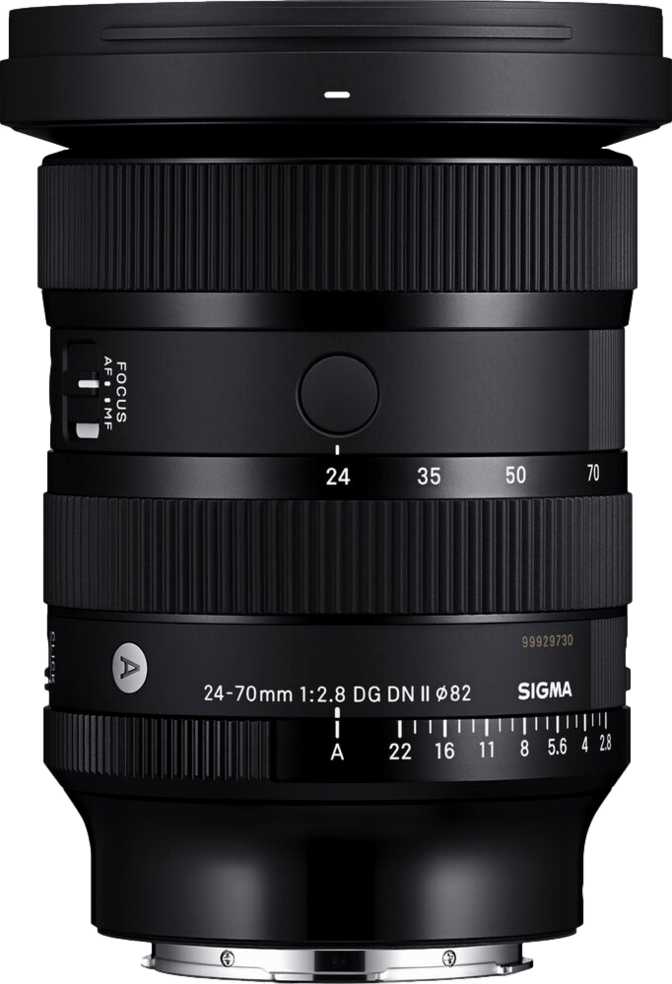
Sigma 24-70mm f/2.8 DG DN II Art: An Honest Full Review
Camera LensesThere is a lens category that every serious photographer eventually returns to, regardless of how many primes fill the bag. The 24-70mm f/2.8 zoom is the workhorse of professional photography — present at weddings, editorial shoots, corporate events, and travel assignments — because it covers the most useful slice of focal lengths with an aperture wide enough to matter in real light. Sigma's second-generation 24-70mm f/2.8 DG DN II Art arrives with meaningful refinements over an already well-regarded predecessor. The question worth answering: is this the standard zoom that L-mount shooters should be reaching for?
Editor's Verdict
4.5 / 5
Highly RecommendedThe definitive standard zoom for serious L-mount photographers.
Performance Ratings
Design and Build Quality
Pick up the Sigma 24-70mm f/2.8 DG DN II Art and the first impression is substance. At 745 grams, it is not a light lens — but it was never meant to be. Lenses built to this optical standard carry weight because glass, mechanical precision, and metal construction have mass. This is not a compromise lens dressed up with marketing; the heft is earned.
The mount is fully machined metal. Over thousands of lens swaps on a busy shooting day, a metal mount maintains its tolerance and fit in a way that composite materials cannot consistently match. For photographers who work in studios with shared kits, shoot demanding event schedules, or simply use their equipment hard, this durability detail has real long-term value.
Weather sealing runs throughout the barrel. While not rated for full waterproofing, the protection handles unpredictable field conditions — a downpour at an outdoor ceremony, humid coastal air, or dusty location work. Paired with a weather-sealed camera body, this lens can operate where unprotected optics cannot.
The 82mm front element is standard for a professional fast zoom. Filter users will need 82mm polarizers or ND filters — widely available in this size and worth standardizing a collection around. A lens hood ships in the box, a practical inclusion that reduces flare and protects the front element during field use.
Build Highlights
Metal Lens Mount
Precision-machined for durability under heavy use
Full Weather Sealing
Rain, dust, and humidity resistant construction
745g Considered Weight
Heavy for good reason — professional glass
Lens Hood Included
Flare protection and front-element impact shield
Optics and Aperture: Where the Art Label is Earned
Constant f/2.8 Across the Full Range
The most technically significant feature of this lens requires explanation for newer photographers: the aperture stays at f/2.8 whether you are shooting at 24mm or 70mm. Many zoom lenses — including some that cost nearly as much — have variable maximum apertures, meaning the widest opening narrows as you zoom in. That forces automatic exposure compensation and catches you off guard when light is already marginal.
With a constant f/2.8 throughout the zoom range, exposure remains predictable. A wedding photographer moving from a wide environmental shot to a compressed portrait does not need to compensate for aperture shift. A photojournalist working in low light can zoom freely without the camera silently raising ISO to compensate.
At 70mm and close focusing distances, f/2.8 also delivers meaningful background separation. Subjects can be cleanly isolated in a way that makes this lens genuinely versatile for portraiture — not just a fallback when a dedicated portrait lens is not available.
11 Rounded Aperture Blades
Bokeh quality is determined by more than maximum aperture. Eleven rounded blades produce circular, smooth out-of-focus highlights even at mid-aperture values like f/4 or f/5.6, where lesser lenses begin showing the geometric, polygon-shaped highlights that look mechanical and distracting. For photographers shooting at stopped-down apertures who still want aesthetically clean backgrounds, this specification matters directly.
Field of View
The wide end at 24mm captures an 84.1-degree field — broad enough for architecture interiors, environmental portraits, and group shots. The 70mm end compresses to 34.3 degrees, well into portrait territory. Together they represent the most-used range in professional event and assignment photography. Ultra-wide architectural work below 24mm or true telephoto reach for sport and wildlife remain outside this lens's scope.
Exceptional Close-Focus Capability
The minimum focus distance of 17 centimeters is genuinely impressive for a lens of this focal range and aperture. Getting a subject within 17cm at 70mm, combined with a 0.37x magnification ratio, opens up near-macro possibilities that a standard professional zoom normally does not offer.
To put 0.37x in context: a subject 10 centimeters wide will fill roughly one-third of the frame. That is not true macro reproduction, but it is close enough for most close-up detail work — product photography, food detail shots, editorial close-ups — without carrying a dedicated macro lens. This is where the DG DN II Art clearly differentiates itself from most competitors in its category.
Focusing System: Fast, Silent, and Controllable
The autofocus motor in this lens was designed from the ground up for mirrorless operation — a distinction the DG DN designation confirms. Many older lenses adapted from DSLR lineages carry over focusing mechanisms engineered for different physical constraints. Native mirrorless design means faster autofocus response, better integration with in-body phase-detection systems, and more reliable subject tracking.
The motor operates in acoustic silence. For video work and quiet environments — ceremonies, conference talks, studio sessions where an on-camera microphone is recording — mechanical focus noise is a genuine problem. Silence here is a practical requirement, not a luxury.
Full-time manual focus override lets photographers turn the focus ring at any point during autofocus operation without switching modes or engaging a physical clutch. Autofocus establishes initial lock; the photographer refines manually. For portraits where millimeter-level precision on eye or lip placement matters, this workflow is fluid and natural. The lens also locks confidently at infinity — relevant for landscape and astrophotography where lesser autofocus systems can hunt past the focus limit.
Focus System at a Glance
- Motor Type
- Native mirrorless, silent operation
- Full-Time Manual Override
- Yes — no mode switching needed
- Minimum Focus Distance
- 17 cm
- Infinity Focus
- Yes — locks confidently
- Magnification
- 0.37x
No Optical Image Stabilization: The Trade-Off to Understand
This lens does not include optical image stabilization in the barrel. Stabilization reduces motion blur caused by camera movement during handheld shooting — more significant in low light and at longer focal lengths.
For most L-mount shooters, this matters less than the spec sheet implies. Cameras using the Leica L mount — across Sigma, Panasonic, and Leica bodies — frequently feature in-body image stabilization (IBIS). When IBIS is present, lens-based stabilization becomes redundant for the majority of scenarios. The lens communicates focal length data to the body, allowing the in-body stabilizer to compensate appropriately.
Where the trade-off becomes real: photographers working on bodies without IBIS, or videographers where the limitations of sensor-shift stabilization are more visible, will need to be deliberate about shutter speed at 70mm. The guideline of maintaining a shutter speed at least equal to the reciprocal of focal length — roughly 1/70th at 70mm — applies, and in dim conditions this may mean raising ISO more than a stabilized lens would demand.
This is an intentional design decision that reduces size, weight, and mechanical complexity while relying on increasingly capable in-body stabilization systems in modern mirrorless cameras. It is a reasonable trade-off for the target user.
Who Should Buy This Lens
Event and Wedding Photographers
The 24-70mm range covers nearly everything: venue-wide shots, candid moments, and close portraits without a lens change. Constant aperture handles unpredictable indoor lighting; silent focus handles quiet, emotional moments.
Commercial and Editorial Shooters
Product backgrounds, environmental portraiture, interior detail — the close-focus capability alongside the full focal range makes this a genuine single-lens solution for mixed assignments.
L-Mount Videographers
Silent focus motor and predictable exposure across the zoom range are direct workflow advantages. IBIS capabilities on the camera body determine how significant the absent OIS is in practice.
Serious Travel Photographers
Professional-level quality in a single-lens kit works well — the 24-70mm coverage is thoughtful and the build quality is reassuring. Weight is the genuine consideration.
Lightweight Travel Shooters
Photographers prioritizing packability over optical performance will find 745g impractical. Smaller zoom options sacrifice aperture and some image quality in exchange for portability that genuinely matters on long trips.
Wildlife and Sports Photographers
70mm telephoto reach does not serve fast action at distance. A dedicated telephoto zoom is a different category of tool entirely — this lens does not substitute for it.
Beginners Still Building Technique
Photographers new to L-mount who are still developing fundamental skills may find a more modest kit zoom allows growth before investing at this level. This lens rewards photographers who can already use what it offers.
Competitive Positioning
The 24-70mm f/2.8 category is competitive across all major mirrorless systems. For L-mount shooters, the primary comparison points are the first-generation version of this same lens, the Panasonic Lumix S Pro 24-70mm f/2.8, and the Leica Vario-Elmarit-SL 24-90mm.
| Feature | Sigma DG DN II Art | Category Standard |
|---|---|---|
| Aperture Consistency | Constant f/2.8 | Matches professional standard |
| Minimum Focus Distance | 17 cm | Best in class for this category |
| Magnification Ratio | 0.37x | Significantly above average |
| Aperture Blades | 11 Rounded | Competitive at this price tier |
| Optical Stabilization | None (IBIS reliant) | Intentional design decision |
| Weather Sealing | Yes | Standard for pro L-mount glass |
| Filter Thread | 82mm | Common professional size |
The close-focus performance is where the DG DN II Art differentiates most clearly. Few lenses in this focal range and aperture class approach 17cm minimum focus distance, and the resulting near-macro capability is a genuine competitive advantage.
Honest Assessment
The constant f/2.8 aperture is not a luxury feature — it is a fundamental workflow improvement that reveals its value over a full day of shooting. Photographers who have worked with variable-aperture zooms and then switched describe the experience as removing a variable they had been unconsciously managing. The mental overhead of tracking aperture shift as you zoom simply disappears.
The close-focus capability at 17cm is a genuine differentiator that earns its mention beyond the specification sheet. For photographers who regularly want tighter detail shots without switching lenses, this changes what the lens is capable of as a single-lens solution — a meaningful difference in how assignments are approached.
The autofocus system is native to mirrorless and communicates efficiently with L-mount bodies. Combined with full-time manual override, the focusing experience is one of the most fluid available in this focal category.
At 745 grams, this lens communicates its presence physically over a long day of handheld shooting. Photographers with smaller hands or those prone to wrist and shoulder fatigue from heavy rigs should factor this honestly. The weight is not prohibitive for its class, but it is not a compromise either — this is a lens that asks something of the person carrying it.
The absence of optical image stabilization generates the most questions, and its significance depends entirely on the camera body being used. Paired with effective in-body stabilization, it becomes largely irrelevant. Without that pairing, it becomes a deliberate constraint in low-light conditions, particularly for video.
82mm filters are widely available but are among the more expensive filter sizes. If building a collection from scratch around this lens, budget for quality glass in that diameter.
Questions Real Buyers Ask Before Purchasing
Final Verdict
The Standard Zoom to Buy for L-Mount
The Sigma 24-70mm f/2.8 DG DN II Art is the standard zoom to buy for L-mount systems if optical performance and build quality are the primary criteria. Its constant maximum aperture, close-focus capability that genuinely extends its versatility, precision silent autofocus, and professional-grade construction represent a complete package for working photographers.
It is not the lens for every L-mount shooter. Those prioritizing portability, those working without in-body stabilization in low-light video scenarios, or those not yet shooting at a level where these capabilities are regularly tested will find more practical value elsewhere.
For photographers who need a single professional zoom they can trust for event work, commercial assignments, editorial photography, or versatile travel where gear changes are impractical — this lens answers the brief fully. If the 24-70mm focal range covers your primary shooting needs and you are committed to the L-mount ecosystem, there is no reason to look further.
Overall
4.5/5
Build
5.0/5
Optics
5.0/5
Value
4.0/5