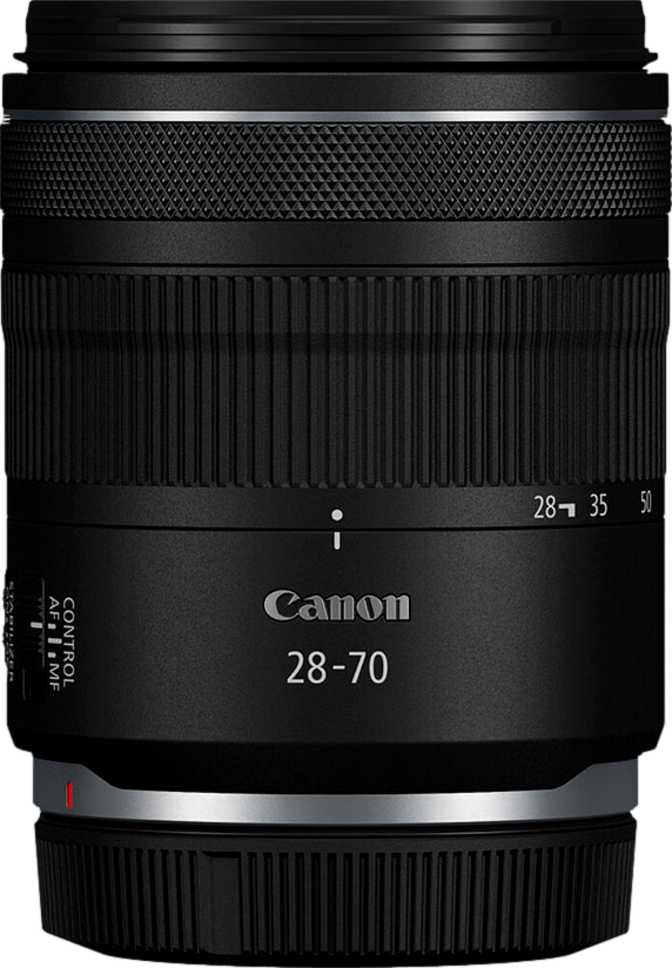
Canon RF 28-70mm f/2.8 IS STM – Full Review for Every Shooter
Camera LensesA fast standard zoom that finally makes sense for most shooters — covering the most-used focal lengths with constant f/2.8 brightness, built-in optical stabilization, and a body that won't strain your back or your budget.
Overall Rating
4.5 / 5
Recommended for travel, events & video
Canon's RF lineup has long offered a 28-70mm range in the form of a monstrous f/2 L-series optic — a masterpiece of optical engineering that also weighs as much as a small dumbbell and costs accordingly. The RF 28-70mm f/2.8 IS STM takes the same useful focal range and rebuilds it around a different philosophy: constant f/2.8 brightness, in-lens image stabilization, a quiet autofocus motor, and a body that won't destroy your back or your budget. The result is a lens that covers the most-used focal lengths in everyday photography — from environmental portraits to street scenes to travel shots — without demanding that you sacrifice either image quality or physical comfort.
The question worth asking is whether this lens genuinely earns its place in the RF ecosystem, especially when Canon already offers a pedigree f/2 option above it and a compact f/4 alternative below. Here is the full picture.
Build Quality and Physical Design
Weight and Handling
At 495 grams, the RF 28-70mm f/2.8 IS STM sits in a genuinely practical weight class for a constant-aperture standard zoom. Lenses with a maximum aperture of f/2.8 across a 2.5x zoom range typically land significantly heavier — some pushing past 700 or 800 grams — because maintaining that light-gathering ability across every focal length requires more glass. Canon has kept this lens lean enough that it balances well on mirrorless RF bodies without front-heaviness becoming a fatigue issue during extended shoots.
The 67mm filter thread is notably compact for a lens of this specification. A smaller filter diameter means standard polarizers and ND filters cost less, and it signals an efficient optical formula rather than simply scaled-up front glass.
Materials and Weather Resistance
The mount is metal — an important detail that gets overlooked on mid-tier lenses. A metal mount holds up to repeated camera-body swaps without the subtle wear that eventually affects alignment on plastic-mount alternatives. Combined with weather sealing throughout the barrel, this lens can handle light rain, dust, and humidity without requiring you to immediately retreat to shelter.
The front element does not rotate during focusing or zooming. If you use a polarizing filter — which must be set at a specific angle to work — you set it once and it stays put regardless of what the lens is doing. Graduated ND filters also remain properly aligned throughout the entire zoom range.
No Lens Hood Included
A lens hood is not a luxury — it blocks stray light from entering the front element at oblique angles, directly reducing flare and improving contrast in challenging lighting. Having to purchase one separately is a minor but real additional expense, and it is the kind of omission that stands out at this level.
Optical Performance
What the specifications actually mean for your photography
Constant Across Every Focal Length
Most zoom lenses start wide and shrink to f/5.6 or f/6.3 as you zoom in, cutting light in half or more. This lens holds f/2.8 from 28mm to 70mm — meaning your exposure settings stay consistent no matter where you are in the zoom range, even in poor light.
Rounded Aperture Blades
Nine curved blades mean background light sources render as soft circular discs when you stop down slightly — not hard polygons. This smooth bokeh quality affects how pleasing portraits and shallow-depth-of-field images look at a fundamental level. Many competing lenses use seven, which produces more visible geometric shapes under certain conditions.
Minimum Focus Distance
The lens can focus as close as 27 centimeters from the subject. At 70mm, this lets you fill a meaningful portion of the frame with relatively small subjects — a product, a flower, a tightly cropped face — without needing a dedicated macro lens for occasional close-up work during travel or documentary shooting.
Autofocus and Image Stabilization
STM: Silent, Smooth, Continuous
The STM (Stepping Motor) drive system was designed with two priorities: near-silence and smooth focus transitions. During video recording, a noisy autofocus motor is catastrophic — the mechanical sound bleeds into the audio track, particularly when using the camera's built-in microphone. STM operation is quiet enough to be a non-issue in virtually all video scenarios.
For still photography, the STM system enables full-time manual focus override. You can touch the focus ring at any moment to fine-tune focus without switching the lens out of autofocus mode — a workflow convenience that saves time and reduces the chance of missing a moment.
The motor can also drive focus reliably out to infinity, which matters for landscape and astrophotography where you need consistent results at maximum focus distance.
Built-In Optical Image Stabilization
Optical image stabilization in a constant f/2.8 zoom is not standard — many comparable lenses omit it entirely. This lens adds its own optical stabilization on top of whatever the camera body provides, giving you two separate tools for low-light shooting.
The combination matters most in three specific situations:
- Telephoto end (70mm) — camera shake is amplified at longer focal lengths; stabilization compensates directly.
- Handheld video — smooth footage requires stabilization at every focal length, not just wide angles.
- Static low-light subjects — you can slow the shutter to keep ISO manageable and let stabilization handle hand movement, while f/2.8 handles moving subjects.
Real-World Shooting Scenarios
Who benefits most from this lens — and who should look elsewhere
Who This Lens Is Built For
Travel & Documentary
The 28-70mm range covers almost everything: scenes and environments at 28mm, natural perspective at 50mm, pulled-in detail at 70mm. Weather sealing handles unpredictable outdoor conditions without requiring a lens change.
Event Photographers
Weddings, conferences, concerts — the constant f/2.8 handles mixed and low-light venues where exposure conditions shift constantly. The silent STM motor means discreet operation during quiet ceremonies or presentations.
Video Creators
Handheld or on a gimbal — optical stabilization, near-silent autofocus, and full-time manual override work in combination. The non-rotating front element keeps follow-focus rigs and matte boxes correctly aligned.
Portrait Photographers
Want one versatile lens rather than a bag of primes? 70mm at f/2.8 handles tight headshots; 28mm covers environmental portraits that show context around the subject — all in a single, weather-sealed barrel.
Who Should Look Elsewhere
Wildlife and Sports Shooters
The 70mm ceiling is a hard constraint. No amount of optical quality changes the fact that 70mm is not 200mm — if your subject requires reach, you need something longer alongside this lens.
Maximum Isolation Seekers
If extreme background blur is paramount and budget is not a concern, Canon's RF 28-70mm f/2 L USM delivers a full stop more light. That difference in subject isolation is real and visible in results.
Ultralight Travel Minimalists
If the smallest possible kit matters above all, a single compact prime — a 35mm or 50mm at f/1.8 — wins purely on size and weight, though you sacrifice the versatility of a zoom range entirely.
Competitive Positioning
How the RF 28-70mm f/2.8 IS STM sits among its logical alternatives
| Feature | RF 28-70mm f/2.8 IS STM This Lens |
Typical RF f/4 Standard Zoom | RF 28-70mm f/2 L USM |
|---|---|---|---|
| Constant Aperture | f/2.8 | f/4 | f/2 |
| Optical Stabilization | Varies by model | ||
| Weather Sealing | Varies | ||
| Approximate Weight | 495g | Lighter | Significantly Heavier |
| Filter Diameter | 67mm | Typically smaller | 95mm |
| Target User | Versatile all-rounder | Lightweight / casual | Professional / specialist |
The addition of image stabilization — absent from the f/2 L-series flagship — is what separates this lens most clearly for shooters who prioritize handheld stability and video versatility over that extra stop of maximum aperture.
Strengths and Honest Limitations
Where It Excels
-
Aperture Versus Portability — Resolved
Constant f/2.8 zoom lenses have traditionally been heavy, expensive, or both. At 495 grams with a 67mm thread and weather sealing, this lens genuinely challenges that expectation without feeling compromised.
-
Optical Stabilization That Actually Earns Its Place
Combined with the f/2.8 aperture, the built-in optical stabilization gives photographers real flexibility in challenging light that most competing options at this focal range simply do not offer.
-
STM Motor: Silent and Overrideable
Full-time manual focus override is a workflow improvement that photographers who move between stills and video will appreciate immediately — no mode switches, no missed moments.
-
Nine Rounded Blades for Genuine Bokeh Quality
The aperture implementation is generous by category standards, producing the smooth, circular background rendering that makes portrait and detail shots look polished.
Limitations to Know
-
No Lens Hood in the Box
This is a real omission at this level, not a nitpick. A lens hood directly improves contrast and reduces flare in backlit conditions — it should not be an optional purchase at this price point.
-
70mm Is a Hard Ceiling
Wildlife, sports, and compressed-perspective architectural shots require more reach than 70mm can provide. This lens covers normal vision well; telephoto it is not.
-
f/2.8 Stops Short of Maximum Isolation
Photographers who specifically need the shallowest possible depth of field will find the f/2 L-series alternative produces a visibly different — and more dramatic — separation between subject and background.
-
Not the Smallest Kit Option
For ultralight minimalists, a single compact prime wins on size. The zoom range versatility is real, but those who travel with one lens and a small body may prefer to go lighter.
Questions Real Buyers Ask
Straight answers to the things people search for before purchasing
Final Verdict
Should You Buy the Canon RF 28-70mm f/2.8 IS STM?
The Canon RF 28-70mm f/2.8 IS STM resolves a genuine tension that has existed in standard zoom design for years: constant f/2.8 brightness versus practical portability. At under 500 grams with a compact 67mm filter thread, weather sealing, a metal mount, optical stabilization, and a near-silent autofocus system, this lens challenges the assumption that fast standard zooms have to be heavy or expensive to own.
The missing lens hood is a real, if small, complaint. The 70mm ceiling will push some photographers toward a telephoto addition. For those who specifically need f/2 maximum aperture, the L-series alternative remains the correct answer.
For photographers who want one lens that handles travel, events, portraits, and video without constant bag-diving — and who want that lens to perform confidently in poor light — this is an easy recommendation. It is practical without being dull, and capable without being extravagant.
Our Score
4.5/5