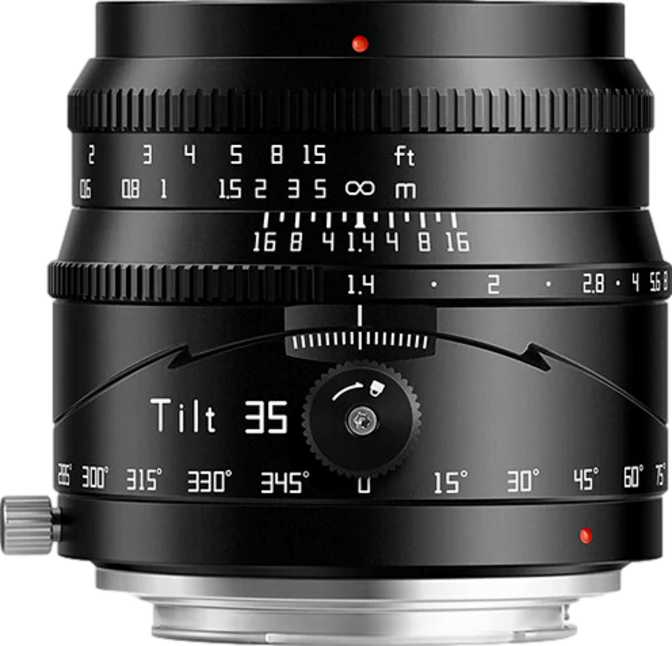
TTArtisan Tilt 35mm f/1.4 Review: A Creative Prime for Fujifilm X Shooters
Camera LensesA specialty creative prime that combines a genuine tilt mechanism with a fast f/1.4 aperture, silent autofocus, and weather sealing — built for deliberate photographers who want images that look like nothing else from their X-mount kit.
Most lenses give you one plane of focus. You point, you lock, you shoot. The TTArtisan Tilt 35mm f/1.4 for Fujifilm X refuses that arrangement. It introduces a mechanical tilt mechanism that physically shifts the optical axis relative to the camera sensor — a capability once reserved for large-format cameras and expensive professional tilt-shift glass. Paired with a genuinely fast maximum aperture and a focal length that behaves like a classic standard lens on APS-C bodies, this is one of the most creatively loaded manual-era tools available for the X mount. It demands time, patience, and intentionality. In return, it produces images that look like nothing else in your portfolio.
Design and Build Quality
Construction That Earns Respect
Pick this lens up and the first thing you notice is that it does not feel like a budget accessory. The barrel is machined metal throughout, with a metal mount at the rear that locks onto the Fujifilm X bayonet with zero play or wobble. At 345 grams, it carries a noticeable heft — not heavy enough to unbalance a compact X-series body, but substantial enough to telegraph quality. This is a lens that feels like a tool, not a toy.
The weather sealing adds meaningful real-world value. Light rain, coastal mist, dusty environments — the kind of conditions where creative photography often happens — are no longer a reason to pack up and leave. That said, weather resistance here is splash protection, not submersion tolerance, and pairing with a weather-sealed Fujifilm body is strongly recommended for full benefit.
The Tilt Mechanism
The defining physical feature is the tilt assembly itself. The lens barrel includes a mechanism that allows it to pivot off-axis relative to the sensor plane. The tilt range enables meaningful control over the Scheimpflug plane of focus — in practical terms, you can tilt the lens forward to bring a diagonal surface into sharp focus at wide apertures, or tilt it away from a subject to isolate a narrow sliver of sharpness across an otherwise blurred scene.
The mechanism is entirely manual — there are no electronic actuators or automated tilt assists. Users will feel a mechanical resistance as they adjust tilt angle, which is intentional: it prevents drift and ensures your chosen angle stays locked during shooting.
Filter and Accessory Compatibility
The front element does not rotate during focusing — an underappreciated convenience for anyone using polarizing filters or graduated NDs. You set the filter angle once and it stays put regardless of where you rack the focus ring. The 52mm filter thread is a common size, meaning compatible filters are affordable and widely available. A lens hood is included in the box, though users shooting near tilt extremes may need to be mindful of vignetting at the hood edges.
Focal Length and Field of View on APS-C
Understanding the 35mm on Fujifilm Equation
On any Fujifilm X camera, the APS-C sensor applies a 1.5× crop factor to the focal length. A 35mm lens on this format delivers a field of view roughly equivalent to a 52mm lens on a full-frame camera — placing it squarely in "standard lens" territory. This is the angle of view closest to natural human vision, wide enough for environmental context and tight enough for subject isolation.
What this means practically: the TTArtisan Tilt 35mm f/1.4 is not a dramatic wide-angle with heavy perspective distortion, nor is it a telephoto compressor. It sees the world in a way that feels familiar and honest, which makes tilt-induced distortions feel artistic rather than accidental.
This lens sits comfortably between a wide street lens and a traditional portrait focal length — making it versatile for editorial work, architectural fragments, still life, and environmental portraiture. All disciplines that benefit from deliberate focus plane control.
Aperture and Optical Character
What f/1.4 Actually Buys You
The maximum aperture of f/1.4 is genuinely fast. In practice, it performs two distinct jobs that many photographers conflate but should treat separately.
Low-Light Performance
At f/1.4, this lens gathers light at a rate that allows hand-held shooting in conditions where slower lenses would demand a tripod or high ISO compensation. Candlelit interiors, early dusk, overcast winter afternoons — these become workable without pushing your sensor into noisy territory.
Depth of Field Control
On APS-C, f/1.4 produces meaningful background separation. With the tilt mechanism engaged, this already-shallow focus plane can be tilted into orientations impossible with any conventional prime — a diagonal plane of sharpness cutting across a tabletop, or a narrow horizontal band hovering at one height while everything above and below dissolves.
Bokeh at Ten Blades
The aperture iris uses ten rounded blades. This matters most in the middle apertures where fully circular openings are hardest to maintain. Specular highlights — small bright points like light reflections or background light sources — render as near-perfect circles across a wide aperture range rather than the angular polygons produced by fewer, straight blades.
For photographers using this lens for portraiture, product photography, or any work where background quality contributes to the image, this construction choice pays visible dividends. At the narrow end, the aperture closes down to f/16, giving full control from the optically minimal to the nearly-maximum.
Ten rounded blades from f/1.4 to f/16 — the full aperture range offers smooth, circular bokeh rendering typically found in lenses at considerably higher price points.
Autofocus and Focus Handling
The Motor That Makes It Accessible
This lens carries a built-in autofocus motor, which distinguishes it from many tilt lenses and manual-focus-only TTArtisan releases. The motor operates silently — a meaningful detail for video shooters and anyone photographing in quiet environments where a loud focus drive would draw attention or pick up on a microphone.
When tilt is applied, the intended focus plane shifts in ways autofocus systems are not designed to anticipate. In practice, autofocus is most reliable when tilt is at or near zero. Once tilt is engaged meaningfully, manual focus becomes the appropriate and intended mode of operation.
Full-time manual focus override means you can intervene at any point without switching modes — turn the focus ring and it responds immediately. For a lens designed around deliberate, considered composition, this is the correct approach.
Minimum Focus Distance
The lens can focus as close as 35 centimeters from the camera's sensor plane. For a 35mm equivalent standard lens, this allows meaningful close-up work: filling the frame with a small object, capturing fine texture, or working with small still-life subjects. It is not a macro lens and cannot replace dedicated close-up glass for extreme detail work, but it expands the lens's usefulness well beyond mid-to-far distance shooting. Infinity focus is fully supported, covering every practical distance from close-up through landscapes.
Who This Lens Is For
The TTArtisan Tilt 35mm f/1.4 rewards specific shooting styles. Understanding whether you fit that profile before purchasing is important, because this lens asks more of the photographer than a standard prime.
Strong Match For
- Fine art and creative photographers who want controlled, intentional blur planes no post-processing can replicate
- Product and still life photographers needing depth of field control across non-parallel surfaces
- Architecture and interior photographers interested in selective focus and layered visual effects
- Experienced X-mount shooters looking to expand beyond what conventional primes offer
- Video creators working on stylized, cinematic content with a unique visual language
Not a Strong Match For
- Sports and wildlife photographers — tilt mechanics and manual-first operation kill the response speed fast-moving subjects require
- Beginners buying their first or second lens — the tilt mechanism adds a learning curve that frustrates before it rewards
- Photographers who need optical stabilization — no built-in OIS, and in-body stabilization does not fully compensate
- Anyone expecting plug-and-play results — the most compelling images require understanding and intentional composition
Competitive Context
There are very few tilt lenses available natively for the Fujifilm X mount, which immediately narrows the comparison field. The table below outlines where the TTArtisan Tilt 35mm f/1.4 sits relative to logical alternatives.
| Lens | Tilt | Max Aperture | AF Motor | Weather Sealed | Category |
|---|---|---|---|---|---|
| TTArtisan Tilt 35mm f/1.4 (X) | Yes | f/1.4 | Silent, built-in | Yes | Specialty creative prime |
| Conventional 35mm f/1.4 primes (X) | No | f/1.4 | Yes (varies) | Varies | Standard fast prime |
| Full-frame tilt-shift via adapter (X) | Yes | Varies | No (most) | Varies | Adapted specialty glass |
| Lensbaby-style creative lenses (X) | Selective only | Varies | No | No | Toy / artistic |
The key differentiators in TTArtisan's favor are the combination of a proper fast aperture, a silent autofocus motor for zero-tilt work, weather sealing, and native X-mount communication — all at a price point that undercuts adapted professional tilt-shift glass significantly. Conventional 35mm f/1.4 primes for Fujifilm X deliver more reliable autofocus across all conditions. If the tilt function holds no interest, a conventional prime is the more practical choice.
Strengths and Honest Limitations
What Works Well
The tilt mechanism is the lens's most obvious strength, but it would be incomplete to evaluate the lens purely on that capability. The f/1.4 aperture gives this lens legitimate utility in low-light environments where tilt is never used. The ten rounded aperture blades produce background rendering that competes with lenses sold at considerably higher prices. The weather sealing is a real operational advantage for any photographer who works outdoors. And the non-rotating front element makes polarizing filter use genuinely practical. The silent autofocus motor broadens the lens's appeal beyond purely manual shooters, and the 35cm minimum focus distance expands compositional range enough to cover small objects and tight product shots.
Where It Falls Short
No optical image stabilization is a real gap for handheld video and low-light static work on bodies without in-body stabilization. Users shooting on older, non-stabilized Fujifilm bodies will feel this absence more acutely.
Autofocus and tilt are uneasy companions. Once meaningful tilt is dialed in, manual focus takes over as the practical operating mode, which eliminates much of the AF motor's value in the lens's most distinctive use case. The AF remains useful for conventional shooting with tilt zeroed out, but buyers who prioritize fast, accurate autofocus above all else will find this lens's AF performance less relevant than the spec suggests.
The 345-gram weight places this lens toward the heavier end for APS-C primes. Paired with a small Fujifilm body, the balance point shifts slightly toward the lens — acceptable for tripod work and deliberate handheld shooting, but noticeable on extended carrying days.
Common Questions Answered
The TTArtisan Tilt APS-C 35mm f/1.4 is a legitimate creative instrument dressed in practical hardware. The tilt mechanism transforms what would be a competent fast prime into something genuinely distinctive — a lens that expands what APS-C photography is capable of without requiring a move to a larger, more expensive system.
It earns its place in a kit through specificity, not versatility. This is not a do-everything lens, and it does not pretend to be. The photographer who buys it knowing what tilt photography demands — careful composition, manual focus discipline, an eye for planes and geometry — will find it richly rewarding. The photographer who buys it hoping the feature will add magic automatically will be frustrated before they find their footing.
The weather sealing, silent autofocus for tilt-off use, and strong optical construction mean this lens does not ask you to compromise on build quality in exchange for its specialty capability. The 10-blade rounded iris and fast aperture mean the optical character holds up in demanding conditions.
Buy this lens if tilt photography is already on your creative roadmap and you shoot Fujifilm X. Buy it if you want a dual-purpose prime that works conventionally most of the time and enables specialized work when you choose. Do not buy it as your primary fast prime if tilt holds no interest — a conventional 35mm f/1.4 will serve those needs more efficiently. For the right buyer, this is one of the most interesting and capable specialty primes available for the Fujifilm X system at any price.