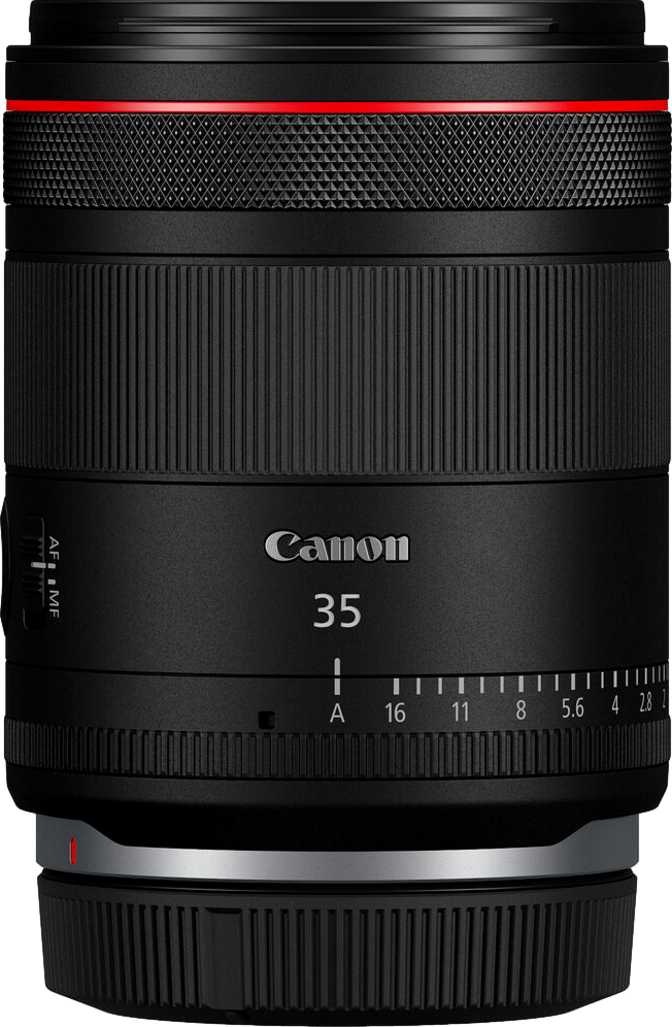
Canon RF 35mm f/1.4 L VCM Review: A Professional Prime Built to Last
Camera LensesAt a Glance
A full-stop faster than the typical 35mm prime, built with cinema-grade autofocus and L-series durability — this lens is Canon's most complete answer to demanding 35mm shooters on the RF system.
Best for: Hybrid & professional shooters
Skip if: Weight or budget is a constraint
Filter Thread: 67mm
The 35mm focal length occupies a peculiar and beloved place in photography. Wide enough to capture environmental context, tight enough to isolate a subject, natural enough to feel like an extension of human vision — it is the focal length that documentary photographers, street shooters, wedding photojournalists, and narrative filmmakers keep returning to. The Canon RF 35mm f/1.4 L VCM is Canon's most serious commitment yet to this focal length on the RF system.
This is not a budget walkaround lens or a casual upgrade. It is a capital-L L-series optic built around a Voice Coil Motor (VCM) — the same high-speed, near-silent autofocus architecture found in Canon's top-tier cine-capable lenses — and it carries every expectation that classification implies.
If you're evaluating this lens, you're likely choosing between spending seriously on a focal length you use constantly, or settling for something that almost gets there. This review is written to help you decide which side of that line the RF 35mm f/1.4 L VCM falls on — and whether it belongs in your bag specifically.
Build Quality and Physical Design
An L-Series Body That Means Business
Canon's L-series designation is not marketing shorthand. It signals a specific standard of physical construction, and the RF 35mm f/1.4 L VCM meets that standard without compromise. The lens features a metal mount — not a polymer or composite hybrid, but full metal — which directly impacts long-term durability and the quality of the mechanical connection between lens and camera body.
The barrel is weather-sealed throughout. For photographers who work outdoors, on location, or in unpredictable environments, this is not a luxury feature. Rain at a wedding, humidity at a beach shoot, dust at a festival: the sealing means you keep shooting while others pack their gear away.
Weather Sealed
Full L-series sealing at mount, rings, and barrel joints for demanding outdoor use
Non-Rotating Front Element
Keeps polarizing and graduated ND filters exactly where you set them
Reversible Lens Hood
Stores in reverse on the barrel when not in use — built for photographers always packing and unpacking
Filter Thread and Front Element
The front element does not rotate during focusing — a significant practical advantage for photographers who use circular polarizing filters or graduated neutral density filters. The 67mm filter thread is common enough that filter sets are widely available and reasonably priced, without stepping into the larger, more expensive diameters some competing lenses require.
Weight and Size in Real-World Use
At 555 grams, this lens is substantial. Paired with a full-frame RF-mount body, you are holding a combination with meaningful mass over an extended shoot. Photographers accustomed to heavier telephoto or zoom lenses will find this weight unremarkable. Those used to compact primes may notice the difference in a shoulder or wrist by the end of a long day.
Optical Performance and What the Specifications Actually Mean
The f/1.4 Aperture: More Than a Number
The maximum aperture of f/1.4 is the defining optical characteristic of this lens, and its implications extend well beyond the spec sheet. At f/1.4, this lens collects significantly more light than a standard kit lens at its widest setting — roughly eight times more, in practical terms. That translates directly into two key capabilities:
-
Low-light shooting without raising ISO: In dimly lit venues, evening environments, or mixed artificial light, f/1.4 lets you maintain shutter speeds that freeze motion while keeping digital noise at levels that preserve image quality.
-
Subject separation through shallow depth of field: At 35mm and f/1.4, the transition between sharp and unsharp areas is smooth and gradual — objects close to the subject blur into soft forms rather than harsh distractions.
Eleven-Blade Rounded Aperture: Why It Matters for Bokeh
The aperture mechanism uses eleven individual blades shaped to maintain a near-perfect circle even as the aperture closes down. Most lenses with fewer, straighter blades produce out-of-focus highlights that take on polygonal shapes — hexagons or heptagons — which can appear mechanical and distracting. Eleven rounded blades produce circular highlights and smooth, organic transitions in out-of-focus areas. For portrait, documentary, and narrative work where background rendering is aesthetically important, this is the correct engineering choice.
Angle of View Across Sensor Formats
| Sensor Format | Effective Angle of View | Equivalent Character |
|---|---|---|
| Full Frame | 63 degrees | Classic wide environmental coverage — the intended character |
| APS-C (RF) | ~38 degrees | Closer to a short portrait focal length (~56mm equivalent) |
Close Focus Capability
The minimum focus distance of just under 30 centimeters from the sensor plane is close enough to fill the frame with objects the size of a large smartphone. The resulting magnification is not macro territory, but it is meaningfully closer than many wide-aperture 35mm lenses allow. For detail shots, product photography with environmental context, or close environmental portraits, this provides flexibility a lens with a more conservative close-focus limit would not.
The VCM Autofocus System: Performance for Stills and Video
What Voice Coil Motor Technology Means
VCM stands for Voice Coil Motor, and it represents a specific category of focus motor engineering. Unlike traditional ring-type ultrasonic motors — which are fast and silent but optimized for stills shooting — a voice coil motor drives focusing elements with a linear magnetic mechanism that allows for extremely precise, continuously variable positioning. This architecture is what Canon uses in its Cinema EOS lenses, and its inclusion in a stills L-series prime signals intent.
For Still Photographers
Autofocus that is fast, quiet, and accurate — the motor architecture does not bottleneck the body's tracking processor in demanding conditions.
For Video Shooters
Smooth, controlled focus pulls without micro-stepping artifacts or audible mechanical noise — directly improving output in documentary, narrative, and hybrid production.
The motor is built to operate silently, which matters in audio-sensitive environments — interviews, live events, theatrical performances, or any situation where an on-camera microphone is recording.
Full-Time Manual Focus Override
The lens supports full-time manual focus, meaning you can reach for the focus ring and make manual adjustments at any point without switching out of autofocus mode. No mode switch required — the system responds instantly to manual input. For photographers who use autofocus to get close and then fine-tune by hand — a common approach for critical portrait focus on eyes, or precise focus on a specific architectural detail — this behavior is natural and unobtrusive.
Image Stabilization: Understanding the Trade-Off
This lens does not include built-in optical image stabilization. At 35mm, this is a more considered trade-off than it might initially appear. The general guideline for handholding without stabilization suggests shutter speeds above 1/35th of a second for sharp results — a threshold that is achievable under most conditions, particularly given that the f/1.4 aperture allows faster shutter speeds in low light without penalty.
Canon RF bodies with in-body image stabilization (IBIS) will provide stabilization through the sensor, meaning body-stabilized shooters are not going without. Photographers using non-stabilized bodies will need to be more deliberate about shutter speed, particularly for video work.
The absence of an in-lens stabilization system also reduces complexity, weight, and the number of optical elements that would otherwise be required to implement it. Eliminating IS elements allows for cleaner glass arrangements at certain apertures — a trade-off that registers differently depending on how you shoot and what bodies you use.
Who Should Buy This Lens — and Who Should Not
- Photojournalists and documentary photographers who need weather protection, fast autofocus, and an aperture that performs in challenging light.
- Wedding and event photographers working in unpredictable environments across a full day of shooting.
- Hybrid shooters and videographers who want cinema-grade focus motor performance in a lens they can also use for stills.
- Portrait photographers who prefer wider environmental context with controlled background rendering.
- RF-system photographers making a long-term investment who want a focal length anchor across multiple camera generations.
- Casual or occasional 35mm users who do not shoot the focal length frequently enough to justify the weight and cost of an L-series prime.
- Travel photographers prioritizing pack weight who need their entire kit in a carry-on. At 555 grams, this lens demands space.
- Macro or close-up specialists who need true 1:1 reproduction magnification — the close focus is useful for detail work but does not replace a dedicated macro lens.
- APS-C-primary shooters who would get a considerably narrower field of view than the lens is designed around, without the intended full-frame character.
How It Compares to the Alternatives
The RF 35mm f/1.4 L VCM does not exist in a vacuum. Photographers evaluating it are also evaluating the options on either side of it.
| Consideration | RF 35mm f/1.4 L VCM | Lighter f/1.8 Alternatives | Third-Party f/1.4 Options |
|---|---|---|---|
| Aperture | f/1.4 Full stop advantage over f/1.8 | f/1.8 — adequate for most low-light work | f/1.4 — comparable maximum aperture |
| Autofocus Motor | VCM Cinema-grade, video-optimized | Ring USM or STM — stills-oriented | Varies — motor quality differs by brand |
| Weather Sealing | Full L-series | Often partial or absent | Varies — not always disclosed |
| Weight | 555g — substantial | Significantly lighter | Generally lighter |
| Build Grade | Metal mount, L-series | Consumer or prosumer grade | Varies by manufacturer |
| Best Use Case | Professional hybrid, demanding stills | Everyday stills, travel | Budget-conscious stills shooters |
The key differentiator over lighter alternatives is not simply the wider aperture. It is the combination of the VCM focus motor, the L-series weather sealing and build standard, and the eleven-blade aperture rendering — none of which are present together in any lighter, cheaper option.
Strengths and Honest Weaknesses
The strongest case for this lens is its completeness as a professional tool. The VCM motor is genuinely differentiated — it is not incremental improvement over a standard ultrasonic motor; it is a different engineering approach with real benefits for video work that other manufacturers have not matched in a 35mm prime at this aperture. The weather sealing and metal construction mean you do not mentally second-guess using this lens in the environments where 35mm is most useful. The eleven rounded aperture blades produce out-of-focus rendering that is optically generous rather than mechanical.
The honest weaknesses are real and worth naming. The weight will be a factor for some shooters over the course of a long day, and anyone hoping this lens disappears into a small bag will be disappointed. The absence of optical image stabilization is a genuine consideration for video shooters on bodies without IBIS, and it requires a behavioral adjustment in low light compared to stabilized alternatives. The investment required is significant — you are paying for professional-grade performance, and that price is not justified for photographers who do not demand professional-grade performance on a regular basis.
Questions Real Buyers Ask Before Purchasing
Final Verdict
The Canon RF 35mm f/1.4 L VCM is not trying to be the smallest, lightest, or most affordable 35mm lens. It is trying to be the best one for professional and advanced hybrid shooters on the RF system — and the engineering choices align coherently with that goal. The VCM motor is a genuine technological differentiator, not a rebadge of existing architecture. The L-series construction and sealing provide the reliability that working photographers need. The f/1.4 aperture and eleven-blade rendering deliver the optical quality the focal length deserves.
If you shoot 35mm seriously — for work, for demanding personal projects, or for any hybrid production context — this lens justifies the investment by delivering across all the dimensions that matter: build, autofocus quality, optical rendering, and weather durability simultaneously. No cheaper alternative combines all four.
If 35mm is an occasional focal length for you, or if weight and pack size are serious constraints, the investment does not match the return. There are competent options that will serve lighter use cases without demanding the same commitment.
Our Rating