Canon RF 24mm f/1.4 L VCM – Full Review and Real-World Performance Test
Camera LensesA professional wide-angle prime built for photographers and filmmakers who need maximum light-gathering capability and cinema-grade autofocus in a single, weather-sealed L-series package.
What the Canon RF 24mm f/1.4 L VCM Actually Is — and Why It Exists
Wide-angle primes occupy a peculiar space in a photographer's kit. Most shooters already have a 24mm equivalent covered by their zoom lens, and the jump to a dedicated prime at this focal length only makes sense when you need something a zoom fundamentally cannot deliver: a maximum aperture so wide it changes what photography is even possible in the first place. The Canon RF 24mm f/1.4 L VCM is Canon's answer to that specific need — built not just as an optical tool, but as a hybrid workhorse designed to perform across both stills and video without compromise on either front.
The "L" designation signals Canon's professional-tier glass, carrying both optical and mechanical expectations that come with it. The "VCM" suffix, standing for Voice Coil Motor, is not marketing language — it fundamentally shapes how this lens focuses and why it behaves differently from its predecessors. Understanding what those three letters mean in practice is arguably the most important thing to grasp before deciding whether this lens belongs in your bag.
Build Quality and Physical Design
Construction and Materials
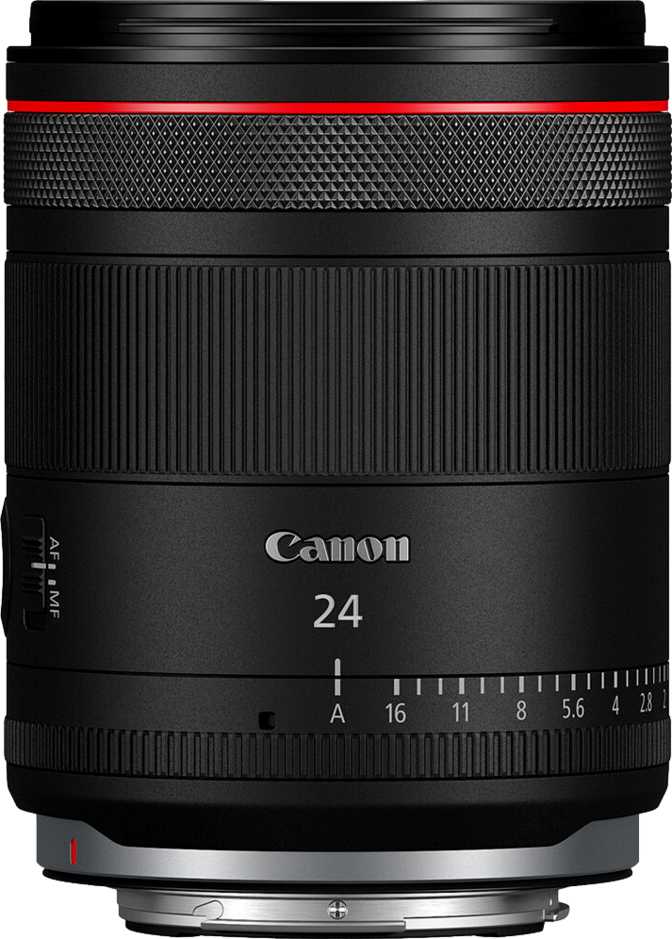
The RF 24mm f/1.4 L VCM is built to Canon's professional L-series standard, which in physical terms means a metal lens mount and weather-sealing throughout the barrel. The metal mount creates a mechanically rigid connection to your camera body — relevant for both longevity and subtle optical alignment over years of heavy use.
Weather-sealing provides meaningful protection against light rain, dust, and humidity during outdoor shoots. This is not waterproofing — heavy downpour without additional protection is still a risk — but a drizzle or a dusty environment is not a reason to pack up.
Weight and Size in the Hand
At just over half a kilogram, the 24mm f/1.4 L VCM sits in a comfortable middle ground for an L-series prime. It is noticeably heavier than budget alternatives, but not the kind of weight that causes fatigue during a full-day shoot when balanced against a modern RF-mount mirrorless body.
The 67mm filter thread is a practical, widely-supported size. Crucially, the front element does not rotate during focusing — a detail that matters significantly for photographers who regularly use polarizing filters or graduated NDs, since a rotating element would require constant readjustment.
Optical Performance: What f/1.4 at 24mm Actually Gives You
Light Gathering and Low-Light Reality
An f/1.4 maximum aperture at 24mm is genuinely exceptional. This lens lets in roughly twice as much light as an f/2 lens and four times as much as an f/2.8. In real shooting terms, that means dramatically higher shutter speeds in dim environments, or dramatically lower ISO settings for the same exposure — which translates directly to cleaner images when shooting indoors without flash, at dusk, or under artificial lighting.
The 84-Degree Field of View
The 24mm focal length on a full-frame sensor captures an 84-degree angle of view — wide enough to capture environmental context and a sense of space, yet contained enough to use for portraiture at a modest distance with intentional creative effect. This is not the distortion-heavy territory of ultra-wide lenses; architectural lines stay believable and faces near frame edges remain flattering. On APS-C bodies, the effective perspective narrows to closer to 38mm equivalent, which shifts the character considerably.
Close-Focus Capability
The 24-centimeter minimum focus distance is impressively short for a 24mm prime. At that working distance, the lens achieves a 0.17x reproduction ratio — small subjects like hands, flowers, or food fill a meaningful portion of the frame. The combination of that close-focus capability with f/1.4 creates genuine creative flexibility: backgrounds still blur at close distances, adding subject separation wide-angle lenses are typically not associated with.
The Aperture Blades and Bokeh Rendering
Eleven rounded aperture blades is a significant count — most lenses use between seven and nine. The higher blade count, combined with their curved shape, produces out-of-focus highlights that remain nearly circular across a wide range of aperture settings. Stop down to f/2.8 or f/4 and most lenses with fewer, straighter blades begin producing polygon-shaped highlights. This lens maintains smooth, near-circular rendition well into stopped-down apertures.
The VCM Focus System: Video-First Without Sacrificing Stills
What Voice Coil Motor Technology Does Differently
A Voice Coil Motor uses electromagnetic coils to move the focus group — the same fundamental principle used in speaker drivers — resulting in exceptionally smooth, continuously variable focus movement with no mechanical steps or increments. Traditional autofocus motors can produce focus pulls with a slight stutter as the lens moves between focus points. A VCM produces transitions that look genuinely cinematic, because the movement is fluid and controllable at any speed.
Focus transitions look cinematic and professional — no stepped or mechanical quality. The fluid VCM movement is camera-ready without post-processing fixes, critical for solo documentary, branded content, and narrative work.
VCM autofocus is fast and near-silent. The lens can be used in ceremonies, wildlife hides, library shoots, or any setting where noise is unacceptable — without drawing attention or contaminating audio when a microphone is present.
Full-Time Manual Focus Override
At any point during shooting — even while in autofocus mode — you can turn the focus ring to override or refine where the lens is focused. The lens does not fight you or snap back to its autofocus position. This is especially valued in portrait work for precise eye-focus refinement, and in video for intentional manual focus pulls mid-shot.
No Image Stabilization — Understanding the Trade-Off
This lens does not include optical image stabilization in the barrel. The practical reality is nuanced. At 24mm, camera shake has far less visual impact than at longer focal lengths — the wider perspective is naturally more forgiving of small hand movements.
Canon's current RF-mount mirrorless bodies include in-body image stabilization (IBIS) that compensates for shake at the sensor level. The lens's lack of OIS does not mean shooting without stabilization when paired with a stabilized body — it means the stabilization is handled in the camera rather than the glass. This is a design choice, not an oversight, freeing up internal space and simplifying optical construction.
Real-World Shooting Scenarios
Where This Lens Thrives
-
Event and Documentary Photography
The wide angle covers large groups and environmental context while f/1.4 handles poor or mixed lighting. The silent VCM focus allows discreet operation during ceremonies and candid moments. -
Environmental Portraiture
24mm at close range with f/1.4 creates compelling, contextual portraits — subjects in their environment with the background present but softened. A distinct editorial and documentary style. -
Architecture and Interiors
Captures full rooms and building facades without resorting to an ultra-wide angle. Moderate distortion keeps lines believable while still showing generous spatial context. -
Video Production
The VCM motor and silent focus make this a natural fit for mirrorless video rigs. Whether shooting solo documentary, branded content, or narrative work, focus transitions are camera-ready. -
Astrophotography
f/1.4 combined with a wide field of view is nearly ideal for night skies and Milky Way captures. More light in means shorter exposures, reducing star trailing and enabling lower ISO settings.
Who Should Probably Look Elsewhere
-
Telephoto or Portrait-First Shooters
If most of your work is above 50mm, a 24mm prime will rarely leave your bag. The investment is harder to justify without a clear use case for wide-angle work. -
Budget-Conscious Hobbyists
L-series glass carries L-series pricing. If your current camera body costs less than this lens, there is a rational argument to invest in a body upgrade before premium glass. -
Photographers Needing True Macro Work
The 0.17x reproduction capability is genuine and useful, but it does not replace a dedicated macro lens. This is a complement, not a solution for extreme close-up detail work.
How It Compares to the Logical Alternatives
Buyers considering the RF 24mm f/1.4 L VCM are typically weighing it against a short list of alternatives. The comparison breaks down along clear lines:
| Lens | Aperture | Stabilization | Focus Motor | Category |
|---|---|---|---|---|
| Canon RF 24mm f/1.4 L VCM | f/1.4 | None (body IBIS) | Voice Coil Motor | L-series professional |
| Canon RF 24mm f/1.8 Macro IS STM | f/1.8 | Optical IS | Stepping Motor | Consumer / enthusiast |
| Sigma 24mm f/1.4 DG DN Art (RF) | f/1.4 | None | Stepping Motor | Third-party pro |
| Canon RF 15-35mm f/2.8 L IS USM | f/2.8 | Optical IS | Ring USM | Wide zoom alternative |
On the Sigma: The Sigma 24mm f/1.4 Art offers comparable maximum aperture at a lower price. The meaningful difference is the VCM focus motor versus Sigma's stepping motor — for video-centric shooters, that advantage is substantial.
On the 15-35mm zoom: The zoom covers 24mm with flexibility to go wider or longer — but loses two full stops of aperture in exchange. That two-stop difference means the difference between shooting at ISO 3200 and ISO 12800 in the same dark room.
Honest Assessment: Strengths and Weaknesses
Where It Excels
- The VCM motor and f/1.4 aperture in a single package removes the compromise that typically forces shooters to choose between stills-optimized and video-optimized glass.
- Eleven rounded aperture blades produce background rendition with a quality that reflects attention to how light is interpreted, not just how much gets through.
- Weather-sealed L-series construction holds up across demanding professional working conditions without babying.
- Near-silent autofocus makes it appropriate in environments where most lenses would be disruptive.
Where It Falls Short
- No built-in optical stabilization is a genuine limitation for shooters without a stabilized body, particularly in handheld video contexts.
- At 515 grams, it is not an ultralight travel companion. Photographers building a minimalist travel kit may find it tips the balance further than they want.
- The premium over the Sigma alternative is significant — justified specifically by VCM technology and Canon ecosystem integration, which matters more to some shooters than others.
Questions Buyers Ask Before Purchasing
Final Verdict
The Canon RF 24mm f/1.4 L VCM is a specialized professional tool that excels precisely when you need what it uniquely offers: maximum light-gathering at wide angle, video-grade focus behavior, and L-series construction that holds up across professional working conditions.
It is not a beginner's first prime, and it is not the right lens if your shooting is primarily in good light or at focal lengths longer than 35mm. But for photographers and filmmakers who regularly work in challenging lighting, need the creative latitude that f/1.4 provides, or produce content across both photography and video, this lens addresses a real gap that no cheaper option resolves as completely.
The lack of built-in stabilization is the clearest limitation, and it matters more on older or entry-level bodies than on current Canon mirrorless flagships. Factor your specific camera body into this decision — the lens performs at its full potential when paired with a body that brings strong IBIS to the equation.
Who should buy it:
Working professionals shooting events, documentary, editorial portraits, or hybrid photo-video projects in unpredictable environments. For that specific shooter, the RF 24mm f/1.4 L VCM is a considered, capable, and difficult-to-replace choice.