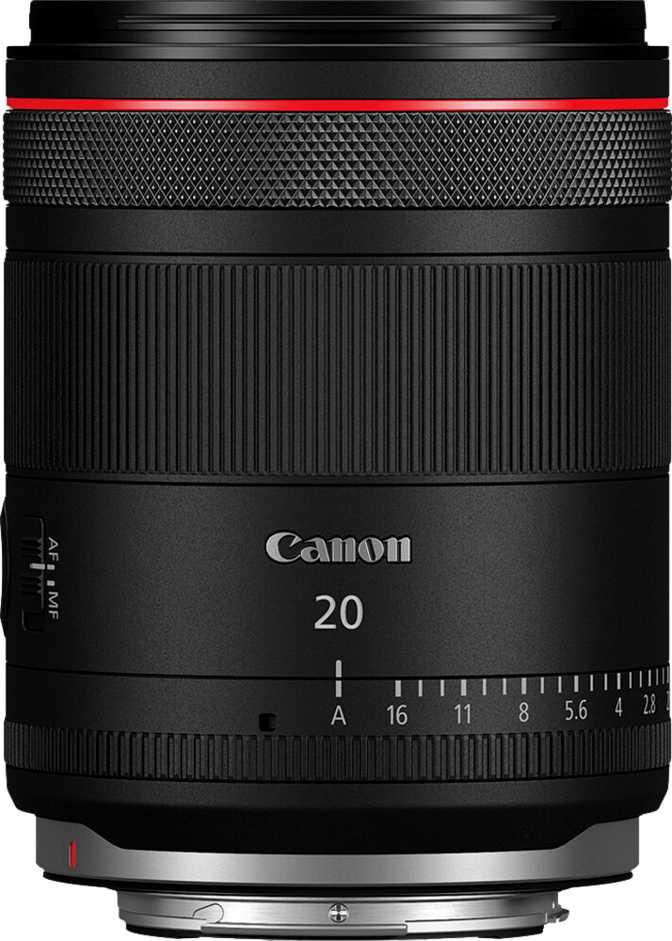
Canon RF 20mm f/1.4L VCM Review: A Specialist Ultra-Wide That Earns Its Price
Camera LensesUltra-wide prime lenses occupy a narrow but fiercely competitive space. Buy too cheap and you get distortion-riddled images with soft corners that no amount of post-processing can fully rescue. Buy the wrong focal length and you end up with a lens that spends most of its life on the shelf. The Canon RF 20mm f/1.4L VCM sits at the serious end of this category — it carries Canon's highest optical designation, a maximum aperture that almost no ultra-wide competitor can match, and a focus motor architecture borrowed directly from Canon's cinema lens lineage. Whether that combination justifies the investment depends entirely on what you actually shoot.
At a Glance
Design and Build: L-Series in Every Detail
The physical experience of this lens makes its tier immediately clear. The barrel is constructed to Canon's L-series standards — meaning materials, tolerances, and finishing are benchmarked against professional working conditions rather than weekend enthusiast use.
Weather Sealing and Durability
The lens is fully weather-sealed and fitted with a metal mount — both meaningful for working photographers who shoot outdoors under unpredictable conditions. Rain, dust, and humidity are occupational hazards for landscape, architectural, and event photographers, and the RF 20mm f/1.4L VCM is built to handle them without requiring retreat indoors. The metal mount adds mechanical reliability at the camera body interface, which matters most for photographers who swap lenses frequently and put real mileage on their gear.
Size, Weight, and Handling
At 500 grams, this lens is substantial but not punishing. That weight sits in the range you'd expect from a large-aperture prime of this caliber — heavier than budget ultra-wides but balanced enough to handhold for extended sessions without fatigue becoming a real factor. Paired with a mid-sized RF mirrorless body, the combination remains manageable for walking tours, architectural walk-arounds, or astrophotography sessions that require setting up and repositioning multiple times across an evening.
Filter Compatibility and Front Element
The 67mm filter thread is a practical size — neither so small that quality filters are hard to source, nor so large that a circular polarizer or ND filter becomes a significant added expense. Critically, the front element does not rotate during focusing. You can attach a graduated ND filter or polarizer, set its orientation, and focus without the filter position shifting — a fundamental workflow advantage for landscape photographers.
The included lens hood is reversible — it flips and stores on the barrel when traveling or transitioning between shots, keeping it accessible rather than lost in a bag pocket.
Optics and Image Quality
What 20mm f/1.4 with L-series optics actually delivers in the real world.
The Focal Length in Real-World Terms
Twenty millimeters on a full-frame sensor captures an extremely wide perspective — roughly 94 degrees across the diagonal. To put that in concrete terms:
- Standing in a moderately sized room, you can capture the entire space in a single frame.
- Photographing a building's facade from across a narrow street, you can include the full structure.
- Shooting the Milky Way from a dark sky location, you can include a large sweep of the galaxy plus a meaningful foreground in a single image.
This is not a subtle wide angle. It is dramatic, immersive, and unforgiving — objects close to the frame edge will show some stretching inherent to the geometry of ultra-wide optics. Skilled use of 20mm requires compositional discipline: place your subject deliberately, because the lens amplifies spatial relationships in ways that look either powerful or chaotic depending on how carefully the frame is built.
The f/1.4 Aperture Advantage
Most ultra-wide lenses for full-frame systems max out at f/2.8, and f/2 is already considered fast for this focal length. An f/1.4 maximum aperture at 20mm is genuinely rare, and its practical value falls into two distinct categories.
At f/1.4, this lens allows roughly four times as much light through as an f/2.8 competitor. In astrophotography, shorter exposures mean less star trailing — or lower ISO settings that reduce noise. For night architecture or interior work without flash, f/1.4 buys options that simply don't exist with slower glass.
Wide lenses are traditionally thought of as everything-in-focus tools, but at f/1.4, even a 20mm lens produces visible background separation when focused close. This opens creative possibilities — environmental portraits where the background blurs just enough — that typical wide primes simply cannot offer.
Aperture Blades and Rendering Character
The lens uses eleven rounded aperture blades. This matters most for photographers who shoot point light sources — city lights, candles, stars near-infinity. Eleven rounded blades produce smooth, circular out-of-focus light discs (bokeh) at wider apertures, and at smaller apertures they generate 22-pointed sunstars rather than the harsh, jagged stars produced by lenses with fewer, non-rounded blades. For landscape photographers who prize sunstar aesthetics — and many do — eleven blades is close to ideal.
The VCM Focus System: Built for Video and Precision
VCM stands for Voice Coil Motor — a fundamentally different approach to autofocus compared to the stepping motors found in most photo-oriented lenses. Voice coil motors move lens elements using direct electromagnetic force, with no gear trains or mechanical linkages introducing lag or noise.
What This Means for Video Work
The practical result is near-silent operation. Pull-focus transitions — where focus shifts from one subject to another — are smooth and linear rather than hunting or stepping. For video shooters, the RF 20mm f/1.4L VCM can be used with a follow focus system, or relied upon for continuous autofocus in video mode, without the focus mechanism introducing audible noise into recordings or visible mechanical stepping into footage.
This is exactly the use case the VCM designation signals. Canon has applied this motor technology in their Cinema EOS lens line for years — bringing it to an L-series still/video hybrid lens is a direct response to the growing number of photographers who shoot both disciplines with the same body and need glass that performs cleanly across both.
Reach for the focus ring and override autofocus at any moment — no switch to flip, no shutter half-press required. For cinematographers, this allows autofocus to handle general tracking while the operator manually takes over for precise focus pulls without breaking shot rhythm.
The lens focuses as close as 20 centimeters — close enough to fill a significant portion of the frame with relatively small objects. Combined with a 0.19x magnification ratio, this is not a dedicated macro tool, but it offers more close-range versatility than typical ultra-wides that often cannot focus below 30–40 centimeters.
No Built-In Stabilization: The Trade-Off to Understand
Optical Image Stabilization: Not Present
The RF 20mm f/1.4L VCM does not include in-lens optical stabilization. For many buyers this will be a non-issue — read why below.
At 20mm, lens-based stabilization is less critical than at longer focal lengths — the shorter the focal length, the less impact camera movement has on sharpness. Many photographers can handhold ultra-wide lenses at relatively slow shutter speeds without visible blur. Additionally, Canon bodies equipped with in-body image stabilization (IBIS) will compensate through the camera's own system.
Where the absence of stabilization is worth noting is video. Smooth, handheld video benefits from stabilization regardless of focal length, because continuous small movements read clearly on screen even when they wouldn't ruin a still photo. Shooters planning handheld video without a Canon IBIS body should budget for a gimbal stabilizer.
Who Should Buy the Canon RF 20mm f/1.4L VCM
This is a specialist lens with a narrow but clearly defined audience. Before spending at this level, it's worth being honest about which side of the line you fall on.
-
Astrophotographers Ultra-wide coverage, f/1.4 aperture, and 20cm minimum focus combine for near-ideal Milky Way and night sky shooting.
-
Architectural & Interior Photographers Non-rotating front element, weather sealing, and L-series optical standards make this a professional-grade architectural tool.
-
Hybrid Stills & Video Shooters The VCM motor is the clearest signal Canon designed this for dual-purpose use. Documentary filmmakers and commercial videographers can rely on a single lens without compromise.
-
Landscape Photographers in Difficult Conditions Weather sealing matters on a wet coastline or during light rain. Wide coverage and fast aperture handle both golden-hour and post-dusk conditions.
-
Non-RF Mount Users This is a native Canon RF lens. While adapters exist, full VCM focus system performance requires a Canon RF-mount body.
-
Photographers Who Need Versatility Twenty millimeters is specific and demanding. For street photography, events, or general travel, a wider zoom or 24mm prime will serve you better.
-
Budget-Conscious Buyers This is an L-series prime with a precision cinema-derived focus motor. It competes on quality, not price. Entry-level ultra-wide options exist on the RF system for significantly less.
How It Compares to the Alternatives
The RF 20mm f/1.4L VCM competes in a narrow space. Among native RF-mount ultra-wide primes, Canon's own RF 14–35mm f/4L IS USM offers stabilization and zoom flexibility at a slower aperture — sensible for shooters who prioritize versatility over maximum light gathering. Third-party options from Sigma and Tokina exist at more accessible prices, though with different focus motor technologies and without L-series optical standards.
| Feature | RF 20mm f/1.4L VCM | Typical f/2.8 Ultra-Wide | Wide-to-Standard Zoom |
|---|---|---|---|
| Maximum Aperture | f/1.4 | f/2.8 | f/4 or f/2.8 |
| Light Gathering | ~4x over f/2.8 | Baseline | Lower |
| Video Focus Noise | Near-silent (VCM) | Varies | Varies |
| Focal Length | Fixed 20mm | Fixed | Adjustable |
| Weather Sealing | Varies | Varies | |
| Non-Rotating Front Element | Varies | Varies | |
| Built-In Stabilization | Varies | Often Yes |
The case for the RF 20mm f/1.4L VCM is not that it outperforms every alternative in every metric. The case is that for the specific combination of ultra-wide coverage, maximum-aperture performance, and video-grade silent focusing, there is no native RF option that replicates it.
Honest Assessment: Strengths and Where It Falls Short
The aperture is genuinely extraordinary for this focal length, and the VCM motor is one of Canon's finest focus implementations in a still-photography lens. The build quality carries the full weight of the L designation — weather sealing, metal construction, and the non-rotating front element are professional tools, not marketing language.
The absence of optical stabilization is real, though its impact depends almost entirely on your camera body and shooting style. If you're using a recent Canon body with IBIS, it's a non-factor for stills. For handheld video without body-level stabilization support, it requires planning.
The weight and size, while reasonable for a lens of this specification, make the RF 20mm f/1.4L VCM a deliberate packing choice rather than a casual carry item. It goes in the bag when you know you need it.
At maximum aperture, edge sharpness and vignetting will follow the physics of fast ultra-wide optics — most lenses of this type perform at their peak across the frame when stopped down one or two stops from wide open. This is not a defect specific to this lens; it is inherent to the optical physics of f/1.4 at 20mm and should be understood as a characteristic to work with, not a flaw to work around.
Questions Real Buyers Ask
Answers to the queries that actually drive purchase decisions for this lens.
Canon RF 20mm f/1.4L VCM
The Canon RF 20mm f/1.4L VCM is a precision instrument built for a specific type of demanding work. Its combination of an ultra-wide field of view, a maximum aperture that outpaces virtually every native competitor, and a cinema-derived focus motor creates a lens profile that has almost no direct native-RF equivalent.
If your work includes astrophotography, serious architectural or interior photography, or hybrid stills-and-video production — and you are shooting on the Canon RF system — this lens belongs in your kit. It is not a casual or versatile option. It is an expert tool for photographers who know exactly what 20mm and f/1.4 get them, and who are prepared to use both deliberately.
For photographers still exploring focal lengths, or those who need lens-level stabilization, or those who want one ultra-wide that handles every situation — look first at Canon's zoom options or at more moderate focal-length primes. The RF 20mm f/1.4L VCM rewards specialists. In the right hands, it is difficult to fault.