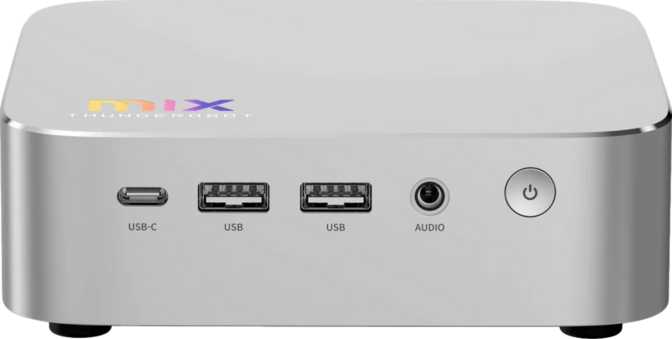
Thunderobot MIX NUC Review: Real Performance in a Compact Desktop
Mini PCsEditor's Rating
Performance by Category
Mini PCs have quietly matured from curiosities into serious productivity tools, and the Thunderobot MIX NUC arrives as a statement piece in that evolution. Built around a laptop-grade processor engineered for high-performance devices — but given the thermal breathing room of a full desktop chassis — this compact machine challenges the assumption that meaningful performance requires a full tower. Add an integrated GPU with genuine gaming credibility, 32GB of next-generation memory at the base configuration, and a port selection that covers an entire peripheral ecosystem without a hub, and the MIX NUC has the ingredients to stand apart from a crowded field.
Design and Physical Experience
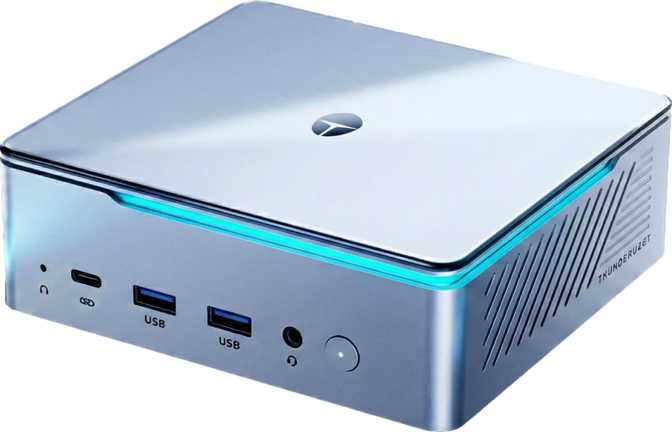
The MIX NUC occupies a Micro-ATX footprint — more substantial than a palm-sized puck machine, but compact enough to sit behind a monitor on a VESA mount or rest on a desk without asserting itself visually. This is not a device you carry between locations daily, but it takes up a fraction of the space required by a traditional tower desktop.
Thunderobot built its reputation on gaming hardware, and traces of that heritage appear in the chassis — though with genuine restraint. The MIX NUC reads as clean and functional rather than aggressively styled, making it equally at home in a professional office and a dedicated gaming corner. The slightly larger footprint compared to puck-style mini PCs delivers a meaningful payoff: better thermal management. More interior volume means better sustained airflow, which means the processor can hold its performance ceiling during extended workloads — a failure point for truly compact competitors.
High-frequency connections — audio and front-facing USB ports — are positioned for easy reach without accessing the rear panel. For a machine likely to live behind a monitor, this is a thoughtful practical detail.
- Micro-ATX compact footprint
- VESA mount compatible
- Professional aesthetic, gaming roots
- Better thermal headroom vs. puck PCs
- Front-accessible ports for daily use
Processing Performance: Laptop Silicon, Desktop Results
The processor at the MIX NUC's core comes from the performance tier of mobile computing — the class of chips designed for demanding professional laptops — and runs inside a desktop chassis where it can sustain its full power budget without the thermal and battery constraints that penalize it in thin portable devices. The practical outcome: desktop-class sustained performance from highly refined mobile silicon.
Eight physical cores with simultaneous multithreading deliver sixteen processing threads, all operating identically — no split between high-performance and background-efficiency types. This uniform core architecture ensures consistent, predictable behavior across every workload, including legacy software that handles hybrid designs poorly. Compiling code, running virtual machines, processing data pipelines, and managing demanding parallel applications all flow naturally at this thread count.
A multi-core PassMark result of 28,797 places the MIX NUC in the same performance bracket as competitive mid-range tower desktop configurations — a result that would have required a full ATX build just a few generations ago. The single-core score of 3,556 confirms per-thread responsiveness keeps pace with the headline figure. Day-to-day snappiness — application launches, file opens, browser rendering — is well-served at this level.
Hardware-accelerated AES encryption, full AVX2 vector processing, and FMA3 floating-point support extend utility to security software, AI inference engines, scientific computing packages, and hardware-optimized multimedia codecs — software that actively takes advantage of these capabilities runs measurably faster.
The Radeon 780M: Integrated Graphics That Earn Their Place
Most mini PCs rely on integrated graphics that handle video playback adequately and collapse under any real graphical demand. The Thunderobot MIX NUC takes a different path, incorporating the AMD Radeon 780M — currently the most capable integrated GPU architecture available in compact desktop hardware. Built on a 4-nanometer fabrication process, it delivers shader processing capacity and clock headroom that the previous generation of integrated solutions could not approach.
4nm Architecture
Cutting-edge fabrication enables high clock speeds and strong compute throughput within the compact thermal constraints of a mini PC chassis.
Real Gaming Capability
Esports titles, MOBAs, and competitive multiplayer games run at 1080p with solid performance — a meaningful step beyond what older integrated solutions delivered.
DirectX 12 + OpenGL 4.6
Modern creative apps, 3D design tools, and current game engines run without API limitations. Full compatibility with current software standards.
OpenCL 2.1 Compute
GPU-accelerated tasks — video transcoding, machine learning inference, image processing pipelines — are viable without discrete hardware.
HDMI 2.1 + DisplayPort
Two dedicated video outputs on the chassis. HDMI 2.1 supports 4K at 120Hz and up to 8K — current-generation and forward-looking simultaneously.
4 Simultaneous Displays
The GPU architecture drives up to four independent displays — workstation-class multi-monitor capability in a compact desktop form.
The 780M's performance is critically enabled by the DDR5 memory subsystem it shares with the CPU. High-speed DDR5 provides the bandwidth the GPU needs to operate near its ceiling — a meaningful advantage over platforms paired with slower DDR4 memory that starves integrated graphics of throughput.
Memory & Storage: Configured to Work From Day One
32GB DDR5 Memory
Shipping with 32GB of DDR5 in a dual-channel configuration avoids the false economy that plagues entry-level mini PCs. Dual-channel operation doubles available memory bandwidth compared to single-channel setups — an effect that matters substantially for integrated graphics throughput and the machine's capacity to handle parallel workloads without slowdown.
Developer environments with multiple active services, creative applications handling large project files, data analysis pipelines, and virtual machines all run without memory pressure at this capacity. The platform's DDR5 support extends to notably high operating speeds — significantly above what DDR4 systems offer — feeding the Radeon 780M the bandwidth it needs for peak graphical output.
1TB NVMe Solid-State Drive
The included 1-terabyte NVMe drive operates on the PCIe Gen 4 interface — the current high-bandwidth standard — delivering transfer speeds that make large file operations feel immediate. Moving video projects, installing major software packages, and decompressing archives complete without noticeable delay.
1TB provides a comfortable working volume for most users: full operating system, active software library, and working project files without immediate space pressure. Media-intensive workflows — large video libraries, extensive game installations, bulk raw photo archives — will approach its limits more quickly than general productivity use. The NVMe slot means future storage upgrades are a standard swap, not a chassis surgery challenge.
Connectivity: Seven Ports, No Compromises
Port density is where the MIX NUC most clearly outpaces competitors in its class. Seven USB connections across three speed tiers mean a keyboard, mouse, external drive, webcam, audio interface, and additional peripherals all connect simultaneously — without a hub. In the mini PC category, this is a genuine differentiator.
| Connection | Count | Speed / Standard | Ideal Use |
|---|---|---|---|
| USB-A | 4 ports | 5 Gbps | Keyboards, mice, webcams, standard peripherals |
| USB-A (Fast) | 2 ports | 10 Gbps | Fast external SSDs, high-speed hubs, demanding peripherals |
| USB-C | 1 port | 10 Gbps | Modern accessories, mobile devices, USB-C storage |
| HDMI | 1 port | HDMI 2.1 | 4K@120Hz, 8K displays, primary monitor |
| DisplayPort | 1 port | DisplayPort | High-refresh-rate panels, secondary monitor |
| Ethernet | 1 port | Gigabit RJ45 | Wired networking, stable low-latency connection |
| Audio | 1 jack | 3.5mm Analog | Headphones, speakers, headsets |
What Is Not Available
- No Thunderbolt 4 or USB4 — users relying on Thunderbolt docking stations or external GPU enclosures will find this a significant limitation that cannot be added after purchase
- No VGA output — relevant for anyone still using legacy monitors or older projectors
- No optical audio output (S/PDIF) — matters only for audiophile setups requiring digital optical or coaxial audio connections
Wireless Connectivity
Wi-Fi 6 (802.11ax)
The current-generation wireless standard is engineered to reduce interference and maintain lower latency in high-device-density environments — homes and offices with many connected devices see a tangible improvement over Wi-Fi 5. Backward-compatible with older routers without any configuration effort.
Bluetooth 5.3
Current-generation short-range connectivity for wireless keyboards, mice, headphones, and speakers. Improved range and connection stability compared to older Bluetooth versions, with better codec negotiation for wireless audio quality at a distance.
Who Should Buy the MIX NUC — and Who Should Not
Performance on paper means nothing if the machine doesn't match your actual workflow. Here is an honest breakdown of both sides.
Strong Match For...
- Home Office ProfessionalsDevelopers, data analysts, designers, writers, and finance roles who need capable, quiet computing in limited desk space.
- Casual and Competitive GamersEsports titles, MOBAs, and competitive multiplayer at 1080p without a discrete GPU — the Radeon 780M makes this genuinely viable.
- Multi-Monitor Power UsersTwo 4K displays connect directly from physical video outputs. The GPU architecture supports up to four screens with additional configuration.
- Content CreatorsPhotography editing, audio production, and proxy-based 4K video workflows run comfortably at this processor and memory tier.
- Tower Desktop UpgradersReplacing a mid-range tower while reclaiming desk space — the MIX NUC delivers equivalent performance in a fraction of the footprint.
Look Elsewhere If You Need...
- AAA Gaming at High SettingsDemanding open-world titles at maximum fidelity require a discrete GPU. This configuration has no discrete graphics support.
- Thunderbolt Dock WorkflowsNo Thunderbolt 4 or USB4 means single-cable docking stations and external GPU enclosures are off the table — permanently.
- ECC Memory WorkstationsScientific computing and financial modeling environments requiring data-integrity guarantees are not supported on this platform.
- Overclocking EnthusiastsThe processor multiplier is locked at factory specification. Manual performance tuning is not available — the ceiling is fixed at purchase.
How It Compares to the Alternatives
The MIX NUC sits in the upper tier of compact desktops. Here is how it measures against the logical alternatives most buyers would consider.
| Feature | Thunderobot MIX NUC | Budget Mini PC | AMD Competitor | Intel NUC Alternative |
|---|---|---|---|---|
| RAM | 32GB DDR5 | 8–16GB DDR4 | 16–32GB DDR4/5 | 16–32GB DDR4/5 |
| Integrated GPU | Radeon 780M | Intel UHD / Iris Xe | Radeon 680M / 780M | Intel Iris Xe / Arc |
| Display Outputs | 4 simultaneous | 2–3 | 3–4 | 2–3 |
| USB Ports | 7 total | 4–6 | 4–6 | 4–6 |
| Wi-Fi | Wi-Fi 6 | Wi-Fi 5 or 6 | Wi-Fi 6 | Wi-Fi 6 / 6E |
| Storage | 1TB NVMe PCIe 4 | 256–512GB | 512GB–1TB | 512GB–1TB |
| Thunderbolt | Not included | Generally absent | Generally absent | Sometimes included |
| Core Architecture | Uniform | Varies | Uniform | Hybrid P+E cores |
Honest Assessment
The MIX NUC gets the core configuration decisively right. Genuine credibility, though, comes from acknowledging where it doesn't — so here are both sides, stated plainly.
What It Gets Right
Processor performance competes with mid-range tower desktops — without qualification or form-factor asterisks.
The Radeon 780M transforms integrated graphics from a spec-sheet footnote into a genuine capability that changes purchase calculus for casual gamers.
32GB DDR5 dual-channel makes the machine ready for demanding professional work immediately — no upgrade required on day one.
Seven USB ports cover a complete peripheral ecosystem without a hub from day one — class-leading port density in this form factor.
Four-display GPU support brings workstation-class multi-monitor capability to a compact home office setup.
A two-year warranty backs the hardware as a primary computing device, not a casual secondary machine.
Where It Asks for Compromise
No Thunderbolt connectivity — the single most consequential limitation, and one that cannot be retrofitted after purchase.
The locked clock multiplier means the performance ceiling is permanent from purchase. No tuning headroom exists for enthusiasts.
No discrete GPU support — a predictable compact-form-factor constraint, but a hard stop for demanding gaming or rendering workloads.
No media card reader — a small but operationally relevant omission for photographers and video professionals with daily card workflows.
ECC memory is not supported, excluding niche workstation use cases that require data-integrity guarantees under sustained computational load.
Questions Buyers Ask Before Purchasing
Final Verdict
The Thunderobot MIX NUC is a compact desktop that earns its performance tier rather than claiming it through marketing positioning. The processor delivers multi-threaded throughput matching mid-range tower desktops. The Radeon 780M makes integrated graphics a genuine feature — not an apology. Shipping with 32GB of DDR5 in dual-channel means demanding professional work is supported immediately. Seven USB ports and four-display support represent the most complete connectivity package available at this compact scale.
The absence of Thunderbolt connectivity is the only genuinely disqualifying limitation — and it applies only to users who specifically depend on Thunderbolt docking workflows. For everyone else, the MIX NUC delivers what it promises: real, sustained performance in a compact package, configured properly from the start. That earns a strong recommendation.