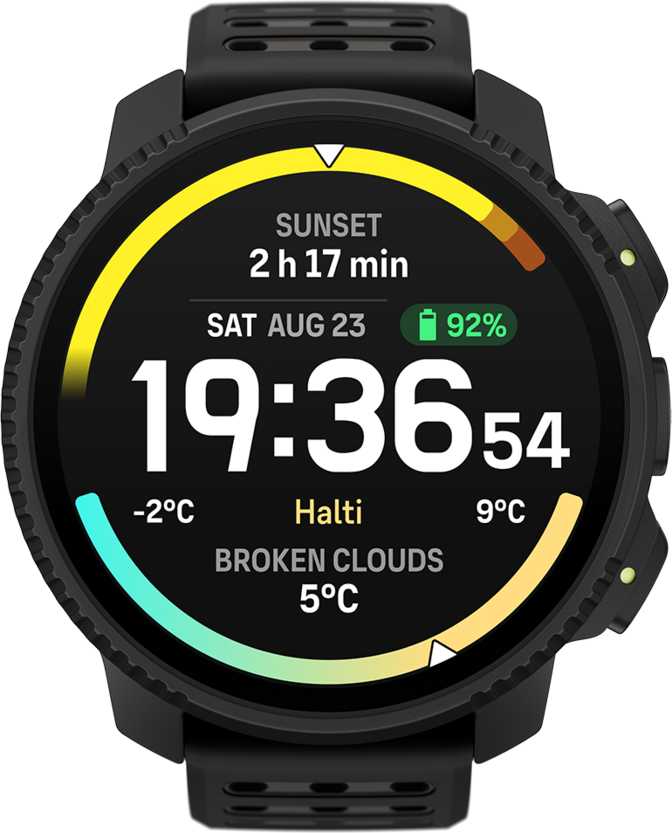
Suunto Vertical 2 Review: A GPS Watch Built for Real Terrain
Sports WatchesDisplay
1.5" OLED · 439 PPI
Sapphire Glass
Battery
30-Day Daily Use
75 hrs GPS Active
Water Resistance
100m · Dive-Rated
10 ATM
Multi-GNSS
GPS + Galileo
Fast Lock
Onboard Maps
32 GB Storage
Custom Uploads
Wind Sensor
Native Anemometer
Real-Time Readings
Suunto has always understood a particular kind of athlete — the one who plans a multi-day alpine traverse on Tuesday and runs a trail 10K on Saturday. The Suunto Vertical 2 is designed for that person. It sits at the serious end of the outdoor sports watch market, blending expedition-level navigation tools with the daily wearability that modern athletes actually demand. This is not a casual fitness tracker with an adventure sticker on it. It is a purpose-built outdoor instrument that happens to track your sleep and buzz when someone texts you.
The question worth answering upfront is whether the Suunto Vertical 2 earns its place in a crowded field where competing brands offer aggressive alternatives at similar price points. The answer, after a thorough look at everything it offers, is a confident yes — with a few honest caveats that every buyer should know before committing.
Design and Build Quality
Size, Weight, and Wrist Presence
At 49mm across and 74 grams, the Suunto Vertical 2 is a substantial watch. That 49mm measurement applies to both height and width, giving it a symmetrical, assertive profile. For context, 74 grams sits in the middle ground of serious outdoor watches — noticeable on a smaller wrist, but balanced enough that most athletes forget it is there after the first hour of a run.
The case depth of 13.6mm houses real hardware — a full sensor stack, a sizeable battery, and the structural integrity to take knocks on rocky terrain. The 22mm band width is an industry-standard lug size, meaning aftermarket straps are easy and affordable to find. The band is fully replaceable.
Display Quality
The 1.5-inch OLED panel is one of the most impressive aspects of the Vertical 2. OLED technology means true blacks, vivid color contrast, and excellent visibility in mixed lighting — qualities that matter when reading a topo map overlay in direct sunlight or checking your heart rate zone during a predawn start.
The resolution translates to 439 pixels per inch — sharp enough that map lines look like map lines, not blurry suggestions. The always-on display mode keeps data readable without requiring a deliberate wrist raise, a practical advantage during fast-moving activities where data checks need to be instinctive.
Durability
The display is protected by sapphire glass — the hardest transparent material used in consumer watchmaking. Unlike chemically strengthened glass, sapphire resists surface scratches from rocks, zippers, and pack straps at a level standard mineral glass cannot match. After months of trail use, a sapphire screen looks new.
- 100-meter water resistance — covers open-water swimming, river crossings, and diving
- Operates from −20°C to +55°C — winter mountaineering to desert ultra conditions
- Sapphire crystal lens without additional coating layers — pure hardness protection
Performance Tracking and Health Metrics
Heart Rate and Blood Oxygen
Continuous optical heart rate monitoring runs throughout workouts and daily wear, feeding into zone-based training analysis and the broader recovery picture the watch builds over time. For athletes training with heart rate zones — which is most serious endurance athletes — this is the primary real-time feedback mechanism during every session.
Blood oxygen saturation monitoring measures the percentage of oxygen your red blood cells are carrying. At altitude, this number drops, and tracking it helps hikers and mountaineers assess acclimatization and exertion safety. It also functions as a general wellness baseline indicator during daily wear.
HRV, Recovery, and Readiness Scores
Heart rate variability tracking separates training tools from training advisors. HRV measures the millisecond variation between heartbeats — high variability generally indicates good recovery and readiness; low variability suggests fatigue, stress, or the early stages of illness. The Vertical 2 uses this data to generate daily readiness scores, giving athletes an objective signal about whether to push hard, hold back, or rest.
This readiness system is most valuable for athletes who struggle to listen to perceived exertion — those who push through fatigue on days they should rest, or feel unmotivated on days they are actually primed to perform well.
VO2 Max and Fitness Estimation
The watch estimates VO2 max — the maximum oxygen your body can process during intense exercise, widely considered the most reliable single predictor of aerobic fitness and endurance performance. Over weeks of training, changes in this estimate reveal whether a block is building fitness, plateauing, or failing to produce adaptation.
Resting heart rate trends alongside VO2 max to paint a complete picture of cardiovascular health and recovery status over time — the combination is considerably more informative than either metric in isolation.
Multi-Sport, Sleep, and Daily Activity
Multi-sport mode is built for triathletes and adventure racers — transitions between disciplines log without stopping the activity, keeping session data coherent from start to finish. Swim stroke counting gives swimmers data granularity comparable to what runners get from pace and distance metrics. Diving mode extends underwater capability into a dedicated tracking context.
Automatic activity detection recognizes when meaningful movement begins and starts logging without requiring navigation to the correct sport profile first — useful for spontaneous outings or athletes who sometimes forget to press start.
Sleep tracking with structured reports integrates into the broader HRV and readiness picture. A silent vibrating alarm and inactivity alerts during the day complete a daily wellness monitoring loop.
Battery Life: Where the Vertical 2 Truly Separates Itself
Battery endurance is one of the clearest differentiators between a serious outdoor watch and a capable fitness tracker with outdoor ambitions.
Always-on display active, continuous background monitoring, typical daily wrist use
Continuous satellite tracking — comfortably covers ultramarathons and multi-day traverses
Maximum sustained activity output — the watch’s full training endurance ceiling
Deep reserve for expeditions without power access — over three continuous weeks
In practical terms: a typical 50-kilometer ultramarathon might take 6 to 12 hours; a multi-day mountain traverse might span 30 to 50 hours. The Vertical 2 comfortably outlasts both scenarios with meaningful reserve. Most athletes charge once every three to four weeks in daily use — a fundamentally different relationship with a charger than most competing watches demand.
Wireless charging eliminates the proprietary cable that becomes a liability when lost, damaged, or simply left at home before a trip. One less thing to think about on the way to the trailhead.
Connectivity and Ecosystem
What It Connects To
- Pairs with both iOS and Android smartphones
- Compatible with Windows and macOS for map uploads and full data management
- Bluetooth external heart rate monitors supported — ideal for chest-strap users during high-intensity or cold-weather training
- Notification forwarding and call management from a paired phone
- Free, ad-free companion app — no subscription required to access any feature
Connectivity Gaps to Know About
- No ANT+ — cyclists with power meters or runners with ANT+ foot pods cannot pair these sensors
- No NFC — contactless payments are not supported
- No Wi-Fi — sync and map uploads require a phone or computer connection
- No cellular — the watch cannot operate as a standalone communication device
Who This Watch Is For — and Who It Isn’t
The Right Buyer
The Suunto Vertical 2 is built for the outdoor endurance athlete who takes navigation seriously. Trail runners preparing for multi-day races, alpine hikers who venture above the snowline, adventure racers, and mountaineers will find a watch that matches their demands without asking them to compromise on the things that matter most in the field.
It also works well as a daily training watch for serious road runners and triathletes who value long battery life over contactless payment and smart home integrations. The free, no-subscription app model makes the full feature set permanently accessible without recurring cost.
- Trail runners targeting multi-day or long-distance events
- Alpine hikers and mountaineers who need reliable navigation
- Adventure racers and multi-discipline endurance athletes
- Athletes who want the full feature set without a monthly subscription
Look Elsewhere If…
Athletes who need ANT+ sensor compatibility will find the missing protocol a real limitation. This is the most common reason an otherwise ideal candidate for this watch should look at alternatives — particularly cyclists using power meters and runners who depend on foot pod data for pace accuracy.
Those who want to pay for coffee from their wrist, respond to messages directly, or operate the watch independently of a phone for communication will be disappointed. The Vertical 2 is an athlete’s tool. Anyone primarily interested in indoor fitness or gym-focused training will be paying for navigation hardware they rarely justify.
- Cyclists relying on ANT+ power meters or cadence sensors
- Users who need NFC payments or cellular independence
- Primarily indoor or urban gym-focused athletes
- Buyers wanting a smartwatch-first experience with fitness secondary
How It Compares to Key Alternatives
The Suunto Vertical 2 sits in a competitive segment. Here is how it stacks up on the features that matter most for outdoor endurance athletes.
| Feature | Suunto Vertical 2 | Outdoor GPS Rival A | Outdoor GPS Rival B |
|---|---|---|---|
| Display Type | OLED Always-On | MIP Transflective | AMOLED |
| Sapphire Glass | Yes | Top tier only | Yes |
| GPS Battery Life | ~75 hours | ~90–140 hours | ~65 hours |
| Daily Battery Life | ~30 days | ~16–28 days | ~14–21 days |
| Onboard Storage | 32 GB | 16–32 GB | 16 GB |
| ANT+ Support | No | Yes | Yes |
| Wind Speed Sensor | Yes | No | No |
| Diving Mode | Yes | Some models | No |
| NFC Payments | No | Some models | Yes |
| App Subscription | Not Required | Required (advanced) | Required (advanced) |
Competitive data represents representative category alternatives. Individual models vary. Based on publicly available specifications.
Honest Assessment: Strengths and Weaknesses
The Vertical 2 gets several things right that are genuinely hard to execute simultaneously. The display is outstanding — OLED at 439 pixels per inch, protected by sapphire glass, with always-on functionality, is a meaningful upgrade over the reflective transflective panels that dominate expedition watches. Reading detailed maps on the wrist is a qualitatively different experience on this screen compared to anything at a comparable price tier using older display technology.
The environmental sensor suite — barometer, compass, wind speed, and multi-constellation GPS together — gives the watch a navigational depth that most fitness-focused wearables do not approach. This is not a watch that tracks elevation as an afterthought. It is a watch built around elevation, weather, and terrain data as its core purpose.
The battery story is genuinely strong. Three weeks of daily wear, 75 hours of active GPS recording, and a deep reserve mode that stretches operation across a full expedition — this hardware is designed to stay on your wrist and keep working when alternatives would be asking for a charger. Wireless charging removes one more logistical friction point.
The free, ad-free app with no required subscription is a business model statement as much as a product feature. It signals that the value exchange happens at purchase, not through a recurring revenue mechanism that progressively locks capabilities behind a paywall.
The weaknesses are real and should not be minimized. The absence of ANT+ is a genuine limitation for cyclists and structured training athletes who have built their sensor ecosystems around that protocol. It is the single most common reason an otherwise ideal candidate for this watch should seriously consider an alternative. No workaround exists for ANT+ devices — the protocol is simply absent.
The one-year warranty is conservative for a watch at this price point and durability positioning. Competing expedition watches from other brands sometimes offer two to three years of coverage on their flagship outdoor models. Buyers planning to put this watch through serious abuse — and the audience for this watch absolutely will — should factor that warranty window into their confidence level.
Anyone primarily interested in indoor fitness, urban running, or gym-focused training will be paying for navigation hardware and battery capacity they will rarely justify using. For that buyer, a more connected watch with a shorter battery and lower entry price makes considerably better practical sense.
The lack of NFC, cellular, and Wi-Fi consolidates the watch firmly in the specialist outdoor category. Buyers who want a single device to handle payments, communication, and fitness will need to compromise somewhere. The Vertical 2 does not try to be everything — and that is both its greatest strength and its clear market boundary.
Frequently Asked Questions
Real questions buyers search before purchasing — answered directly.
Final Verdict
The Suunto Vertical 2 is a serious outdoor sports watch for athletes who spend meaningful time navigating real terrain. It earns that description through hardware choices — sapphire glass OLED display, full environmental sensor suite including wind speed, diving capability, multi-constellation GPS — and through software choices that prioritize navigation depth and open access over subscription revenue.
The battery life is excellent and practically important for the audience this watch targets. The display quality is the best in its class. The lack of ANT+ support is a legitimate concern for cycling and multi-sport athletes invested in that sensor ecosystem, and it should factor directly into the purchase decision. The one-year warranty is short for a watch in this category and worth factoring into long-term confidence.
Recommended For
- Outdoor endurance athletes and serious trail runners
- Alpine hikers, mountaineers, and adventure racers
- Athletes needing multi-day expedition endurance
- Buyers who want the full feature set with no subscription
Look Elsewhere If
- ANT+ sensor support is required for your training setup
- NFC payments or cellular independence are a priority
- Primary use is indoor fitness or urban-only training
- A smartwatch-first experience is your main requirement