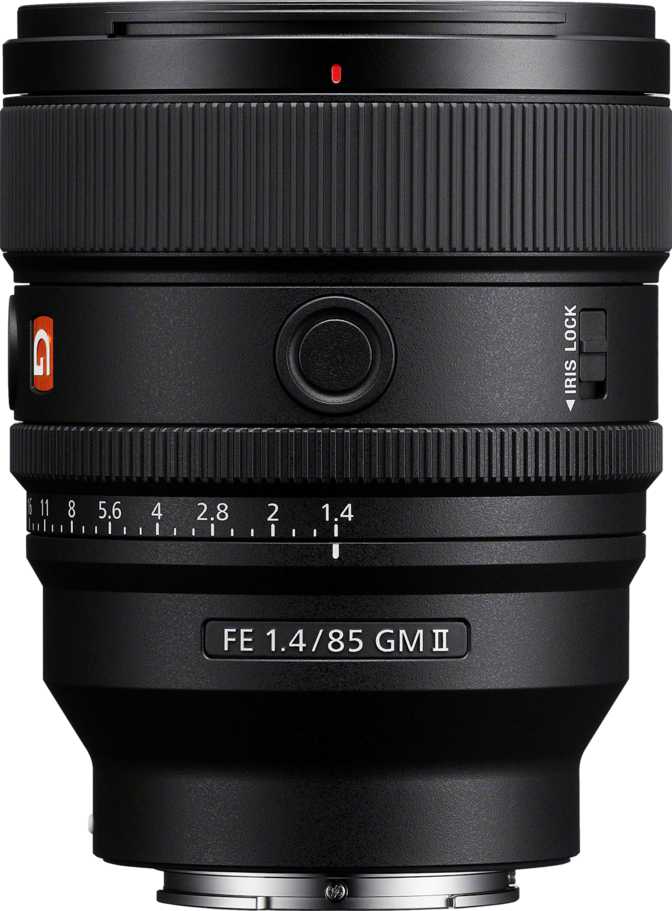
Sony FE 85mm f/1.4 GM II: Full Review of the Premier Portrait Prime
Camera LensesPortrait photographers shooting Sony full-frame cameras have always had strong options, but the original 85mm f/1.4 GM cast a long shadow — brilliant glass hampered by a demanding build. The GM II changes all of that. Sony rebuilt this lens with a lighter chassis, faster and quieter autofocus, and optical performance that raises the bar for the fast 85mm category. Whether you are a working professional or a dedicated enthusiast ready to invest in glass that outlasts several camera bodies, this lens deserves your full attention.
Build Quality and Physical Design
A Lighter Frame That Does Not Compromise Durability
At 642 grams, the GM II sits in a noticeably more manageable weight class than its predecessor. That might sound modest on paper, but after a full day on set or walking a wedding venue, the difference registers in your wrist, your shoulder, and your ability to shoot handheld late into the day without fatigue. Paired with Sony's mirrorless bodies, the balance is excellent — the combination feels like a unified tool rather than a heavy lens dragging down a lightweight body.
The build feels premium throughout. The metal mount at the rear provides the rigid, confident connection that professional glass demands — no flex, no play, just a solid mechanical bond. The 77mm filter thread is a widely used standard, meaning most photographers already have compatible polarizers or neutral-density filters in their kit, with a vast range of options available at no size-premium pricing.
Non-Rotating Front Element
The front element stays fixed during autofocus and does not rotate. For photographers using a circular polarizer, this is essential rather than merely convenient — rotating front elements make CPL filters nearly unusable during handheld work, requiring readjustment every time focus is acquired.
Weather Sealing for Real-World Shooting Conditions
The lens carries weather sealing throughout its construction, providing meaningful protection against dust ingress and moisture splatter. This is not a lens for deliberate rain shooting, but it means you can continue working through a light drizzle at an outdoor event or in dusty environments without reaching for the lens bag at every cloud on the horizon. Professional reliability means not having to stop shooting because the sky gets complicated.
Reversible Lens Hood Included
The included lens hood reverses onto the barrel for compact transport without needing to remove it entirely — a small but thoughtful detail for photographers who move constantly between locations throughout a shoot day.
Optical Performance: What f/1.4 Actually Delivers
Aperture and Bokeh — The Reason This Focal Length Exists
The f/1.4 maximum aperture is the defining characteristic of this lens, and understanding what it means in practical terms matters more than the number itself. At this aperture on a full-frame sensor, the depth of field becomes extremely shallow — at typical portrait distances, subject separation is so pronounced that even slight front-to-back differences within a face can fall out of focus. For environmental portraits, the subject emerges from the background as if lit differently from everything around them.
The 11-blade aperture diaphragm, with fully rounded blades, produces the smooth, circular bokeh highlights this focal length is known for. Lenses with fewer blades or angular aperture openings create polygonal highlight shapes — hexagons or octagons — that look mechanical and distracting in comparison. At f/1.4 and stopped down through the midrange, the out-of-focus rendering is consistently organic and pleasing. The aperture range extends to f/16, giving full flexibility for controlled studio work, flash sync at slower speeds, or any scenario demanding maximum depth of field.
Angle of View and Subject Compression
The 85mm focal length on full-frame gives a 29-degree angle of view — narrow enough to compress background elements toward the subject, creating the flattering perspective that has made this focal length the default choice for portraiture for decades. It keeps the photographer at a comfortable working distance: close enough for genuine connection, far enough to avoid the facial distortion that wider lenses introduce.
Minimum Focus Distance and Magnification
The closest focusing distance of 0.8 meters is well-suited to tight portraiture. At that distance with f/1.4, you can fill a significant portion of the frame with a face and achieve extreme subject isolation — ideal for tight headshots or dramatic close-up portrait work. The 0.11x magnification ratio makes clear that this is a portrait lens first, not a macro tool. It will not replace a dedicated macro lens for product or nature close-up photography, but for its intended purpose the close-focus capability is precisely right.
Autofocus System: Speed, Silence, and Reliability
A Focus Motor Built for Moving Subjects
The focus motor built into this lens is the primary upgrade that defines the GM II's practical advantage over its predecessor. It drives focus quickly enough to track subjects in genuine motion — not just stationary portrait sessions, but events, performers, athletes in moderate movement, and candid street work. Portrait photography increasingly demands this kind of responsiveness: subjects move, turn, laugh, and shift, and a lens that hesitates costs you the frame.
The motor operates silently. For video work — interviews, documentary, narrative — this matters enormously. Autofocus noise recorded through the camera's built-in microphone or a mounted on-camera mic has been a persistent problem with older motor designs. This lens eliminates that concern for the vast majority of video workflows.
Full-Time Manual Focus Override
The lens does not support full-time manual focus override — you cannot freely grab the focus ring and adjust while in autofocus mode without first switching the camera's focus mode. For photographers who rely entirely on autofocus, this will never surface as a concern in practice.
Who Should Buy the Sony FE 85mm f/1.4 GM II
- Portrait and wedding photographers who need optical quality, reliable autofocus in mixed lighting, and a build that survives demanding professional schedules day after day.
- Solo video creators and documentary filmmakers who need clean, silent autofocus in a focal length that excels for interviews and environmental coverage.
- Enthusiast photographers who shoot portraits regularly and want the best optical rendering the Sony system offers without making any concessions.
- Event photographers working in unpredictable conditions where weather sealing, fast autofocus, and wide-aperture low-light performance are non-negotiable.
- You are new to portrait photography on a tighter budget. Sony's 85mm f/1.8 delivers excellent image quality at significantly lower cost — the right starting point before stepping up to this tier.
- You need macro or close-up capability. The minimum focus distance and magnification ratio suit portraiture, not product or nature photography at close range.
- You shoot APS-C Sony bodies. On a crop sensor, this focal length becomes the equivalent of 127.5mm — a narrow working angle that limits versatility for most photography styles.
- You pull focus manually in video workflows. The absence of full-time manual focus override will disrupt techniques that depend on free AF-to-MF adjustment without switching modes.
Competitive Positioning
Three lenses compete for the portrait photographer's attention at 85mm on Sony full-frame. Here is how they compare across the specifications that matter most in daily shooting.
| Sony FE 85mm f/1.4 GM II | Sony FE 85mm f/1.8 | Sigma 85mm f/1.4 DG DN Art | |
|---|---|---|---|
| Max Aperture | f/1.4 | f/1.8 | f/1.4 |
| Weight | 642g | ~371g | ~625g |
| Aperture Blades | 11, rounded | 9, rounded | 11, rounded |
| Weather Sealing | |||
| Silent AF Motor | |||
| Filter Thread | 77mm | 67mm | 77mm |
| Mount | Sony E (native) | Sony E (native) | Sony E |
| Price Tier | Premium | Mid-range | Mid-premium |
The Sigma 85mm f/1.4 DG DN Art is the closest direct competitor on aperture and rendering. Sony's native lens protocol gives the GM II a consistent autofocus advantage when used on Sony bodies.
Honest Assessment: Strengths and Limitations
The GM II's greatest strength is the combination of optical quality and usability that the first generation could not offer simultaneously. The original was a lens you accepted as heavy and demanding — optically irreproachable, but exhausting over a long shoot. This version removes that compromise entirely. At 642 grams, it is still not light by any measure, but it is no longer a burden that dictates how you work.
The silent autofocus system is a genuine step forward for anyone doing video work or shooting in quiet environments — ceremonies, theatrical performances, hushed editorial sessions. It is one of those features that sounds unremarkable until the moment you actually need it.
The 11-blade rounded aperture diaphragm produces out-of-focus rendering that is consistently smooth and organic across the aperture range — the kind of bokeh quality that shows immediately in both print and digital output at a professional level of scrutiny.
The lack of built-in optical image stabilization is worth addressing plainly. Sony's in-body stabilization across the A7 and A9 lineup compensates substantially at typical portrait shooting speeds. But photographers shooting video handheld who depend on lens-based stabilization — or those on older bodies with less capable in-body systems — will feel the difference compared to stabilized alternatives.
The absence of full-time manual focus is a real limitation for certain video workflows. Most photographers shooting autofocus will never encounter it, but it is a meaningful constraint for anyone whose technique depends on free AF-to-MF handoff without a mode switch.
The minimum focus distance, while well-suited to tight portraiture, means this lens will not serve double duty in macro or close-up applications. Photographers seeking one lens for both portrait and product work will need a dedicated close-focus option alongside it.
Common Questions Buyers Ask Before Purchasing
Final Verdict
The Sony FE 85mm f/1.4 GM II is the portrait lens the Sony system needed. It takes an already optically excellent design and makes it genuinely practical for daily professional use — lighter, faster to focus, quieter in operation, and built to handle real working conditions. For Sony full-frame shooters whose work centers on portraiture, events, editorial, or interview video, this lens resolves the one longstanding complaint about the original: that optical perfection came at too high a physical cost.
It is not a lens for everyone. The price positions it squarely in the professional tier, and the excellent Sony 85mm f/1.8 covers the core needs of most portrait photographers at significantly lower cost. But for the photographer who pushes against the limits of what good glass can do — who notices the difference between adequate and exceptional bokeh rendering, who relies on autofocus performance under demanding conditions, who needs a lens that keeps pace through a twelve-hour event — the GM II justifies its place at the top of this focal length category on Sony full-frame.
Bottom Line
If 85mm portraiture is central to how you work on Sony full-frame, this is the lens to own. Everything else at this focal length is a compromise by comparison.