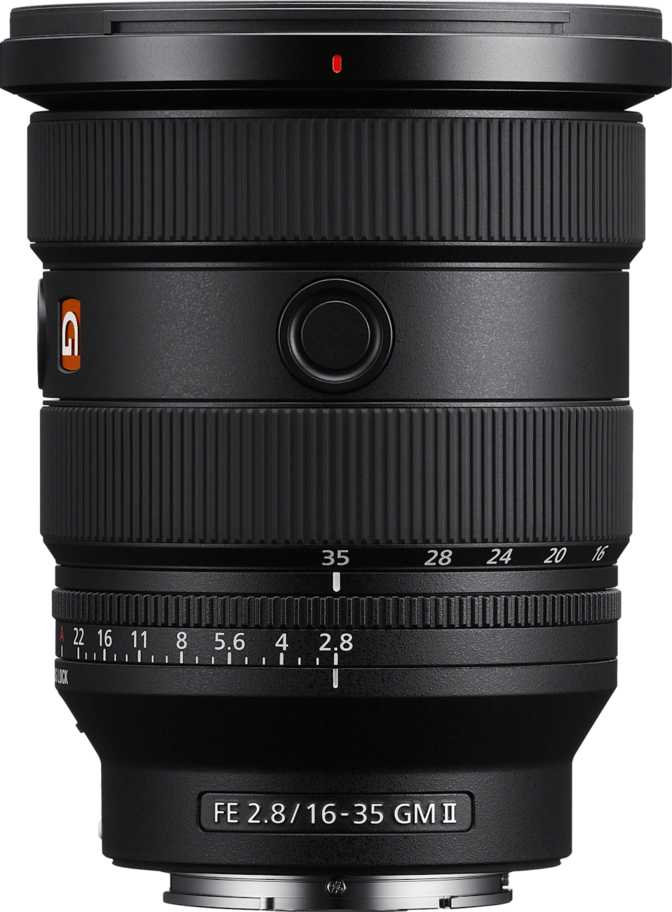
Sony FE 16-35mm f/2.8 GM II Review: The Best Wide Zoom for Sony?
Camera LensesThe Sony FE 16-35mm f/2.8 GM II is the clearest answer available to photographers asking what the best wide-angle zoom for Sony's full-frame E-mount system looks like. It combines a constant f/2.8 aperture, an unusually short minimum focus distance, eleven rounded aperture blades, and a fully weather-sealed metal build into a package that weighs less than most competing f/2.8 wide zooms.
Best suited for: wedding, documentary, landscape, and architectural photographers on Sony full-frame bodies.
What Makes This Lens Worth Your Attention
Wide-angle zoom lenses are the workhorses of professional photography. Architecture, landscape, wedding, photojournalism, astrophotography — nearly every demanding genre calls for a lens that can go wide without compromise. Sony's G Master lineup has long represented the company's commitment to optical excellence for its full-frame E-mount system, and the FE 16-35mm f/2.8 GM II represents a thorough rethinking of that promise.
It is not simply an update for the sake of a marketing cycle. The changes are substantive enough that photographers who shoot in difficult conditions, demand clean bokeh at wide angles, or need to work fast in low light will feel the difference immediately.
This is also not a lens for everyone. At this level of optical engineering, you are paying for capability that casual shooters will never unlock. Understanding exactly what this lens does — and what it asks of you in return — is the purpose of this review.
Build Quality and Physical Design
A Professional Tool Built to Last
Pick up the Sony FE 16-35mm f/2.8 GM II and the first thing you notice is that it feels serious without feeling punishing. At 547 grams, it occupies an interesting middle ground: heavier than the lightest wide zooms on the market, but meaningfully lighter than what earlier-generation f/2.8 wide zooms from any manufacturer typically weigh. For a full-frame, constant-aperture zoom covering this focal range, that weight is genuinely impressive — the kind of figure that makes a difference over a full wedding reception or a ten-hour documentary shoot.
The mount is metal, which matters more than it might sound. A metal mount ensures that repeated attachment and detachment — something working pros do dozens of times a week — will not introduce slop or play over time. It also provides a more secure mechanical foundation for the lens's weather sealing, which protects against moisture and dust intrusion.
The Details That Matter in the Field
Non-Rotating Front Element
Polarizing and graduated ND filters maintain their orientation as you adjust focus and focal length — critical for landscape work.
Full Weather Sealing
Shoot confidently in drizzle, sea spray, or dusty conditions without reaching for a rain cover every time a cloud appears.
Metal Lens Mount
Durable foundation that holds up to years of professional use and strengthens the weather-sealing interface at the camera body.
Lens Hood Included
At this price tier, you should not have to hunt for accessories separately. The hood ships in the box, ready to use.
Optical Performance: What the Specifications Actually Mean
Understanding the Focal Range
The 16-35mm zoom range covers everything from an ultra-wide perspective to a moderate wide angle. At 16mm on a full-frame sensor, you capture a 107-degree field of view — wide enough to encompass an entire cathedral interior, fit a large group in frame at close quarters, or make a mountain range feel genuinely immersive.
Pull back to 35mm and the angle of view narrows to 63 degrees, which is closer to a natural human field of vision and well-suited to environmental portraits, documentary work, and street photography where you want context without distortion. Many of the most compelling compositions happen somewhere in the 20-24mm middle ground, where breadth comes without the pronounced perspective distortion that appears at the widest settings.
- 107° field of view
- Cathedral interiors & vast landscapes
- Immersive environmental scenes
- Dramatic architectural perspectives
- 63° field of view
- Environmental portraits
- Documentary & street photography
- Natural human perspective feel
The Constant f/2.8 Aperture
The maximum aperture remains f/2.8 regardless of whether you are zoomed to 16mm or 35mm. This is not a given — many wide zoom lenses start at f/4 or even f/4.5, and kit-style wide zooms often have variable apertures that shrink as you zoom in. Constant f/2.8 across the full range carries two practical consequences that matter in real shooting situations.
Exposure settings do not need to change as you zoom. In fast-moving situations — a ceremony, a news event, a performance — this eliminates one variable and keeps your workflow fluid.
Combined with in-body stabilization on current Sony bodies, f/2.8 lets you shoot in conditions where a slower lens would force aggressive ISO increases or a tripod.
Bokeh and the Eleven-Blade Aperture Design
Eleven rounded aperture blades produce background blur that holds its circular quality even as you stop down slightly from wide open. At 35mm with the minimum focus distance, the bokeh is genuinely attractive — soft, smooth, and free of the harsh geometric outlines that lower blade-count apertures produce. Wide-angle bokeh tends to look busier and less refined than telephoto blur, so the optical design here is clearly working hard to deliver pleasing out-of-focus rendering even in this challenging focal range.
Stopped down to f/11 or f/16, starburst effects on point light sources become pronounced and visually dramatic — useful for night cityscapes, interior architectural shots, and any scene where point lights form a compositional element.
Close Focus Capability
The minimum focus distance of 22 centimeters — measured from the sensor plane — is exceptional for a wide-angle zoom of this specification. At that distance, the front element is only a few centimeters from your subject. The 0.32x maximum magnification means this lens can produce semi-macro results that a standard wide zoom simply cannot deliver.
Autofocus System
Speed and Silence
The built-in focus motor operates silently — you will not hear it during video recording, and it will not distract subjects during still photography sessions. The full-time manual focus override means you can reach for the focus ring at any moment without switching modes, which is how experienced photographers instinctively work when autofocus makes a wrong call and immediate correction is needed.
The autofocus can focus through to infinity, which matters for landscape and astrophotography where a lens needs to maintain accurate focus at the far end of its range, especially in low light when contrast-based systems can hunt.
- Silent Focus Motor
- No audible operation during video capture — essential for run-and-gun documentary and event videography.
- Full-Time Manual Override
- Grab the focus ring at any time without switching AF/MF modes. Instant correction when autofocus misjudges.
- Infinity Focus
- Accurate focus at maximum distance — critical for stars, horizons, and landscapes shot in near-darkness.
- 22cm Minimum Focus
- Snap-fast focus to subjects just centimeters from the front element — no hunting at close range.
No In-Lens Stabilization: What This Means For You
The lens does not include optical image stabilization built into the barrel. For photographers shooting on Sony Alpha bodies with in-body stabilization — which includes all current Sony full-frame mirrorless bodies — this is a non-issue. The camera's sensor-shift system cooperates with the lens's focal length data to deliver effective compensation.
For videographers, the combination of in-body stabilization and Sony's electronic stabilization modes handles most handheld shooting scenarios adequately. Shooters who prioritize extremely smooth handheld video in demanding conditions typically use a gimbal regardless of whether the lens has optical stabilization — so the absence here is unlikely to change anyone's workflow.
Why no in-lens OIS? Optical stabilization mechanisms add both weight and complexity. The decision to rely on in-body stabilization allowed the optical design to focus entirely on image quality and compactness — contributing directly to the 547-gram figure that makes this lens competitive in its class.
Real-World Usage Scenarios
Who This Lens Is Designed For
-
Wedding & Event Photographers
Ceremonies happen in dim churches. Receptions have unpredictable lighting. Couples do not postpone for rain. This lens handles all of it without stopping your workflow.
-
Landscape & Travel Photographers
The close focus capability, non-rotating front element for filters, and weather sealing cover every condition. 16mm for sweeping vistas, 35mm for intimate travel portraits.
-
Photojournalists & Documentary Shooters
Works fast, stays quiet, and survives the environments that come with the territory. Fast autofocus and manual override match the rhythm of unscripted shooting.
-
Architecture & Interior Photographers
Wide open for dim interiors, stopped down for edge-to-edge sharpness. The wide coverage and geometric control make technical architectural images achievable.
-
Video Shooters
Silent focus motor and wide coverage make small spaces feel cinematic. Ideal for documentary, narrative, and commercial productions on Sony bodies.
Who Should Look Elsewhere
-
Casual Shooters & Vacation Photographers
The Sony FE 16-35mm f/4 G, or compact wide prime options, will serve casual needs at a fraction of the cost. The capability gap will never be noticed in vacation albums.
-
Astro Photographers with Existing Fast Primes
If you already own a fast prime at 14mm or 20mm optimized for stars, the zoom flexibility of this lens may not justify the investment over your current setup.
-
APS-C Body Shooters
This is a full-frame lens. On an APS-C sensor, the crop factor shifts effective coverage significantly and weakens the rationale for this specific lens at this specific price.
Competitive Positioning
The Sony FE 16-35mm f/2.8 GM II competes in a narrow but clearly defined category: fast, full-frame wide-angle zooms for the Sony E-mount system. The relevant comparisons come down to three realistic alternatives.
| Comparison Point | Sony FE 16-35mm f/2.8 GM II | Sony FE 16-35mm f/4 G | Third-Party f/2.8 Wide Zooms |
|---|---|---|---|
| Maximum Aperture | f/2.8 constant | f/4 constant | f/2.8 constant |
| Light Advantage | Full stop faster than f/4 | — | Comparable |
| Weight | ~547g | Lighter | Often heavier |
| Weather Sealing | Varies | ||
| Minimum Focus Distance | ~22cm | ~25cm | Typically 28cm+ |
| Aperture Blades | 11 rounded | 7-blade | Varies |
| AF Integration | Native, silent | Native, silent | Adapter-dependent or native |
Versus the f/4 G: The Sony FE 16-35mm f/4 G is the rational alternative for photographers who rarely shoot in low light or need the background separation of f/2.8. It is smaller, lighter, and less expensive. If you shoot primarily in daylight and rarely push ISO limits, the f/4 version is a sound choice.
Versus Third-Party Options: Sigma, Tamron, and others have closed the optical quality gap considerably. The trade-offs tend to appear in autofocus precision under demanding conditions and service infrastructure. For working professionals, Sony ecosystem support is part of what the price includes.
Strengths and Weaknesses
Where It Excels
The constant f/2.8 aperture delivers light-gathering capability that genuinely changes what you can photograph without artificial lighting or excessive ISO adjustments. This is not a marginal improvement over f/4 — it is a full stop of light, which translates to half the exposure time or half the noise at equivalent shutter speeds.
The 22cm minimum focus distance transforms this from a landscape-only tool into something far more versatile. Finding a wide zoom that can also serve as a close-focus environmental lens is unusual at any price point.
The eleven-blade rounded aperture is a statement of intent about bokeh quality. Wide-angle lenses are not typically purchased for their out-of-focus rendering, but this one offers it genuinely — particularly at the 35mm end.
The weather-sealed metal build reflects what working professionals actually need. A tool that survives the conditions that come with the job is worth more than its optical specifications alone suggest.
Where It Asks for Compromise
The 87.8mm filter thread means the accessories ecosystem is expensive. Any circular polarizer or ND filter that fits this lens commands premium pricing. This is not a hidden cost — plan for it before purchase.
The lack of in-lens stabilization is genuinely not a problem for most Sony shooters, but it creates a dependency on in-body stabilization worth understanding clearly before committing. Shooters moving this lens between Sony bodies and cameras from other systems will not have that fallback.
At 547 grams, the weight is reasonable for what this lens is — but it still adds substantially to the total carried weight of a kit, and that accumulates over long shooting days.
The price is a statement of market positioning rather than a weakness per se, but it demands honest self-assessment. Casual photographers will never unlock the capability they are paying for.
Frequently Asked Questions
Final Verdict
The Sony FE 16-35mm f/2.8 GM II is the clearest answer available to the question: what is the best wide-angle zoom for serious Sony full-frame shooting? It does not hedge. The constant f/2.8 aperture, exceptional close focus distance, eleven-blade bokeh, weather-sealed metal construction, and silent responsive autofocus add up to a lens that removes limitations rather than introducing them.
It earns a strong recommendation for professional photographers and serious enthusiasts whose work regularly demands low-light wide-angle coverage, environmental versatility, or the credibility of a fully weather-sealed kit in unpredictable conditions. Wedding photographers, documentary shooters, and working photojournalists on Sony systems should consider this lens a cornerstone purchase rather than a luxury.
For photographers whose wide-angle needs are more occasional, or who primarily shoot in controlled and well-lit conditions, the investment requires honest self-assessment. The Sony FE 16-35mm f/4 G or third-party alternatives will deliver image quality that exceeds what most photographers can distinguish in finished work, at a meaningfully lower cost.
Full Specification Summary
| Lens Type | Wide-angle Zoom |
| Mount | Sony E (Full-Frame) |
| Weather Sealed | Yes |
| Metal Mount | Yes |
| Weight | 547g |
| Filter Diameter | 87.8mm |
| Front Element Rotation | Does not rotate |
| Lens Hood Included | Yes |
| Focal Length Range | 16–35mm |
| Angle of View | 63°–107° |
| Maximum Magnification | 0.32x |
| Optical Stabilization | None (use in-body) |
| Maximum Aperture | f/2.8 (constant) |
| Minimum Aperture | f/22 |
| Aperture Blades | 11 (rounded) |
| Minimum Focus Distance | 0.22m (22cm) |
| Built-in Focus Motor | Yes |
| Silent Motor | Yes |
| Full-Time Manual Focus | Yes |
| Infinity Focus | Yes |