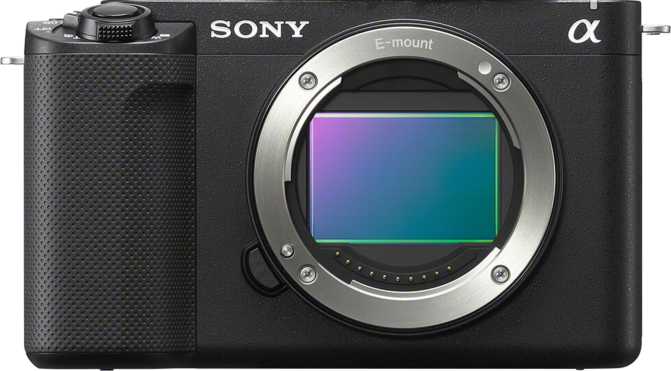
Sony Alpha ZV-E1 Review: Full-Frame Quality for Video Creators
CamerasMost cameras force a choice between serious image quality and genuine ease of use. The Sony Alpha ZV-E1 refuses that trade-off — pairing a full-frame sensor with a body designed entirely around video creation, solo operators, and creators who need both quality and speed without the bulk.
Editor's Score
Recommended for video-first creators
Performance at a Glance
Video Quality
4K/60p at 200 Mbps with cinema 24p mode
Autofocus
759-point phase-detection with subject tracking
Stabilization
5-stop CIPA-rated in-body stabilization
Battery Life
570 CIPA shots; plan for spares on long shoots
Design and Build Quality
Compact enough to hold in one hand. Serious enough to take on a professional shoot.
Physical Footprint
At 121 mm wide, 71.9 mm tall, and 54.3 mm thick, the ZV-E1 is genuinely compact for a full-frame mirrorless camera. The 483 g body weight hits a workable middle ground — light enough for extended handheld sessions, substantial enough to feel like a professional tool rather than a toy.
The grip is shallower than a traditional full-frame body, but for the camera's primary use case — one-handed vlogging and handheld shooting — it works. Operators with larger hands who shoot long telephoto sessions may find the ergonomics a stretch, but the vlogging audience this camera targets will find it natural.
Weather Sealing
The ZV-E1 carries splash resistance for real-world outdoor conditions — light rain, mist, beach proximity, and high-humidity environments are all manageable. This is not the same as full dust-and-moisture sealing on Sony's professional Alpha bodies. The operating range runs from 0°C up to 40°C, covering most practical outdoor conditions without issue.
Important: Splash-resistant does not mean weatherproof. Shooting in heavy rain, sandstorms, or extremely dusty environments falls outside the ZV-E1's design tolerance. Treat the sealing as a safety net for incidental moisture, not a green light for harsh conditions.
Physical Specifications
| Width | 121 mm |
| Height | 71.9 mm |
| Thickness | 54.3 mm |
| Weight | 483 g |
| Weather Sealed | Splash-Resistant |
| Operating Temp. | 0°C – 40°C |
| Screen | 3", 1,036,800 dots, Touch |
| Flip-Out Screen | Yes — faces forward |
| Viewfinder | None |
| Built-in Flash | None |
| Hot Shoe | Advanced Multi-Interface |
Screen and Viewfinder
The fully articulating 3-inch touchscreen is central to the ZV-E1's identity. It flips out to face the subject — essential for anyone shooting themselves — and resolves sharply enough for confident composition and focus monitoring. Tap-to-focus and swipe navigation work as expected, keeping single-operator workflows fast.
There is no electronic viewfinder. This is a deliberate design decision that reflects the camera's audience: creators who compose on a screen rather than through an eyepiece. For photographers who built their technique around an EVF, or who regularly shoot in bright sunlight where screen visibility drops, this is not a minor omission — it is a real daily limitation.
The Full-Frame Sensor — What 12.1 MP Actually Means
Resolution tells you how large an image prints. Sensor size tells you how much light each pixel captures. The ZV-E1 makes a very deliberate argument on the second point.
Resolution in Real-World Context
Twelve megapixels sounds modest when smartphones advertise 50MP or more. The ZV-E1 makes a different argument entirely. With a full-frame BSI CMOS sensor, each pixel is physically much larger than what you find on a crop-sensor body or a phone, which means each one collects significantly more light.
In low light, this translates to less grain, better tonal gradation, and cleaner shadows — advantages no software processing can fully replicate from a smaller starting point. For video, where output resolution rarely exceeds 4K regardless of sensor resolution, this full-frame approach is exactly the right trade-off.
For web delivery, social content, and standard prints up to A2, 12.1 MP is entirely sufficient. For those who crop aggressively, shoot billboards, or need extensive reframing flexibility in post, the resolution ceiling will become a genuine constraint.
Sensor Technology and Processor
The backside-illuminated design repositions the sensor's circuitry behind the light-sensitive layer rather than in front of it. The wiring that would otherwise partially block incoming light is moved out of the way, improving dynamic range — the camera's ability to hold detail simultaneously in bright highlights and deep shadows.
Sony's Bionz XR processor handles the raw sensor data at high speed, enabling the dense autofocus calculations, high-bitrate video encoding, and fast continuous capture the ZV-E1 offers. This is the same processor architecture found in Sony's higher-tier bodies, not a scaled-down variant.
Sensor Specifications
- Sensor FormatFull Frame
- Resolution12.1 MP
- Sensor TypeBSI CMOS
- ProcessorBionz XR
- Native ISO RangeUp to 102,400
- Expanded ISOUp to 409,600
Low-Light Performance in Plain Terms
The native ISO ceiling of 102,400 means the ZV-E1 can produce usable footage in near-darkness — candlelit venues, evening outdoor shoots, and indoor spaces with minimal lighting are all within practical range. Expanded sensitivity beyond that is available but introduces visible noise; for most real-world creative scenarios, you will rarely need it.
Autofocus — 759 Points, Phase-Detection, Subject Tracking
For a camera used frequently by solo operators, autofocus reliability is not a feature — it is a fundamental requirement.
The ZV-E1 uses phase-detection autofocus across a dense grid of 759 points covering the frame. Phase-detection works by comparing two slightly offset views of a subject to calculate not only whether focus is off, but in which direction and by how much. This makes corrections faster and more decisive than older contrast-detection systems that had to hunt back and forth before settling.
AF tracking operates continuously for both photography and video. The system locks on to a subject and maintains focus even as it moves toward or away from the camera, changes position within the frame, or temporarily moves out of sight. For operators who are also the subject — setting a camera on a tripod, stepping in front of it, and moving naturally — this tracking reliability is a significant practical advantage.
Touch autofocus allows tapping a subject on the flip-out screen to initiate tracking. Combined with the screen's forward-facing position, this makes subject selection intuitive even when the operator cannot see what the camera is looking at from the shooting position.
AF System Features
- 759 phase-detection focus points
- Phase-detection active in video
- Continuous AF during recording
- Subject tracking enabled
- Touch-to-track on touchscreen
- Manual focus override
Video Performance — The Core Capability
Video is not an afterthought on the ZV-E1. It is the primary design brief, and the specifications reflect that priority at every level.
4K
Max Resolution
60fps
Max Frame Rate at 4K
200
Mbps Internal Bitrate
24p
Cinema Mode Available
Resolution, Frame Rates, and Cinema Mode
The ZV-E1 records 4K video at up to 60 frames per second — smooth enough for fast-motion content and high enough quality for any professional delivery platform. At 24 frames per second, the camera includes a dedicated cinema mode that produces the characteristic motion blur and temporal rhythm associated with film, giving footage a more polished, cinematic feel without any post-processing.
Slow-motion recording is also supported, allowing creators to capture footage intentionally for speed-ramping and dramatic slow-down effects in editing. Timelapse recording is built in natively as well, covering the full range of temporal effects a creator might need.
Bitrate — Why 200 Mbps Matters
At 200 Mbps, the camera captures a large volume of image data per second of video. Higher bitrate means more visual information is preserved per frame — finer color transitions, more detail in shadow regions, and cleaner results when footage is color graded, composited, or heavily processed in post-production.
Many consumer-oriented cameras record at 50–100 Mbps internally. The ZV-E1's ceiling of 200 Mbps places it alongside cameras positioned significantly further up the professional ladder. For creators who deliver finished work to clients, or who spend significant time in color grading, this headroom is genuinely useful.
HDMI Output and External Recording
The full-size HDMI 2.0 output allows the ZV-E1 to feed a clean signal to an external recorder or streaming encoder. For productions that require even higher-quality capture than internal recording allows — or for livestream setups that route video into dedicated encoding hardware — this is a production-ready connection that requires no adapters or converters.
Audio Infrastructure
Video quality is only half the equation. Audio design on the ZV-E1 reflects the same seriousness as the imaging hardware.
The ZV-E1 carries both a 3.5 mm microphone input for standard external microphones and Sony's Multi Interface Shoe for digital audio connection from compatible Sony microphones — no cable required for the latter, which keeps rigs clean and removes a common point of failure. The built-in stereo array uses two capsules for directional recording adequate for casual content without any additional accessories.
A 3.5 mm monitoring output allows real-time audio playback while recording, which is essential for catching audio problems — wind, clipping, interference — before they ruin a take rather than after it.
For serious voice recording, particularly in environments with ambient noise, an external microphone will produce substantially better results than the built-in array. The infrastructure to support one — both connections, the monitoring output, and the digital hot shoe — is all present.
Audio Connections
- 3.5 mm external microphone input
- 3.5 mm headphone monitoring
- Digital audio via Multi-Interface Shoe
- Built-in dual-capsule stereo mic
- No built-in speaker
Image Stabilization — 5 Stops Explained
The ZV-E1 uses in-body sensor-shift stabilization rated at 5 stops by CIPA — the photography industry's standardized methodology for comparing stabilization performance across manufacturers. Five stops of compensation means the camera can theoretically produce sharp results at shutter speeds 32 times longer than an unstabilized camera would allow.
In practical video terms, this reduces the micro-tremor, sway, and shake that accumulates during handheld walking shots, reaching movements, or operating in any situation where holding perfectly still is not realistic. It does not replace a gimbal for smooth cinematic motion, but it substantially raises the floor of what handheld footage looks like before any post-stabilization is applied.
Where the ZV-E1 uses a lens with its own optical stabilization, the in-body and in-lens systems combine for enhanced performance — particularly relevant at longer focal lengths where camera shake is magnified.
5 Stops
CIPA-Rated In-Body Stabilization
Lens + Body Combined Stabilization
SupportedBattery Life and Power Management
Sony rates the ZV-E1 at 570 shots under CIPA testing conditions — a methodology that measures still photography with regular standby periods between captures. This consistently underestimates what the battery delivers during continuous video recording, which involves sustained sensor readout, continuous autofocus calculation, and a live screen running throughout.
For a typical vlogging session of 30–60 minutes of active recording with the flip-out screen in use, one charge covers the session comfortably. For full-day event coverage, travel days with unpredictable shooting patterns, or live streaming over multiple hours, carrying a spare battery is essential planning rather than optional preparation.
The USB-C port supports charging while shooting, meaning a connected power bank keeps the camera running indefinitely when mobility is not required — streaming setups, desk-based content, studio interviews, and any situation where the camera is stationary. The battery is also removable, so a fully charged spare swaps in within seconds when it matters.
Power Specifications
- CIPA Rating570 shots
- Battery Capacity2,280 mAh
- Removable BatteryYes
- USB-C ChargingYes (USB 3.2)
- Charge While ShootingYes
- Battery IndicatorOn-screen
Plan for a spare battery on shoots exceeding 60 minutes of continuous video. For fully stationary setups, USB-C power bank passthrough eliminates the concern entirely.
Connectivity and Integration
The ZV-E1's connectivity suite is built around the modern creator workflow — not the traditional photography studio.
| Feature | Specification | Practical Use |
|---|---|---|
| Wi-Fi | Wi-Fi 4 + Wi-Fi 5 (802.11ac) | Fast file transfer, remote camera control from smartphone |
| Bluetooth | Bluetooth 4.2 | Low-energy persistent connection; smartphone GPS tagging, remote triggering |
| USB | USB Type-C, USB 3.2 | Fast file transfer, charging in-use, tethered shooting |
| HDMI | HDMI 2.0 | External recorder output, streaming encoder connection |
| Live Streaming | First-party supported | Direct platform streaming without a capture card |
| Remote Smartphone | Supported | Full camera control and image transfer via Sony's companion app |
| GPS | None built-in | Location data via Bluetooth phone pairing only |
| NFC | Not available | Quick-tap pairing not supported |
| Memory Card | Single slot | No redundant backup recording |
Live Streaming Support
Native live streaming support means the ZV-E1 can connect directly to compatible devices or encoder hardware via USB or HDMI and stream to platforms without an intermediate computer running capture software. For creators who broadcast regularly, this simplifies the setup considerably and removes one layer of potential technical failure.
GPS — A Workaround, Not a Solution
Location tagging depends on Bluetooth pairing with a smartphone running Sony's Imaging Edge Mobile app, which pipes GPS coordinates from the phone into image metadata. It works, but requires the phone to be nearby and the app to be active during the shoot. For those who rely on automatic geotagging, this dependency is worth knowing about in advance.
Lens Ecosystem — The Sony E Mount Advantage
The ZV-E1 uses Sony's E mount — the broadest native mirrorless lens ecosystem currently available from any manufacturer. This covers dedicated full-frame lenses across every focal length and aperture class, APS-C lenses (usable with a slight automatic crop), and legacy glass from other manufacturers via readily available adapters.
Wide primes for vlogging, compact zooms for travel, fast portrait lenses for interview setups — the E mount library covers every creative scenario without compromise. For existing Sony Alpha users upgrading from an APS-C body, every lens they already own will work on the ZV-E1 from day one.
Sony E Mount
Broadest mirrorless ecosystem available
- Full-frame E-mount lenses
- APS-C E-mount lenses (with crop)
- Third-party native lenses
- Legacy glass via adapters
Who Should Buy the ZV-E1 — And Who Should Not
- You are a video-first content creator who wants full-frame image quality without a steep manual learning curve or a large, heavy system
- You vlog or operate solo and need autofocus that works reliably when you cannot supervise the camera
- You are a hybrid shooter who prioritizes video but occasionally needs competent stills for thumbnails or secondary content
- You want native live streaming capability without investing in a separate capture card setup
- You are an existing Sony E-mount user who wants a compact full-frame second body compatible with your current lenses
- You primarily shoot sports or action and need high resolution, a fast buffer, and extensive burst capability for continuous sequential capture
- A viewfinder is non-negotiable for your shooting style — bright outdoor conditions or eye-level composition will frustrate you daily
- You run professional video productions that require dual-card redundancy, higher internal codec tiers, or full broadcast specification compliance
- You need a high-megapixel primary photo body for large-format prints, heavy cropping, or professional portrait deliverables
- You are starting from zero lenses on a tight budget — full-frame E-mount glass adds meaningfully to the total system cost
Competitive Positioning
How the ZV-E1 sits against the most logical alternatives a buyer in this category would consider.
| Consideration | ZV-E1 | APS-C Vlogging Cameras | Full-Frame Competitors |
|---|---|---|---|
| Sensor Size | Full-Frame | Smaller — APS-C | Full-Frame |
| Body Weight | ~483 g — compact for FF | Generally lighter | Generally heavier |
| Viewfinder | None | Some models include EVF | Most include EVF |
| Autofocus | 759-pt phase-detection | Varies widely by model | Comparable tier |
| Video Bitrate | 200 Mbps | Typically 50–100 Mbps | Broadly comparable |
| Lens Ecosystem | Sony E — broadest mirrorless | Varies by brand/mount | Varies by brand/mount |
| Audio Inputs | 3.5 mm + digital hot shoe | Varies; some lack inputs | Generally comparable |
| Live Streaming | First-party support | Varies by model | Varies by model |
| Dual Card Slots | No | Rarely at this tier | Often yes |
APS-C alternatives offer a lighter, lower-cost starting point but cannot match the low-light performance and depth-of-field rendering of a full-frame sensor. Full-frame competitors from other manufacturers bring comparable capability but lack access to Sony's mature E-mount ecosystem and, in many cases, trail Sony's autofocus system for continuous video subject tracking.
An Honest Assessment
Where the ZV-E1 genuinely excels, and where it honestly gives ground.
Where It Excels
The ZV-E1 makes a compelling case on the strength of three things working together: sensor quality, autofocus reliability, and a form factor that does not punish the user for wanting portability. A full-frame BSI sensor with Sony's top-tier processor and 759-point phase-detection is not a beginner specification set wearing creator-friendly clothing — this is genuinely capable imaging hardware in a deliberately accessible body.
The 5-stop stabilization rating is a real differentiator in the handheld video scenarios the camera was built around — not a headline figure that collapses under real-world use. Creators who rely on smooth handheld footage will notice the difference immediately compared to less well-stabilized alternatives.
The audio infrastructure — dual microphone input paths, headphone monitoring, and digital hot shoe — is more complete than the majority of cameras at any price point in the creator-focused category. It is the kind of thoughtful, practical design that separates cameras built by people who understand the workflow from those that simply checklist the features.
Where It Gives Ground
The absence of a viewfinder is the most significant ergonomic limitation, and it will affect more than just photographers who prefer eye-level composition. In direct sunlight, screen-only shooting becomes a genuine practical obstacle. For anyone who spent years developing technique around an EVF, the adjustment is real and daily.
The single memory card slot is a trade-off that professional workflows cannot easily absorb. Redundant recording — writing the same footage to two cards simultaneously — is standard practice when a missed take cannot be reshot. For professional productions, this is a hard limitation, not a minor inconvenience.
The 12.1 MP ceiling will never trouble a video creator, but still photographers considering the ZV-E1 as a primary photo body should honestly audit their needs. Aggressive cropping, large-format printing, and high-resolution commercial deliverables are scenarios where more megapixels translate directly into more options — and the ZV-E1 cannot offer them.
Common Questions — Answered Directly
The questions real buyers search for before committing to the ZV-E1.
Final Verdict
The Sony Alpha ZV-E1 is the right camera for a specific, well-defined creator: someone who wants full-frame image quality, trusts their camera's autofocus to work without constant supervision, shoots primarily video, and refuses to carry a heavy system to do it. It does not try to be everything to everyone, and the product is better for that honest focus.
The missing viewfinder and single card slot are real limitations that matter to specific users — but to the audience this camera was designed for, they are acceptable trade-offs for a compact, full-frame, video-optimized body with one of the most reliable autofocus systems in the mirrorless category, 5 stops of in-body stabilization, and a 200 Mbps internal bitrate ceiling that outpaces most of its competition.
Overall Score
Ideal for video-first content creators, vloggers, and solo operators who want full-frame quality in a compact, capable package.