Samsung QN83S90HAEXZA 83-Inch OLED: Full Review and Honest Verdict
TVsQuick Take
Samsung QN83S90HAEXZA — 83-Inch 4K OLED Smart TV with 165Hz and Four HDMI 2.1 Ports
Category Ratings
At a Glance
- 83-inch OLED — true infinite contrast at this scale
- 165Hz with Nvidia G-Sync and AMD FreeSync Premium Pro
- Four full-bandwidth HDMI 2.1 ports
- HDR10, HDR10+, Dolby Vision, and HLG — all formats covered
- Wi-Fi 6E, Bluetooth 5.3, and wired Ethernet
- Built-in subwoofer with Dolby Atmos decoding
- No 3.5mm headphone jack; one-year warranty only
Display: What OLED at 83 Inches Really Delivers
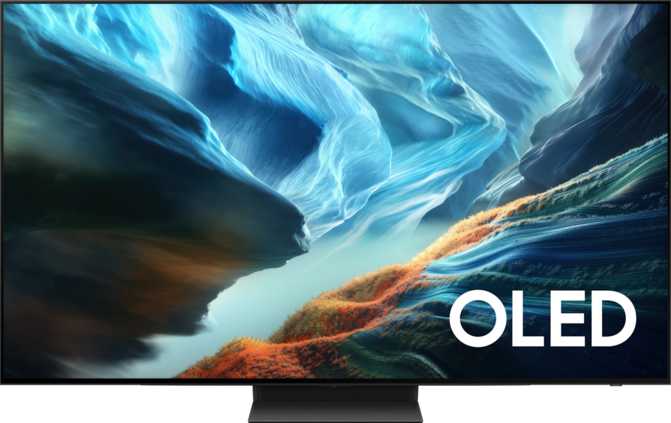
Most large-screen televisions force a compromise between screen size and contrast quality. The Samsung QN83S90HAEXZA refuses that trade-off — pairing self-emissive OLED technology with an 83-inch canvas to produce an image that backlit LCD alternatives at this scale simply cannot match.
Self-Emissive OLED: Why It Matters at This Size
Unlike a conventional LED television where a backlight shines through a liquid crystal layer, every pixel in an OLED panel generates its own light and can switch itself completely off. The practical result is true black levels and contrast ratios that are effectively infinite.
On an 83-inch screen, this matters more than on a smaller one. When seated at a comfortable distance from a display this large, your peripheral vision is fully engaged. Blooming — the faint halo of light around bright objects against dark backgrounds, common in edge-lit LCD televisions — becomes harder to ignore at this scale. With OLED, that artifact does not exist.
4K Resolution and 10-Bit Color in Real-World Terms
The panel resolves 3,840 by 2,160 pixels across 82.5 inches of actual viewable area. At a typical lounge distance of 10 to 12 feet, the human eye cannot resolve individual pixels — the image appears continuous and film-like, even in close-up facial shots or fine architectural detail.
The panel's 10-bit color depth produces over a billion distinct color values rather than the 16 million available on an 8-bit display. In practice, this eliminates the visible color banding that appears in smooth gradients like sunsets, fog, and skin tones on lesser panels.
HDR Format Support — Every Major Standard Covered
Supporting all four major HDR formats means you will never encounter content that this television cannot display in its intended format. You buy it once; it handles whatever standard your streaming service or disc library uses, now and for the foreseeable future.
HDR10
The open baseline standard used by most streaming services and 4K Blu-ray discs. Universal format compatibility guaranteed.
HDR10+
Dynamic metadata adjusts brightness and contrast scene by scene for more precise HDR rendering throughout a film or series.
Dolby Vision
Licensed, scene-by-scene optimization heavily used by Apple TV+, Netflix, and Disney+ for their premium catalogue titles.
HLG
Hybrid Log-Gamma — the broadcast standard for live HDR television transmissions, covering live sports and broadcast events.
178-Degree Viewing Angles
Both horizontal and vertical viewing angles reach 178 degrees — essentially edge-to-edge. Because each pixel emits its own light rather than transmitting a backlight, color accuracy and contrast hold stable even from extreme off-axis positions. Households where viewers watch from couches arranged at angles to the screen will notice this advantage immediately compared to VA-panel LCD alternatives that shift visibly in color and contrast when viewed off-center.
Anti-Reflection and Adaptive Brightness
The anti-reflection coating diffuses incoming light rather than returning it as a mirror image. The built-in ambient light sensor automatically adjusts the panel's output as room lighting changes — practical in everyday use and acting as a form of panel management by reducing brightness output when extra luminance would go unnoticed by the viewer.
Gaming Performance: Built for Competitive and Cinematic Play
The S90H 83 carries a gaming specification that exceeds many dedicated gaming monitors. Between the refresh rate, the adaptive sync suite, and the HDMI connectivity, this is a television that current and near-future gaming hardware cannot outpace.
165Hz Refresh Rate
At 165 refreshes per second, this television accepts frame rates up to 120fps natively from a gaming console or PC — a significant step up from the 60fps ceiling that older televisions impose. The headroom beyond 120Hz also allows the panel's processing to operate without artificially capping input signal quality.
Nvidia G-Sync
Synchronizes the display's refresh cycle to your Nvidia GPU's output in real time, eliminating screen tearing and stutter regardless of whether the frame rate is fluctuating between 60 and 120fps. Particularly valuable in open-world titles and fast-paced games where rendering pace is naturally variable.
FreeSync Premium Pro
The highest tier of AMD's FreeSync certification requires low framerate compensation — sync stays active below 48fps — plus full HDR support within the sync range. This is the most demanding certification for cinematic and HDR gaming scenarios, not a baseline compatibility claim.
Four HDMI 2.1 Ports — A Meaningful Advantage
HDMI 2.1 is the only version capable of carrying an uncompressed 4K signal at 120 frames per second. Budget and mid-range televisions typically include only one or two HDMI 2.1 ports, forcing you to choose which device gets the premium connection. On the S90H, all four HDMI inputs run the full 2.1 specification — a PlayStation 5, Xbox Series X, gaming PC, and streaming device can all be connected simultaneously without compromise. Port 1 additionally carries eARC for lossless audio passthrough to a capable soundbar or receiver.
Physical Connections Reference
| Connection Type | Quantity | Notable Specification |
|---|---|---|
| HDMI | 4 | All HDMI 2.1; Port 1 supports both ARC and eARC |
| USB | 3 | Supports direct recording of broadcast TV to an external drive |
| Ethernet (RJ-45) | 1 | Wired network; preferred for gaming and 4K streaming |
| Optical Audio Out | 1 | Digital audio passthrough to external receivers and soundbars |
| 3.5mm Headphone | 0 | Not present — Bluetooth or eARC soundbar required for private listening |
| VGA / DVI | 0 | Legacy formats not supported |
Built-In Audio: Better Than Most, Not a Substitute
The audio system in the QN83S90HAEXZA is a genuine step above what most flat-panel televisions produce — but the physical constraints of a 45mm chassis mean buyers with serious audio expectations should still budget for an external solution.
Stereo Speakers with Dedicated Subwoofer
Most flat-panel televisions produce no meaningful bass frequencies because their enclosures cannot move enough air. The presence of a physical subwoofer driver in this chassis produces audible low-frequency output that brings a sense of physical weight to explosions, music, and cinematic scores — an inclusion that most competitor televisions at this price tier cannot match natively.
The stereo speaker array decodes Dolby Atmos natively. Atmos is an object-based audio format where sound designers position individual elements in three-dimensional space rather than mixing them into fixed channels. On these built-in speakers, Atmos produces a wider, more spatially convincing soundstage than standard stereo — though it cannot replicate what a full surround sound system delivers.
Audio Format Compatibility
- Dolby Atmos — decoded natively by the built-in speaker system
- Dolby Digital & Dolby Digital Plus — covers all compressed streaming and disc sources
- Dolby Audio — broad compatibility layer for mixed-format content sources
- HDMI eARC (Port 1) — passes lossless Dolby Atmos to a compatible external soundbar or AV receiver
- Optical Digital Out — compatible with legacy receivers and soundbars via optical cable
Smart TV Features and Wireless Connectivity
The QN83S90HAEXZA integrates with virtually every major smart home and streaming ecosystem. Whether your household runs on Google, Amazon, or Apple devices, this television has a native or cast-based entry point for your content and control workflows.
Voice Assistant Compatibility
Casting and Wireless Standards
-
AirPlay 2iPhone, iPad, and Mac users mirror or cast content directly to the screen without any app installed on the television's side.
-
Chromecast Built-InCast directly from any Android phone, tablet, or Chrome browser without a separate Chromecast dongle.
-
Wi-Fi 6E (802.11ax — 6GHz Band)The newest consumer Wi-Fi standard. Lower latency and higher sustained throughput than Wi-Fi 5 — relevant for 4K HDR streaming and gaming responsiveness over a wireless connection.
-
Bluetooth 5.3Superior range and connection stability compared to older Bluetooth versions. Handles wireless audio output and smartphone remote control simultaneously.
-
Miracast and USB RecordingWireless display mirroring support plus native recording of broadcast television to an external USB drive — a subscription-free local DVR option that is increasingly rare on smart TVs.
Physical Design, Size, and Installation Considerations
An 83-inch television is a commitment to the room it inhabits. Before the picture quality becomes relevant, the physical reality of this display deserves careful consideration.
Dimensions
Width: 185.1 cm
Height: 106.3 cm
Depth: 4.5 cm
The depth of approximately 45mm is reasonable for an OLED panel at this size — it sits closer to the wall than any edge-lit LCD of comparable scale.
Weight and Handling
The set weighs approximately 39.4 kilograms without a stand. Two people are required for safe installation and positioning.
Wall mounting demands a bracket rated for this load. The wall structure itself must be verified for adequacy — standard drywall anchors alone are insufficient at this weight.
Operating Environment
Rated operating range: 10°C to 40°C. This covers the vast majority of interior living spaces without concern.
Unheated garages, outbuildings, or environments near direct sustained heat sources should be evaluated against these limits before permanent installation.
VESA Mount Compatibility
Standard VESA mounting patterns are supported, making the television compatible with a wide range of third-party wall brackets — fixed, tilting, and full-motion articulating arms. Verifying the specific VESA hole pattern dimensions before purchasing a bracket is advisable, as larger televisions often use non-standard spacing.
Power Consumption
Under normal viewing conditions, the panel draws around 232 watts. On standby, consumption drops to half a watt — negligible. At 232W during operation, annual electricity cost depends on usage hours and local rates, but is broadly comparable to other large-screen premium televisions. OLED panels at this screen size have historically consumed more power than smaller OLED panels, and this figure reflects that reality.
Who Should Buy This — and Who Should Not
The QN83S90HAEXZA is a high-specialization product. Understanding whether your usage patterns align with its strengths is the most important question you can ask before purchasing at this price level.
-
The Dedicated Home Cinema EnthusiastViewers who want the largest OLED screen available in a controlled-lighting room will find this television challenges dedicated projector setups at a fraction of the complexity.
-
The Serious Console or PC GamerBuyers who refuse to accept a smaller gaming monitor but want OLED black levels, 120fps, adaptive sync, and all four devices connected via HDMI 2.1 simultaneously will find this set checks every box.
-
Multi-Ecosystem HouseholdsHouseholds mixing Android phones, iPhones, Chromecasts, and voice assistants benefit from this television's unusually broad compatibility across Google, Amazon, and Apple casting platforms.
-
Bright Rooms with Uncontrolled WindowsWhile the anti-reflection coating helps, OLED peak brightness limitations mean a premium high-output QLED may sustain better image quality in rooms dominated by direct daylight.
-
Apple HomeKit HouseholdsAirPlay content casting works, but the television does not appear as a native HomeKit device. Smart home automation with Apple's platform requires workarounds.
-
Budget-Conscious BuyersBuyers who primarily watch broadcast and standard streaming content without gaming will not extract proportional value from the gaming-focused specification. A smaller OLED at mid-range pricing serves them better.
Competitive Positioning: How It Compares
The realistic competition for the S90H 83 sits in two categories: other large-format OLED displays, and large-format premium LCD televisions. Understanding the trade-offs clarifies the purchase decision without ambiguity.
| Feature Area | Samsung S90H 83" | Large QLED Alternative | Smaller OLED (65"–77") |
|---|---|---|---|
| Black Level / Contrast | True infinite contrast | Deep but not absolute — backlight always present | Same OLED advantage |
| Peak Brightness | High for OLED; not the absolute brightest overall | Often higher peak output | Comparable to S90H |
| Screen Size | Maximum OLED at 83" | Available at 85"–98" | 65" to 77" only |
| Gaming Spec (120fps, VRR) | Full HDMI 2.1 x4, 165Hz | Varies by model and price tier | Similar specification range |
| Bright Room Performance | Good with coating — not the best overall | Better in direct light conditions | Comparable to S90H |
| Viewing Angle Consistency | OLED — stable edge-to-edge | VA panels shift noticeably off-axis | Same OLED advantage |
| Typical Relative Cost | Premium — flagship tier | Varies widely; often lower | Lower than the S90H 83" |
The core argument for the S90H over a premium QLED competitor is contrast performance and viewing angle consistency. The argument against it is peak brightness in very bright rooms. The argument for choosing a smaller OLED is purely cost and physical space — the panel technology and picture quality are comparable.
Questions Buyers Ask Before Purchasing
These are the specific questions that come up repeatedly when buyers research a television at this scale and price level. Answered directly, without hedging.
Final Verdict
The Samsung QN83S90HAEXZA makes an almost irresistible case on paper, and much of that translates directly to real-world performance.
The combination of OLED contrast with an 83-inch screen size is genuinely rare, and the gaming specification — 165Hz, full HDMI 2.1 on every port, G-Sync, FreeSync Premium Pro — exceeds what most televisions twice the price offered just a few years ago.
The HDR format support deserves specific credit. Supporting HDR10+, Dolby Vision, and HLG simultaneously means there is no content you cannot watch in its intended format — a frustration point that has historically affected Samsung televisions is addressed here.
The weaknesses are real but targeted. The absence of a headphone jack is an inconvenience rather than a flaw. The one-year warranty is modest for a flagship purchase at this price level — extended coverage is worth factoring into your budget. The television's performance in bright, sun-lit rooms, while aided by the anti-reflection coating, remains the weak point of OLED technology at any size; this is a screen that performs best when you control the ambient light.
Core Strengths
- Exceptional OLED contrast at maximum 83-inch scale
- Complete HDR ecosystem — all four major formats supported
- Four HDMI 2.1 ports with 165Hz and full adaptive sync suite
- 178-degree viewing angles hold stable from any position
- Broad smart platform coverage — Google, Amazon, and Apple casting
Key Limitations
- Bright room performance lags behind high-output LCD alternatives
- No 3.5mm headphone jack — private listening requires workarounds
- One-year warranty only on a significant investment
- No native Apple HomeKit support — AirPlay casting only
- Built-in bass, while improved, does not replace a soundbar