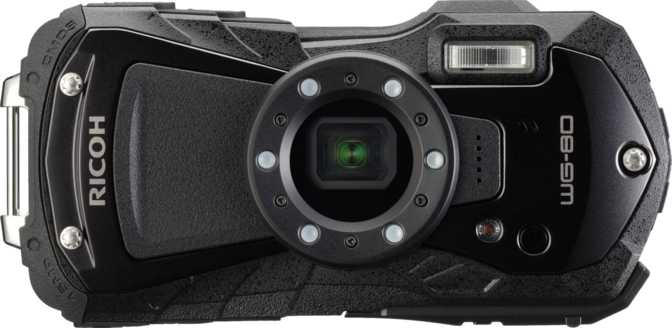
Ricoh WG-80 Full Review: Tough Enough for Real Adventures?
CamerasMost cameras ask you to protect them. The Ricoh WG-80 flips that relationship — it is designed to go places you would normally leave your camera behind. Poolside, in the rain, on a snowfield, or handed to a child with no concept of fragile things. If you have ever missed a shot because conditions were too wet, too cold, or too chaotic for a normal compact, this camera was built for exactly that frustration. What follows cuts through the rugged-camera marketing to tell you what the WG-80 actually delivers — and where it genuinely falls short.
Overall Rating
out of 5
Design, Build Quality, and Physical Experience
Physical Toughness
The WG-80 is waterproof to a depth of 14 meters — not splashproof, not shower-resistant. You can take this camera snorkeling, into a wave pool, or submerge it in a lake and it will come back working. That depth rating puts it firmly in serious underwater photography territory for recreational divers and snorkelers without requiring any additional housing.
14-meter waterproof depth is among the deepest ratings in the rugged compact category — deep enough for snorkeling and most recreational diving scenarios.
Cold-weather resilience is equally real. The camera operates down to -10°C, covering skiing, ice fishing, winter hiking, and most harsh-weather shooting situations short of polar expeditions. The body is also sealed against dust and impacts — this is a camera built for environments where others go to die.
Size, Weight, and Handling
At roughly 122mm wide, 61mm tall, and just under 30mm thick, the WG-80 sits comfortably in a jacket pocket or small gear bag. It weighs 194 grams — light enough to forget you are carrying it, dense enough to feel like something worth carrying. For a rugged camera with this level of weather protection, that is a genuinely compact package.
The body carries no hot shoe, no flip-out screen, and no touch input on the display. The fixed 2.7-inch rear screen delivers adequate resolution for framing and basic review, but do not expect the clarity you would find on a premium mirrorless. The absence of touch control is a real limitation for anyone accustomed to tap-to-focus on a smartphone.
Physical Specifications
-
Waterproof Depth14 meters
-
Cold ResistanceOperates down to -10°C
-
Dimensions122.5 × 61.5 × 29.5 mm
-
Weight194 g
-
Rear Screen2.7″ fixed, 230,000 dots — no touch
-
Built-in FlashYes — no external flash supported
Image Quality and Optical Performance
The Sensor
The WG-80 uses a 16-megapixel back-illuminated CMOS sensor. Back-illumination (BSI) rearranges the internal architecture so more light reaches each pixel — in practical terms, this produces cleaner results in dim conditions than a conventional sensor of the same resolution. That matters more than you might expect for a camera used in caves, under canopies, or in the shade of a waterfall.
Sixteen megapixels is ample for prints up to A3, large screen displays, and all social media formats. Heavy cropping will expose the resolution's limits faster than on a higher-resolution system — but for the scenarios this camera is designed for, it is comfortably sufficient.
The Lens and Zoom Range
The built-in lens covers a 5x optical range. The widest setting suits landscapes, group shots, and interiors well. At maximum zoom, you can bring in a distant subject at a focal length that handles wildlife, sports, and travel photography adequately without being extreme.
Wide open, the lens admits a moderate amount of light at its widest setting — typical for this class of zoom. As you zoom in, the aperture narrows, meaning zoomed-in shots in lower light will rely on the camera's stabilisation or burst mode for clean results. In good light, the zoom performs its job reliably.
Stabilisation and Sharpness
Sensor-shift stabilisation is built in — the sensor itself moves to counteract hand shake rather than relying on electronic compensation alone. This is a meaningful advantage for handheld shots at slower shutter speeds or when zoomed in. For travel and outdoor photography where tripods are inconvenient, this system provides a real-world buffer against blur.
The fastest available shutter speed is 1/4000th of a second — quick enough to freeze most action: a jumping child, a breaking wave, a cyclist. At the opposite end, exposures can stretch to 4 seconds for low-light or creative long-exposure work.
Focus System and Low-Light Sensitivity
The autofocus uses contrast detection across 9 focus points, with AF tracking that follows a moving subject across the frame. Contrast-detection AF is inherently slower than phase-detection systems found on more expensive cameras — in good light it is reliable, but expect hesitation in dim conditions or with fast-moving subjects. Manual focus override is available for tricky situations such as shooting through glass or underwater macro work.
The maximum sensitivity tops out at ISO 6400. The BSI sensor keeps images cleaner than older designs at elevated settings, but images will show noise beyond ISO 800–1600. Set realistic expectations and the WG-80 holds up well in daylight and moderate indoor light.
Burst Mode and Video Recording
Burst Shooting Speed
The WG-80's continuous shooting speed is notably high for this category — it captures rapid sequences that let you select the precise moment rather than gambling on a single frame. For jumping swimmers, birthday cake blowouts, or wildlife that refuses to cooperate, this speed advantage is genuinely useful and stands out against competitors at the same price point.
The camera shoots JPEG only — there is no RAW option — which means burst buffers clear relatively quickly. For the scenarios this camera handles, JPEG output is acceptable, but photographers who expect to do significant post-processing will feel the limitation immediately.
Video Recording
Video tops out at Full HD with continuous autofocus that works during recording — preventing the jarring loss-of-focus that plagues some cameras when subjects move. A timelapse function is also built in, adding a useful creative tool without any accessories.
What is not here is just as important: no 4K, no cinema mode, and no slow-motion capability. A single built-in microphone handles all audio — there is no microphone input port, no headphone jack, and no stereo recording. Wind noise outdoors is a persistent weakness of any sealed, single-microphone setup.
Battery Life and Connectivity
How Long Between Charges
The battery is rated to approximately 300 shots per charge under standardised test conditions. Real-world use — frequent image review, short video clips, or shooting in cold weather where batteries discharge faster — will bring that number down. One charge covers a half-day excursion comfortably, but for multi-day trips without reliable power, a spare battery is a necessity rather than a luxury.
The battery is user-removable — you can swap a dead cell for a charged spare in seconds without hunting for an outlet. That practical advantage partially offsets the modest total capacity.
Cold weather accelerates battery drain — carry a spare inside a warm inner pocket on winter outings.
Connectivity and Ports
Charging and data transfer use a USB 2.0 connection. There is no USB-C port — the older connector is a genuine inconvenience in a world where most bags carry only USB-C cables. Plan to keep the original cable with the camera at all times.
HDMI output is available, allowing images and video to be displayed on a TV or monitor directly from the camera — useful for reviewing shots on a larger screen after a day out.
There is no Wi-Fi, no NFC, no Bluetooth, and no GPS. Images transfer via cable or by removing the memory card physically. The onboard storage holds only a handful of shots — an external memory card is essential from day one. If instant wireless sharing or automatic location tagging matters to you, this camera cannot deliver it.
Key Features Explained
What the specifications actually mean for everyday use.
14m Waterproofing
Covers snorkeling, wave pools, and shallow recreational diving — no housing required.
-10°C Cold Operation
Reliable on ski slopes, winter hikes, and ice fishing — keeps shooting where others shut down.
BSI CMOS Sensor
Back-illuminated design captures more light per pixel — cleaner shots in shade and mixed lighting.
Sensor-Shift Stabilisation
Physically counteracts hand movement — sharper handheld shots at slower shutter speeds.
5x Optical Zoom
Versatile range from wide-angle landscapes to mid-telephoto wildlife — all in your pocket.
High-Speed Burst Mode
Rapid sequential shooting lets you pick the perfect frame from action sequences rather than guessing.
Manual Controls
ISO, white balance, exposure, and focus are all adjustable manually for photographers who want control.
Built-in HDR Mode
In-camera tone management for high-contrast scenes like bright skies over shadowed landscapes.
AF Tracking
Follows a moving subject across the frame — extends the camera's usefulness for children and wildlife.
Built-in Timelapse
Create timelapse sequences in-camera — no apps, no external accessories, no fuss.
HDMI Output
Connect directly to a TV or monitor to review photos and video on a larger screen after a day out.
Swappable Battery
User-removable and rechargeable — carry a spare and double your shooting time on long expeditions.
Who Should Buy the Ricoh WG-80 — and Who Should Not
This Camera Is For
-
Outdoor adventurers and active travellersHiking, kayaking, beach holidays, ski trips — the WG-80 is built for all of it without constant anxiety.
-
Parents with young childrenHand it to a child, bring it to the pool, leave it in a bag that might get rained on — the WG-80 handles all of it.
-
Snorkelers and shallow diversFourteen meters of waterproofing covers nearly every recreational diving scenario without renting underwater housing.
-
Durability-first travellersOne camera that handles everything a trip throws at it — from dusty markets to tropical downpours.
This Camera Is Not For
-
Photographers who shoot RAWThe WG-80 captures JPEG only. There is no RAW option at all — a hard limit for anyone with editing ambitions.
-
People who rely on wireless connectivityNo Wi-Fi means no wireless transfer to your phone. Swapping memory cards feels distinctly outdated today.
-
Video enthusiasts and content creators1080p with mono audio and no slow-motion is where video begins and ends. Not a vlogging camera.
-
Low-light and night photographersThe BSI sensor helps, but compact physics still limits what is possible after dark. Concerts and astrophotography will hit the ceiling quickly.
-
Touch-screen-dependent usersThe fixed, non-touch screen requires traditional button navigation throughout — no tap-to-focus, no swipe-to-gallery.
How It Compares to the Competition
The rugged compact market is narrow but competitive. Here is how the WG-80 stands against the category.
| Feature | Ricoh WG-80 | Category Average | Top Rival |
|---|---|---|---|
| Waterproof Depth | 14 m | 15 m | 10 m |
| Cold Resistance | -10°C | -10°C | -10°C |
| Sensor Resolution | 16 MP | 12 MP | 16 MP |
| BSI Sensor | Yes | No | Varies |
| Burst Speed | High | Moderate | Moderate |
| Wi-Fi | No | Yes | Yes |
| RAW Support | No | No | No |
| Max Video | 1080p / 30fps | 1080p / 30fps | 4K (select models) |
Competitor data reflects general category characteristics. Individual models may vary.
Honest Strengths and Genuine Weaknesses
Where the WG-80 Excels
Waterproof depth is among the deepest in its class — 14 meters is genuine snorkeling and casual diving territory, not just rain protection.
Burst shooting speed is a genuine category standout — captures sequences that competitors at the same price simply cannot match.
BSI sensor delivers meaningful low-light advantage over older or budget-tier sensors in comparably priced rugged cameras.
Compact and light for its protection level — fits in a jacket pocket without sacrificing the rugged spec sheet.
Manual controls are present — ISO, white balance, exposure, and focus give experienced photographers meaningful flexibility.
User-removable battery makes it practical for multi-day use — carry spares and eliminate power anxiety entirely.
Where It Falls Short
No Wi-Fi is the most glaring omission — at a time when even inexpensive rugged cameras include wireless, Ricoh's decision feels like a deliberate cost trade-off, not an oversight.
JPEG-only capture limits post-processing — anyone who edits images seriously will hit this ceiling fast and may not forgive it.
No USB-C is a real inconvenience in everyday carry when every other device in your bag uses the newer connector.
Screen resolution and interface feel dated — 230,000 dots and button-only navigation are functional but well behind current standards.
Battery life is modest — 300 shots is acceptable for a half-day shoot; it demands careful management or a spare on any full day out.
Video and audio limitations are real — no 4K, no slow-motion, and a single mono microphone constrain creative video use significantly.
Questions Real Buyers Ask
Answers to the most common concerns before purchasing.
A Camera That Knows Exactly What It Is
The Ricoh WG-80's case rests almost entirely on durability — and for the right buyer, that clarity of purpose is its greatest strength. It delivers on its core promise without apology.
Buy the WG-80 If...
- Your primary concern is durability in water, cold, and rough conditions
- You need a camera safe for children, pools, and unpredictable weather
- You want optical zoom that goes where no smartphone can follow
- Wireless transfer and RAW shooting are not part of your workflow
Look Elsewhere If...
- Wireless photo sharing or remote connectivity is part of your daily use
- You shoot RAW and expect meaningful post-processing control
- Video quality, 4K, or slow-motion footage matters to you
- Low-light performance or night photography drives your buying decision
The bottom line
Buy the Ricoh WG-80 for what it is — one of the toughest, most capable compact cameras you can carry anywhere without worry. Accept what it is not — a connected, RAW-shooting, video-forward device — and it will serve you reliably in conditions where every other camera would have stayed home.