pTron Musicbot Evo Review: An Honest Look at This Budget Soundbar
SoundbarsThe pTron Musicbot Evo sits in a crowded corner of the budget audio market — the sub-₹2,000 soundbar segment where expectations are modest but disappointments are common. pTron has built its identity on affordable consumer electronics for the Indian market, and the Musicbot Evo follows that philosophy: a compact, wire-optional stereo bar with Bluetooth connectivity at a price most buyers will not agonize over. It makes no grand promises about cinematic surround sound or smart home integration. Whether that straightforwardness works for or against you depends entirely on what you bring it home to do.
At a Glance
20W
Total Output Power
BT 5.0
Bluetooth Version
2 × 2"
Stereo Drivers
AUX In
Wired Input
Editor’s Rating
Overall Score
Design, Build Quality, and Physical Experience
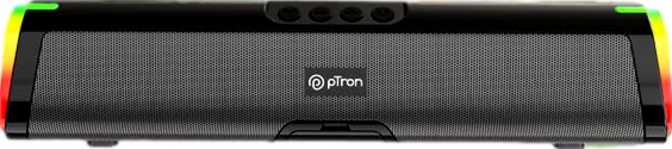
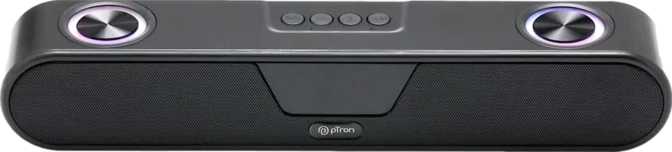
The Musicbot Evo follows the classic compact soundbar silhouette — a long, slim horizontal bar designed to sit in front of a television, on a desktop, or on a shelf without demanding attention. At 387mm wide and 65mm in both height and depth, it fits comfortably in front of most 32-inch televisions without obscuring the lower screen edge, and tucks onto a desk alongside a monitor without claiming meaningful real estate.
At 530 grams, it carries enough substance to feel like a considered purchase rather than a toy, while remaining easy to reposition at will. The form factor is deliberately unpretentious — no angled grilles, no fabric-wrapped premium finish, no lighting effects. This is a no-frills plastic enclosure built to a price, and it looks exactly like that. For most entry-level buyers, that is not a concern worth losing sleep over.
Worth knowing before you buy: All controls live directly on the unit — there is no remote control. Adjusting volume or switching inputs means physically reaching for the device. Workable at desk range, genuinely frustrating from a sofa.
Width
387 mm
Height / Depth
65 mm each
Weight
530 g
Audio Performance: What 20 Watts Means at This Size
Output Power and Room Coverage
The Musicbot Evo runs two dedicated drivers, each rated at 10 watts, for a combined total of 20 watts. To frame that correctly: most built-in television speakers output between 2 and 5 watts total, typically through rear- or downward-firing drivers designed to save space rather than project audio. The Musicbot Evo’s output represents a meaningful step up — louder, more forward-projected, and with more dynamic headroom for music peaks and on-screen action.
At 20 watts from 2-inch drivers, you should expect clear dialogue, solid midrange presence, and adequate high-frequency detail for casual listening in a bedroom, personal office, or compact living room. The low-end floor means deep bass notes fall off the edge of its range — the physical thump of movie effects and bass-heavy music genres will feel noticeably thin. For spoken content, news, and dialogue-heavy television, however, this frequency range is a natural match.
Where the Audio Shines
- Clear vocal reproduction — ideal for news, podcasts, and TV dialogue
- Noticeably louder and more dynamic than built-in TV or laptop speakers
- Genuine stereo image across the 387mm enclosure width
- 60Hz low-end reach outperforms most rivals in this price bracket
Where It Falls Short
- Bass-heavy music lacks physical weight and full low-end impact
- Cannot fill a large or open-plan living space at volume
- No spatial audio, surround simulation, or Dolby/DTS processing
- Bluetooth audio quality is capped by SBC codec compression
Stereo Separation
Two physically separated drivers produce genuine stereo output — left and right channels handled by their own dedicated speakers. At 387mm of width, the stereo image is narrower than two bookshelf speakers placed meters apart, but clearly superior to any mono speaker or single-driver system. For music and film content, this produces a sense of width that a phone or laptop simply cannot replicate.
Codec Quality and the SBC Ceiling
The Musicbot Evo transmits audio over Bluetooth using only the baseline SBC codec — no higher-fidelity wireless codec is supported. SBC handles background music and streaming video adequately, but anyone accustomed to enhanced wireless audio transmission will notice reduced detail and a slightly compressed dynamic range. For critical listening sessions, the AUX input bypasses all wireless compression entirely and is the recommended connection path when audio quality matters most.
The speaker carries no spatial audio processing of any kind — no surround simulation, no Dolby or DTS decoding. It processes received audio as stereo: two channels, no upmixing, no virtual depth. Movie soundtracks will not benefit from any simulated surrounds beyond the physical stereo separation of the two drivers.
Connectivity: Bluetooth and One Cable
The Musicbot Evo’s connection options are intentionally minimal. Two inputs — one wireless, one wired — cover the majority of everyday use cases without adding complexity or cost. Here is exactly what is and is not available.
Available Connections
Bluetooth 5.0 Wireless
Standard pairing with improved range and connection stability over older Bluetooth versions. No NFC shortcut — standard discoverable-mode pairing applies.
3.5mm AUX Input
Direct wired connection from any device with a headphone jack. Bypasses all Bluetooth compression — the highest-quality audio path this unit offers.
On-Device Control Panel
Physical buttons on the speaker body for volume adjustment and input management.
Not Available
- Wi-Fi or network streaming
- HDMI ARC / eARC connection
- Optical / S/PDIF digital input
- Voice assistant support (Alexa, Google, Siri)
- Dedicated smartphone app
- Remote control
- Spotify Connect, Chromecast, or AirPlay
Full Specifications Reference
| Audio Output | 20W total (2 × 10W per channel) |
|---|---|
| Driver Size | 2 × 2-inch full-range stereo |
| Frequency Response | 60Hz – 20,000Hz |
| Bluetooth Version | 5.0 |
| Bluetooth Codec | SBC only |
| Wired Input | 3.5mm AUX |
| Digital Input | None (no HDMI, no optical) |
| Remote Control | Not included |
| Smart Features | None |
| Width | 387 mm |
| Height / Depth | 65 mm / 65 mm |
| Weight | 530 g |
Who Should Buy the Musicbot Evo — and Who Should Pass
This Speaker Is Right For…
Bedroom Television Users
Pairs naturally with 32–43 inch TVs in compact rooms. Delivers a clear improvement over built-in TV speakers for dialogue, music, and everyday viewing at a fraction of a mid-range soundbar’s cost.
Desktop and Monitor Setups
Fits naturally at 387mm wide in front of a monitor. Better stereo separation and output headroom than laptop speakers for music, casual gaming, and work-from-home media.
First-Time Buyers and Students
Delivers the essential speaker experience — stereo playback, wireless convenience, adequate volume — without complexity or cost that would go unused.
This Speaker Is Not Right For…
Bass-Focused Listeners
Electronic music, hip-hop, and bass-heavy genres will sound thin. The physics of 2-inch drivers at this price cannot deliver the low-end impact these styles demand.
Large Living Room Use
At listening distances beyond 3–4 meters or in open-plan spaces, this unit will feel underpowered. It is a personal-space speaker, not a room-filling one.
Smart Feature Seekers
Voice assistants, app-based EQ, Wi-Fi streaming, and multi-room audio are all completely absent. Anyone coming from a smart speaker ecosystem will find this unit frustratingly bare.
How It Compares to Budget Alternatives
At this price tier, the Musicbot Evo competes primarily with entry-level Bluetooth bars and 2.0 desktop speakers from brands like Portronics, Zebronics, and Fingers. Here is how the key trade-offs stack up against the typical segment offering:
| Feature | pTron Musicbot Evo | Typical Budget Alternatives |
|---|---|---|
| Total Output | 20W (2 × 10W) | 10–16W typical at this price |
| Driver Configuration | 2 × 2" Dedicated Stereo | Often 1 driver or unclearly spec’d 2.0 |
| Bluetooth Version | 5.0 | 4.2–5.0 |
| AUX Input | Yes | Often available |
| Remote Control | Not included | Occasionally included |
| Smart Features | None | Generally none at this price |
| Bluetooth Codec | SBC only | SBC standard; aptX rare at this price |
| Low Frequency Floor | 60 Hz | 80–120 Hz common at this price |
The Musicbot Evo’s 60Hz low-frequency reach is its most measurable competitive advantage in this segment. Most rivals at this price roll off noticeably higher, giving this unit a genuinely wider frequency response than the category norm.
Honest Assessment: Strengths and Weaknesses
“The Musicbot Evo’s greatest strength is clarity of purpose. It does not pretend to be something it is not.”
The 20-watt combined output from two dedicated drivers genuinely outperforms the majority of competing units in this segment, and the AUX input adds real value for users who want a lossless wired path from a laptop or television without paying extra for it. The frequency range advantage — reaching down to 60Hz when many rivals give up above 80Hz — means this speaker handles a broader slice of the audible spectrum than its price suggests. These strengths are not accidental: they reflect sensible engineering priorities, where the budget went to output power and driver capability rather than cosmetics or feature lists.
The key weaknesses are equally clear-eyed.
No remote control is an oversight that will irritate any user who places this beyond arm’s length. The SBC-only Bluetooth is a genuine audio quality ceiling that matters to music enthusiasts. The absence of any digital input — HDMI ARC, optical — makes it incompatible with higher-end TV audio routing. And without Wi-Fi, apps, or smart features, there is simply no growth path as user needs evolve.
These are not unexpected failures — they are the predictable trade-offs of an entry-level product built with ruthless budget discipline. The risk is only if a buyer arrives unaware of them. Which is precisely why they are worth stating plainly.
Common Questions Before You Buy
Final Verdict
The pTron Musicbot Evo is a clear, honest product: a compact stereo Bluetooth bar that does exactly what entry-level buyers need and nothing more. It delivers a meaningful audio upgrade over built-in television or laptop speakers — louder output, a wider stereo image, better vocal clarity, and a frequency response that genuinely outreaches many rivals in this price bracket. The AUX input is a practical bonus for users who want a direct wired connection without wireless compression. It earns its place in a bedroom, on a desk, or in front of a small television without embarrassment.
Buy it if you…
Want a clear stereo upgrade from built-in speakers for a bedroom, desk, or small personal space — without complexity or cost that would go unused.
Pass on it if you…
Need strong bass, a remote control, smart features, or higher Bluetooth audio fidelity. Slightly pricier options address each of those gaps specifically.