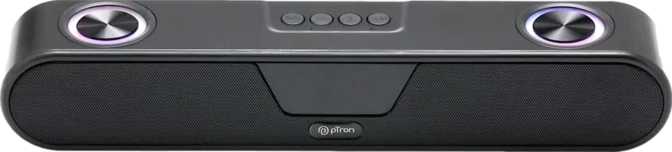
pTron Fusion Boom Review: Premium Codec Quality in a Budget Soundbar
SoundbarsMost speakers at the accessible end of the market ask you to make peace with compromises — pick connectivity or pick sound quality, but rarely expect both. The pTron Fusion Boom enters that conversation with an unusual argument: a stereo speaker built around Bluetooth 5.3 and a codec stack that belongs several price tiers higher. Whether the rest of the package holds up that promise is exactly what this review unpacks.
Design and Physical Profile
The Fusion Boom is built in a soundbar-style form factor — roughly 38.5 centimetres wide and just under 7.5 centimetres tall, with a depth that matches that height almost exactly at just over 7 centimetres. The result is a compact bar you can place flat on a desk, shelf, or TV stand without it demanding attention or space.
At 580 grams, it is meaningfully lighter than most home audio bars of comparable width. Pick it up and it does not feel hollow or fragile — but it also will not anchor itself through sheer mass. This is a speaker you can reposition easily, which matters if you share a workspace or rearrange your setup often.
Physical controls sit directly on the unit. There is no remote control and no companion smartphone app, so everything you adjust — volume, playback, input switching — you do by reaching for the device itself. That keeps the experience simple, but it also means the Fusion Boom is best placed somewhere within arm's reach rather than across a room.
The overall volume of the enclosure — roughly two litres of internal space — is on the smaller side for a unit this wide, suggesting the cabinet is fairly shallow internally. Enclosure size influences low-frequency extension, a trade-off worth keeping in mind when evaluating what the Fusion Boom can realistically deliver in bass performance.
Physical Specifications
| Width | 38.5 cm (approx. 15 in) |
|---|---|
| Height | 7.3 cm |
| Depth | 7.1 cm |
| Weight | 580 g (approx. 1.28 lb) |
| Cabinet Volume | Approx. 2 litres |
| Form Factor | Compact soundbar |
The Codec Lineup: Where This Speaker Punches Above Its Category
This is the specification that genuinely sets the Fusion Boom apart, and it deserves a thorough explanation rather than a quick mention.
The Star of the Show
Most wireless speakers at this price ship with basic Bluetooth audio compression. The Fusion Boom supports aptX Adaptive — Qualcomm's most advanced codec — which adjusts its bitrate in real time based on connection conditions. On a compatible Android device, the wireless link is no longer the weakest point in your audio chain. aptX Adaptive also includes a low-latency mode, which noticeably reduces the gap between screen and sound when watching video content.
Covering the Ecosystem
Standard aptX serves as the fallback for older Android devices, delivering CD-quality wireless audio even when aptX Adaptive is not negotiated. AAC is Apple's preferred high-quality codec — it ensures iPhone and iPad users connect without falling back to the lowest-common-denominator compression. Between the three codecs, the Fusion Boom covers the realistic majority of smartphones currently in use.
Stability Over Marketing
Bluetooth 5.3 matters more for what it prevents than what it enables. Newer versions bring improved connection negotiation, better interference handling in environments with many competing devices, and more efficient power usage on both ends. In a home or office with multiple Bluetooth devices active, 5.3 maintains a cleaner, more stable link than older implementations — and within a typical room, dropouts under normal conditions should be rare.
Wired Connectivity: The AUX Input as a Genuine Asset
The Fusion Boom includes a standard 3.5mm auxiliary input. This is straightforward but important. If your Bluetooth source has poor battery, you can plug in and keep listening. If you want to connect a device that does not support Bluetooth — an older laptop, a desktop PC without a wireless card, a record player with a built-in preamp — the AUX input handles it without fuss.
The AUX input also serves as a backup when you are in a dense wireless environment where Bluetooth performance degrades. In a student residence or open-plan office with dozens of competing devices, wired is simply more reliable.
Connectivity at a Glance
- Bluetooth 5.3 (wireless primary)
- 3.5mm AUX input (wired backup)
- No Wi-Fi or streaming integration
- No HDMI or S/PDIF digital input
- No NFC tap-to-pair
- No microphone input
Smart Features: Understanding the Intentional Absences
Not Available on This Speaker
- Google Assistant
- Amazon Alexa
- Siri / Apple HomeKit
- Spotify Connect
- Chromecast Built-in
- AirPlay
- Dedicated smartphone app
- NFC tap-to-pair
For buyers who specifically want any of these, this is a firm dealbreaker — and it is worth being direct about that.
The Case for Simplicity
For everyone else, the absence of these features is a different kind of feature. No app to configure means nothing to update, nothing to grant permissions to, and no account to create.
Connection is: open Bluetooth settings, find the speaker, pair. That is the entire process. No platform account, no firmware dependency, no subscription.
- Pairs with any Bluetooth device
- No ecosystem lock-in
- Works without internet access
- No app account required
Stereo Sound in a Single Unit
The Fusion Boom outputs two channels — left and right stereo — from a single enclosure. This means the stereo image comes from a single bar rather than two separated speakers, which physically limits the width and depth of the soundstage compared to a true stereo pair placed apart from each other.
That said, a well-tuned stereo bar still produces noticeably more dimension than a mono speaker. For music listening at a desk or from a shelf, the separation between instruments and vocals is perceptible in a way that a single-driver mono speaker cannot achieve. For cinematic surround sound, a two-channel bar cannot substitute for a proper multichannel setup — and the Fusion Boom makes no claim to the contrary.
Left + right stereo output from a single compact soundbar enclosure
Real-World Usage Scenarios
Where the Fusion Boom Excels
-
The Desk or Study Setup
Placed on a desk a metre or so away, this speaker connects cleanly to a laptop or phone, handles audio at work or while studying, and sits unobtrusively without occupying significant space. On-device controls mean volume adjustments are quick.
-
Bedroom or Small Room Audio
For a bedroom TV or a modest living space, the Fusion Boom functions well as a primary audio source. Stereo output at this form factor is meaningful in a room that does not require projection-level volume.
-
The Secondary Speaker
In spaces where you want audio without committing to a large system — a workshop, a kitchen counter, a guest room — the combination of Bluetooth and AUX input gives flexibility across devices and situations.
-
Android Audiophiles on a Budget
If you own an Android device with aptX Adaptive support and have been looking for a speaker that can use that capability without spending significantly, this is a notable match.
Who Should Look Elsewhere
-
Home Theatre Builders
Without HDMI, optical input, Dolby Atmos, or DTS:X, the Fusion Boom cannot anchor a TV audio setup that demands positional audio or a proper surround chain.
-
Smart Home Users
If your life runs through voice commands — turning on music by asking your speaker, integrating with smart lights — the absence of any voice assistant support means this speaker sits entirely outside that world.
-
Large Room Coverage
The compact enclosure suggests this speaker is optimised for near-to-medium-distance listening. Filling a living room of 25 square metres or more is a different ask.
-
iPhone-First Ecosystem Users
AAC support ensures quality audio, but the lack of AirPlay or Siri means the Apple ecosystem connection ends at Bluetooth pairing.
Competitive Positioning
At its tier, the Fusion Boom competes primarily with other compact Bluetooth soundbars and desktop speakers. Here is how the key differentiators map out across category types.
| Feature | pTron Fusion Boom | Smart Speaker (same price) | Basic Budget Soundbar |
|---|---|---|---|
| aptX Adaptive | Yes | Rarely | Usually No |
| AAC Support | Yes | Varies | Often No |
| Bluetooth Version | 5.3 | 5.0 – 5.2 | 5.0 – 5.1 |
| Wi-Fi / Streaming | No | Yes | No |
| Voice Assistant | No | Yes | No |
| AUX Input | Yes | Rarely | Sometimes |
| App Required | Not needed | Yes | Rarely |
| Stereo Channels | 2 | 1 – 2 | 1 – 2 |
| Remote Control | No | N/A | Sometimes |
Honest Assessment: Where It Wins and Where It Falls Short
Where It Wins
The codec specification is genuinely impressive. aptX Adaptive at this price point is rare, and buyers with compatible Android devices will hear a tangible difference compared to budget speakers using basic Bluetooth audio. Bluetooth 5.3 adds real reliability. The AUX input adds genuine utility.
The lightweight build and compact footprint make placement flexible. The absence of an app ecosystem means zero setup friction — ideal for users who find software dependencies more annoying than convenient. The speaker does not try to be something it is not, and that clarity of purpose works in its favour.
Where It Falls Short
On-device controls only — no remote, no app — means this speaker is not ideal for mounting above eye level or placing across a room from your seating position. The relatively compact enclosure limits how much physical air the speaker can move, which constrains deep bass output.
No NFC means pairing is the standard multi-tap Bluetooth process rather than an instant tap. The total absence of any smart home or streaming platform integration is a hard ceiling for users invested in those ecosystems. These are not bugs — they are design choices — but they are worth weighing honestly.
Editorial Rating Breakdown
Questions Real Buyers Ask
Final Verdict
The pTron Fusion Boom is a focused product that earns genuine respect for its wireless audio transmission quality. Fitting aptX Adaptive and Bluetooth 5.3 into this form factor and price bracket is a real differentiator — Android users with compatible devices will experience wireless audio that feels meaningfully better than what most budget speakers offer.
The trade is clarity. No voice assistants, no app, no streaming integration, no remote. Within the scope of a Bluetooth-and-AUX bar with excellent codec support, physical controls, and a sensible footprint, it is well-specified and a genuine overperformer in its category.
Buy It If...
- Audio quality per rupee is your priority over smart features
- You own an Android device with aptX Adaptive support
- You want a desk or small-room speaker that simply works
- Setup complexity is more annoying to you than helpful
Skip It If...
- You want voice control, AirPlay, Chromecast, or Spotify Connect
- You need to connect a TV that lacks a 3.5mm headphone output
- You need a remote for far-placement or across-room control
- You are building a multiroom or home theatre audio system