pTron Fusion Concert Review: Codec-First Compact Stereo Speaker
SoundbarsA compact stereo bar speaker that bets everything on wireless audio transmission quality. aptX Adaptive support at this size and price tier is rare — but smart-home features are entirely absent by design.
Design and Build: Slim, Purposeful, and Unpretentious
Physical experience & construction quality
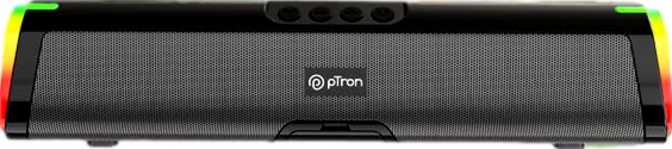
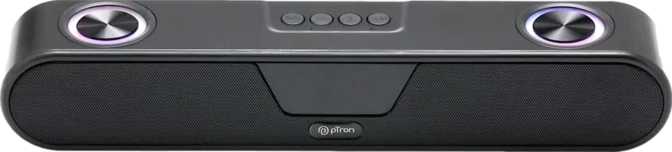
At roughly 370mm wide and just 65mm in both height and depth, the Fusion Concert is shaped like a narrow bar — the kind of profile that sits cleanly on a desk, a shelf, or a bedside table without demanding attention. That near-square cross-section gives it a tidy, cylindrical quality that reads as understated rather than cheap.
The weight comes in just above 620 grams — light enough to move from room to room without a second thought, but substantial enough that it does not feel hollow or fragile. Speakers in this size category often err toward feeling plasticky at the corners or rattly when tapped. Pay attention to that when you first unbox this one, as the physical build impression will tell you a lot about the engineering priorities behind it.
Controls are placed directly on the device rather than managed through a smartphone app or a remote. Every adjustment happens at the speaker itself — a practical choice for a device designed to live on a surface within arm's reach.
Physical Specifications
- Width
- 370 mm
- Height
- 65 mm
- Depth
- 65 mm
- Weight
- 622 g
- Form Factor
- Compact bar
- Controls
- On-device panel
The Audio Codec Advantage: Why aptX Adaptive Matters Here
Understanding the wireless audio transmission stack
Budget Bluetooth speakers routinely compromise on the audio transmission layer — exactly where the listening experience lives or dies. The Fusion Concert makes a deliberate counter-bet. For a speaker at this price tier and size, it ships with codec support you would normally expect from something considerably more expensive.
What Bluetooth Audio Codecs Actually Do
When music travels from your phone to a Bluetooth speaker wirelessly, it is compressed into a data stream the wireless connection can carry, then decoded back into audio at the other end. The codec handles this compression and decompression. A poor codec introduces dullness at the high end, smearing of detail, and loss of spatial separation. A strong codec keeps the signal as close to the original as possible. The standard fallback every Bluetooth device supports — SBC — works but is the lowest common denominator.
The Fusion Concert's Codec Stack
Apple's preferred codec. If you stream from an iPhone or use Apple Music, AAC delivers noticeably cleaner audio than SBC. The standard expectation on any speaker sold in this decade.
Qualcomm's codec for CD-quality wireless audio. Reduces latency and handles compression more efficiently than AAC on Android devices. Supported by most mid-range Android phones.
Qualcomm's current top-tier codec. Variable bitrate transmission adjusts dynamically to wireless conditions. Capable of up to 24-bit, 96kHz high-resolution audio with near-real-time latency. Rare at this speaker size and price tier.
aptX Adaptive requires your source device (phone, tablet, laptop) to also support it. When that chain is complete, the difference in clarity, stereo imaging, and transient detail is audible. If you use a recent Qualcomm-powered Android phone, the Fusion Concert can receive audio at a quality level most speakers in its class are not equipped to handle.
Stereo Separation and Spatial Performance
How the two-channel output translates to real listening
The Fusion Concert outputs sound through two channels — left and right — providing the baseline for genuine stereo audio. At 370mm wide, the two drivers have enough physical separation to create a real soundstage rather than a single-point mono blob. For near-field listening — sitting at a desk with the speaker a meter away — this spacing works well. Instruments and vocals have room to occupy distinct positions in the mix.
Stereo performance degrades as you move further away or off-axis, which is true of every speaker at this width. This is not a speaker designed to fill a large room with enveloping sound — it is designed to deliver quality audio to one or two people in a defined space.
Spatial Format Support
-
True Stereo (2-Channel)
Real left/right driver separation at 370mm width -
Dolby Atmos
Not supported — and physically unrealistic at this form factor -
DTS:X
Not supported — consistent with the speaker's honest positioning
Connectivity: Bluetooth 5.3 and a Smart Analogue Fallback
Wireless performance and physical input options
Bluetooth 5.3 — What the Version Means in Practice
Bluetooth 5.3 is the current generation of the standard, and its advantages over older versions are meaningful rather than cosmetic. Connection stability improves particularly in crowded wireless environments — apartments with many nearby devices, offices with dense Wi-Fi coverage. Pairing time is faster. The connection maintains consistent quality at greater distances from the source device.
For everyday listening, Bluetooth 5.3 means fewer drop-outs, fewer audio stutters as someone walks between you and your phone, and a connection that pairs reliably rather than requiring manual re-pairing every session.
The AUX Input as a Practical Asset
The presence of a 3.5mm auxiliary input is worth highlighting because it is increasingly absent from modern wireless speakers. If your Bluetooth device is occupied, out of battery, or if you want to connect something without Bluetooth — a record player with a preamp, an older laptop, a TV — the AUX input provides a direct analogue path with zero latency and no wireless dependency.
This also means the speaker remains fully functional in environments where Bluetooth is problematic or restricted. There is genuine longevity in a speaker that can be driven two different ways.
What Is Not Here
Who the pTron Fusion Concert Is For
Real-world usage scenarios and buyer fit
This Speaker Suits You If...
- You have a recent Qualcomm-powered Android phone that supports aptX Adaptive and want to hear the difference quality wireless transmission makes
- You want a clean, no-setup stereo speaker for a desk, bedroom, or small workspace
- You value audio fidelity over smart features and ecosystem integration
- You occasionally need to connect non-Bluetooth devices via a physical cable
- You prefer simple, on-device controls over app dependency
Look Elsewhere If...
- You want to stream music directly from Spotify or Apple Music without a phone acting as the source
- You are building a multi-room audio setup or want smart-home system integration
- You need hands-free calling capability
- You plan to place this across a large room and control it from a distance
- You are an Apple ecosystem user expecting AirPlay 2 compatibility
Competitive Positioning: How It Compares
Where the Fusion Concert sits among similar compact Bluetooth bar speakers
At this footprint and price positioning, the Fusion Concert competes primarily against other compact Bluetooth bar speakers that prioritize portability and simplicity over smart-home integration. The codec support column is where it distinguishes itself — aptX Adaptive at this tier is unusual.
| Feature | pTron Fusion Concert | Typical Competitor |
|---|---|---|
| Bluetooth Version | 5.3 | 5.0 – 5.2 |
| aptX Adaptive | Rarely | |
| AAC Support | Often | |
| AUX Input | Sometimes | |
| Wi-Fi / Multi-Room | Occasionally | |
| Voice Assistant | Sometimes | |
| Dedicated App | Sometimes | |
| NFC Pairing | Rare anyway |
Competing speakers often offset the absence of aptX Adaptive with Wi-Fi streaming or voice assistant features. The comparison comes down to what your listening habits actually demand. If audio transmission fidelity matters more to you than ecosystem features, the Fusion Concert's stack wins. If ecosystem integration comes first, the calculus flips.
Honest Assessment: Strengths and Trade-offs
A balanced look at where this speaker delivers and where it falls short
Where It Delivers
The codec credentials are genuinely impressive for a speaker at this scale. aptX Adaptive support at this form factor is not common, and when your source device supports it too, the improvement in clarity and detail over standard SBC transmission is real and audible. Bluetooth 5.3 ensures the connection holding that signal is as stable as current technology allows.
The physical footprint is practical — slim enough to fit almost anywhere, stereo channel separation wide enough to produce a credible soundstage at close range. The AUX input is a genuinely useful inclusion that many modern speakers have quietly dropped. It extends the speaker's compatibility well beyond wireless-only scenarios and adds meaningful longevity to the purchase.
Where It Asks for Compromise
The complete absence of a microphone removes call functionality — something some buyers will find surprising at any price point. The lack of smart features — no app, no voice control, no Wi-Fi — is a deliberate trade rather than an oversight, but it will genuinely frustrate anyone who wants ecosystem integration.
The on-device-only controls work well for close-range use but become inconvenient if you are managing playback from across a room. Without battery specifications available, it is not possible to speak to endurance or charge times in this review — that information is worth verifying with the retailer before purchasing if portability and runtime are priorities.
Score Breakdown
Common Questions Before You Buy
Answers to what real buyers search for
Final Verdict
The pTron Fusion Concert makes a clear, defendable bet: strip out smart-home integration and invest that budget in the wireless audio codec layer instead. For listeners who care about the quality of the signal reaching their ears, that is a reasonable trade.
aptX Adaptive support at this form factor is not common. Bluetooth 5.3 ensures the connection holding that signal is as stable as current technology allows. The AUX input adds genuine versatility without adding complexity. This is a speaker that does fewer things than its competitors — but does the things that matter for audio quality better than most of them.
If you want a compact stereo speaker that delivers the best possible wireless audio from a compatible Android phone — without subscriptions, apps, or ecosystem lock-in — the Fusion Concert is worth serious consideration. If you want a smart speaker or need hands-free calling, it is not trying to be that.