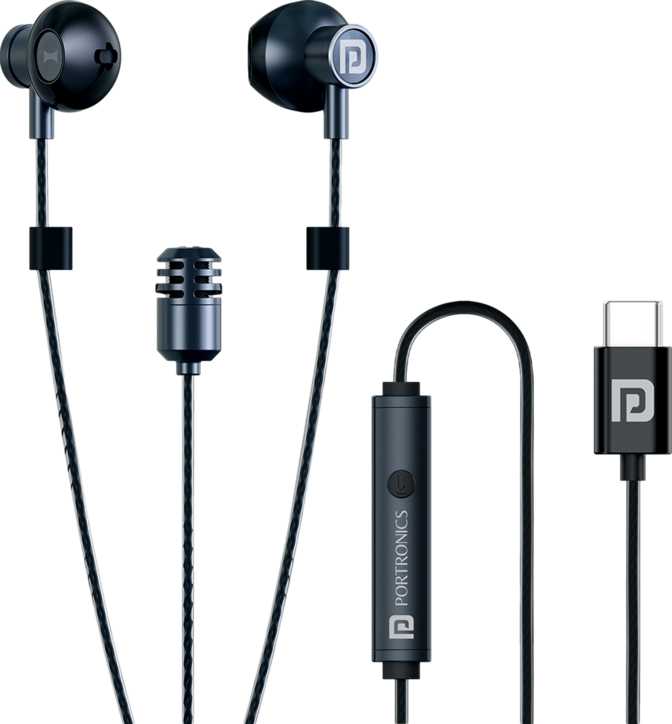
Portronics Conch One Review: A No-Nonsense USB-C Wired Earbud
HeadphonesWired earbuds have quietly staged a comeback. As Bluetooth fatigue sets in — dead batteries mid-call, pairing failures before presentations, latency during video editing — a growing number of users are rediscovering the appeal of plugging in and just getting on with it. The Portronics Conch One is positioned squarely in this space: a USB Type-C wired earbud designed for everyday use, built for people who want reliable audio without the overhead of charging or connectivity management.
What makes the Conch One worth a closer look is not any single feature — it is the combination of a sensibly large driver, a functional inline control system, and a USB-C connection in a price bracket where compromises are usually severe. Whether it delivers on that promise is what this review answers.
Design and Build: Familiar Form, Practical Choices
The Conch One follows the classic earbud silhouette — not the deep-insertion in-ear monitor style, but the more traditional bud shape that rests in the outer bowl of the ear. This distinction matters for comfort. Earbuds of this type do not create a seal inside the ear canal, which means they sit more lightly, cause less pressure fatigue during long sessions, and are considerably easier to put on and take off repeatedly throughout the day.
The cable is built with a tangle-resistant design, which sounds like a minor detail until you have spent three minutes unraveling a knotted earbud before a meeting. In practice, a tangle-free cable changes the daily-use experience more than most premium features do. Pull it out of your pocket, plug in, and go.
Build at a Glance
- Outer-ear fit — lower fatigue for extended sessions
- Tangle-resistant cable for reliable daily carry
- Stereo speaker configuration — full left/right audio separation
- Non-detachable cable — cable damage means full unit replacement
- No travel case included — storage solution required separately
- No water or sweat resistance — indoor and dry-use only
Comfort Consideration
Traditional earbuds do not create an in-canal seal. This significantly reduces listening fatigue during multi-hour use — making the Conch One a better daily driver for desk work than tightly fitted in-ear monitors. The trade-off is reduced passive noise isolation, explored in detail in the Sound Quality section below.
Sound Quality: What a 14.2mm Driver Actually Means
Driver size is one of the most misunderstood specifications in consumer audio. Here is the plain version: the driver is the miniature speaker inside each earbud that converts electrical signals into sound. The Conch One uses a 14.2mm driver — a notably large diameter for an earbud in this category.
Most standard earbuds at this price point use drivers between 8mm and 11mm. A larger driver has more physical surface area to move air, which translates to stronger bass reproduction and more dynamic sound at higher volumes without significant distortion. Driver tuning and component quality still matter enormously, but a larger driver is a meaningful indicator that the Conch One is engineered for fuller audio output than its price implies.
The frequency range covers the entire audible spectrum — from the deepest bass tones the human ear can detect to the uppermost limits of high-frequency detail. Hitting both extremes cleanly in practice depends on the quality of source material and the output capability of the connected device.
Features Not Present — and Why They Matter
Active Noise Cancellation
ANC uses microphones to electronically cancel ambient sound. It adds cost and battery complexity. Its absence is expected and appropriate for a wired budget earbud.
Passive Noise Isolation
Passive isolation comes from a physical in-canal seal — the kind in-ear monitors provide. The outer-ear fit means ambient sound from your environment will bleed through consistently.
Spatial Audio
Spatial audio processing creates a 3D soundstage. Primarily relevant for streaming service content or gaming — not a significant factor for general everyday media use.
Connectivity: The USB-C Advantage
The single most forward-thinking decision in the Conch One's design is the choice to use USB Type-C rather than a 3.5mm headphone jack. Most modern Android smartphones — flagship and mid-range alike — have eliminated the 3.5mm jack entirely. Laptops, tablets, and ultrabooks increasingly follow the same path. A 3.5mm earbud bought today often requires a dongle tomorrow.
The Conch One plugs directly into the USB-C port that virtually every modern device already has. No adapter required, no pairing process, no wireless interference to manage. Audio output begins the moment the connector is seated.
Works Directly With
- Modern Android phones — no adapter needed
- USB-C laptops, tablets, and ultrabooks
- Zero pairing, zero Bluetooth interference
- Audio begins the moment the connector is seated
Compatibility Limits
- Older devices with only a 3.5mm port require a separate adapter
- Lightning-port iPhones are not compatible
- Some USB-C ports are data-only — verify audio support for your specific device
Microphone and Call Performance
The Conch One functions as a full headset, handling both audio playback and voice input for calls, video meetings, and voice recording. A single microphone handles all voice pickup.
The microphone does not feature active noise cancellation. Background noise — a café, keyboard clatter, or room echo — will be audible to the person on the other end of your call. For quiet home or office environments, this is rarely a problem. In noisier settings, it is a genuine limitation.
A built-in mute function is accessible directly from the inline control panel. For anyone in frequent video calls, hardware mute control on the cable — without reaching for a screen or keyboard — is a practical convenience that pays off noticeably during a typical workday.
Inline Controls: Managing Audio Without Touching Your Device
The control panel sits on the cable itself, positioned for easy thumb access while the earbuds are in use. From this panel, users can manage playback, handle calls, and engage the mute function — all without picking up the connected device.
This inline control design is particularly valuable for desk use and commuting, where reaching for a phone repeatedly becomes tedious. The physical controls on the cable eliminate the need to unlock screens or navigate menus for basic audio tasks.
Who Should Buy the Portronics Conch One
A Strong Fit For
- Remote workers and students on frequent video calls who want reliable audio without managing battery life
- Users of modern Android phones, laptops, or tablets with USB-C ports who want a no-fuss wired connection
- Anyone who has grown tired of Bluetooth pairing failures or constant low-battery anxiety
- People who prefer the lighter, non-occluding feel of traditional earbuds over canal-sealing in-ear monitors
- Budget-conscious buyers who need a capable USB-C headset for voice and general media use
Not the Right Choice For
- Gym users or outdoor athletes — no water or sweat resistance puts the earbuds at risk during physical activity
- Anyone in consistently noisy environments who needs effective noise blocking — the open design makes focus difficult
- Users with older devices that only have a 3.5mm headphone jack
- Those who prioritize microphone quality in loud or complex acoustic environments
- Audiophiles seeking high-fidelity reference-grade sound — this is a daily-use earbud, not a critical-listening tool
How It Compares to the Alternatives
The Conch One's positioning becomes clearest when placed alongside the two most logical alternatives a buyer in this category would consider.
| Feature | Portronics Conch One | Typical 3.5mm Budget Earbud | Budget Wireless Earbud |
|---|---|---|---|
| Connection Type | USB-C Wired | 3.5mm Wired | Bluetooth |
| Adapter on Modern Phones | Not required | Often required | Not required |
| Battery Required | No | No | Yes |
| Driver Size | 14.2mm (above average) | 8–11mm (typical) | 6–10mm (typical) |
| Hardware Mute Function | Yes (inline) | Rare at this tier | Varies |
| Passive Noise Isolation | None | Low to moderate | Low to moderate |
| Audio Latency | Zero | Zero | Present |
| Water Resistance | None | None | Sometimes (IPX4) |
The Conch One's clearest advantages over a 3.5mm equivalent are its direct USB-C compatibility and its larger driver. Against budget wireless options, it wins on latency and zero charging overhead, but loses on cable-free convenience and sometimes on water resistance.
Honest Assessment: Strengths and Weaknesses
Where It Gets Things Right
The tangle-free cable alone eliminates one of the most frustrating aspects of wired earbuds. The USB-C connection is not a gimmick — it is a deliberate choice that aligns with where the device market has moved, and it means the Conch One works directly with the phones most people actually use today.
The 14.2mm driver suggests a sound signature that leans toward fuller bass response, which suits general music and media consumption well. The inline control system with a hardware mute button makes this a genuinely work-ready headset. For video conferencing, having mute control on the cable without touching your device is a practical daily-use advantage that the competition in this price tier rarely offers.
Where It Falls Short
The absence of any water or sweat resistance makes the Conch One a purely indoor, dry-environment product. The open earbud design means noise isolation is essentially nonexistent — this is a quiet-environment device by design, not by accident.
The single microphone without noise cancellation will struggle in any setting that is not relatively quiet. And without a carrying case, portability requires deliberate storage discipline to avoid the cable tangling that the design otherwise works hard to prevent.
Common Questions Before You Buy
Final Verdict
Portronics Conch One — Our Recommendation
The Portronics Conch One is a focused, purposeful product that does not try to be everything — and is better for it. It is built for the user who wants reliable, zero-hassle audio on a modern device: someone who works from a desk, takes frequent calls, connects to a USB-C phone or laptop, and does not want to think about battery life or pairing every morning.
The USB-C connection and the above-average driver size are the standout decisions in its design. Both suggest a product developed with a clear understanding of its intended user — not a generic budget earbud with a connector swap. The inline mute control rounds it out as a work-ready headset with practical daily-use value that outpunches its price.
Buy If
You need a dependable USB-C earbud for calls and everyday media in quiet or semi-quiet environments, and you want to eliminate Bluetooth complexity entirely.
Skip If
You need workout durability, meaningful noise-blocking, or strong microphone quality in loud settings. Look for options with water resistance or passive noise isolation instead.