Roomba Mini Review: Powerful Suction in a Compact Package
Robot Vacuum CleanersThe robot vacuum market is crowded with machines that look impressive on paper but fall short when carpet meets reality. The Roomba Mini strips away some of the bells and whistles found on flagship models and focuses energy on what actually matters inside a home: pulling dirt out of floors with enough force to make a visible difference. Whether that trade-off works in your favor depends entirely on how you live and what you expect a robot vacuum to do each day.
This review unpacks every specification in plain terms, flags the compromises honestly, and tells you exactly which households this machine earns its keep in — and which ones it will frustrate.
Quick Verdict
- Exceptional 7,000 Pa suction for its size
- HEPA + allergy filter — ideal for allergy sufferers
- Compact 245mm frame fits under most furniture
- Full smart home integration (Google + Alexa)
- 150 ml dustbin requires frequent emptying
- No self-emptying — fully manual bin management
Design and Build: Compact Enough to Go Where Others Cannot
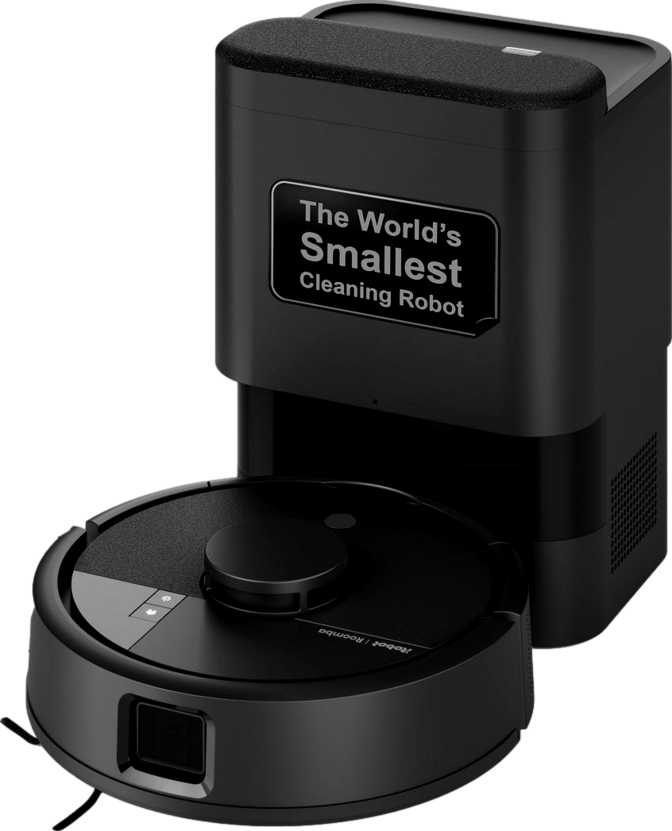
At 245 millimeters across — roughly the diameter of a large dinner plate — the Roomba Mini is genuinely compact by the standards of this category. Many robot vacuums creep up to 280–350mm, which means they struggle around chair legs, tight hallway corners, and the gap between a sofa and a side table. The Mini's slimmer footprint lets it navigate those cluttered spaces without getting wedged or requiring you to rearrange your furniture around it.
The height of 92mm is a figure worth paying attention to. Most standard sofas and beds clear the floor by 100–120mm, so the Roomba Mini should slide beneath the majority of furniture without needing a running start. That said, very low-profile furniture — bed frames that sit close to the floor — may still block it. Measure before you assume.
At 2 kilograms, it sits in a comfortable middle range. Light enough to pick up and relocate easily, heavy enough that it does not feel like a toy. The overall volume of the unit is compact relative to auto-emptying competitors, which makes sense given that this model handles its own bin manually rather than through a self-emptying dock.
There is no display on the unit itself — all feedback and control happens through the companion app or via voice. The robot does offer voice prompts to communicate status, errors, and cleaning updates out loud, which is genuinely useful when your hands are full or you are in another room.
Physical Specifications
- Diameter
- 245 mm
- Height
- 92 mm
- Weight
- 2.0 kg
- Noise Level
- 60 dB
- Dustbin
- 150 ml
- Warranty
- 1 Year
The docking station is notably larger in footprint than the robot itself, so plan for it to occupy a meaningful spot along a wall. It is tidier than the large tower bases that come with premium self-emptying systems, but it is not a unit you can tuck invisibly into a corner.
Suction Power: Where the Roomba Mini Genuinely Surprises
What 7,000 Pa Actually Means for Your Floors
Suction is measured in Pascals (Pa), a unit that describes how much pressure the motor creates to pull air — and with it, debris — into the dustbin. The Roomba Mini delivers 7,000 Pa, which places it firmly in the high-performance tier of the robot vacuum segment. For context, entry-level robot vacuums often operate in the 1,500–2,500 Pa range, and mid-range models typically land between 3,000–5,000 Pa. At 7,000 Pa, this machine is designed to pull embedded pet hair from low-pile carpet, lift fine dust from hardwood gaps, and extract the kind of debris that lighter suction simply shuffles around.
Suction Power Tier Context
This level of suction is particularly meaningful for households with medium-pile carpets where dust settles below the surface fiber, pets that shed regularly, or high-traffic hard floors where fine grit accumulates quickly.
Four Cleaning Modes
The Roomba Mini offers four distinct cleaning modes, allowing variation between quiet eco operation, standard daily cleaning, intensive passes for heavily soiled areas, and a spot or targeted clean function. This range lets the machine balance noise output against cleaning need rather than running at full power every session.
Dirt Detection That Changes Behavior
A built-in dirt sensor allows the Roomba Mini to detect areas of higher debris concentration and increase cleaning effort accordingly — spending longer on a patch of carpet near a dog bed, for example, or making additional passes over kitchen tile grout lines where crumbs collect. In practice, it results in more thorough cleaning of problem areas without you having to manually direct the robot every time.
Mopping: A Basic Supplement, Not a Replacement
The Roomba Mini includes mopping capability, which extends its usefulness on hard floors. However, there are important limits: the mopping system does not self-clean the pad, cannot raise the mop head to avoid carpet (no mop-lifting mechanism), and does not dry the pad after use. This is wet-mopping in its most basic form — useful for lightly soiled hard floors after vacuuming, but not suited for tackling sticky residue, heavily soiled tiles, or rooms with mixed hard and carpeted surfaces.
The mopping function is best understood as a finishing pass on already-vacuumed hard floors, not a standalone deep-cleaning capability. If you run it on a floor that transitions from hard to carpeted areas, you will need to set boundaries carefully using the app.
Mopping Limitations
- No mop pad lifting on carpet
- No self-cleaning pad
- No pad drying function
- Good as a post-vacuum finish
Smart Features: Navigation, App Control, and Voice Integration
Mapping and Obstacle Avoidance
The Roomba Mini includes full route mapping, which means it builds a spatial understanding of your home over time rather than bouncing around randomly. Mapped cleaning is more efficient, more thorough, and more predictable — you can direct it to specific rooms rather than letting it wander.
Combined with obstacle sensors and an anti-stuck system, it avoids most physical traps before they become a problem. Anti-fall sensors along the base prevent the robot from tumbling down staircases or off elevated surfaces — an essential safeguard in any multi-level home.
No-Go Zones and Virtual Barriers
Two tools help you define where the robot is and is not allowed to go. No-go zones are set within the app as virtual boundaries on the floor map — useful for keeping the robot away from a water bowl, a pile of cables, or a delicate floor lamp.
Virtual barriers restrict access to entire rooms or doorways without physical blockers. Having both options gives more flexibility than many competitors at this price tier.
App Control and Voice Assistants
Control is entirely app-based — there is no physical remote included with the unit. The companion smartphone app handles scheduling, zone configuration, cleaning history, and mode selection.
Voice control is available through both Google Assistant and Amazon Alexa. Natural-language commands like "start cleaning the living room" or "send the robot back to its dock" work through existing smart home setups without any additional configuration beyond the initial pairing.
Wi-Fi and Scheduling
The Wi-Fi connection runs on Wi-Fi 4 (802.11n). This is not the latest Wi-Fi generation, but it is proven, stable, and more than sufficient for the data volumes a robot vacuum needs to transmit. The 2.4GHz band also offers better range through walls compared to 5GHz, which matters if your router is not in the same room as the dock.
Full scheduling is supported via the app, so you can set it to clean at specific times on specific days — automatically, without any action on your part. Combined with auto-docking, daily cleaning can become genuinely hands-off for the vacuuming portion of your routine.
Filtration: The Right Choice for Allergy and Asthma Sufferers
The Roomba Mini includes both a HEPA filter and an allergy-grade filter — a meaningful pairing for households sensitive to airborne particles. HEPA filtration captures at least 99.97% of particles at 0.3 microns in size, which includes dust mite debris, pet dander, pollen, and mold spores.
Without this level of filtration, a robot vacuum can inadvertently redistribute fine particles into the air as it exhausts air from its motor. For households with allergy or asthma sufferers, a HEPA-equipped vacuum is not a luxury — it is a health consideration the Roomba Mini takes seriously.
Important maintenance note: The filters are not washable. They are disposable and will need periodic replacement as part of ongoing maintenance. Factor that into running costs alongside power consumption.
- HEPA filter included
- Allergy-grade filter included
- Captures 99.97% of 0.3-micron particles
- Traps pet dander, pollen, dust mite debris
- Filters are NOT washable — require replacement
Battery Life and Charging: Good Enough for Most Homes
120 min
Runtime per charge
3 hours
Full recharge time
30W
Operating power draw
Runtime in Practice
Two full hours of continuous cleaning is sufficient for a typical apartment or small-to-medium home — up to roughly 100–130 square meters of accessible floor space — for a complete pass without the robot needing to pause mid-session to return and recharge. Larger homes may require the robot to dock, recharge, and resume, a common behavior across the category. Running at maximum suction draws more energy; if you regularly use the most intensive mode, expect runtime to fall short of the rated maximum.
Charging in Context
A three-hour recharge from empty is a standard figure for the category. Since the robot auto-docks when a session completes or when charge is low, the three-hour window typically happens overnight or during a workday — periods when the robot is idle anyway. The auto-off feature ensures the robot does not sit drawing power unnecessarily once it is docked and charged.
The Dustbin Problem: The Roomba Mini's Most Significant Limitation
There is no polite way to frame this: the Roomba Mini's dustbin holds just 150 milliliters of debris. That is roughly the volume of a small yogurt container. For comparison, mid-range robot vacuums typically offer 400–600ml dustbins, and models with self-emptying stations effectively extend that to weeks of autonomous operation.
At 150ml, the bin will fill quickly in any home with pets (especially medium-to-large breeds that shed), children who track in debris regularly, or high-traffic hard floors where sand and grit accumulate daily.
In homes with light foot traffic, minimal shedding, and primarily smooth hard floors, the bin may last a full cleaning session or even two before requiring attention. In busier households, you may find yourself emptying it mid-session or after every run.
There is also no fullness indicator — the robot will not alert you when the bin is at capacity. You will need to check it manually or learn from experience how often your specific cleaning patterns fill it. This is the most important caveat in this review.
| Category | Typical Capacity |
|---|---|
| Roomba Mini | 150 ml |
| Mid-Range Robots | 400–600 ml |
| Self-Emptying Models | Weeks of capacity |
Noise Level
At 60 decibels during operation, the Roomba Mini is audible but not disruptive. A normal conversation between two people registers around 60 dB, while a traditional upright vacuum typically runs at 70–80 dB. The Roomba Mini sits at that conversational level — present in the background but unlikely to make a video call difficult or wake a lightly sleeping child in a nearby room.
Running a scheduled clean while you are out of the home sidesteps noise concerns entirely, which is the most practical approach regardless of noise sensitivity.
Floor Compatibility
The Roomba Mini cleans all floor types — hard floors including tile, hardwood, laminate, and vinyl, as well as low-to-medium pile carpet. The robot does not automatically adjust its height, relying on its fixed clearance to transition between surfaces. Most transitions between hard floor and carpet will be handled without issue; very thick, high-pile rugs may slow it down or prove impassable depending on edge height.
On hard floors, the suction and mopping combination delivers the most complete clean. On carpet, the 7,000 Pa suction does genuine work on embedded debris — more so than most competitors in its size class.
Who This Robot Vacuum Is For — and Who It Is Not
- Small-to-medium apartments or homes
- Hard floors or low-pile carpet as primary surface
- Allergy or asthma sufferers (HEPA filtration)
- Google or Amazon smart home users
- Those comfortable emptying a bin daily or every two days
- Homes with low-clearance furniture that trips up larger robots
- You have a large home needing extended coverage
- You have pets that shed heavily
- You need truly hands-off, weeks-long autonomous operation
- You need advanced mopping with pad-lifting or self-cleaning
- Noise sensitivity is a top priority
- You prefer a physical remote over app-based control
How the Roomba Mini Compares to the Alternatives
| Feature | Roomba Mini | Typical Mid-Range Robot | Self-Emptying Premium Robot |
|---|---|---|---|
| Suction Power | 7,000 Pa (high) | 2,500–4,000 Pa | 2,500–6,000 Pa |
| Dustbin Capacity | 150 ml (small) | 400–600 ml | Station holds weeks |
| Self-Emptying | No | No | Yes |
| HEPA Filtration | Yes | Varies | Varies |
| Mopping | Basic (no pad lift) | Often none | Advanced on premium |
| Runtime | 120 min | 90–120 min | 90–150 min |
| No-Go Zones | Yes | Varies | Yes |
| Route Mapping | Yes | Varies | Yes |
| Voice Assistant | Google + Alexa | Varies | Yes (most) |
| Body Size | Compact (245mm) | Standard (280–330mm) | Standard–Large |
The Roomba Mini's strongest advantage over typical mid-range competitors is its suction output, HEPA filtration, and compact footprint — all in one package. Against self-emptying flagships, the gap is clearest in daily convenience and bin management. The price difference between the two tiers is typically substantial, which may resolve the comparison for many buyers.
Honest Strengths and Weaknesses
Where It Gets It Right
The Roomba Mini gets a great deal right. Its suction output is exceptional for a compact robot, and 7,000 Pa translates to noticeably cleaner carpets and harder-to-reach floor debris. The HEPA filter alongside an allergy-specific filter is a genuine differentiator and worth a significant premium for the right household.
The navigation system — combining route mapping, no-go zones, virtual barriers, obstacle avoidance, and anti-fall sensors — is complete and reliable by category standards. Two hours of runtime is practical for real-world use, and the auto-docking behavior means the battery is always ready when you need it. Voice and app integration are genuinely polished, not tacked-on afterthoughts.
Where It Falls Short
The weaknesses are fewer but harder to overlook. The 150ml dustbin is the defining limitation of this robot. No amount of suction power or smart navigation compensates for having to empty the bin every one to two sessions. In a home with pets, this will happen daily. The absence of a fullness indicator makes it easy to miss the bin being overfull, causing the robot to stop mid-clean without warning.
The mopping function, while present, is best treated as a secondary feature. It works, but only in the most basic sense, and the lack of pad-lifting means mixed-surface homes need careful boundary configuration. The one-year warranty is on the shorter end for an electronics purchase at this price tier.
Common Questions Before Buying
Final Verdict
The Roomba Mini is a capable, well-specified robot vacuum that delivers cleaning performance well above its physical size. The suction output stands out in this class, the smart navigation is complete, HEPA filtration makes it a standout option for allergy sufferers, and the app and voice integration work as advertised.
The recommendation comes with one clear condition: you must be willing to empty the dustbin frequently. This is not a minor inconvenience — for some households, it will be a daily task, and the lack of any fullness alert means you need to build the habit proactively. If that trade-off fits your routine, the Roomba Mini earns a strong recommendation as a compact, high-suction robot with genuine smart home integration and best-in-class air filtration credentials.
Bottom line: For households with heavy shedding pets, large floor areas, or a specific need for genuinely hands-off operation, the step up to a self-emptying model is worth the additional investment.
For everyone else — particularly those in smaller spaces with allergy concerns and a preference for compact, intelligent, app-controlled cleaning — the Roomba Mini is a well-built machine that does its primary job with more force and precision than its size suggests.