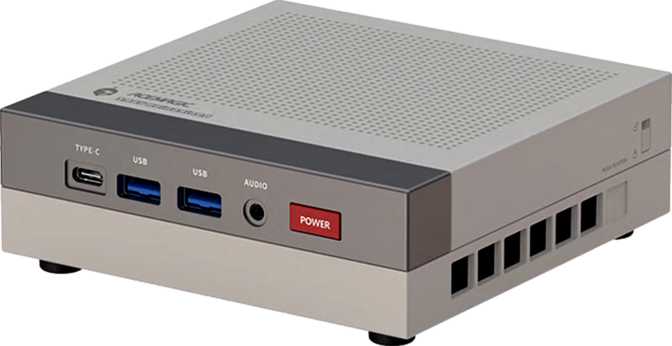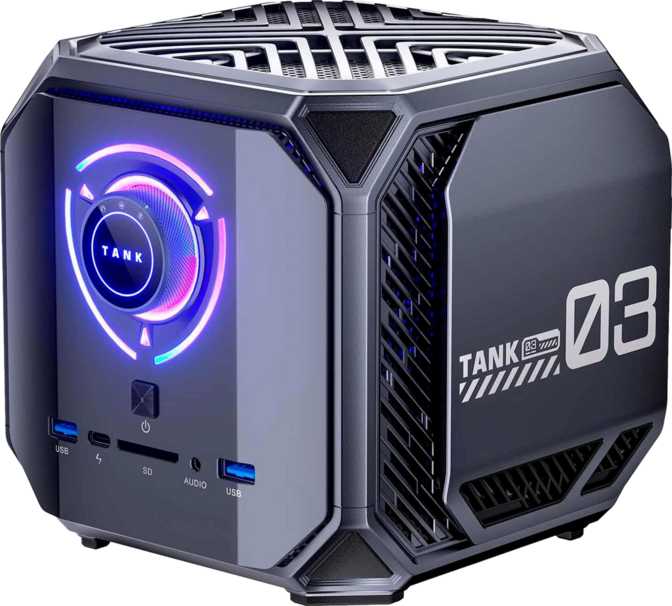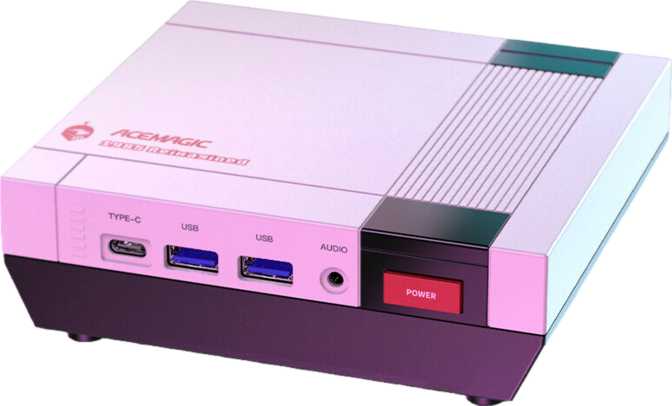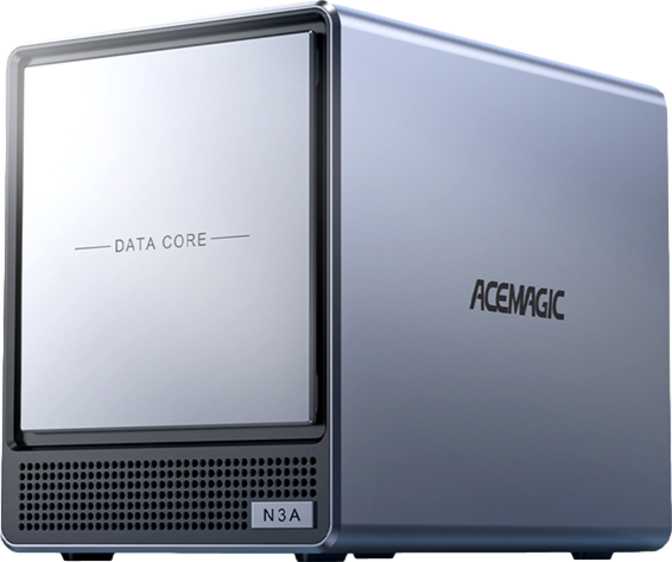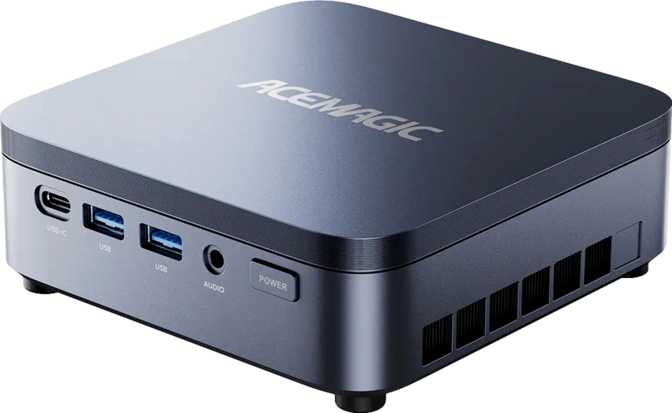
Mini PCs have spent years fighting a reputation problem. For most of their existence, they were underpowered compromises — fine for web browsing, painful for anything real. The Acemagic Matrix Mini M5 is a direct argument against that reputation. Stuffed into a chassis smaller than most paperback books, it carries a 24-core processor, 32 gigabytes of memory, a one-terabyte solid-state drive, and enough ports to outfit a small workstation. Whether it actually delivers on that promise is worth examining carefully — because the specifications are genuinely impressive, and the form factor is genuinely tiny.
At a Glance
Core specifications translated into daily-use meaning
Design and Build: Small Enough to Disappear
The Matrix Mini M5 measures 128mm on each side and stands just over 41mm tall. It fits comfortably on a desk surface no larger than a paperback novel, and it can sit behind most monitors on a VESA mount without drawing any attention whatsoever. The entire enclosure displaces roughly 677 cubic centimeters — less volume than most water bottles.
That compactness is the central promise of this machine, and Acemagic delivers it without the chassis feeling cheap or flimsy. The build quality sits in the upper tier of the mini PC category, where the enclosure must manage serious heat in a very constrained space. The cooling system addresses a genuine 55-watt thermal envelope — that is real heat in a very small box, and the chassis design reflects that engineering challenge directly.
The result is a machine that can live in places a tower or even a slim desktop never could: mounted behind a display, tucked in a server rack, sitting flat on a shelf, or perched beside a monitor in a tight studio space. For users who have been tolerating a bulky desktop out of necessity rather than preference, the physical liberation is immediate and meaningful.
- Width
- 128 mm
- Depth
- 128 mm
- Height
- 41.3 mm
- Volume
- 677 cm³
- Processor TDP
- 55 W
- Warranty
- 1 Year
The Processor: A Laptop Chip Running Free
Core Architecture and Real-World Meaning
The processor inside the Matrix Mini M5 uses Intel's big.LITTLE architecture — pairing two distinct core types in one package. Eight high-performance cores handle demanding, latency-sensitive tasks: video editing renders, compiling code, running complex applications. Sixteen efficiency cores run alongside them, managing background tasks and light workloads without consuming the power budget of the performance cores.
The result is 32 processing threads available simultaneously — enough that heavily multi-threaded workloads like 3D rendering, data processing, and running multiple virtual machines will find real headroom. A 36MB shared cache keeps frequently accessed data close to the processor, reducing latency across both core types.
The performance cores reach up to 5.8GHz under turbo conditions — a peak speed that keeps daily desktop responsiveness sharp and immediate. Single-threaded speed is the primary determinant of how quickly applications feel to open and use, and 5.8GHz is fast by any current standard.
Benchmark Performance
Integrated Graphics: More Capable Than Expected
The Intel UHD Graphics 770 handles all visual output. For anyone expecting dedicated graphics performance, this section deserves careful attention — but the picture is more nuanced than the phrase "integrated graphics" might suggest at first glance.
The UHD 770 contains 32 execution units running up to 1,650MHz. Its memory bandwidth reaches nearly 90 GB/s — substantially higher than older integrated graphics, reflecting shared access to the system's fast DDR4 memory. It supports OpenGL 4.6 and OpenCL 3.0, making it compatible with the vast majority of professional visualization tools, CAD software, and creative applications that rely on GPU acceleration for non-gaming tasks.
The Intel Quick Sync engine built into this graphics processor also accelerates video encoding in compatible software — meaningfully speeding up export times for content creators working in standard editing applications at 1080p and moderate 4K resolutions.
The Matrix Mini M5 supports up to four independent displays simultaneously — an unusual capability at this form factor and price tier.
-
HDMI 2.0Up to 4K resolution at 60Hz
-
DisplayPortHigher refresh rates and daisy-chain support
-
USB-C Display OutputFlexibility for modern monitor types
-
OpenCL 3.0 SupportGPU-accelerated professional software compatibility
Memory and Storage: Configured for Real Work
32GB RAM — The Right Starting Point
32 gigabytes of DDR4 memory runs in a dual-channel configuration at 3,200MHz. Running a browser with thirty tabs, a code editor, a virtual machine, a video call, and background processes simultaneously — this handles all of it without hesitation. Dual-channel effectively doubles memory bandwidth compared to a single-stick setup, which also directly benefits the integrated graphics that share system memory for their GPU tasks.
1TB NVMe SSD — Fast From Boot
The 1TB NVMe SSD provides fast, responsive storage over a direct PCIe connection — delivering read and write speeds that mechanical hard drives and older SATA SSDs cannot approach. Applications open quickly, large files transfer without waiting, and the operating system responds immediately after waking from sleep.
One terabyte is a comfortable amount for most users — enough for the operating system, a full software library, and a substantial working file collection, with room to spare. Users managing large media libraries or raw video archives will supplement with external drives over the USB ports.
Connectivity: Seven USB Ports and Wi-Fi 6E
Wired Connections
The port selection is one of the Matrix Mini M5's genuine practical strengths. Seven USB ports across three speed tiers, two video outputs, wired Ethernet, and a 3.5mm audio jack — all without a hub or dock.
| Port Type | Count | Speed / Notes |
|---|---|---|
| USB-A 3.2 Gen 1 | 4 | 5 Gbps — peripherals, flash drives, external drives |
| USB-A 3.2 Gen 2 | 2 | 10 Gbps — fast external SSDs, high-speed peripherals |
| USB-C 3.2 Gen 2 | 1 | 10 Gbps — modern accessories, hubs, portable SSDs |
| HDMI 2.0 | 1 | Up to 4K at 60Hz |
| DisplayPort | 1 | Higher refresh rates, daisy-chain capable |
| RJ45 Ethernet | 1 | Gigabit wired networking |
| 3.5mm Audio | 1 | Headphones or speakers |
No USB4 or Thunderbolt 4 ports are present. Users who need extreme external bandwidth — eGPU enclosures or high-speed Thunderbolt RAID arrays — will need to factor this in before purchasing.
Wireless
Wi-Fi 6E accesses the 6GHz band alongside the traditional 2.4GHz and 5GHz bands. In practice: faster speeds, less interference in crowded environments such as apartment buildings or offices, and lower latency for time-sensitive applications. Fully backward compatible with all existing routers.
Handles wireless peripherals — mice, keyboards, headphones, speakers — with reliable, low-latency pairing. No dongles required for any Bluetooth device.
Who This Machine Is Built For
The Right Buyer
-
Home Office ProfessionalsGenuine computing power without the footprint of a tower desktop. Multi-monitor and peripheral support is covered out of the box.
-
Developers and Programmers32 threads and 32GB of RAM handle large codebase compilation, Docker containers, local dev servers, and multiple simultaneous virtual machines without trade-offs.
-
Light Content Creators1080p and moderate 4K video editing, large RAW photo batches, and podcast production are well within scope. Intel Quick Sync accelerates compatible export workflows.
-
IT Administrators and Small BusinessesECC memory support, seven-port connectivity, and the compact profile simplify rack or desk deployment as a management node, thin client, or desktop replacement.
-
Multi-Monitor Productivity UsersFour simultaneous displays for trading desks, data analysis, control room monitoring, or digital signage — rare at this form factor and price level.
Who Should Look Elsewhere
-
GamersDedicated GPU performance is not available here. A mini PC with a discrete GPU, or a dedicated gaming desktop, is the appropriate choice for any serious gaming workload.
-
Heavy Video Professionals8K timelines or effects-driven projects will hit the limits of integrated graphics and the 55W thermal ceiling. A workstation-class machine with a discrete GPU is the right tool here.
-
Thunderbolt 4 UsersNo Thunderbolt 4 or USB4 ports. eGPU enclosures and high-bandwidth Thunderbolt storage arrays are not compatible with this machine.
Competitive Positioning
The mini PC market at this performance level has several active competitors. The table below maps the M5 against its logical alternatives in the same category and price tier.
| Characteristic | Acemagic Matrix Mini M5 | Typical Competitor A | Typical Competitor B (Barebones) |
|---|---|---|---|
| Core / Thread Count | 24 cores / 32 threads | 12–16 cores / 16–24 threads | Varies — often unconfigured |
| RAM (included) | 32GB DDR4 | 16GB DDR4/DDR5 | None (user-supplied) |
| Storage (included) | 1TB NVMe | 512GB NVMe | None (user-supplied) |
| Display Outputs | Up to 4 | 2–3 | 2–4 |
| USB Port Count | 7 ports | 4–6 ports | 4–6 ports |
| Wi-Fi Standard | Wi-Fi 6E | Wi-Fi 6 or 6E | Wi-Fi 6 |
| ECC Memory | Yes | Rarely | Rarely |
| Warranty | 1 Year | 1–2 Years | Varies |
Competitor profiles represent generalizations across the mini PC market at this performance tier — not specific named products.
Strengths and Limitations: The Honest Picture
Where It Excels
- Raw multi-threaded performance per cubic centimeter — no machine this physically small offers 32 processing threads at this price without meaningful compromise
- 32GB RAM included from day one — removes the common frustration of inadequate out-of-box memory that forces an immediate and costly upgrade
- Seven USB ports across three speed tiers — competing machines frequently require a hub or dock to match this level of out-of-box connectivity
- Four simultaneous display outputs — a genuinely rare capability at this form factor and price point, serving multi-monitor professionals well
- ECC memory support — an unexpected reliability differentiator that adds real value for IT and professional deployments
- Wi-Fi 6E for current-generation wireless performance, lower interference, and meaningful forward compatibility
Real Limitations
- No Thunderbolt 4 or USB4 — a real gap for users who need eGPU enclosures or high-bandwidth external Thunderbolt storage
- Integrated graphics only — no path to a discrete GPU; modern gaming and 8K video production are outside this machine's scope
- DDR4 rather than DDR5 — competing platforms on newer memory standards hold a bandwidth advantage in memory-intensive workloads
- One-year warranty — the shortest in the competitive set; extended coverage is worth budgeting for business-critical deployments
- 55W laptop processor may throttle under hours of unrelenting maximum-load computation where a full desktop platform would sustain output without restriction
Common Questions Before Buying
Answers to what real buyers search for before making a purchase decision
Final Verdict
The Acemagic Matrix Mini M5 is one of the more honest products in the mini PC category: it makes a specific promise — workstation-class multi-threaded performance in a chassis that disappears on a desk — and the hardware largely keeps it.
For home office workers, developers, multi-monitor productivity users, and IT professionals who need a capable, compact machine that is ready to work the moment it is unboxed, the M5 makes a persuasive case. The 32GB of included RAM, the 1TB storage, the seven-port connectivity, and the four-display support represent real value packed into one small package.
Buy it if you need compact, multi-threaded workstation power for office work, development, content creation, or multi-screen productivity — and want everything included, out of the box, with no mandatory upgrades on day one.
Skip it if gaming, 8K video production, Thunderbolt 4 compatibility, or a two-year warranty are non-negotiable requirements for your specific use case.
The Matrix Mini M5 occupies a genuine sweet spot between performance and compactness, and does so without asking users to accept the crippled specifications that once defined the mini PC category. For everyone it is built for, the recommendation is clear.