PNY RTX 5070 Ti Slim Dual Fan OC: Full Review and Honest Verdict

PNY RTX 5070 Ti Slim Dual Fan OC: Full Review and Honest Verdict

Graphics Cards
8.7
Overall Score / 10
Strongly Recommended
Raw Performance9.2
Memory & Bandwidth9.5
Feature Set9.0
Thermal Efficiency7.2
Value Proposition8.3
46.09
TFLOPS
Compute Power
16GB
GDDR7
Video Memory
896
GB/s
Mem. Bandwidth
2,572
MHz
Boost Clock
290mm
Slim
Card Length
3 Yrs
Coverage
PNY Warranty

Design and Build: The Slim Name Actually Means Something

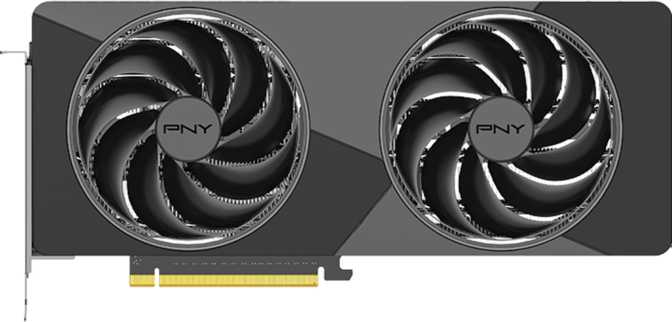
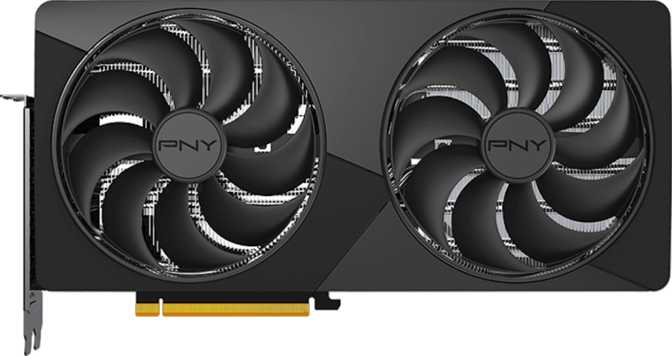
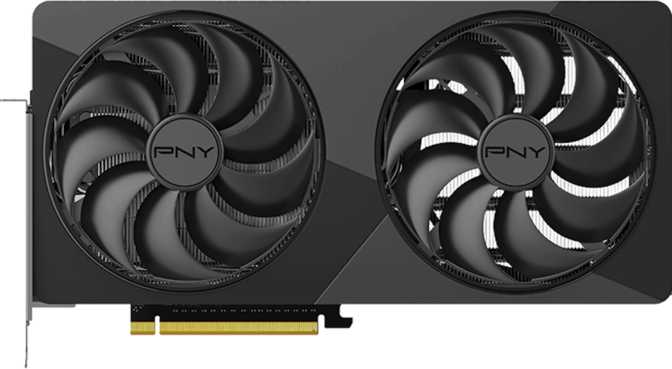
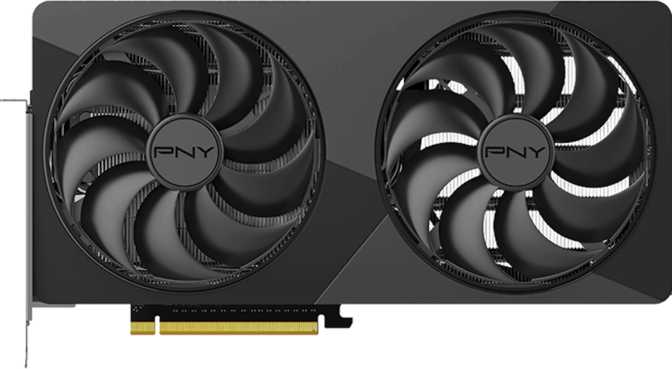
The word "slim" on a GPU box is often marketing gloss. On this card, it reflects a deliberate engineering decision. At 290mm in length, the PNY RTX 5070 Ti Slim fits comfortably in mid-tower cases that would reject a standard triple-fan RTX 5070 Ti, and it slides cleanly into compact mid-towers where airflow clearance is measured in millimeters.

The dual-fan cooler is the defining physical characteristic. Two fans managing 300 watts of thermal load is an engineering challenge — PNY addresses it by keeping the card height to 150mm, which allows better airflow management within the cooler rather than simply stacking a third fan on top. In practice, the fans work harder under sustained load than a triple-fan equivalent would. That is an honest trade-off, not a flaw — and for builders prioritizing form factor, it is the right trade.

RGB lighting is included and tasteful. The card uses no active liquid cooling — it is a pure air-cooled design requiring no radiator mount and no tubing management, compatible with any standard PCIe slot.

Builder's Note: At 290mm, this card is 30–50mm shorter than most triple-fan RTX 5070 Ti variants from other manufacturers — making it the only option at this performance tier for many compact ATX and ITX-adjacent builds.

Physical Specifications

Card Length
290 mm
Card Height
150 mm
Cooler Type
Dual Fan — Air Cooled
RGB Lighting
Included
Liquid Cooling
Not Required
PCIe Interface
PCIe 5.0

Core Performance: What Blackwell Architecture Delivers

Built on NVIDIA's Blackwell architecture using a 5-nanometer process and housing over 45 billion transistors, this card delivers more computational density per millimeter of silicon than any previous consumer GPU generation. That density is part of how PNY achieves this level of performance in a dual-fan, 290mm package.

46.09
TFLOPS
The GPU's raw mathematical throughput — trillions of floating-point operations executed every second, driving everything from game rendering to AI inference.
246.9
GPixel/s
Billions of pixels filled every second. At 4K resolution, this headroom allows the GPU to handle complex scenes without becoming the bottleneck.
720.2
GTexels/s
Surface texture mapping throughput — the speed at which the GPU applies and filters detail across every object in a rendered scene.

The Architecture Advantage

Blackwell on 5nm means more transistors in less space — over 45 billion of them. The result is higher performance per watt compared to the previous generation, and meaningful gains in tasks that depend on instruction-level efficiency rather than raw clock speed alone.

The boost clock reaches 2,572 MHz under load. Clock speed in isolation tells only part of the story — Blackwell's improved instructions-per-clock throughput means these frequencies translate to genuinely faster real-world rendering than prior-generation cards running at similar numbers.

What This Means at Your Resolution

At 1440p — the most popular resolution among enthusiasts — this card operates well below its ceiling, leaving substantial headroom for ray tracing, high-refresh targets, and demanding settings to run simultaneously without performance degradation.

At 4K, the nearly 247 GPixel/s pixel rate provides genuine native rendering headroom before DLSS even enters the equation. When DLSS is enabled, the 4K experience transforms from "capable" to "effortless" across the vast majority of current titles.

Memory: 16GB of GDDR7 Is a Meaningful Upgrade

Why the Memory Type Matters More Than the Capacity

Sixteen gigabytes of VRAM covers any current gaming workload — modded open-world titles, high-resolution texture packs, multi-monitor configurations — without issue. But the more important story is the type: GDDR7.

GDDR7 is the current state of the art in consumer graphics memory. The effective memory speed on this card reaches 28,000 MHz, and combined with a 256-bit memory bus, peak bandwidth exceeds 896 gigabytes per second. Previous high-end cards running GDDR6X operated at roughly half this bandwidth. In practice: the GPU almost never waits for data. Texture streaming, ray tracing acceleration, and AI inference workloads that are memory-bound all benefit directly from this headroom.

ECC Support: A Professional-Grade Bonus

Error Correcting Code memory support allows the card to detect and correct certain memory errors in real time. Gamers will never notice or need it. Professionals running scientific simulations, machine learning training, or financial modeling will appreciate that data integrity is handled at the hardware level — a capability normally reserved for dedicated workstation cards, included here at no extra cost.

Memory Specifications

VRAM Capacity16 GB
Memory TypeGDDR7
Effective Speed28,000 MHz
Bus Width256-bit
Peak Bandwidth896 GB/s
ECC Support Yes

Bandwidth in Context

At 896 GB/s, this card's memory bandwidth is approximately double what leading GDDR6X cards from two generations ago delivered — a generational leap that shows clearly in texture-heavy rendering and AI-assisted creative workloads.

Feature Set: More Than Just Fast Hardware

DLSS — The Feature That Changes the Performance Conversation

Dedicated AI processors on the chip render frames at a lower resolution and reconstruct a sharper, higher-resolution image using deep learning. The result: frame rates that would otherwise require significantly more raw GPU power, without a meaningful quality penalty. At 4K, this transforms the card from "very capable" to "effortless" in the vast majority of supported titles. No competing upscaling technology currently matches its output quality at equivalent performance cost.

Ray Tracing — Real Light, Real Results

Dedicated hardware acceleration computes how light actually behaves — reflections, shadows, and global illumination simulated physically rather than approximated. Blackwell's improved RT architecture handles this more efficiently than prior generations. The honest trade-off: ray tracing still costs performance. This card has enough headroom — especially with DLSS active — that enabling it does not mean sacrificing playable frame rates in current titles.

DirectX 12 Ultimate — Full API Coverage

Full DirectX 12 Ultimate support covers every advanced rendering feature current game developers can deploy on PC — mesh shaders, variable rate shading, sampler feedback, and hardware ray tracing. OpenGL 4.6 and OpenCL 3.0 add coverage for professional and scientific software that runs outside the gaming ecosystem entirely.

Four-Display Output

One HDMI 2.1b port and three DisplayPort outputs support up to four monitors simultaneously. HDMI 2.1b covers 4K at 144Hz and 8K at 60Hz, accommodating current and near-future display standards. There is no USB-C video output — monitors that connect via USB-C will require a DisplayPort or HDMI connection, or a quality active adapter. No legacy DVI output is included, as expected for a current-generation card.

Intel Resizable BAR

Intel Resizable BAR allows the CPU to access the full GPU memory directly rather than in small chunks, producing measurable frame rate improvements in CPU-bound scenarios on compatible Intel platforms. AMD system builders will not benefit from this specific feature, though the card's core GPU performance remains identical regardless of the CPU platform used.

RGB Lighting & PCIe 5.0

Integrated RGB lighting is controllable and tasteful — functional aesthetics rather than excess. PCIe 5.0 connectivity means the card will not become an interface bottleneck for the foreseeable future, and it remains fully backward-compatible with PCIe 4.0 motherboards without any meaningful performance loss in typical gaming scenarios.

Power and Thermals: Planning Your Build Around 300 Watts

The 300W Reality

A 300-watt Thermal Design Power figure is the card's maximum sustained draw under full load — a number that demands respect during system planning. When accounting for CPU, storage, RAM, fans, and other components, a quality 850W power supply is a reasonable minimum for a mid-range build. A 1,000W unit provides proper headroom for high-end configurations with power-hungry processors.

Modern high-end power connectors are required — the current NVIDIA standard for this performance tier. Your PSU should support the appropriate connector natively or via a manufacturer-supplied adapter. Budget PSUs are not appropriate partners for this card regardless of their stated wattage rating.

Thermal Expectations for a Dual-Fan Design

Two fans managing 300 watts means the cooler operates at the edge of its design envelope under extended heavy load. Expect fan speeds to rise noticeably during prolonged gaming sessions or sustained GPU compute tasks. In a well-ventilated case with good intake and exhaust, temperatures remain within safe operating ranges throughout.

Case airflow matters more here than it does with a larger three-fan cooler. In cramped or thermally limited environments, the card will throttle more readily than triple-fan alternatives. Plan your intake and exhaust before ordering — the performance you paid for is only fully available when thermals are managed correctly.

Power Supply Guide

  • 1,000W+ — Ideal for high-end builds with overclocked or high-TDP CPUs
  • 850W — Minimum recommended for a mid-range system pairing
  • 650W or below — Insufficient; risk of instability and component damage
  • Budget-brand PSUs — Not suitable regardless of wattage rating

Warranty Coverage

The 3-year manufacturer warranty provides meaningful protection over the card's primary use window — reflecting PNY's confidence in the build's durability despite the thermal demands a dual-fan design at 300W presents.

Who Should Buy This Card — and Who Should Look Elsewhere

This Card Is Right For You If…

  • Your case won't fit a standard triple-fan card — you need 5070 Ti-tier performance in under 300mm, and this is one of the only ways to get it.
  • You game at 4K — and want current titles handled with DLSS and ray tracing at high refresh rates, without stepping up to an RTX 5080 price bracket.
  • You target 1440p at high refresh rates — and want significant headroom above your display's ceiling to future-proof against demanding upcoming titles.
  • You run GPU-accelerated creative workloads — 3D rendering, video editing, or AI-assisted tools where 16GB GDDR7 and 46 TFLOPS of CUDA compute make a real difference.
  • You're building a compact ATX or ITX-adjacent system — and have been waiting for Blackwell-generation performance in a form factor that actually fits.
This Card Is Not Right For You If…

  • You primarily game at 1080p — this level of GPU far exceeds 1080p requirements at any refresh rate. The cost premium will not translate into a meaningfully better experience at that resolution.
  • Your case has poor airflow — a dual-fan card at 300W needs proper ventilation to perform at its ceiling. Cramped or poorly exhausted cases will cause throttling and elevated noise under load.
  • You need ISV-certified professional GPU compute — true workstation workloads requiring NVIDIA's professional certifications and drivers are better served by the dedicated Quadro/RTX Pro product line.
  • This card strains your total build budget — if spending here means compromising on your CPU, storage, or monitor, the performance delta may not justify the sacrifice at the system level.

Competitive Positioning: How It Stacks Up

Understanding where this card sits relative to its logical alternatives helps clarify whether it is the right choice for your specific situation — or whether a step up, step down, or platform switch makes more sense.

Feature PNY RTX 5070 Ti Slim RTX 5070
Standard Triple-Fan
RTX 5080
Step-Up Tier
AMD High-End
RDNA Architecture
Performance Tier High-End Upper Mid-Range Ultra High-End High-End
Compute Output 46.09 TFLOPS Lower Significantly Higher Comparable Range
VRAM 16GB GDDR7 Less VRAM Higher Varies by SKU
Memory Bandwidth 896 GB/s Lower Higher Lower
Ray Tracing Quality Excellent Good Best-in-Class Good
AI Upscaling DLSS (Full) DLSS (Full) DLSS (Full) FSR Only
Power Draw 300W Lower Higher Similar Range
Card Length 290mm (Slim) 300–330mm+ 330mm+ 300mm+
Ideal Resolution 1440p – 4K 1080p – 1440p 4K – 8K 1440p – 4K
Best For Compact 4K Builds Value-First Builds No-Compromise 4K Rasterization Value

Competing card data represents general architecture tier positioning. The AMD row covers the competing high-end RDNA tier without referencing a specific SKU. All comparisons are qualitative and editorial in nature.

Strengths and Weaknesses: An Honest Assessment

Where It Excels

Unique Form Factor Value

The combination of top-tier Blackwell GPU performance in a 290mm dual-fan package addresses a genuine gap. This is not a slight variation on existing cards — it is one of the only paths to RTX 5070 Ti-tier performance for builders whose cases exclude standard-length alternatives.

GDDR7 Memory — A Generational Leap

The 896 GB/s bandwidth is not an incremental improvement — it is approximately double what leading GDDR6X cards delivered two generations ago. Users running AI-assisted creative tools, heavy texture streaming, or memory-bound compute workloads will feel this advantage clearly in day-to-day use.

DLSS Maturity — Industry's Best Upscaling

DLSS at this level of implementation makes a compelling case for NVIDIA as the platform for 4K gaming and AI-assisted creative work. No competing upscaling technology currently matches its output quality at equivalent performance cost — and this card runs it without constraint.

Professional Viability Beyond Gaming

ECC memory support, 46 TFLOPS of CUDA compute, and 16GB of GDDR7 make this a legitimate tool for GPU-accelerated creative and semi-professional work — not merely gaming hardware with borrowed specs.

Where It Falls Short

Dual-Fan Thermal Ceiling

Physics does not negotiate: two fans move less air than three. Under extended gaming or rendering sessions, fan speeds and temperatures run higher than equivalent triple-fan designs. In thermally compromised cases, this tips from an acceptable trade-off to an active performance limiter.

Fan Noise Under Sustained Load

A dual-fan cooler handling 300 watts produces clearly audible fan noise during heavy use. This is not unacceptable — but buyers who prioritize near-silent operation should manage their expectations or invest in sound-dampening case panels.

No USB-C Video Output

As USB-C monitor connectivity becomes increasingly common, the absence of a native USB-C video port is a minor but real inconvenience. Buyers with USB-C monitors will need to plan for a quality active adapter or a display with a secondary input.

Power Supply Demands Careful Planning

300W TDP is not unusual at this tier, but it demands a quality PSU and careful system-level planning. Budget or undersized power supplies paired with this card are a real risk for first-time high-end builders who underestimate total system power draw.

Common Questions Before You Buy

At 290mm in length and 150mm in height, the PNY RTX 5070 Ti Slim fits the majority of mid-tower and full-tower ATX cases, and many compact mid-towers. Check your case's published GPU clearance specification — 300mm of internal GPU space is sufficient, and most ATX mid-towers offer at least this. The 150mm height also avoids conflicts with wide aftermarket CPU coolers in most standard layouts.

A quality 850W power supply is the minimum recommendation for a mid-range system. For high-end builds with power-hungry or overclocked processors, 1,000W provides proper headroom and stability margin. The card uses the current NVIDIA high-end power connector standard — verify your PSU supports this connector natively or includes a manufacturer-supplied quality adapter. Budget-brand PSUs should be avoided regardless of their stated wattage rating.

Yes. The 16GB of GDDR7 memory, 46 TFLOPS of CUDA compute throughput, and hardware acceleration make this a capable card for GPU-accelerated creative work in applications including DaVinci Resolve, Blender, and Adobe Premiere Pro. The ECC memory support adds data integrity protection for precision workloads. For true workstation environments requiring NVIDIA's professional ISV certifications, the dedicated RTX Pro line remains the appropriate choice.

For the vast majority of AI image generation tools running locally — including current large diffusion models — 16GB covers everyday use cases comfortably. Very large batch operations or experimental models pushing beyond this ceiling will encounter memory limits. For practical daily creative work with AI tools, 16GB on GDDR7 represents a comfortable working margin that should remain adequate for the foreseeable future of consumer AI generation software.

Yes — NVIDIA GPUs are fully platform-agnostic and work with both Intel and AMD systems. The Resizable BAR feature is specified as Intel-compatible on this card, meaning AMD SAM (Smart Access Memory) functionality is not guaranteed. Consult your specific motherboard's documentation for AMD compatibility. The card's core GPU performance, memory bandwidth, and feature set are identical regardless of which CPU platform you pair it with.

Expect the fans to be clearly audible during heavy gaming or sustained rendering. A dual-fan design at 300W works harder than a triple-fan equivalent to maintain safe temperatures, and the fan noise reflects that engineering reality. With a gaming headset on during play, it will not be distracting. In a quiet room with open audio, the fan ramp under heavy load is noticeable. This trade-off is inherent to choosing compact performance over additional cooler volume — it is the cost of the form factor, and for most target users, it is the right cost to pay.
Final Verdict

A Specialized Card That Solves a Real Problem

The PNY GeForce RTX 5070 Ti Slim Dual Fan OC is a niche product in the best sense — it exists to solve a specific problem elegantly, and it does exactly that.

8.7
Overall Score / 10

For the builder whose case cannot accommodate a standard-length triple-fan RTX 5070 Ti, this card removes the performance compromise entirely. You get Blackwell architecture, GDDR7 bandwidth that leaves prior generations well behind, full DLSS support, and genuine 4K gaming capability — all in a package that fits where others won't.

The dual-fan thermal design is the price you pay for that footprint, and in a well-ventilated case it is absolutely worth paying. In thermally limited environments, it becomes a limiting factor — plan your airflow before ordering.

For builders without case constraints, compare directly against triple-fan RTX 5070 Ti options at similar prices — they will run quieter and cooler. But if compact form factor with no performance compromise is the goal, this is exactly what you have been waiting for.

Compact 4K Gaming
Strongly Recommended
GPU-Accelerated Creative Work
Well Suited
Poor Airflow Builds
Not Recommended
Julian Braun Hamburg, Germany

macOS Hardware & Apple Silicon Reviewer

Software architect and Apple Silicon performance analyst who reviews MacBooks and Mac desktops with a focus on unified memory architecture, Metal GPU performance, and Rosetta 2 compatibility for professional creative and development workflows.

Apple Silicon macOS Hardware MacBooks Unified Memory Creative Workflows
  • MSc in Software Engineering
  • Apple Certified Mac Technician (ACMT)
View Full Profile