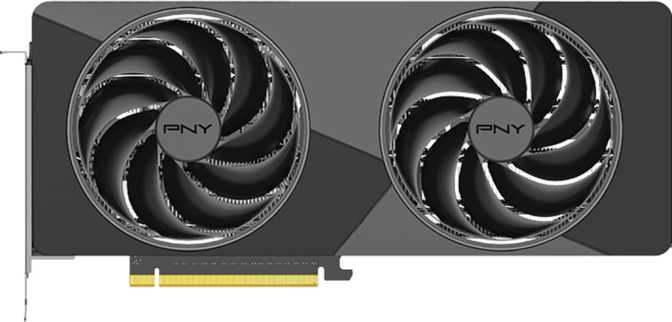
PNY GeForce RTX 5070 Slim Dual Fan OC: Real-World Performance Review
Graphics CardsThe mid-to-high GPU segment is always the most contested ground in PC gaming, and the GeForce RTX 5070 sits squarely in the middle of it. PNY's take on this card — the Slim Dual Fan OC — makes a deliberate design choice that sets it apart from the chunky, triple-fan behemoths that dominate this tier: it keeps things compact without cutting corners on performance. If you have a smaller case, a tighter build aesthetic, or simply resent GPUs that block every expansion slot on your motherboard, this card enters the conversation immediately.
But a slim form factor means thermal compromises are always a lurking concern. The question isn't just whether this card is fast — it's whether PNY has managed to keep a 250-watt chip cool inside a dual-fan shroud at a length that doesn't demand a full-tower chassis. That's what this review works through, specification by specification, with an honest look at who this card genuinely serves.
Design and Build Quality
Form Factor First
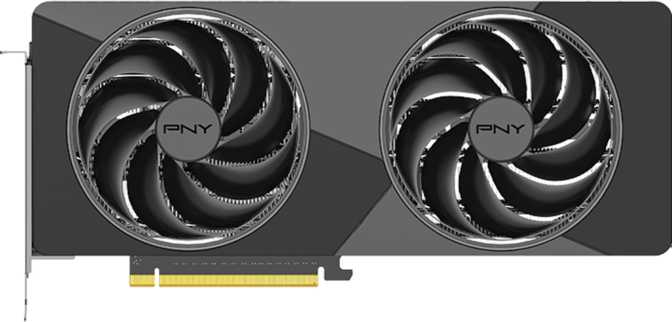
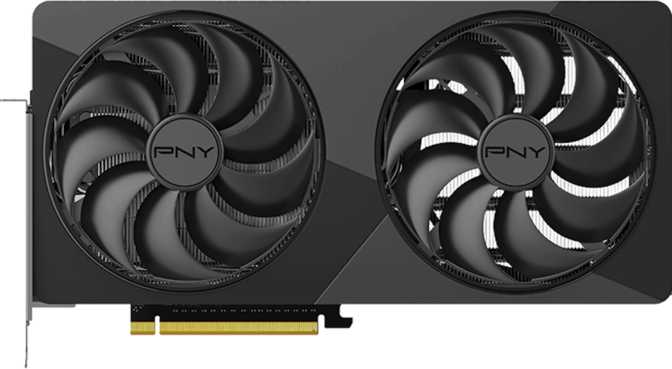
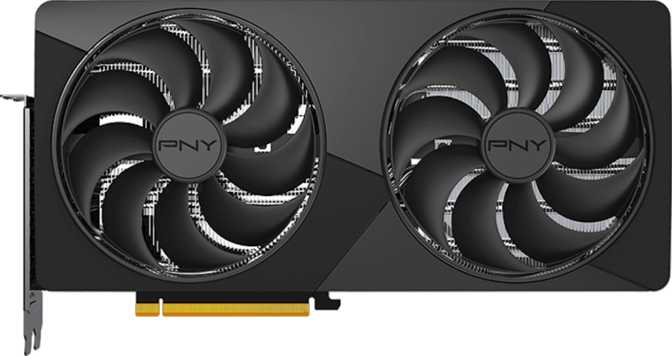
The PNY RTX 5070 Slim Dual Fan OC measures 290mm in length and 128mm in height — a profile that puts it in genuine small-to-mid case territory. By comparison, many competing cards at this performance tier stretch north of 320mm, sometimes approaching 340mm. That 30–50mm difference is meaningful: it's the gap between fitting your build and not fitting it at all.
The "Slim" designation refers to the card's reduced vertical footprint. At 128mm tall, this doesn't bloat across adjacent PCIe slots the way triple-fan designs inevitably do. For builds in Micro-ATX cases or ITX chassis with longer PCIe slots, this is a significant practical advantage.
Cooling Philosophy
Two fans, not three. That's the trade-off made for size, and it's a fair one if the thermal solution underneath is well-engineered. The dual-fan setup works here because NVIDIA's Blackwell architecture was built with power efficiency as a priority. Practically, two fans tend to run quieter at equivalent RPM compared to larger three-fan arrays because the blades can spin at lower speeds to move the same volume of air — though this depends heavily on heatsink fin density and overall airflow within the case.
Aesthetics and RGB Lighting
PNY has included RGB lighting, which keeps this card competitive in builds where visual presentation matters. It's not a feature that affects performance, but it does affect whether the card looks out of place in a windowed case — and at this price tier, that matters to a significant share of buyers. The build feels purposeful rather than flashy; PNY doesn't go overboard with decorative shroud elements, which suits the card's "serious but accessible" positioning.
Performance Architecture — The Blackwell Foundation
The Chip Underneath
The RTX 5070 Slim Dual Fan OC is built on NVIDIA's Blackwell GPU architecture, fabricated on a 5-nanometer process. The 5nm node matters for two reasons: it allows an enormous number of transistors — just over 31 billion — to be packed into a physically compact die, and it improves the performance-per-watt ratio compared to older manufacturing processes. More transistors mean more parallel computing resources, and better efficiency means those resources don't demand as much electricity to operate.
31 billion transistors in this class of GPU represents a substantial engineering effort. This is not a mid-range chip in terms of internal complexity; the process node keeps it from requiring a physically massive die to house that silicon.
Clock Speeds and What They Mean in Practice
The GPU runs at a base clock that, under gaming conditions, boosts to approximately 2,587 MHz at peak. That turbo figure is what matters during gameplay, not the base clock, because modern GPUs constantly adjust their speed based on temperature, power budget, and workload demand.
This boost speed, paired with 6,144 shader units — the individual processors that handle graphics math — translates to the card's headline compute throughput of approximately 31.79 TFLOPS. TFLOPS measures how many trillion floating-point calculations per second the GPU can perform. At nearly 32 TFLOPS, this card sits well above what's needed for smooth 1440p gaming and enters territory where 4K gaming becomes a realistic discussion, especially with DLSS assisting.
The texture processing capability — roughly 496 billion texels per second — and pixel fill rate of approximately 207 billion pixels per second are similarly high. These numbers define how quickly the GPU can apply surface detail and output finished pixels to your display. In real terms: fewer frame stutters when scenes are dense with textures, and higher sustainable frame rates across demanding titles.
The Factory Overclock Advantage
PNY's "OC" designation means the card ships with clock speeds set slightly above NVIDIA's reference specification. Factory overclocks at this tier are typically modest — they don't transform performance, but they do ensure the card operates at the upper end of what the chip can comfortably sustain. You're getting the best version of this GPU out of the box without needing to manually overclock in software.
Memory Configuration — A Genuine Story to Tell
GDDR7 and Why It Matters Here
The memory configuration on this card is one of its most technically interesting aspects. It uses GDDR7 — the current leading standard for graphics memory — delivering a bandwidth figure of 672 gigabytes per second. To put that in perspective: a card from two generations ago at the same tier might offer 300–400 GB/s. At 672 GB/s, memory-intensive workloads become far less of a constraint — dense open-world environments, high-resolution texture packs, and ray tracing scenes that require large data throughput to render reflections and lighting in real time.
The move from GDDR6X to GDDR7 represents a 50%+ increase in how fast data flows through the memory system. Combined with Blackwell's architectural improvements over the previous generation, this is a generational uplift that genuinely changes what the GPU can handle in memory-heavy scenarios — not merely an incremental spec bump.
12GB VRAM Over a 192-Bit Bus
The card carries 12GB of GDDR7 VRAM. This is the figure most buyers fixate on, and rightly so — VRAM sets the ceiling for texture resolution and the complexity of scenes the GPU can handle before it starts struggling. 12GB is currently sufficient for 1440p gaming at maximum settings in virtually all major titles. At 4K with extreme texture settings in the most demanding games, some titles may approach this ceiling, though DLSS significantly reduces the effective VRAM demand by rendering internally at a lower resolution before upscaling.
The 192-bit memory bus is narrower than what you'd find on higher-end cards in this GPU family, but the exceptionally fast GDDR7 memory largely compensates. The raw bandwidth figure of 672 GB/s is the operative number, and it's competitive with cards running wider buses on slower memory. The card also supports ECC (Error Correcting Code) memory — a feature more relevant to professional or creative workloads than gaming, but it signals that this GPU is engineered for reliability across a broader range of tasks.
Key Features Explained
What each specification actually means for your daily experience
DLSS — The Performance Multiplier
DLSS 4 on Blackwell hardware is materially better than earlier versions. The GPU renders at a lower resolution internally and uses dedicated AI processing circuits to reconstruct frames at your target resolution with impressive fidelity. For a 4K display, the effective rendering load drops dramatically while image quality remains indistinguishable from native. For 1440p gaming with a high-refresh-rate monitor, DLSS pushes frame rates well beyond what brute-force rendering allows.
Hardware-Accelerated Ray Tracing
Ray tracing simulates how light physically behaves — reflections that actually reflect the scene, shadows with accurate penumbrae, indirect lighting that fills rooms believably. This card has dedicated hardware circuits for ray tracing rather than attempting it in software. At 1440p with ray tracing enabled and DLSS compensating, it handles modern ray-traced titles well. Full path tracing in the heaviest implementations will push limits, but for the vast majority of ray-traced gaming, the headroom is comfortable.
Quad-Display Output Flexibility
Three DisplayPort outputs and one HDMI 2.1b port allow up to four simultaneous displays — a genuine productivity advantage for multi-monitor setups. HDMI 2.1b supports 4K at high refresh rates and variable refresh rate on modern televisions, making this card equally at home in a living-room gaming setup. Note: there is no USB-C port, which is a notable omission for users who own USB-C displays or monitors.
Resizable BAR Support
Intel's Resizable BAR technology allows the CPU to access the full VRAM pool rather than a limited 256MB window at a time. In supported games, this measurably improves performance — typically by a few percent in CPU-bound scenarios. It requires a compatible motherboard and CPU but is enabled by default on most modern Intel and AMD platforms with up-to-date firmware. A small but consistent free performance gain.
PCIe 5.0 Interface
The card connects via PCIe 5.0 — the latest standard — future-proofing it for next-generation motherboards while maintaining full backward compatibility with PCIe 4.0 and 3.0 platforms. Running this card on an older board works without issue. You won't be bottlenecked in any practical gaming scenario by PCIe 3.0 or 4.0, as the bandwidth ceiling of those interfaces is still rarely the limiting factor in graphics workloads.
DirectX 12 Ultimate and Full API Coverage
Full DirectX 12 Ultimate support means this card is ready for every graphical feature modern games can use — variable rate shading, mesh shaders, and sampler feedback included. OpenGL 4.6 and OpenCL 3.0 round out the API coverage for developers and users running GPU-compute software. ECC memory support further extends the card's relevance into professional workflows where data reliability matters.
Power and Thermal Considerations
The card's thermal design power is rated at 250 watts. For a card delivering approximately 32 TFLOPS, this is a favorable efficiency ratio — previous-generation cards achieving similar performance often demanded 285–300 watts. The Blackwell architecture's efficiency gains on the 5nm process are directly responsible for this improvement, and they have a direct impact on your electricity bill and how hard the cooling solution has to work.
Power Supply Recommendation
The dual-fan cooling solution needs to dissipate 250 watts through a 290mm × 128mm form factor — a non-trivial thermal challenge. The card does not use liquid cooling, so airflow within the case matters. Good cable management and at least one intake fan in the chassis will help the GPU fans draw fresh air rather than recirculate warm air from inside the case.
Who This Card Is For
Matching the right buyer to the right GPU before you spend
The Ideal Buyer
-
1440p gamers seeking headroom
High or maximum frame rates in demanding titles with DLSS providing additional ceiling for years ahead as games become more demanding.
-
4K gamers willing to use DLSS
4K gaming with DLSS Quality mode is visually excellent and runs well. A legitimate option at this tier for 4K display owners who understand and accept AI-assisted upscaling.
-
Small and mid-size case builders
The 290mm length and 128mm height open up Micro-ATX and many ITX builds that reject larger designs outright. This is a meaningful differentiator, not a marketing label.
-
Content creators and GPU-compute users
Video rendering, AI image generation, and 3D viewport work all benefit from GDDR7 bandwidth, compute throughput, and ECC memory support for data reliability.
Who Should Look Elsewhere
-
1080p gamers on a tight budget
This card is overkill at 1920×1080. The additional performance goes underutilized at that resolution, and you'd get far better value from a card one or two tiers down.
-
Users demanding native 4K without DLSS
Native 4K with ray tracing in the heaviest titles will push this card's limits. The RTX 5080 tier is the right choice if you refuse to rely on upscaling for 4K playability.
-
USB-C monitor users
No USB-C output means you'll need an active adapter or hub, which adds cost and a potential point of failure. If USB-C connectivity is essential, this card isn't the right fit.
Competitive Positioning
How the PNY RTX 5070 Slim Dual Fan OC stacks up against logical alternatives
| Card | Compute (TFLOPS) | VRAM | Mem. Bandwidth | TDP | Form Factor |
|---|---|---|---|---|---|
| PNY RTX 5070 Slim Dual Fan OC This Card | ~31.8 | 12GB GDDR7 | 672 GB/s | 250W | Compact dual-fan |
| RTX 5070 Reference Cards | ~31.8 | 12GB GDDR7 | 672 GB/s | 250W | Varies, typically larger |
| RTX 5070 Ti Tier | Higher | 16GB GDDR7 | Higher | Higher | Triple-fan typical |
| RTX 4070 Super (Prior Gen) | ~21.5 | 12GB GDDR6X | 432 GB/s | 220W | Triple-fan typical |
The PNY Slim's compute performance is identical to any other RTX 5070 — GPU silicon doesn't change between board partners. PNY differentiates through form factor, factory OC, and the dual-fan thermal solution.
Strengths and Weaknesses — An Honest Assessment
What the PNY RTX 5070 Slim Dual Fan OC genuinely gets right, and where it falls short
Where It Excels
- The 290mm compact body opens this card to builders that triple-fan competition simply cannot serve — a genuine differentiation that's felt immediately when planning a small-form-factor build.
- GDDR7 memory at 672 GB/s is a real-world advantage in texture streaming, ray tracing data throughput, and GPU compute — not just a spec-sheet talking point over older GDDR6X designs.
- The factory overclock extracts maximum stable performance from day one without requiring the buyer to tune anything manually — PNY has already done the stress testing.
- 250W TDP is efficient for the performance delivered, meaning lower electricity costs over time and less thermal challenge for the cooling solution relative to previous-gen equivalents.
- A 3-year warranty, 4-display output (including HDMI 2.1b for TV gaming), RGB lighting, and full API support round out a competitive feature set at this price tier.
Where It Falls Short
- Dual-fan cooling is inherently less thermally forgiving than triple-fan solutions under sustained maximum-load conditions — long rendering jobs or gaming sessions in warm, poorly ventilated cases will push fan speeds higher and may result in more audible noise.
- The 12GB VRAM ceiling will come under pressure before 16GB alternatives do as game asset budgets grow. It's adequate today, but the longevity question is real for buyers planning to keep this card for four or more years.
- No USB-C output is a genuine gap for a subset of users — not a dealbreaker for most, but it adds adapter cost and an extra point of potential failure for anyone using USB-C displays or docking stations.
Questions Buyers Actually Ask
Answers to the most common pre-purchase concerns about the RTX 5070 Slim Dual Fan OC
A Well-Considered Card for the Right Builder
The PNY GeForce RTX 5070 Slim Dual Fan OC is a well-considered product built around a clear value proposition: full Blackwell-tier RTX 5070 performance in a form factor that respects case constraints. The GDDR7 memory configuration delivers bandwidth that other cards at this tier can't match on older memory standards, the factory overclock means you're getting the best version of this chip from day one, and the compact body opens up build options that triple-fan alternatives close off.
It is not the right card if you need a USB-C output, demand the absolute lowest fan noise under extreme sustained loads, or want the insurance of 16GB VRAM for a longer upgrade cycle. For those situations, the RTX 5070 Ti or larger-format alternatives deserve consideration.
For 1440p gaming, hybrid 4K gaming with DLSS, creative GPU workloads, and any build where case space is genuinely at a premium — this card earns a confident recommendation. PNY has made the right compromises for the audience this card was designed to serve, and the specifications back that up at every tier of the analysis.