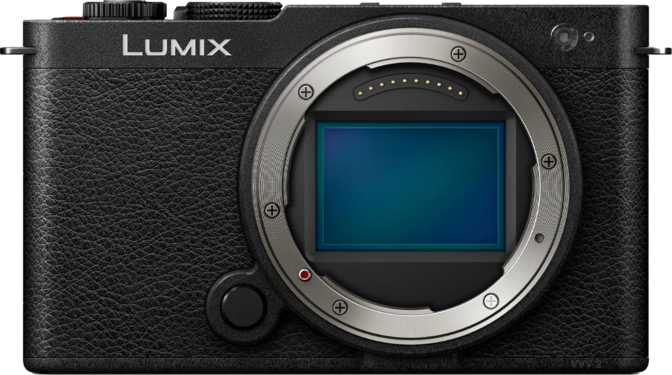
Panasonic Lumix S9 Review: Full-Frame Quality, Pocket-Sized Body
CamerasRecommended for Creators & Travelers
Full-frame image quality in one of the most compact mirrorless bodies available. Real trade-offs apply.
Strengths
- Top-tier in-body image stabilization for its sensor class
- Professional-grade 200 Mbps video with 24p cinema mode
- Full-frame BSI sensor in a strikingly compact body
- External mic input plus headphone monitoring jack
Weaknesses
- No weather sealing of any kind
- Single memory card slot only
- Modest battery capacity — carry a spare
- Non-stacked sensor limits extreme burst-speed scenarios
A Full-Frame Camera That Actually Fits in Your Bag
Most full-frame mirrorless cameras present a choice: carry serious glass and sensor, or carry comfortably. The assumption baked into this category for years has been that the two are mutually exclusive — that full-frame image quality necessarily arrives in a body that demands a dedicated bag, a reinforced strap, and a commitment to looking conspicuously equipped.
The Panasonic Lumix S9 is a direct argument against that assumption. It packs a full-frame sensor — the same sensor class that powers professional studio cameras and high-end cinema rigs — into a body that slides into a jacket pocket with the right lens attached. Whether that ambition holds up under scrutiny, and what it costs to achieve, is exactly what this review examines.
Build and Physical Design: What Compact Actually Means Here
The Dimensions in Practice
The S9 is compact without being precious. Its footprint — roughly 126 mm across, 74 mm tall, and 47 mm deep — places it among the smallest full-frame mirrorless bodies currently produced. The weight, sitting just under 490 grams with battery and card installed, is easy to carry across an entire day of shooting without the shoulder and wrist fatigue that accompanies larger bodies.
For a travel photographer or content creator who has previously accepted extra weight as the price of full-frame quality, the S9’s dimensions are a meaningful shift. This is a camera you reach for because it is accessible, not one you psych yourself up to carry.
What You Give Up for That Size
The body also runs a single memory card slot. Professional photographers who rely on dual-card backup workflows will need to adjust their expectations or look elsewhere. For content creators, enthusiasts, and travel photographers shooting for personal projects, a single slot is rarely a practical problem — but it is worth naming clearly.
The Screen and Controls
The rear display is a fully articulating touchscreen that hinges out to face forward — the configuration that matters for solo content creators filming themselves, for overhead flat-lay shots, and for any angle where pressing your eye to a viewfinder is not an option. It moves freely rather than locking at fixed positions, making it more versatile than simpler tilt mechanisms.
The touch interface lets you tap to place focus or drag an autofocus zone during recording. A standard hot shoe is present for external flash units or wireless triggers. There is no built-in flash, which is entirely expected at this level.
Sensor and Image Quality
Full-frame credentials examined
Full-Frame Advantage
A full-frame sensor captures substantially more light than the smaller APS-C sensors found in most compact mirrorless cameras. More sensor area means better light-gathering efficiency, more pleasing background blur, and a rendering quality that smaller formats cannot replicate. The S9’s sensor is back-illuminated (BSI), meaning the signal-processing circuitry is repositioned to maximize how much incoming light actually reaches each pixel.
24 MP: The Right Resolution
Twenty-four megapixels is correctly sized for this camera and its intended audience. Files are large enough for generous cropping and significant prints, but not so large that they overwhelm typical consumer storage pipelines or slow down editing on mid-range laptops. For portrait, travel, event, and hybrid content shooting, this resolution stops being the limiting factor well before the glass or the photographer does.
Low-Light Performance
The native sensitivity range extends well into territory useful for candlelit interiors, evening events without supplemental lighting, and dim urban environments. The BSI sensor architecture supports cleaner output at elevated ISO settings compared to conventional designs. An expanded mode pushes the ceiling further still for emergencies — though extreme settings should be treated as headroom rather than a reliable creative tool.
Stabilization: The Engineering Advantage That Changes Real Shooting
Six and a half stops of stabilization compensation places the S9 at or near the top of the current full-frame mirrorless category. In practical terms, this means that where a steady hand might limit you to a 1/60 second shutter speed, this camera can produce sharp results at exposures more than 90 times slower. Dimly lit museum interiors, architecture in confined spaces, and handheld portraits in available evening light become confident shots rather than hopeful ones.
For video, the advantage is even more pronounced. The S9 can layer its optical in-body stabilization together with electronic stabilization during recording, combining the two systems for additional smoothness on top of the mechanical compensation. The result is footage that holds steady during walks, pans, and moderate movement — a substantive workflow benefit for solo creators who cannot always afford a gimbal on every shot.
Autofocus: Phase Detection for Stills and Video
The S9 uses phase-detection autofocus for both still photography and video recording. Phase detection works by analyzing incoming light from two angles simultaneously, allowing the camera to calculate not just that focus is off, but by how much and in which direction. The result is faster, more decisive focus acquisition than contrast-detection systems — particularly when subjects are moving or when light is inconsistent.
-
Subject Tracking Holds focus on moving subjects across both stills and video, removing manual focus management in single-operator video work.
-
Continuous AF During Video Phase-detection continuous autofocus maintains lock as subjects move within the frame throughout the recording.
-
Touch Autofocus Tap a face, eye, or object on the touchscreen to lock on. Pairs naturally with the flip-out display for self-filming.
-
Full Manual Control Manual focus, shutter speed, ISO, and white balance give experienced photographers complete creative override.
-
Two-Stage Shutter Half-press confirms focus before committing to capture — fundamental behavior the S9 handles correctly.
-
Burst Mode with Fast Electronic Shutter Serial shot mode is included, with the fast electronic shutter providing additional capture speed when subjects demand it.
Video Performance: The Department Where the S9 Makes Its Case
Two hundred megabits per second represents how much image data is captured each second, and it sits at the high end of what mirrorless cameras at this price point typically offer. At this bitrate, color information is captured with enough fidelity to support serious post-production — color grading, noise reduction, and exposure correction all respond more cleanly to higher-bitrate source files.
Footage captured at this rate gives editors real latitude. It does not fall apart under adjustment the way compressed, lower-bitrate files do — a meaningful advantage for anyone whose footage goes through any meaningful edit before delivery.
Key Video Capabilities
Audio: Professional Inputs in a Small Body
The S9 includes both a 3.5 mm microphone input and a 3.5 mm headphone monitoring jack. These two ports together represent the audio dividing line between consumer cameras and tools that can produce professional audio without external recorders. The microphone input accepts any external directional microphone, lavalier, or audio interface. The headphone jack allows real-time monitoring of recorded audio while shooting, catching distortion, wind noise, or level problems before they become unfixable.
Battery Life: Realistic Expectations
Under standardized testing conditions, the S9 delivers approximately 470 frames per charge. In real-world shooting — where the screen is on more often, autofocus is working continuously, and wireless connections are active — that figure should be understood as an optimistic ceiling rather than a guaranteed floor.
For a full day of mixed shooting, 470 frames is enough for many photographers but tight for high-volume work. The battery is removable, which allows swapping in the field. Carrying a second battery eliminates this constraint for most use cases and should be treated as standard equipment, not optional.
The modest battery capacity is a direct consequence of the compact body. A larger battery requires more physical space; the S9 prioritizes portability. This is a trade-off made deliberately, not an engineering oversight.
Connectivity and the Digital Workflow
Wireless Integration
Wi-Fi 5 support provides fast wireless transfer of images and remote control of the camera from a smartphone. Bluetooth maintains a persistent low-energy connection to your phone, enabling location tagging from the phone’s GPS — compensating for the fact that the S9 has no built-in GPS — and keeping the camera paired even when Wi-Fi is off.
Smartphone remote control allows triggering the shutter, adjusting settings, and previewing the live view from your phone. For self-portraits, wildlife photography from a hide, or any scenario where you cannot be at the camera, this is a practical and well-integrated capability.
Connectivity at a Glance
- Wi-Fi 5 (802.11ac dual-band)
- Bluetooth persistent low-energy pairing
- USB-C (3.2) fast transfer and charging
- HDMI Output external monitor or recorder
- 3.5 mm mic input and headphone jack
- No GPS — smartphone geotagging only
The Leica L Lens Mount: Ecosystem Access
The S9 uses the Leica L bayonet mount — a standard shared across three manufacturers
Panasonic S-Series
Compact primes designed to suit the S9’s portable form factor, alongside professional zoom lenses for more demanding applications. First-party ecosystem support.
Sigma Art Series
Exceptional optical quality at prices that undercut comparable first-party options across much of the focal length range. The strongest value proposition in the ecosystem.
Leica Glass
Extraordinary optical instruments the S9 can fully utilize. Prices reflect Leica’s position at the top of the market. For photographers where only the finest glass qualifies.
The L-mount ecosystem is not as expansive as Sony’s E-mount or Canon’s RF-mount in raw lens count, but it covers every focal length and use case most photographers will ever encounter.
Who This Camera Is For — and Who It Isn’t
-
Content Creators and Vloggers Who need full-frame video quality, a selfie-capable screen, and a camera that does not look imposing on a gimbal. The flip screen, continuous AF, 200 Mbps bitrate, and professional audio inputs address nearly every priority.
-
Travel Photographers Who want full-frame image quality without the weight penalty. Under 490 grams with a compact prime represents real portability in the full-frame category.
-
Enthusiasts Moving to Full-Frame Who want a camera with room to grow. Manual controls, RAW capture, a credible lens ecosystem, and a strong sensor make this a system they won’t outgrow quickly.
-
Hybrid Shooters Who divide their time between stills and video and want strong performance in both without carrying separate bodies.
-
Outdoor and Adventure Photographers Who regularly shoot in rain, dust, or humidity. Competing full-frame bodies from Nikon and Sony offer meaningful splash resistance; the S9 has none.
-
Professionals Requiring Card Redundancy A single slot means no in-camera backup. If losing a card means losing irreplaceable images, this is a workflow mismatch the S9 cannot resolve.
-
High-Volume Burst and Action Shooters Sports and wildlife photographers who need the absolute ceiling of burst performance. The non-stacked sensor design is not where the category limit is highest.
-
Photographers Who Need In-Camera GPS The S9 has no built-in GPS. Smartphone geotagging requires a maintained Bluetooth connection and can be inconsistent in practice.
Competitive Positioning: Where the S9 Stands
How the Lumix S9 compares against typical compact full-frame alternatives
| Feature | Panasonic Lumix S9 | Compact FF Alternative | Budget FF Alternative |
|---|---|---|---|
| Sensor Size | Full-frame | Full-frame | Full-frame |
| Resolution | 24 MP | 12–24 MP | 24 MP |
| Weather Sealing | None | Limited | Limited |
| IBIS Rating | 6.5 stops | 4–5.5 stops | 5–6 stops |
| Video Bitrate | 200 Mbps | 100–600 Mbps (varies) | 100–150 Mbps |
| Dual Card Slots | No | Varies by model | No |
| Flip-Out Screen | Yes | Some models | Tilt only |
| Lens Ecosystem | Leica L (3-brand) | Sony FE / Canon RF | Nikon Z |
| Headphone Jack | Yes | Some models | No (typically) |
The S9’s primary competitive advantage is its stabilization performance and professional audio capability. Its primary disadvantage is the absent weather sealing that several competitors address at comparable price points.
Strengths and Weaknesses: The Unvarnished Picture
The S9 earns its place in the compact full-frame conversation through a combination of strong individual capabilities. The stabilization system delivers a real, daily advantage — not a specification point that matters only in edge cases, but a consistent improvement to handheld image and video quality that changes what is achievable.
The video package — high-bitrate capture, cinema frame rate, slow motion, phase-detection continuous autofocus, and professional audio inputs including a headphone monitoring jack — punches above where you would expect at this size. The full-frame BSI sensor hits the resolution target for virtually every creative application a non-commercial photographer will encounter.
The flip-out touchscreen is well-implemented. The USB-C connection makes charging and transfer simple. The Leica L mount opens a credible and growing lens library without locking you into a single manufacturer’s pricing.
Where the S9 stumbles, it does so without ambiguity. The lack of weather sealing is the most consequential design decision and the one most likely to cost Panasonic sales to buyers who shoot outdoors regularly. A competitor that offers even basic splash resistance gets those buyers.
The single card slot is a real limitation for professional use, though it matters far less to the enthusiast and creator audience the S9 is most clearly aimed at. The battery is modest in absolute terms — structurally inevitable given the compact body, but a spare is a practical necessity.
The non-stacked sensor means cameras using stacked CMOS will outperform the S9 in scenarios demanding extreme speed. For most users, this is never encountered. For the subset it matters to, it is disqualifying.
Questions Real Buyers Ask Before Purchasing
Answers to the most common searches before buying the Lumix S9
Final Verdict: Who This Camera Rewards
Recommended for Creators, Travelers, and Full-Frame Newcomers
The Lumix S9 is not trying to be everything to everyone. It is a compact full-frame mirrorless camera built for portability, video capability, and shooting comfort — and within those priorities, it is very well constructed. The stabilization system is a legitimate standout. The video package is coherent and professional-grade. The sensor delivers image quality that exceeds what any smaller-format compact provides, without the operational weight of a professional body.
The compromises are equally clear. No weather sealing, one card slot, and a battery that requires active management are the three points where the S9 asks you to adjust your expectations or your workflow. For photographers whose shooting life fits within controlled or predictable environments, those compromises are entirely manageable. For photographers who need all-weather capability or professional redundancy, they are not.