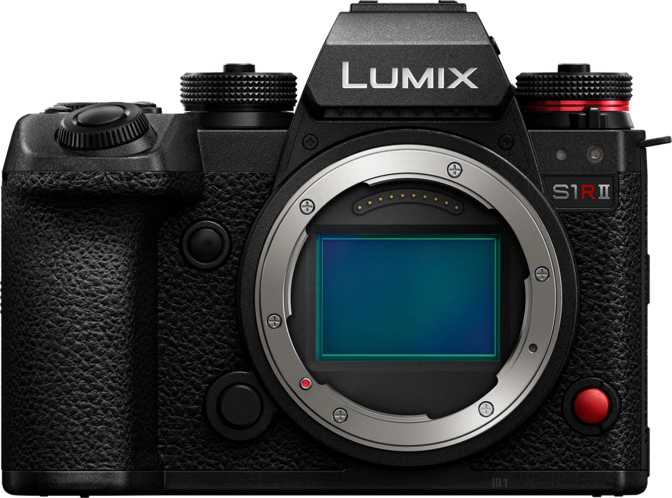
In-Depth Review
A High-Resolution Statement in a Crowded Category
High-resolution mirrorless cameras have become a genuinely competitive space. Every major manufacturer now fields at least one full-frame body promising to satisfy commercial photographers and working filmmakers in the same package. The Panasonic Lumix DC-S1R II earns its place in that conversation not through broad promises but through a specification set built around a specific commitment: serious resolution paired with exceptional stabilization and video capability that professionals can use without compromise. If you are trying to decide whether this camera deserves your investment — or whether a competing body makes more sense for your work — this review answers that question with the detail the decision deserves.
Key Specs at a Glance
44.3MP
Full-Frame Resolution
8 Stops
In-Body Stabilization
4.3K/30p
Internal Video Recording
350 Shots
CIPA Battery Rating
795 g
Body Weight
-10°C–40°C
Weather-Sealed Range
Build Quality, Dimensions, and Everyday Handling
A Camera That Means Business
The S1R II is not a camera that pretends to be smaller than it is. At just over 134 mm wide, roughly 102 mm tall, and nearly 92 mm deep, with a body weight of 795 grams before you've attached anything to the front, this is a substantial piece of equipment. Whether that's a problem depends entirely on what you're shooting. For studio assignments, landscape sessions with a tripod in the field, or commercial work where gear lives in a rolling case, the weight is functionally irrelevant. For a photographer hoping to travel light through city streets or pack a minimal bag for a hiking trip, it will wear on you by the end of the day.
That mass is not waste — it reflects the engineering inside. The body carries full weather sealing with an operating range that extends down to -10°C at the cold end and up to 40°C at the warm end. The lower limit is genuinely practical: mountain photographers, winter sports shooters, and anyone working outdoors in northern climates in the colder months can keep shooting in conditions that would force a less protected body into a bag. Rain, mist, blowing dust, and splashing water are handled without ceremony. For photographers who regularly work in demanding outdoor environments, that confidence matters.
Viewfinder and Screen Experience
The electronic viewfinder delivers 100% frame coverage — what you compose is exactly what the sensor captures, with nothing cropped or hidden at the edges. For photographers working at maximum resolution where every pixel of the frame has value, and where careful placement of a horizon or architectural element matters, full coverage is not a small luxury.
The 3-inch rear screen is fully articulating rather than simply tilting. For photographers accustomed to a tilt-screen, this takes approximately thirty seconds to adjust to and then becomes preferable for a simple reason: it handles more positions. Low-angle shooting, overhead framing, angled mounting on a cage or rig, vertical orientation — the flip-out mechanism accommodates all of them without restriction. Video shooters, in particular, will use this constantly. The screen responds to touch for focus point selection and menu navigation, and its resolution is sufficient for detailed review and confirmation work in the field.
There is no pop-up flash built into the body — standard for a professional camera at this level — but the hot shoe accepts external flash units, radio triggers, and accessory microphones according to your setup.
Build & Handling at a Glance
- Body Weight
- Approximately 795 g, body only
- Dimensions (W x H x D)
- Approximately 134 x 102 x 92 mm
- Operating Temperature
- -10°C to 40°C
- Weather Sealing
- Yes, splash-resistant construction
- Viewfinder Coverage
- 100% electronic viewfinder coverage
- Rear Screen
- 3-inch fully articulating touchscreen
The 44.3-Megapixel Sensor: What That Resolution Actually Delivers
Resolution With Real-World Meaning
Forty-four megapixels on a full-frame sensor places the S1R II in a distinct tier. To give that figure practical meaning: a single image captured at this resolution can be printed at commercial quality large enough to fill a wall, cropped aggressively and still retain enough pixel density for a full-page editorial spread, or supplied with the level of detail that product and fashion clients expect when they need extensive retouching latitude. The resolution is not a number in search of a use case — it answers real demands in commercial, architectural, and fine art photography.
For photographers stepping up from a 24 or 26-megapixel body, the practical difference is tangible in multiple directions. Files are larger, storage fills faster, and processing demands increase — these are real costs. But what you gain is compositional flexibility after the fact. A slightly off-center frame can be corrected in post without meaningful quality loss. A portion of a wider image can become a distinct secondary deliverable. Fine textures — fabric weave, skin detail, architectural surface, foliage — render at a level that simply cannot be replicated from a sensor with significantly fewer pixels, regardless of the lens used.
The Back-Illuminated Design and Its Practical Value
The sensor uses a back-illuminated (BSI) architecture, which positions the sensor's light-gathering elements closer to the incoming light path — a design that improves light capture efficiency compared to conventional sensor construction. The practical benefit appears most clearly at elevated ISO settings, where the S1R II manages noise better than you might expect from a sensor with this pixel density. High-resolution sensors typically produce smaller individual photosites, which gather less light per pixel — the BSI design partially offsets this by improving the efficiency of each photosite.
The usable sensitivity ceiling is high. The native range extends into territory suitable for low-light commercial and event work, with an expanded setting available for situations where some noise is acceptable in exchange for a workable exposure. The S1R II is not a specialist low-light body in the way that lower-resolution cameras with large photosites can claim to be, but it is not limited to bright conditions either. For most professional applications, its light sensitivity is entirely adequate.
44.3 MP
Full-frame, back-illuminated sensor resolution
In-Body Stabilization: Where This Camera Stands Apart
8 Stops
CIPA-rated in-body image stabilization
The S1R II's image stabilization system is among the most capable in any production mirrorless body available. Rated at eight stops under standardized testing conditions, it allows hand-holding at shutter speeds where camera movement would otherwise be visible as blur in a 44-megapixel file — a problem that gets worse, not better, at higher resolutions, because more pixels means more detail to reveal motion.
Eight stops is not an abstract boast. At the kind of shutter speeds a landscape photographer uses to balance ambient light without a tripod, or an interior photographer uses to avoid flash in a sensitive space, the stabilization system is genuinely keeping shots sharp that would otherwise be unusable. The practical gain is most significant in marginal light: the difference between needing a tripod and not needing one, between shooting at a shutter speed that freezes ambient movement and one that doesn't.
The system also works in combination with optically stabilized lenses — specifically, compatible native L-mount glass that includes its own stabilization element. Combined operation extends the effective benefit further, particularly with longer focal lengths where stabilization pays the highest dividends.
For video recording, stabilization of this caliber is transformative for handheld and shoulder-mounted work. Footage that would otherwise require gimbal support for a smooth result can be captured without additional hardware when conditions allow.
Autofocus: A Genuine Improvement
Panasonic's autofocus performance has historically been a point of hesitation for photographers considering the system. Earlier iterations relied on contrast-detection approaches that were slower to acquire focus than the phase-detection systems used by competing manufacturers. The S1R II uses phase-detection autofocus for both stills and video capture — a meaningful architectural shift, not an incremental refinement.
Phase-detection AF calculates subject distance directly from the characteristics of the incoming light rather than searching for peak contrast through a lens movement cycle. It acquires focus faster and more confidently on moving subjects, and it tracks more reliably when a subject changes speed or direction within the frame. Subject tracking is included, so the camera can maintain focus on a chosen subject as it moves — useful for portrait work with active subjects, event coverage, wedding ceremonies, and any scenario where a static composition is not guaranteed.
At ten frames per second in continuous mechanical shooting, the S1R II is not optimized for professional sports or wildlife photography at the highest performance tier. But context matters here: ten full-resolution frames per second from a 44-megapixel sensor represents a significant amount of processing and data handling per second. For the majority of commercial, portrait, wedding, event, landscape, and architectural applications, ten frames per second is more than adequate, and the burst will rarely be the bottleneck.
Touch-based autofocus selection through the rear screen offers an intuitive alternative to using rear controls for focus point placement — particularly practical during video recording or when shooting at an angle that makes the camera body harder to read by feel.
10 fps
Continuous shooting with phase-detection AF and subject tracking
Video: Designed for Production, Not Just Content
Resolution and Bitrate — Together, They Matter
The S1R II records video at approximately 4.3K resolution at 30 frames per second as its maximum specification, with a 24-frame-per-second cinema mode available for productions where standard film-rate motion characteristics are required. That resolution level provides meaningful flexibility in post-production: a 4K deliverable can be extracted from a 4.3K capture with room for minor reframing, and the detail density is high enough to support the overhead that color grading and visual effects work adds to footage.
What most distinguishes the S1R II's video credentials, however, is not its resolution — it's the internal recording bitrate, which operates at an extremely high ceiling by the standards of any mirrorless camera. High bitrate recording means the camera is applying minimal compression to the image data it captures. In practical terms, this translates to footage that responds exceptionally well to color grading: you can push the color and exposure in post without artifacts or breakdown appearing in the image. Chroma keying is cleaner, shadow detail is better preserved, and mistakes made in the field are more recoverable in editing. For videographers and cinematographers who are accustomed to reaching the limits of lower-bitrate cameras in post-production, this internal recording capability is the specification that changes how you work.
4.3K/30p
Maximum internal video recording, plus a 24p cinema mode
Worth Knowing
One characteristic worth understanding before committing: the sensor does not use a stacked CMOS design. Stacked sensors read out data faster, which reduces rolling shutter — the subtle distortion that appears when fast-moving subjects or rapid camera pans interact with the sequential line-by-line readout of a standard sensor. In everyday shooting — interviews, documentary work, controlled cinematographic movement — rolling shutter will not be a notable issue. For content involving rapid camera motion or fast-spinning subjects under electronic shutter, it is worth being aware of.
Audio, Slow Motion, and Timelapse
The S1R II approaches audio seriously, and rounds out its video toolset with features built for real production work rather than casual clips.
- edraleBuilt-in stereo microphone for run-and-gun situations where external audio isn't practical
- 3.5mm input for a dedicated external microphone, plus headphone monitoring to confirm what's actually being recorded
- Slow-motion recording available for impact footage
- Built-in timelapse function, removing the need for external intervalometer hardware
- Continuous phase-detection autofocus that stays active throughout recording, not just for stills
- 24p cinema mode for standard film-rate motion characteristics
Battery Life: Plan Accordingly
The S1R II's rated battery endurance under standardized testing conditions comes in at around 350 frames per charge. For photographers accustomed to higher-rated bodies or the generous endurance of DSLRs, this requires planning.
Three hundred fifty frames is an honest number for a high-power body with a full-frame sensor, active electronic viewfinder, continuous image stabilization, and wireless connectivity operating. Every one of those systems draws power continuously. How far a single charge actually takes you in the field depends heavily on EVF-versus-rear-screen usage ratio (the rear screen draws less power), frequency of image review, cold-temperature shooting that reduces battery efficiency, and how much video recording is mixed into a session.
For video-focused work, where the camera runs continuously, plan battery usage differently from the per-frame estimate — continuous recording draws power on a different curve than the wake-shoot-sleep cycle of stills work.
≈350 Shots
CIPA-rated battery life per charge
Practical Tip
For professional use, the practical approach is straightforward: carry charged spare batteries. The battery is removable and swappable in seconds, and the USB-C connection supports charging from a power bank or laptop between locations — during a car journey between venues, over a lunch break, or during any downtime in a shooting day. A vertical battery grip, where available, doubles the onboard capacity and meaningfully extends endurance for all-day assignments.
Connectivity and Workflow Features
- Dual Card Slots
- Dual memory card slots allow the kind of professional redundancy that job-critical work demands. Simultaneous backup writing means a card failure mid-shoot does not mean lost images. Alternatively, RAW files can be directed to one slot and JPEGs to another, or one slot can be designated as overflow when the primary fills.
- Wi-Fi 5 & Bluetooth 5
- Wireless connectivity covers both Wi-Fi 5 and Bluetooth 5. The Wi-Fi standard supports faster transfer speeds than older implementations, which matters when moving high-resolution RAW files that are considerably larger than typical files from lower-resolution bodies. Remote smartphone control via a companion application enables wireless triggering and image review.
- HDMI & USB-C
- HDMI output feeds an external monitor or recorder for video work requiring a large reference display or external recording pipeline. The USB-C port handles both high-speed data transfer and power input.
- Leica L Lens Mount
- The Leica L mount connects the S1R II to a shared ecosystem of lenses produced by Panasonic, Sigma, and Leica. This is a smaller catalog than the Sony E or Canon RF ecosystems, but the representation across the focal lengths most photographers use daily is strong, and the quality of available glass from all three manufacturers is high. Third-party adapters also allow glass from other systems to mount with varying levels of electronic communication.
- Not Included
- GPS is not built in, so photographers who embed location data in image metadata will need to use a companion smartphone's location data through the remote application, or work without geotags. NFC pairing is also absent, so initial wireless setup requires going through a connection process rather than a one-tap action.
RAW capture is fully supported, as expected at this tier, and the camera connects to external flash systems via its hot shoe.
Who This Camera Is For — And Who Should Look Elsewhere
Built For
The S1R II is built for professionals and serious enthusiasts whose work places maximum resolution and serious video capability at the top of the priority list simultaneously.
- Commercial and editorial photographers shooting for large-scale reproduction — advertising, architecture, fine art prints, and high-end product work
- Filmmakers and documentary creators who need a professional recording format with serious audio connectivity and a flexible screen for adaptable shooting positions
- Studio photographers who benefit most from the resolution while the battery and weight trade-offs become largely irrelevant in a controlled environment
- Photographers working in demanding weather and temperature conditions — landscape, architecture, and travel work where the sealing and -10°C rating matter
Better Suited Elsewhere
For other shooting priorities, a different body in the category may serve you better.
- Professional sports and fast wildlife shooters who need the fastest sustained burst speed and most aggressive continuous tracking, best served by a stacked-sensor body
- Street photographers, travel journalists, and documentary shooters who move constantly on foot and prioritize portability above resolution
- Buyers who need the broadest possible native lens ecosystem across multiple manufacturers, including ultra-specialized or niche optical designs
- Travelers who depend on built-in GPS geotagging for every file rather than a smartphone-based workaround
How the S1R II Positions in the High-Resolution Mirrorless Market
The full-frame high-resolution mirrorless category now has clear competitors from Sony, Canon, and Nikon — each approaching the same core proposition from different angles.
Versus Sony
Sony's flagship high-resolution option has a longer history and a mature autofocus reputation, backed by the broadest third-party lens ecosystem in the mirrorless market.
Versus Canon
Canon's high-resolution R-series body competes strongly on autofocus innovation and benefits from Canon's own extensive native glass lineup.
Versus Nikon
Nikon's professional full-frame offerings in this tier provide strong ergonomics and excellent image quality, with a native mount that has attracted strong third-party support.
| Feature | Assessment | How the S1R II Stands |
|---|---|---|
| Sensor Resolution | Strength | Among the highest available at full-frame |
| Image Stabilization | Strength | Exceptional, at the upper edge of what any production body currently offers |
| Internal Video Bitrate | Strength | Extremely high, exceeding most competing mirrorless bodies without external recording |
| Autofocus System | Notable | Substantially improved with phase detection; competitive, not yet class-defining |
| Continuous Burst Speed | Notable | Competitive for a high-resolution body, though not the fastest overall |
| Battery Endurance | Watch For | Below category average; requires active management with spare batteries |
| Lens Ecosystem | Notable | Smaller in breadth, but high in quality via Panasonic, Sigma, and Leica |
| Weather Protection | Strength | Comprehensive, including low-temperature operation |
| Body Size & Weight | Watch For | On the larger and heavier end of the full-frame mirrorless category |
The S1R II's clearest competitive differentiator is the combination of stabilization rating and internal video bitrate. No other camera at this resolution level currently pairs eight stops of rated stabilization with the recording quality this body offers internally, without requiring an external recorder attached to the HDMI output. For buyers who need both, the comparison narrows considerably.
What the S1R II Gets Right and Where It Falls Short
The S1R II's primary strength is coherence. It takes a clear position — maximum resolution, exceptional stabilization, professional video capability in a single body — and executes that position without obvious sacrifices in the areas it prioritizes.
Where It Excels
- The resolution is genuinely useful, not aspirational — it answers real commercial and editorial demands
- Stabilization performs at the level claimed, extending handheld shooting into marginal light
- Video output is built for production, with a bitrate ceiling that rewards post-production investment
- 100% viewfinder coverage and a fully articulating touchscreen reflect thoughtful, practical design
- Phase-detection autofocus substantially closes Panasonic's historical autofocus gap, though it doesn't yet lead the category in tracking aggressiveness
Trade-Offs to Accept
- Battery endurance demands a multi-battery strategy for any extended professional session
- Body size and weight are a genuine constraint for certain shooting styles and travel contexts
- The Leica L lens ecosystem is high in quality but narrower in breadth than the major competing mounts
- No GPS or NFC — not critical, but a gap some users will work around daily
- The non-stacked sensor can show rolling shutter in specific fast-motion or electronic-shutter scenarios
Questions Real Buyers Ask Before Purchasing
The Verdict
The Panasonic Lumix DC-S1R II is a focused, purposeful instrument built for photographers and hybrid creators who place maximum resolution and exceptional stabilization at the center of their requirements. Its video capability, defined by a recording bitrate that challenges dedicated production tools, elevates it beyond a stills camera with video added as an afterthought, into something a working filmmaker could genuinely rely on as a primary camera.
It asks for acceptance of a substantial body, requires an active approach to battery management for long professional sessions, and operates within a lens ecosystem that, while excellent in quality, offers fewer options than the largest competing mount families. These are real trade-offs, not minor details, and photographers for whom any of them represent genuine obstacles should take the alternatives in the category seriously.
But for the photographer or filmmaker whose work actually calls for what the S1R II specifically offers — 44-megapixel full-frame resolution, eight stops of image stabilization, professional-grade internal video recording, and a weather-sealed body that operates in demanding field conditions — no single competing body currently delivers all of that simultaneously.
If those core capabilities align with how you actually shoot, the S1R II will not disappoint you. In a category where many cameras make overlapping promises, that clarity of purpose is worth something.