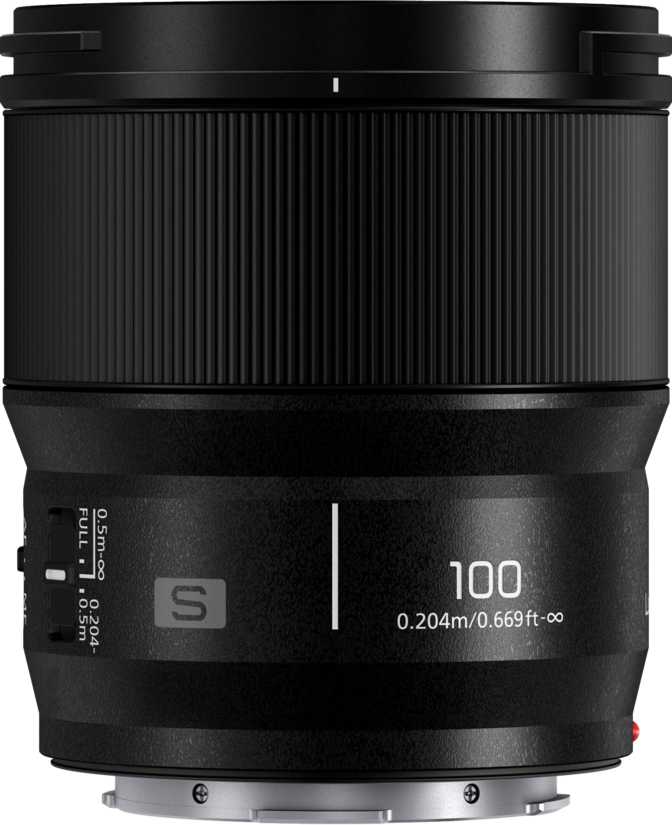
Panasonic Lumix S 100mm f/2.8 Macro: Full Review for L-Mount Shooters
Camera LensesA true 1:1 macro prime that weighs under 300 grams — the Lumix S 100mm f/2.8 is a rare blend of portability and field-ready toughness for the Leica L ecosystem.
Design and Build: Lightweight Without Feeling Cheap
Physical experience, materials, and field-ready construction
At 298 grams, the Lumix S 100mm Macro is genuinely light for a full-frame macro prime of this focal length. To put that in physical terms, it is roughly the weight of a large apple — and that matters in macro photography, where you are often handholding for extended periods, hovering over a flower bed or a product table, waiting for the right moment.
The lens ships with a hood included, which is more thoughtful than it sounds. Lens hoods for macro lenses are often sold separately or simply ignored by manufacturers, yet they are critical for controlling flare when shooting with a light source close to frame — a common macro scenario.
The mount is metal, which means the connection point between the lens and your camera body is durable and precise. Plastic mounts can loosen over time through repeated lens swaps; a metal mount keeps tolerances tight across years of use.
The front element is fixed — it does not rotate when focusing. Photographers who use circular polarizers or graduated ND filters will immediately appreciate this. With a rotating front element, any filter requiring precise alignment has to be readjusted every time focus shifts. Here, you set it once and it stays.
The 67mm filter thread is a moderate, widely available diameter. Filters at this size are easy to find at reasonable prices, unlike the larger 77mm or 82mm threads common on faster or longer lenses.
Physical Specifications at a Glance
- Weight
- 298g
- Lens Mount
- Leica L
- Filter Thread
- 67mm
- Mount Material
- Metal
- Front Element Rotation
- Fixed
- Lens Hood Included
- Yes
- Weather Sealed
- Yes
Weather Sealing: A Serious Field Credential
Dust and moisture are resisted at the joints and elements, allowing you to shoot in light rain, humid greenhouses, or dusty outdoor environments without wrapping the lens in a plastic bag. For macro work — which frequently happens outdoors, close to water, soil, and organic matter — this is not a luxury. It is the difference between being able to use the lens when the scene demands it and having to pack up when the weather shifts.
Optical Character: What 100mm and f/2.8 Actually Mean for Your Work
Focal length advantages, aperture behavior, and bokeh quality explained
The Focal Length Advantage in Macro
100mm is the classic working distance for macro photography, and the reason comes down to physics. At 1:1 magnification — true life-size reproduction, where a 1cm subject fills 1cm of sensor — this lens allows you to position the front of the barrel roughly 20cm from your subject. Close enough to fill the frame; far enough not to shadow your subject with the lens or disturb an insect with your presence.
Shorter macro lenses at 50mm or 60mm require the front element almost touching the subject at 1:1, which creates lighting problems and subject disturbance. The 100mm working distance is a well-established solution to that fundamental problem.
Maximum Aperture: f/2.8 as a Dual-Purpose Tool
The f/2.8 maximum aperture plays two distinct roles depending on how you use the lens. For non-macro subjects — portraits, still life, indoor work — f/2.8 at 100mm produces strong background separation with smooth, gradual falloff into blur rather than the edgy bokeh of shorter lenses at similar apertures.
In strict macro work, even f/2.8 renders an extremely shallow plane of focus at 1:1 — fractions of a millimeter for small subjects. Macro photographers often stop down to f/8 or f/11 for usable depth of field, making the f/2.8 maximum most relevant for subject-finding and composition rather than the final capture itself.
Full Aperture Specifications
| Parameter | Value | Real-World Meaning |
|---|---|---|
| Maximum Aperture | f/2.8 | Strong subject isolation; usable in dim light |
| Minimum Aperture | f/22 | Deep depth of field; note diffraction softening applies |
| Aperture Blades | 9 Rounded | Smooth circular bokeh highlights at all apertures |
| Angle of View | 24° | Telephoto framing; natural perspective compression |
Nine-Blade Rounded Aperture
The aperture diaphragm uses nine blades shaped to maintain a near-circular opening even as it stops down. The practical result: out-of-focus points of light — street lights, window highlights, background specular reflections — render as smooth circles rather than angular polygons. For portrait work at 100mm, this contributes meaningfully to overall image quality. For macro, it matters less optically but reflects the care taken in the lens's construction throughout.
Focus System: Capable, with One Clear Limitation
Autofocus performance, minimum focus distance, and the full-time manual focus question
Minimum Focus Distance and What It Achieves
The lens focuses down to 20 centimeters measured from the sensor plane — not from the front of the lens. At that distance, with the 100mm focal length, the lens achieves 1:1 magnification. This is life-size reproduction: a bee's eye, a coin, a circuit board component, or a water droplet fills the frame at exactly the same size it exists in reality. It is the gold standard for macro classification.
The lens also focuses all the way to infinity, which makes it fully functional as a portrait and general telephoto prime. You are not buying a specialty tool that collects dust between macro sessions — 100mm at f/2.8 is a legitimate portrait and event focal length.
Internal Focus Motor
The built-in focus motor enables autofocus operation directly through the camera body. For non-macro shooting — portraits, product shots pulled back from the subject — autofocus works as expected, with the camera's phase-detection or contrast-detection system doing the work.
In close macro work, autofocus becomes less reliable universally across all macro lenses because the depth of field is so thin that the camera struggles to lock. Manual focus override becomes the standard practice at 1:1.
Full-Time Manual Focus Override: Not Available
This is the lens's most meaningful operational limitation. Full-time manual focus allows you to grab the focus ring and refine focus at any moment, even in autofocus mode, without flipping a switch. This lens does not offer that. In a fast-moving macro session — chasing an insect, adjusting to a breeze shifting a flower — this is a genuine workflow interruption compared to lenses that offer seamless mode switching. Photographers coming from lenses with full-time manual override will feel this absence. Not a dealbreaker for deliberate work, but worth knowing before you buy.
Focus Specifications
- Min. Focus Distance
- 0.2m
- Max Magnification
- 1:1 Life-Size
- Focus Motor
- Built-in
- Infinity Focus
- Yes
- Full-Time Manual Focus
- No
No Optical Image Stabilization: The IBIS Context
Understanding the stabilization trade-off in the L-mount ecosystem
The lens has no built-in optical stabilization. On paper, this looks like a significant omission for a macro lens — camera shake is amplified at high magnification ratios, and a stabilized lens helps during handheld work.
In practice, the impact is softened considerably by the in-body image stabilization built into Panasonic Lumix S camera bodies. For stationary macro subjects, sensor-shift IBIS provides meaningful assistance. Shooters planning extensive handheld macro will get the most from this lens when paired with a body that has IBIS; on older L-mount bodies without it, the lack of lens stabilization becomes more noticeable.
That said, the best stabilization for true 1:1 macro work remains a tripod, a focusing rail, and controlled lighting. No stabilization system — lens-based or sensor-based — fully compensates for the razor-thin depth of field at life-size magnification.
Stabilization Reality Check
- Pairs with Panasonic S-series IBIS for effective handheld correction
- Stationary macro subjects benefit well from body IBIS alone
- More noticeable gap on older L-mount bodies without IBIS
- At true 1:1 magnification, a tripod remains the gold standard regardless
Who This Lens Is For — and Who It Isn't
Real-world usage scenarios and honest shooter profiles
This Lens Suits You If...
- You shoot on the Leica L ecosystem — Lumix S, Leica SL series, or Sigma fp — and want a true macro prime without significant weight penalty
- Your macro work is deliberate and methodical — close-up photography of products, food, natural details, jewelry, or flora where you control the scene and pace
- You also want a portrait-capable prime in the same focal length, making this lens genuinely dual-purpose
- Weather resistance matters to you, whether for outdoor nature macro or humid studio environments
- You prioritize a smaller filter size and lens weight for travel or lightweight setups
This Lens Is Less Suited If...
- You shoot fast-moving macro subjects such as insects in flight or small animals, and rely heavily on seamless focus-mode switching — the absent full-time manual focus is a real constraint
- You primarily handhold macro work and your camera body lacks IBIS — the optical stabilization gap will show in borderline lighting conditions
- Your shooting is entirely outside the Leica L ecosystem — no native adapter path to Canon RF or Nikon Z exists, and third-party adapters introduce their own focus and compatibility limitations
Competitive Positioning: How It Stands Against the Alternatives
Logical L-mount alternatives compared side by side
| Feature | Panasonic Lumix S 100mm f/2.8 Macro | Sigma 105mm f/2.8 DG DN Macro Art (L) | Leica APO-Macro-Elmarit-TL 60mm f/2.8 |
|---|---|---|---|
| Mount | Leica L | Leica L | Leica L |
| Magnification | 1:1 | 1:1 | 1:1 |
| Max Aperture | f/2.8 | f/2.8 | f/2.8 |
| Weight | 298g | 715g | 300g |
| Weather Sealed | Yes | Yes | No |
| Built-in OIS | No | No | No |
| Full-Time MF Override | No | Yes | — |
| Filter Thread | 67mm | 62mm | 52mm |
| Subject Working Distance | Longer (100mm) | Longer (105mm) | Shorter (60mm) |
The Sigma 105mm Art is the most direct native L-mount competitor. It is optically exceptional with a strong reputation, but it weighs more than twice as much as the Panasonic. For shooters who prioritize portability and weather sealing over absolute optical prestige, the weight difference alone shapes the conversation. The Sigma does offer full-time manual focus, which is a genuine advantage for macro specialists.
The 60mm Leica occupies a different working-distance category entirely, requiring you to get considerably closer to achieve 1:1 — making it less practical for live subjects or situations where proximity causes problems. It also lacks weather sealing. The Panasonic's clear advantage across this field is its combination of weight, sealed construction, and 1:1 capability in a compact package.
Honest Strengths and Weaknesses
A balanced assessment beyond the specification sheet
Where It Excels
The lens's strongest credential is its physical design. At under 300 grams with full weather sealing, a metal mount, and a non-rotating front element, it is built thoughtfully for the conditions in which macro photographers actually work. These are not spec-sheet bullet points — they are daily-use advantages that accumulate over time.
The 1:1 magnification at a 100mm focal length is exactly what it should be, and the nine-blade rounded aperture reflects quality construction throughout the optical assembly. For portrait work alongside macro duty, f/2.8 at 100mm is a genuinely compelling combination that gives this lens a real secondary life beyond close-up work.
Where It Falls Short
The absence of full-time manual focus override is an unusual omission for a macro-focused product. Most macro photographers find themselves toggling between autofocus for initial subject acquisition and manual fine-tuning for the final shot — and having to explicitly switch modes rather than simply grabbing the ring adds friction to what is already a patience-intensive type of photography.
The lack of built-in optical stabilization is a lesser concern given the L-mount ecosystem's strong IBIS support, but it does mean the lens performs at its best when paired with a stabilized body — a dependency worth acknowledging before purchasing, particularly if you are considering older L-mount hardware.
Common Questions Before You Buy
Answers to what real buyers search for
Final Verdict
The Panasonic Lumix S 100mm f/2.8 Macro earns its place in the L-mount ecosystem by doing something genuinely difficult: delivering proper macro credentials — true 1:1 magnification, 100mm working distance, weather sealing, and solid build quality — in a package light enough to carry without thinking about it.
It is not the choice for photographers who need every ergonomic refinement that macro work can demand. The missing full-time manual focus override is a real gap for specialists who work fast or chase unpredictable subjects, and it will push those users toward the Sigma 105mm Art or other alternatives despite the significant weight penalty that comes with them.
For the photographer who wants a single lens that covers deliberate macro work, portrait sessions, and general telephoto duties — and who values portability and weather resistance as much as optical performance — this lens is a well-considered, genuinely capable option. It does not try to be everything; it tries to be the right thing for a specific shooter profile, and it mostly succeeds.
Recommended For
L-mount photographers wanting lightweight, weather-sealed macro capability with genuine portrait versatility built in.
Pass If
Full-time manual focus override is essential to your workflow, or if you shoot primarily handheld on a body without IBIS.