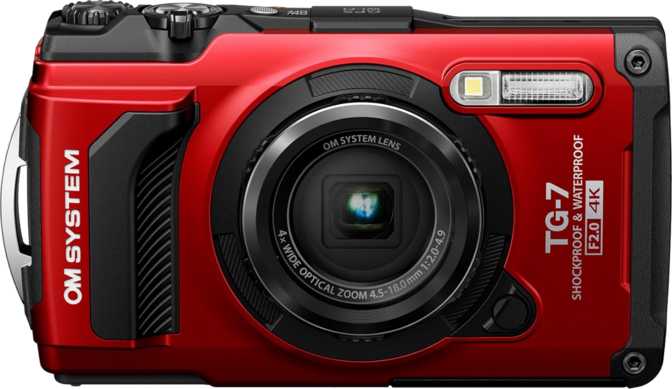
OM System Tough TG-7: Full Review of the Ultimate Rugged Compact
CamerasMost cameras treat water as an enemy. The OM System Tough TG-7 treats it as a natural habitat. Built for people who refuse to leave their camera behind when conditions get uncomfortable — whether that is a kayaking trip, a rainy hike, a snorkeling session, or a kitchen where splashes happen — the TG-7 is one of the few compact cameras designed from the ground up to go wherever you do, not merely survive it.
But durability alone does not make a camera worth recommending. The more interesting question is whether the TG-7 takes photographs worth keeping once you are back home. That is precisely what this review addresses — the real-world performance behind the waterproof marketing.
Build Quality and Physical Design
The Body: Engineered for Abuse
Pick up the TG-7 and the first thing you notice is that it feels meaningfully solid for a camera this small. At approximately 250 grams it carries enough weight to feel substantial in the hand without straining a wrist lanyard, and its footprint — roughly 114mm wide, 66mm tall, and 33mm thick — slides comfortably into a jacket pocket, a dry bag side pouch, or a hiking vest.
The waterproofing is the headline capability, and it earns genuine respect. Rated to 15 meters of submersion, it sits far beyond the splash-resistance that phones and non-rugged compacts claim, placing it comfortably within recreational diving and snorkeling territory with substantial margin to spare. Cold-weather capability is equally serious — the camera operates down to -10°C, making it practical for ski trips, winter hikes, and sub-zero outdoor work where most consumer electronics simply shut down. The rated upper limit of 40°C handles desert heat and tropical sun without issue.
Screen and Controls
The fixed 3-inch rear display delivers enough resolution for comfortable framing and image review in good light. It does not flip, tilt, or articulate — a limitation that becomes tangible during underwater photography, where angling the camera without being able to see the screen requires compositional guesswork. Experienced underwater photographers adapt quickly, but this is worth knowing before purchasing.
The absence of a touchscreen is the right decision for a camera of this type. Wet hands, dive gloves, and cold-numbed fingers interact with physical buttons far more reliably than capacitive glass. All control runs through dedicated physical buttons — a deliberate trade made in favour of the camera's primary environment. No hot shoe means no external flash mounting; the built-in flash handles fill and snapshot duties adequately.
Optical Performance: Zoom, Aperture, and the Macro Advantage
The Zoom Range
The lens spans a range equivalent to approximately 25mm through 100mm in traditional full-frame terms. The wide end is genuinely spacious — wide enough to include a group of swimmers, fill a frame with a landscape, or work in confined indoor spaces. At full extension, the 100mm equivalent gives comfortable portrait reach and the ability to isolate a subject across a pool or reef from a respectful distance.
Four times optical magnification sounds modest compared to bridge cameras advertising 30x or 40x reach, but achieving any meaningful zoom range inside a fully sealed waterproof housing is a genuine engineering constraint. For the scenarios the TG-7 targets, the zoom range is purposefully matched to likely use.
Aperture: Bright at Wide, Reasonable at Tele
At its widest setting the lens opens to f/2.0 — a fast aperture for a compact camera in this category. Practically, it admits significantly more light than most rugged compact competitors, reducing flash dependency in shaded forests, on overcast beaches, or in the filtered-light conditions beneath the surface. Less flash means more natural colour, less glare from suspended particles in water, and faster available shutter speeds to freeze motion.
At full zoom the aperture narrows to approximately f/4.9, consistent with what physics imposes on compact telephoto designs. Expect to rely on supplemental flash or accept modest shutter speeds when shooting at the long end in challenging light.
The 1cm Macro: A Category-Defining Capability
The TG-7 can achieve sharp focus from as close as one centimeter — near enough to press the lens almost against the subject. No comparable rugged compact camera achieves this distance. It enables genuine macro work: insects, flowers, mineral crystals, watch components, and small reef creatures, all resolved in detail a smartphone cannot replicate. Combined with GPS location tagging and the 15-meter waterproof rating, this positions the TG-7 as a serious field documentation tool for naturalists, researchers, and underwater photographers.
Image Stabilization
The sensor-shift optical stabilization system compensates for approximately 2.5 stops of camera shake. In practical terms, that allows shooting in light roughly five times dimmer than you could without stabilization while still achieving sharp results. Operating at the sensor layer rather than in the lens ensures the system remains effective across the full zoom range — the preferable architecture for a camera used at widely varying focal lengths.
Sensor Performance and Image Quality
What the 12MP BSI Sensor Delivers
The back-illuminated CMOS sensor captures at 12 megapixels — enough for generous prints, full-screen display, and meaningful cropping without visible degradation. Back-illuminated architecture positions the sensor's circuitry behind the light-capturing layer rather than in front of it, improving light collection efficiency. The result is better performance in the dim conditions the TG-7 regularly encounters: caves, shaded trails, and underwater scenes where sunlight filters through metres of water.
For sharing, social platforms, and prints up to A3 format, 12 megapixels is more than adequate. For buyers who need to crop heavily, produce very large commercial prints, or extract pixel-level detail from wide frames, the sensor will show its physical limits. This is a predictable constraint of the compact rugged camera format — not unique to the TG-7.
High ISO Performance
The camera can push sensitivity high enough to shoot in conditions as dark as a dimly lit restaurant or forest at dusk without flash. At low and moderate sensitivity settings images are clean and well-detailed. As sensitivity climbs, digital noise becomes visible — texture softens and colour loses saturation. At the extreme upper end, results are acceptable for social sharing but not ideal for printing. This performance curve is normal for the sensor format and sets accurate expectations for buyers researching the camera.
Exposure Control: Understanding the Trade-off
The TG-7 does not offer manual shutter speed, manual aperture selection, or full manual exposure. This is a deliberate design choice for its active-lifestyle audience — scenarios where shooting speed matters more than creative exposure control. What you do have: manual white balance (particularly valuable underwater, where depth progressively removes warmer wavelengths) and RAW file capture, giving post-processing software full latitude to correct colour, recover detail, and adjust exposure after the fact.
Buyers comfortable working in aperture priority or full manual mode will notice the ceiling. For buyers who want reliable, technically competent results without managing exposure triangles, the TruePic VIII processor handles automatic metering across a wide range of conditions with commendable consistency.
Speed and Autofocus
Burst Shooting and Instant Startup
Twenty frames per second in continuous shooting mode is a genuinely fast rate for this camera category. It gives photographers a substantial frame pool from which to select the decisive moment in any motion sequence — surfing, wildlife crossing a trail, children in action, or a diver sweeping through a current. Few rugged compact cameras approach this figure.
The camera powers on with no perceptible startup delay. Press the shutter button and the camera is immediately live. For wildlife and fast-action photography, this is a direct practical advantage — the decisive moment does not pause for a camera still waking from standby.
Autofocus: Capable with Honest Limits
AF tracking enables the camera to identify a subject and follow it through the frame as it moves — exactly the scenario divers and action sports photographers encounter most often. Phase-detection autofocus, which provides faster and more confident subject acquisition in difficult light, is not present. The contrast-detection system used is accurate in good light and adequate for moderate-paced action. Very fast or erratically moving subjects in dim or low-contrast conditions will challenge it, and buyers should set expectations accordingly.
Video: 4K Capable with Standout Audio Options
Resolution and Frame Rate Options
The TG-7 records at 4K resolution and 30 frames per second — the current standard for high-quality video output. Footage holds enough detail for editing, social distribution, and display on 4K screens without upscaling. A 24fps cinema mode delivers the slightly slower, more filmic motion quality associated with theatrical video. Slow-motion capture enables post-production speed reduction for impact sequences — a wave crashing, a fish evading, a waterfall — without heavy interpolation artefacts.
Continuous autofocus operates throughout video recording and tracks moving subjects without manual intervention. Phase-detection autofocus is not available for video, so the system uses contrast-detection throughout. In low-contrast scenes, occasional focus hunting is a predictable limitation.
Audio: Unexpectedly Capable
A camera marketed for outdoor adventure would ordinarily offer compromised audio. The TG-7 makes a different decision. It carries both a 3.5mm combination headphone/microphone jack and a dedicated external microphone input, accepting clip-on lavalier microphones, compact directional microphones, or broadcast-style mics. The built-in dual stereo microphones handle general use natively without any attachment. For dive instructors recording tutorials, travel content creators, field researchers logging observations, or wildlife documentarians, this audio flexibility is genuinely valuable — and largely absent in competing rugged compact cameras.
Battery Life and Charging
Under standardised testing the removable battery delivers approximately 330 shots per charge. Continuous GPS use, extended video recording, and active Wi-Fi transfer each reduce that figure in real-world conditions. Cold temperatures — one of the TG-7's defined strengths — suppress lithium-ion efficiency as physics dictates, so winter shooting trims endurance more noticeably than temperate-weather use.
For a full day of mixed shooting in temperate weather, one charge is typically sufficient. For multi-day backcountry trips, liveaboard diving, or any expedition without reliable access to power, a spare removable battery is a practical necessity — the battery is removable and relatively inexpensive as accessories go.
USB-C charging is a genuinely convenient inclusion: the same cable powering a laptop or recent smartphone works here. The underlying data connection runs at USB 2.0 speeds, meaning large RAW files or 4K video transfers through the camera itself are slower than current USB standards allow. A dedicated card reader via a faster port is the practical workaround for regular large-volume sessions.
Connectivity and Location Features
Built-in GPS
Every photograph and video clip is automatically tagged with precise location coordinates. For travellers this builds a searchable geographic record of a journey. For naturalists and researchers it produces geotagged field observations without manual logging. For athletes reviewing action footage it adds spatial context to each sequence. GPS operation draws additional power; toggling it selectively preserves endurance without losing the feature entirely.
Wi-Fi and Bluetooth
Pairing with the OM System smartphone app enables remote camera control — useful when the camera is mounted on a board, positioned near a wildlife trail, or set up for time-lapse without a photographer behind it. Image transfer to a phone works smoothly for JPEGs. Initial connection requires manual pairing through the app, as NFC is not present. Large RAW or 4K video files transfer more slowly than they would via more recent Wi-Fi standards, so a dedicated card reader remains the faster option for large-volume sessions.
Who Should Buy the TG-7 — and Who Should Not
Ideal For
- Outdoor and adventure photographers — hikers, cyclists, kayakers, and skiers wanting a camera that handles rain, dust, drops, and cold without protective cases or special care.
- Recreational divers and snorkelers who want underwater photography without renting housing. The depth rating and macro capability together make the TG-7 unusually capable in this role.
- Macro and nature photographers who need extreme close-up capability in a weather-resistant body that survives demanding field conditions.
- Travel photographers wanting one compact camera for city streets, beach days, snorkeling excursions, and mountain hikes without switching systems.
- Field researchers and naturalists needing GPS-tagged macro documentation and a camera that performs equally in the lab and in the field.
Not the Right Choice For
- Buyers who need manual exposure control. If aperture priority, shutter priority, or full manual modes are part of your creative workflow, the automatic-only exposure system will feel genuinely limiting.
- Low-light and night photographers. The sensor format has physical limits in absolute light-gathering that restrict nightscape, astrophotography, and dim-venue performance compared to larger-sensor cameras.
- Video creators who need 4K at 60fps, higher resolution, or LOG colour profiles for professional grading workflows. The TG-7 records 4K at 30fps without these advanced video features.
- Buyers expecting flagship-phone autofocus performance. Modern smartphones use sophisticated phase-detection with subject recognition. The TG-7's contrast-detection system is competent but not comparable in speed or subject awareness.
How It Compares to the Competition
The TG-7 measured against representative rugged compact alternatives within the same market segment.
| Feature | OM System TG-7 | Rugged Compact A | Rugged Compact B |
|---|---|---|---|
| Waterproof Depth | 15 meters | 10–12 meters | 10 meters |
| Minimum Focus Distance | 1 cm — true macro | 5–10 cm | 10 cm |
| Continuous Burst Rate | 20 fps | 5–10 fps | 6–8 fps |
| Built-in GPS | Varies | Often absent | |
| External Microphone Input | |||
| RAW File Capture | Rarely | ||
| 4K Video | |||
| Manual Exposure Control | Partial | ||
| USB-C Charging | Varies | Varies |
Competitor columns represent category-typical specifications. Individual models vary.
Strengths and Honest Weaknesses
Where It Excels
The TG-7's protection credentials are class-leading and genuine. A 15-meter waterproof rating, sub-freezing cold tolerance, and a body built for the incidental impacts and splashes of active life — these are real-world advantages, not marketing veneer applied to a fragile camera.
The macro performance is the TG-7's most differentiated capability. No other rugged compact camera achieves one-centimeter focus distance, and for close-up natural history, underwater reef documentation, and field science photography, this stands essentially alone at this price and size.
The audio implementation is genuinely surprising for this camera type. Stereo microphones plus a 3.5mm external input expand the TG-7's usefulness for video-focused buyers in a way no competing rugged compact matches. The 20fps burst rate and instant power-on complete a purposeful action photography feature set.
Where It Falls Short
The sensor format constrains absolute image quality, particularly in low light and in direct comparison with cameras using physically larger sensors. This is not addressable through firmware updates — it is a physical constraint of the compact rugged camera market as a whole.
The absence of manual exposure control limits the creative ceiling. Buyers who have built their photography around aperture priority or full manual mode will feel genuinely constrained by the automatic-only approach, regardless of how well the automation performs.
USB 2.0 data speeds are a quiet ongoing frustration. The USB-C port makes charging convenient, but moving large volumes of RAW files or 4K video through the camera connection is noticeably slower than current USB standards allow. A separate card reader is the practical workaround, but it should not be necessary at this price point.
Questions Real Buyers Ask
The OM System Tough TG-7 is the right camera for a specific and well-defined buyer: someone who regularly operates in environments that would destroy or sideline a conventional camera, who values macro photography capability, and who wants a purpose-built tool designed for those conditions from the inside out.
Its combination of 15-meter waterproofing, 1cm macro focus distance, 20fps burst shooting, built-in GPS, RAW capture, and 3.5mm external microphone input forms a package with no direct equivalent at this price and size. If your photography regularly involves water, cold weather, or close-up subjects in challenging field conditions, the TG-7 earns a clear recommendation.
If image quality in controlled environments is your primary concern, or if manual exposure control is integral to your creative practice, the TG-7's automatic-only exposure and compact sensor will leave you wanting more. In that scenario, a larger-sensor compact without rugged credentials delivers more satisfying daily results. For adventure, travel, nature, and underwater photography, however — the TG-7 remains one of the most purposeful and complete tools in the compact camera market.