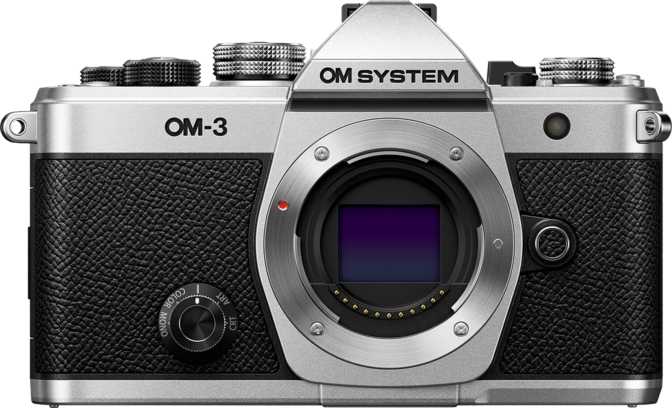
OM System OM-3 Review: Exceptional Stabilization, Real-World Limits
CamerasPerformance at a Glance
The Micro Four Thirds system has always attracted a specific kind of photographer — someone who wants serious optical capability without the physical and financial weight of a full-frame kit. The OM System OM-3 lands squarely in that tradition, but it arrives with a hardware profile that pushes well beyond the “travel camera” pigeonhole its compact dimensions might suggest. This is a weather-sealed, phase-detection-equipped body with some of the most aggressive in-body stabilization numbers in any camera at any price, built on a stacked sensor architecture typically associated with higher-end sports and wildlife shooters. Whether the OM-3 earns its place in an increasingly competitive mirrorless market depends on how those specifications translate into actual shooting — and where the inevitable compromises show up.
Build Quality and Physical Design
How It Feels in the Hand
At just under 500 grams with a footprint comparable to a thick paperback book, the OM-3 occupies the compact end of the interchangeable-lens camera spectrum without feeling like a compromised tool. The body has a solidity that belies its size — this is not a camera that flexes or creaks under a firm grip.
The build is weather-sealed to a meaningful standard. Operational clearance extends from −10°C to 40°C, covering everything from winter street photography in freezing conditions to tropical outdoor work. Photographers who shoot in rain, near water, or in dusty environments will find genuine reassurance here — not just marketing language about splash resistance.
Screen and Viewfinder
The rear screen is a 3-inch fully articulating flip-out panel at 1,620,000-dot resolution. The flip-out hinge mechanism swings the display entirely away from the body on a side hinge — unlike a simple tilt screen. This enables overhead, ground-level, and front-facing angles while keeping the monitor stable. Touch response is integrated across the full interface, including autofocus point selection while shooting.
The electronic viewfinder delivers 100% frame coverage. What you see through it is precisely what will be captured, with no unchecked edges or framing uncertainty.
- Weight496 g
- Width139.3 mm
- Height88.9 mm
- Depth45.8 mm
- Min. Operating Temp.−10°C
- Max. Operating Temp.40°C
- Rear Screen3” · 1,620K dots
- Screen TypeFlip-out · Touch
- EVF Coverage100%
- Built-in FlashNone
- Hot ShoeYes
Sensor and Image Quality
The Stacked Architecture Advantage
The OM-3 uses a 20.4-megapixel stacked BSI CMOS sensor — a hardware configuration with specific real-world implications. “Stacked” refers to a design where processing circuitry sits directly beneath the pixel layer rather than on a separate chip. The result is dramatically faster data readout, which reduces the rolling shutter distortion that plagues action and panning shots on conventional CMOS designs. Back-side illumination (BSI) means more light reaches each pixel by removing obstructing circuitry from the photon-capturing side of the sensor.
Twenty megapixels on a Micro Four Thirds sensor resolves ample detail for large print work, editorial use, and significant cropping flexibility. As a format-level property rather than a specific OM-3 limitation, the smaller sensor size means per-pixel low-light performance falls short of what equivalent megapixel counts deliver on APS-C or full-frame.
Dynamic Range and Light Sensitivity
The native ISO ceiling reaches 25,600, with an expanded mode pushing further to 102,400. The expanded range is primarily useful for visibility in near-darkness conditions where some grain is acceptable — live event documentation, astronomy framing, or emergency situations. For clean results, the practical working ceiling will sit well below the maximum, as it does with every camera regardless of format. A built-in HDR mode handles scenes with extreme contrast automatically, blending multiple exposures into a finished file without post-processing.
Pixel Shift for Maximum Resolution
For static subjects — product photography, landscapes, or any scenario where neither camera nor subject moves — the pixel shift mode is a significant capability. It moves the sensor in sub-pixel increments across multiple frames and combines the results, dramatically increasing effective resolution and color accuracy beyond what the sensor delivers in a single capture. This is a niche feature, but for the photographers who need it, it changes the output ceiling entirely.
Autofocus System
Coverage and Intelligence
With 1,053 phase-detection autofocus points distributed across the frame, the OM-3’s focusing system provides extensive coverage. Phase-detection AF works by measuring the convergence of light from two directions simultaneously, allowing the camera to calculate both the direction and magnitude of the required focus adjustment in a single step. It is fast, and it works in lower light with less hunting than contrast-detection systems.
AF tracking locks onto a subject and follows it across the frame as it moves, and it functions in both stills and video modes. Touch autofocus lets you tap the screen to designate your focus target instantly — particularly useful when shooting from awkward angles with the display articulated away from the body.
Continuous Shooting Speed
The mechanical shutter reaches 6 frames per second — a moderate burst rate that handles general sports and action work adequately but will not satisfy photographers dependent on the 20-plus fps rates available on dedicated sports bodies. The electronic shutter, by contrast, reaches approximately 1/32,000 second, enabling shooting in very bright conditions at wide apertures without neutral density filtration.
Flash sync at 1/250 second is standard for this category, supporting studio and location strobe work without limitation.
- AF Points1,053
- AF TypePhase-Detection
- AF TrackingYes
- Touch AFYes
- Continuous (Mech.)6 fps
- Fastest Mech. Shutter1/8,000 s
- Fastest Elec. Shutter1/32,000 s
- Flash Sync1/250 s
- Max Exposure Time60 s
The OM-3’s Defining Capability
The in-body image stabilization system carries a 6.5-stop CIPA rating — a figure that requires context to appreciate. The CIPA standard measures how many stops of shutter speed you can recover while still achieving sharp handheld results. Six and a half stops means that a shot requiring 1/500 second to be sharp from a stationary position can be made equally sharp at roughly 1/8 second, handheld. That is exceptional by any standard and sits at or above what competing cameras at any price point typically achieve.
The system goes further: it can combine IBIS with optical stabilization built into compatible lenses, creating a coordinated dual-stabilization approach that pushes performance beyond what either system achieves independently. For travel, documentary, and low-light handheld photography, this capability changes what is achievable without a tripod.
Video Capabilities
Specification Overview
The OM-3 records 4K footage at up to 60 frames per second, with a maximum bitrate of 205 megabits per second. That bitrate figure determines how much data is captured per second, directly affecting detail retention, color accuracy under compression, and editing flexibility. At 205 Mbps, the OM-3 produces footage that holds up well in post-production without the blocky artifacts that affect cameras with lower bitrate ceilings.
A 24p cinema mode supports the frame rate conventional in narrative filmmaking and documentary styles. Slow-motion recording is available, and phase-detection AF remains fully active during video recording — the camera does not fall back to a slower contrast-only system when video mode is engaged.
Audio
The built-in stereo microphone captures spatial audio in-camera for run-and-gun situations. A 3.5mm microphone input accepts external microphones for controlled production work, and a 3.5mm headphone socket enables real-time audio monitoring during recording. Both are standard expectations for a video-capable camera at this tier, and the OM-3 meets them fully.
- Max Resolution4K (2160p)
- Max Frame Rate (4K)60 fps
- Max Bitrate205 Mbps
- Cinema 24p ModeYes
- Slow-MotionYes
- Video AF TypePhase-Detection
- Continuous AF (Video)Yes
- Built-in MicStereo
- Mic Input3.5mm
- Headphone Output3.5mm
- TimelapseYes
Battery Life and Power
Rated for approximately 590 shots per charge under standardized conditions, the OM-3 holds its own for a body of this size. CIPA ratings are measured under specific conditions that include frequent playback and pauses between frames — in practice, they tend to underestimate performance for photographers who shoot in continuous sessions. Most users in typical outdoor conditions will exceed that figure.
The battery is removable, allowing a spare to extend shooting without access to power. USB-C charging means the same cable used for data transfer can also top up the battery — a meaningful convenience for travel where managing multiple USB-C devices is standard.
- Removable, replaceable battery for extended sessions
- USB-C charging and data transfer via a single port
- Battery level indicator always active during shooting
Connectivity and Features
Wireless and Transfer
Wi-Fi 5 and Wi-Fi 4 support enable wireless image transfer and remote camera control. Bluetooth 5.2 handles low-power persistent pairing for always-on remote triggering and location data logging via a connected smartphone — a functional workaround for the absent built-in GPS. Remote smartphone control covers both composition review and shutter triggering from a phone screen.
There is no NFC for one-tap pairing, which adds minor friction for photographers accustomed to that quick connection method. GPS must be provided via the Bluetooth-linked smartphone, requiring the phone to be paired and the workflow pre-configured.
Storage and Output
The OM-3 uses a single memory card slot. In a market where dual card slots have become more common in enthusiast bodies, the single-slot design is a meaningful limitation for professional work where a card failure during a critical shoot is a serious problem. For hobbyists and enthusiasts, it is rarely a practical concern.
RAW files with lossless compression provide full editing flexibility without the storage penalty of uncompressed files. HDMI output supports external monitors and recorders. USB-C handles both charging and data transfer via a single port.
Who Should Buy the OM System OM-3
- Travel and adventure photographersThe combination of weather sealing, compact dimensions, and exceptional stabilization makes this an outstanding travel body. A full MFT kit weighs dramatically less than an equivalent full-frame system.
- Documentary and street photographersA discreet profile, silent electronic shutter, and stabilization that enables difficult-light handheld shooting make the OM-3 a capable everyday documentary tool.
- Landscape and nature photographersHandheld slow-shutter work, telephoto stability, and the pixel shift mode for maximum-resolution static captures make this a compelling nature and landscape body.
- Hybrid stills and video shooters4K/60fps at 205 Mbps, full audio monitoring, and phase-detection AF during video recording form a credible hybrid package without additional accessories.
- High-speed burst performancePhotographers requiring 20-plus fps for fast and unpredictable action will find the 6 fps mechanical ceiling limiting compared to dedicated sports bodies.
- Maximum high-ISO performanceLow-light specialists who prioritize the cleanest extreme-ISO images will consistently favor full-frame or APS-C sensor formats. The physics of sensor size cannot be overcome by processing alone.
- Professional storage redundancyWedding photographers and photojournalists for whom a card failure is a professional catastrophe should weigh the single card slot carefully against their risk tolerance.
- Budget-first buyersPhotographers who don’t require weather sealing, advanced IBIS, or a stacked sensor architecture may find excellent value in other MFT or APS-C bodies at lower price points.
Competitive Positioning
The OM-3 competes most directly with enthusiast APS-C mirrorless bodies and, on occasion, full-frame entry bodies where system cost is relevant. The table below reflects category-level positioning rather than specific model comparisons.
| Feature | OM System OM-3 | Typical APS-C Competitor | Typical Full-Frame Entry |
|---|---|---|---|
| Sensor Format | Micro Four Thirds | APS-C | Full-Frame |
| In-Body Stabilization | 6.5 stops (CIPA) | Typically 5–6 stops | Varies widely |
| System Weight | Notably lighter | Moderate | Significantly heavier |
| 4K Max Frame Rate | 60 fps | Varies; often 30 fps at 4K | Varies |
| Weather Sealing | Yes | Sometimes | Often, at higher price |
| Memory Card Slots | Single | Often single at this tier | Often dual |
| High-ISO Advantage | Less than larger formats | Moderate | Best in class |
| Lens Ecosystem | Mature, compact MFT range | Large, format-specific | Largest, most expensive |
Honest Strengths and Limitations
Where the OM-3 Excels
The stabilization system is genuinely class-leading and practical in a way that changes daily shooting habits. Six and a half stops of coordinated IBIS, capable of combining with compatible lens stabilization, is the OM-3’s single strongest argument in any format comparison at this price tier.
The stacked sensor architecture delivers benefits that show up in real shooting — reduced rolling shutter, faster burst readout, and the foundation for high-speed electronic shutter performance. Combined with 1,053 phase-detection points and touch AF, the focusing experience is confident and flexible across both stills and video.
The 4K/60fps video specification at 205 Mbps does not feel like an afterthought. Full audio monitoring support — both microphone input and headphone output — completes a credible video package for most production scenarios without additional accessories. Weather sealing down to −10°C, the fully articulating screen, and the 100% EVF coverage round out a hardware package that is coherent and purposeful.
Where It Asks for Compromise
The single card slot is a real and practical limitation. For photographers whose work is time-sensitive, irreplaceable, or professionally committed — events, journalism, commercial work — the absence of redundant storage is a genuine risk factor that the OM-3’s other capabilities cannot offset.
The 6 fps mechanical shutter ceiling is moderate, not exceptional. Photographers who regularly track erratic, fast-moving subjects in burst sequences will reach that ceiling often. It is not a flaw in execution; it is a design priority choice. The OM-3 was built for precision and stability, not maximum throughput.
The format-level ceiling on high-ISO performance is not specific to the OM-3 — it applies to every Micro Four Thirds body and is the fundamental physics trade-off of the smaller sensor. Buyers should calibrate expectations accordingly, rather than expecting the OM-3 to defy the laws of optics.
GPS via Bluetooth smartphone tethering works but requires the phone to be paired and the workflow configured in advance. It is not as frictionless as a dedicated chip in the camera body.
Common Questions Buyers Ask
The OM System OM-3: A Clear, Confident Recommendation
The OM System OM-3 is a focused, well-executed camera that rewards photographers who shoot in the real world — outside, in variable conditions, often handheld, frequently at the limits of available light. Its stabilization system alone sets it apart from most of what competes at similar price points, and the stacked sensor architecture delivers tangible benefits in daily shooting rather than just specification comparisons.
The 4K/60fps video at 205 Mbps is a strong specification that does not feel like an afterthought. Full audio monitoring support completes a credible video package without requiring additional accessories for most use cases.
Where the OM-3 asks for compromise: the single card slot is a real limitation for anyone whose work is time-sensitive or professionally irreplaceable. The 6 fps mechanical burst ceiling will not satisfy action-first shooters. The format-level ceiling on high-ISO performance is a property of the sensor size, and buyers should calibrate expectations accordingly rather than expecting the OM-3 to perform beyond the physics of the Micro Four Thirds format.
Buy it if you value:
- Class-leading stabilization and consistent handheld performance
- Genuine weather sealing and compact, go-anywhere portability
- A mature, versatile lens ecosystem at a competitive overall system cost