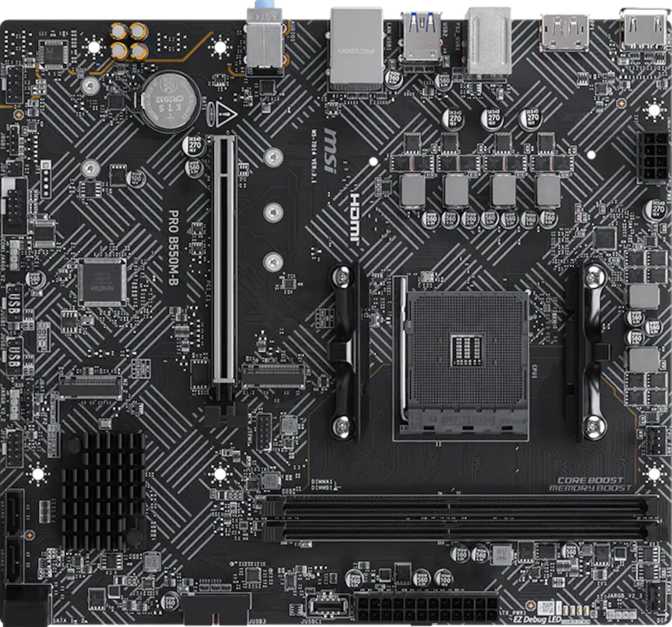
MSI Pro B550M-B Review: The Focused AM4 Board for Serious Builders
MotherboardsWhat the MSI Pro B550M-B Actually Is
The MSI Pro B550M-B occupies a deliberate niche in the AMD motherboard market. It is a compact, wired-first platform that trades wireless radios, RGB lighting, and visual extras for a capable B550 chipset, PCIe 4.0 bandwidth, DDR5 memory support, and a RAID feature set that is genuinely uncommon at this price tier. This board is built for the builder who measures value in longevity and capability, not aesthetics.
That positioning is a strength or a dealbreaker depending entirely on what your build requires. The sections below work through every specification in plain terms so you can make that call with confidence before committing.
- CPU SocketAM4
- ChipsetB550
- Form FactorMicro-ATX
- MemoryDDR5 · 2 slots · 64 GB
- M.2 Slots2
- Primary PCIePCIe 4.0 x16
- Wi-Fi / BluetoothNot Included
- USB-C (Rear)None
- RAID Support0, 1, 5, 10
- Warranty3 Years
Design and Build Quality
Form Factor and Physical Footprint
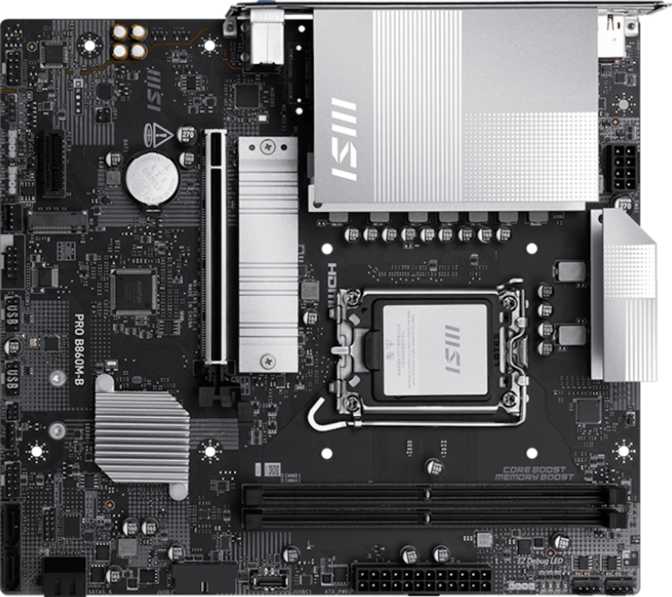
At roughly 244 mm wide by 220 mm tall, the Pro B550M-B uses the Micro-ATX standard — a footprint compatible with virtually any mid-tower or compact case without the slot restrictions of Mini-ITX. It is the right size for a capable single-GPU build that does not need physical room for multiple add-in cards.
There is no RGB lighting, no translucent shroud, and no visual drama of any kind. The board's matte, functional aesthetic suits a closed-panel workstation or server perfectly. If your build has a windowed side panel and aesthetics matter to you, this board offers nothing to display.
Build Confidence and Warranty Coverage
A three-year warranty from MSI is a meaningful signal at this price tier. Many boards in this segment offer one or two years; three years reflects genuine confidence in component longevity and puts this board closer to professional-grade assurance than most budget alternatives.
Two features aggressive tinkerers will notice are absent: there is no rear-panel clear-CMOS button and no dual-BIOS chip for backup recovery. For a stable day-to-day system these omissions are invisible — but if you frequently experiment at the BIOS level and occasionally corrupt a flash, your only reset path involves physical CMOS removal.
Core Platform Performance
The AM4 and B550 Foundation
Built on AMD's AM4 socket with the B550 chipset, this board supports the full range of compatible Ryzen processors from entry-level chips up through the Ryzen 9 series. B550 sits in the middle of AMD's chipset hierarchy — meaningfully more capable than the entry-level A520, without the premium price of the enthusiast X570. The critical advantages over A520 are direct CPU-connected PCIe 4.0 bandwidth and unlocked overclocking support.
The single PCIe 4.0 x16 slot runs at full bandwidth directly from the processor — the correct configuration for a discrete graphics card. PCIe 4.0 doubles the theoretical throughput of PCIe 3.0, so high-end GPUs are not artificially throttled at the interface level. There are no additional expansion slots beyond this one, making the Pro B550M-B a dedicated single-GPU platform by design.
Overclocking Capability
The B550 chipset allows multiplier-based CPU overclocking on unlocked Ryzen processors — any chip carrying an "X" or "XT" suffix, for example. This board is confirmed overclocking-capable. Actual gains depend on your specific chip, cooling solution, and power delivery quality, but the platform headroom is real and is not artificially restricted as it is on the A520.
Expansion Slot Summary
- 1x PCIe 4.0 x16 — CPU-direct, full bandwidth
- No PCIe x1 slots
- No secondary PCIe x16 slot
- No PCIe 5.0
No Onboard Graphics
The HDMI and DisplayPort outputs on the rear panel are only active when paired with a Ryzen APU (G-series chip) that includes integrated Radeon graphics. Processors such as the Ryzen 5 5600X or Ryzen 9 5900X have no integrated GPU — a discrete graphics card is not optional with those chips. Without one, there is no display output at all.
Windows 11 Ready
A dedicated TPM header is included, allowing a discrete TPM module to be fitted. This satisfies the hardware security requirement for Windows 11 on systems where the CPU does not provide a firmware TPM natively.
Memory: DDR5 on a Budget Platform
Two DDR5 memory slots with a combined ceiling of 64 GB give this board an advantage over platforms still running DDR4 at comparable prices. DDR5 delivers higher bandwidth at lower operating voltage, which benefits multithreaded workloads, content creation pipelines, and any task that moves large amounts of data through the processor rapidly.
For most builds, the practical sweet spot is a 32 GB kit — two matched 16 GB sticks. Populating both slots with identical modules activates dual-channel mode, meaningfully improving memory bandwidth over a single-stick single-channel setup. The real-world benefit is visible in video editing, large file operations, and heavily parallel software where memory throughput is the bottleneck.
The board supports memory speeds up to 4600 MHz — reaching into enthusiast territory for DDR5. Achieving those speeds requires an XMP or EXPO profile enabled in the BIOS, which this board's overclocking capability supports. High-frequency DDR5 kits carry a significant price premium and stability can vary across different kits. For most use cases, a mid-tier kit running at stable speeds is the smarter purchase.
Memory Specifications
- Type
- DDR5
- Slots
- 2
- Max Capacity
- 64 GB
- Max Speed
- 4600 MHz
- Channels
- Dual-channel
- ECC Support
- Not Supported
ECC memory is designed for servers and mission-critical workstations. Its absence has no practical impact on gaming, content creation, or general productivity.
Storage Configuration
M.2 NVMe
Two M.2 sockets allow ultra-fast NVMe solid-state drives alongside — or entirely replacing — traditional SATA storage. Running your operating system and applications from an NVMe drive delivers dramatically faster boot times, application launches, and file transfer speeds compared to any SATA-based alternative. With two slots, a fast primary OS drive and a secondary volume coexist without consuming a single SATA port.
SATA Storage
Four SATA 3 ports handle conventional hard drives and SATA-based SSDs — enough for an OS drive, two or three data drives, and an optical drive if your case supports one. Every port operates at the fastest available SATA interface speed; there are no slower legacy SATA 2 connections on this board.
RAID Support
RAID 0, 1, 5, and 10 are all supported — a range genuinely uncommon at this price tier. RAID 1 mirrors drives for redundancy. RAID 0 stripes for speed. RAID 5 balances throughput with fault tolerance across three or more drives. RAID 10 combines mirroring and striping for both performance and resilience. This makes the board a legitimate candidate for a home NAS or small server where storage reliability matters.
RAID is not a backup. Any RAID configuration protects against drive hardware failure, but not against accidental deletion, ransomware, or physical damage to the system. A separate offsite or cloud backup strategy is essential regardless of which RAID level you run.
Rear Panel and Connectivity
USB Ports and Internal Headers
Six USB ports occupy the rear panel: four USB 3.2 Gen 1 Type-A and two USB 2.0 Type-A. The Gen 1 ports transfer at up to 5 Gbps — fast enough for external SSDs, high-speed flash drives, and most peripherals without throttling. The two USB 2.0 ports cover keyboards, mice, and other low-bandwidth devices without competing for Gen 1 bandwidth.
No USB-C Anywhere on This Board
There is no USB Type-C on the rear panel and no USB-C internal header for case front panels. If you use USB-C daily — for external drives, audio interfaces, smartphones, or monitors — a USB adapter or PCIe expansion card is required. Even a case with a USB-C front port gets nothing to connect to.
Internal Header Summary
- 2x USB 3.2 Gen 1 headers (case front panel)
- 2x USB 2.0 headers (case front panel)
- TPM header (discrete TPM module support)
- No USB-C front panel header
Display, Network, and Legacy Ports
One HDMI port (version 2.1) and one DisplayPort are available on the rear panel. HDMI 2.1 supports higher refresh rates and resolutions than the older 2.0 standard — meaningful when using an AMD APU with a modern high-refresh monitor. As noted in the performance section, both outputs require an APU processor with integrated Radeon graphics to function.
A single gigabit Ethernet port handles all wired networking. There is no Wi-Fi module and no Bluetooth radio. If wireless is needed, a USB Wi-Fi adapter is the practical solution for most builds since the PCIe slot is occupied by a GPU. One PS/2 port covers legacy keyboards and mice, preferred by some users specifically for BIOS access or KVM configurations.
| Connection | Specification | Qty |
|---|---|---|
| USB Type-A (rear) | 3.2 Gen 1 — 5 Gbps | 4 |
| USB Type-A (rear) | 2.0 | 2 |
| USB Type-C | None | — |
| Display Output | HDMI 2.1 | 1 |
| Display Output | DisplayPort | 1 |
| Ethernet | Gigabit RJ45 | 1 |
| Audio Jacks | 3.5 mm | 3 |
| PS/2 | Legacy keyboard / mouse | 1 |
Audio and Thermal Management
Onboard Audio
The board supports 7.1 channel surround audio through three 3.5 mm jacks on the rear panel, covering front-left, center, front-right, rear-left, rear-right, surround, and subwoofer outputs for a complete multi-speaker configuration. For headphone users, onboard audio performance is adequate for everyday use and casual media consumption.
There is no S/PDIF optical output, which means connecting to an AV receiver or external DAC via optical is not possible without an add-in card. Content creators and audiophiles requiring studio-grade input quality will want a dedicated USB audio interface regardless of platform choice.
Fan Headers and Thermal Planning
Two fan headers is the minimum practical allocation. For a straightforward build — one CPU cooler and one chassis exhaust fan — two headers is workable without additional hardware. For multi-fan radiators, high-static-pressure intake and exhaust arrays, or any configuration involving three or more fans, a PWM fan hub or splitter will be necessary to manage all cooling from these two connection points.
Builders planning thermal-intensive configurations — overclocked CPUs under large air towers or 240/360 mm radiators with three or four fans — should budget for fan control hardware and its associated cable management from the outset.
Who This Board Is For — and Who Should Look Elsewhere
The Right Buyer
Home office and workstation builders who need a stable platform for productivity, content creation, or development with no requirement for wireless connectivity or decorative aesthetics.
Small NAS and home server builders who value full RAID 0/1/5/10 support, a compact Micro-ATX footprint, and wired-only networking in a headless or near-rack environment.
Budget-conscious AMD builders who can redirect savings from skipping Wi-Fi and RGB toward a better CPU, faster memory, or a more capable GPU.
AMD APU (Ryzen G-series) builds targeting a capable HTPC or slim workstation where integrated Radeon graphics handle all display output.
The Wrong Buyer
Anyone who uses USB-C daily — there is no USB Type-C in any form on this board, making it a genuine daily-friction problem for USB-C-centric workflows and peripherals.
Builders in wireless environments where running an Ethernet cable is impractical — there is no Wi-Fi or Bluetooth, and the available workarounds add cost and consume a USB port.
Multi-card expansion builds — the single PCIe slot means adding any secondary card (capture card, Wi-Fi adapter, storage controller) requires displacing the GPU.
Aggressive BIOS experimenters who need a quick hardware reset path — no clear-CMOS button and no dual-BIOS chip means recovery from a bad flash is more involved.
Competitive Positioning
The Pro B550M-B competes against two natural alternatives: higher-featured B550M boards that include Wi-Fi, and entry-level A520M boards at lower prices. Here is how the most relevant differences stack up.
| Feature | MSI Pro B550M-B | B550M with Wi-Fi (typical) | A520M Budget (typical) |
|---|---|---|---|
| Chipset | B550 | B550 | A520 |
| Wi-Fi / Bluetooth | No | Yes | No |
| CPU Overclocking | Yes | Yes | No |
| PCIe 4.0 x16 | Yes | Yes | No |
| M.2 Slots | 2 | 2 | 1–2 |
| RAID Support | 0, 1, 5, 10 | Varies | Limited |
| USB-C (Rear Panel) | No | Sometimes | No |
| RGB Lighting | No | Sometimes | Rarely |
| Warranty | 3 Years | 2–3 Years | 1–2 Years |
The clearest trade-off is against Wi-Fi B550M boards. If your system connects via Ethernet — as most workstations and servers do — you pay for a radio you will never use on those alternatives. Against A520M, spending a bit more for B550 buys overclocking freedom, PCIe 4.0 bandwidth, and comprehensive RAID coverage that A520 simply cannot provide.
Strengths and Honest Weaknesses
Where It Earns Its Price
The board's most compelling quality is its RAID feature set. Supporting RAID 0, 1, 5, and 10 at this price point is genuinely unusual — a specification you typically pay considerably more for, and one that opens legitimate home server and small NAS scenarios unavailable on comparable budget boards.
The three-year warranty stands out equally. Longevity assurance at this tier is rarely offered, and it meaningfully reduces the financial risk of a motherboard failure within the typical ownership window.
DDR5 support with speeds up to 4600 MHz positions this board for a generational step forward without requiring a platform change later. The B550 chipset's overclocking support on unlocked Ryzen processors adds further headroom for users who want to optimize CPU output beyond factory defaults.
Where It Falls Short
The complete absence of USB-C is the most pressing weakness. Not on the rear panel, not as a front panel header — USB-C does not exist on this board in any form. As USB-C proliferates across external drives, audio interfaces, docking stations, and monitor connections, this gap will grow more noticeable over the board's service life.
Two fan headers limit thermal ambition for complex cooling setups without additional hardware. The absence of a clear-CMOS button is a minor but real inconvenience for BIOS experimenters. The hard dependency on wired networking means anyone building without easy cable access must budget for an adapter.
The single PCIe slot also constrains future expansion. Adding any secondary card — a Wi-Fi adapter, capture card, or storage controller — means displacing the GPU, since there is no secondary slot available.
Questions Buyers Ask Before Purchasing
Final Verdict
The MSI Pro B550M-B is a deliberately focused product, and that focus is its greatest asset. It does not try to be a gaming showcase, a wireless hub, or a visual centerpiece. It is a compact, durable, overclocking-capable B550 board with unusually comprehensive RAID storage support, a three-year warranty, and a wired-first philosophy built on AMD's proven AM4 platform.
Buy it if you are building a workstation, a home server, or a compact productivity machine where cables run to the desk, the build stays closed, and performance-per-dollar is the metric that matters most. The savings over feature-loaded alternatives are real, and if you do not need Wi-Fi, RGB, or USB-C, you are not giving up anything that affects your actual use case.
Pass on it if USB-C is a daily-use requirement, if your cooling plans call for more than two fan connections, or if wireless connectivity is non-negotiable. In those cases, the workarounds will cost more than the price difference to a more complete board would have been from the start.
Recommended for: Wired workstation builds, home NAS servers, AMD APU systems, and budget-focused AM4 builds where Wi-Fi and USB-C are not daily requirements.