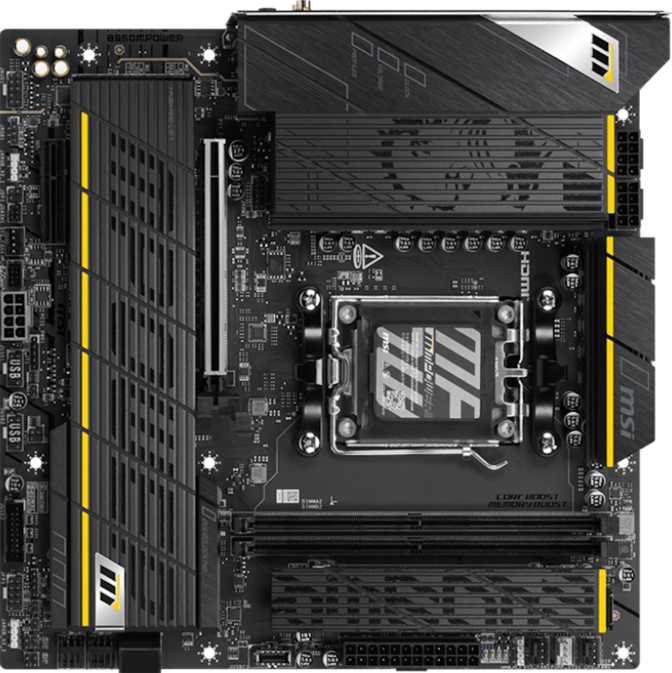
MSI B850MPower Review: Compact AM5 Board, Full Enthusiast Features
MotherboardsCompact builds have a reputation problem. For years, enthusiasts choosing Micro-ATX boards were quietly accepting trade-offs — fewer M.2 slots, watered-down connectivity, or chipsets that throttled expansion before the system was finished. The MSI B850MPower challenges that assumption directly, arriving with PCIe 5.0 graphics support, Wi-Fi 7, extreme DDR5 overclocking headroom, and a port selection that flatly embarrasses many full-size competitors.
Built on AMD's AM5 platform with the B850 chipset, this board targets builders who want a high-performance, future-ready foundation without committing to a full ATX footprint.
Standout Features at a Glance
What separates the B850MPower from the Micro-ATX crowd
Wi-Fi 7 Onboard
The latest wireless generation closes the gap with wired ethernet more than any predecessor — lower latency, higher throughput in congested environments, and future-proof for next-gen routers.
Four M.2 Slots
Exceptionally rare on a Micro-ATX board. Run a fast boot drive, a dedicated games drive, a backup volume, and still have a slot free — without reorganizing your storage when you expand.
PCIe 5.0 x16 GPU Slot
No current GPU saturates this interface, and next-generation cards will have the bandwidth they need. This slot does not bottleneck any GPU available today or in the near future.
Extreme DDR5 OC Headroom
Two-slot DDR5 configuration trades slot count for signal integrity, enabling overclocked memory speeds that place this board among the most capable B-series memory platforms available.
20Gbps USB-C Rear Port
The fastest consumer USB-C standard on the rear panel handles external NVMe enclosures at full speed — a specification typically reserved for higher-tier boards.
RAID 0 / 1 / 5 / 10
Full RAID support across four configurations — including RAID 5 and RAID 10 — is unusual at this chipset tier and adds genuine value for data redundancy and performance aggregation.
Design, Build Quality, and Physical Experience
What you get inside the box and in the hand
A Micro-ATX Board That Does Not Feel Like a Compromise
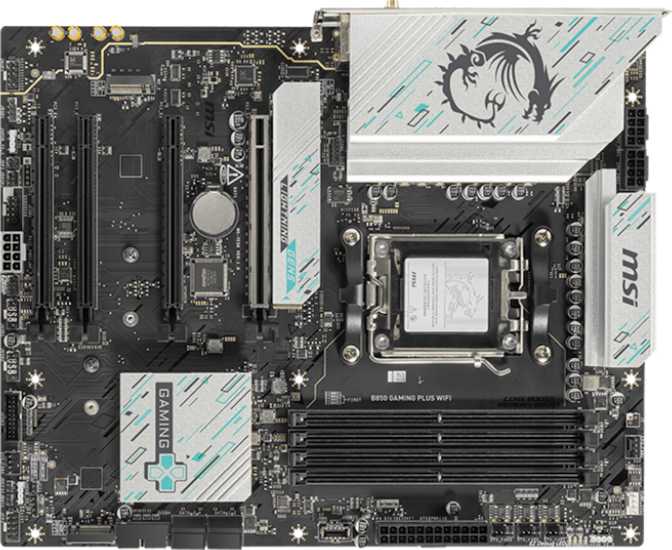
At 243.8mm × 243.8mm, the MSI B850MPower occupies the standard Micro-ATX footprint — large enough to host genuine performance hardware, small enough to fit mid-tower and compact cases that would reject a full ATX board. This is the sweet spot for builders who want real power without a desk-dominating chassis.
MSI's Power series sits in the enthusiast tier of their lineup — above the mainstream MAG and Tomahawk lines, with a build aesthetic that leans toward functional aggression. RGB lighting is present but applied with restraint, complementing the board rather than overwhelming it. It can be disabled entirely through MSI's software ecosystem if your build preference is for clean, light-free aesthetics.
A physical Clear CMOS button is built in. If an aggressive overclock renders the system unbootable, recovery is a button-press away — no jumper hunting inside a dark case, no needing to partially disassemble the build to reach a header.
The B850MPower carries a single BIOS chip. Failed BIOS updates are rare with modern flash processes, but enthusiasts running frequent firmware experiments should be aware of this before purchase.
- Form Factor Micro-ATX
- Dimensions 243.8 × 243.8 mm
- CPU Socket AM5
- Chipset AMD B850
- RGB Lighting Yes
- Clear CMOS Physical Button
- Dual BIOS No
- Warranty 3 Years
Platform and Chipset: What AM5 + B850 Actually Means
Understanding the foundation before evaluating what's built on it
AM5 is AMD's current-generation CPU socket, supporting Ryzen 7000 and Ryzen 9000 series processors. It is a DDR5-only platform — there is no DDR4 compatibility, which is the correct design direction for a board positioned at this performance tier. DDR5 brings higher bandwidth and a longer technology runway than DDR4 can offer.
The B850 chipset sits in a deliberate position within AMD's lineup. It is not a budget-tier product — B850 delivers PCIe 5.0 support for the primary graphics slot, substantial overclocking capability, and a meaningful number of PCIe lanes for storage. What distinguishes it from the flagship X870E chipset is primarily total lane count and certain platform-level multipliers. For the vast majority of real-world builds — including demanding gaming rigs and prosumer workstations — B850 provides everything needed without the X-class price premium.
Memory: High Ceiling, Focused Configuration
Two slots done right — and the trade-offs you need to understand
The B850MPower uses a two-slot DDR5 configuration. To someone accustomed to four-slot boards, this might initially register as a limitation. In practice, it is an engineering choice with genuine advantages: two slots allow for tighter signal integrity on the memory traces, which directly benefits overclocking stability. You are trading maximum slot count for improved high-frequency headroom — a trade that makes sense on a board explicitly designed to push memory performance.
At standard speeds, the board runs DDR5 at the current mainstream performance tier. When overclocking is enabled, the ceiling climbs dramatically — into territory that places the B850MPower among the most capable memory overclocking platforms at this chipset level. Reaching those upper bounds requires high-quality memory kit and time in the BIOS, but the headroom is genuinely there.
Total supported capacity reaches 128GB across the two slots — a ceiling that comfortably covers any workload short of server-class virtualization. For gaming, video editing, 3D rendering, and professional desktop use, two high-capacity DDR5 sticks handle whatever you run.
ECC (Error-Correcting Code) memory is not supported. For scientific computation, financial modeling, or data integrity-critical applications, this is a firm disqualifier. For all other workloads, ECC is not relevant.
- DDR Version DDR5
- Total Slots 2 Slots
- Memory Channels Dual Channel
- Max Capacity 128 GB
- Stock Speed (max) 5600 MHz
- Overclocked Ceiling 10200 MHz
- ECC Support No
Storage: Four M.2 Slots Is the Real Headline
More NVMe flexibility than most Micro-ATX boards will ever offer
Four M.2 sockets on a Micro-ATX motherboard is a meaningful specification. Most competing boards in this form factor offer two or three. With four available, a thoughtful storage hierarchy becomes possible without compromise:
- A primary high-speed drive for the operating system and applications
- A dedicated drive for games or creative project libraries
- A fast backup or cache volume
- A spare slot for future expansion — no storage reorganization required
Beyond M.2, two SATA 3 connectors remain available for SATA SSDs and mechanical hard drives. This matters for builders migrating storage from a previous build, or those needing high-capacity archival drives that do not fit M.2 form factors.
RAID Support
Full RAID support across four configurations provides meaningful options for both redundancy and performance. RAID 1 mirrors data across two drives for protection. RAID 5 and RAID 10 combine fault tolerance with performance across three or more drives. This level of RAID support is uncommon at the B-series chipset tier and adds genuine value for small business and prosumer setups where data loss is not acceptable.
- M.2 Sockets 4 Slots
- SATA 3 Connectors 2 Ports
- SATA 2 Connectors None
- U.2 Sockets None
- RAID 0 Performance striping
- RAID 1 Drive mirroring
- RAID 5 Parity redundancy
- RAID 10 Mirror + stripe
- RAID 0+1 Not supported
Expansion Slots: PCIe 5.0 as the Primary Lane
Graphics headroom today, future-proofing for tomorrow
The primary PCIe slot runs at the current generation's fastest specification. At this bandwidth level, no GPU currently on the market is bottlenecked by the interface — and next-generation cards that begin to push PCIe 4.0's limits will have the headroom they need. This is genuine future-proofing rather than a marketing claim.
A secondary expansion slot operating at a lower bandwidth tier handles capture cards, PCIe SSDs in add-in card format, and other peripherals. There are no additional x16-width slots and no legacy PCIe x1 slots — a deliberate consolidation. Most modern expansion needs are served by M.2 or USB, and removing legacy slots keeps the board layout efficient in a compact footprint.
-
1 SlotPCIe 5.0 x16Primary GPU slot
-
1 SlotPCIe x4Secondary expansion
-
NonePCIe x1 / Legacy PCINot present
Connectivity: Wireless, Wired, and USB
Every port and protocol this board brings to your build
Wireless: Wi-Fi 7 and Bluetooth 5.4
The included wireless module supports Wi-Fi 7 — the current generation standard. Wi-Fi 7's practical value is in reduced latency and improved performance in congested multi-device environments, where previous generations struggled with interference from many simultaneous connections. For gaming, Wi-Fi 7 closes the gap with wired ethernet more substantially than any previous wireless generation.
Backward compatibility covers Wi-Fi 4 through Wi-Fi 7, meaning any router you own today will work — and upgrading your router later unlocks the full Wi-Fi 7 capability without touching the board.
Bluetooth 5.4 handles wireless peripherals — headsets, controllers, keyboards, and mice. AptX codec support improves audio quality over Bluetooth for compatible headphones and speakers compared to standard SBC encoding.
Wired Ethernet
A single gigabit ethernet port provides wired network connectivity. Gigabit handles internet connections up to 1Gbps symmetrically — sufficient for current residential broadband. Builders who transfer large files to NAS devices or other machines on a local network may note the absence of 2.5GbE, which some competing boards at this tier have adopted.
USB Rear Panel Breakdown
-
USB 3.2 Gen 2 Type-A (10Gbps) 3 PortsFast external SSDs, high-bandwidth peripherals
-
USB 3.2 Gen 1 Type-A (5Gbps) 4 PortsKeyboards, mice, hubs, moderate external storage
-
USB 3.2 Gen 2 Type-C (10Gbps) 1 PortModern peripherals, some external displays
-
USB 3.2 Gen 2x2 Type-C (20Gbps) 1 PortFastest consumer USB-C — for top-tier external drives
Internal Headers for Front Panel
- 4× USB 2.0 via front-panel headers
- 2× USB 3.0 (3.2 Gen 1) via expansion headers
- 1× USB-C 3.2 Gen 2 front-panel header (unusual at this tier)
Display Output
An HDMI 2.1 output is present on the rear panel, but it requires a Ryzen processor with integrated graphics (Ryzen G-series) to function. Standard Ryzen 7000 and 9000 series processors without the "G" designation do not include integrated graphics, so this port will be inactive in the majority of desktop gaming configurations. If you are pairing this board with a discrete GPU, the HDMI port is simply unused.
Audio Performance
Onboard sound that earns its keep
The onboard audio solution delivers a signal-to-noise ratio that places it at the upper end of what motherboard audio typically achieves. At this performance level, background hiss and noise are essentially inaudible at any practical listening volume, and the audio chain handles the dynamic range of high-quality music, competitive gaming, and film without audible degradation.
Full 7.1 surround channel support covers home theater speaker configurations, and an S/PDIF optical output enables digital audio passthrough to external receivers or DACs for users who want to bypass the onboard analog stage entirely.
For users running gaming headsets, studio monitors, or quality headphones directly from the rear panel — this audio solution is genuinely good enough that most will never need a discrete sound card.
- Signal-to-Noise Ratio 120 dB
- Surround Channels 7.1
- S/PDIF Optical Out Yes
- Rear Audio Jacks 2 Connectors
Thermal Management
Six fan headers for comprehensive airflow control
Six fan headers across a Micro-ATX board allows complete airflow control without requiring fan hubs or splitters in most configurations. A typical high-performance build uses headers for the CPU cooler, two or three intake fans, one or two exhaust fans, and potentially a pump for a liquid cooling loop. Six headers covers this comprehensively without additional hardware.
Both PWM and DC control modes are supported, and MSI's firmware allows custom fan curves tied to specific temperature sensors across the system. With careful configuration, this translates to a system that runs quietly under light loads while maintaining full cooling capacity during sustained gaming or rendering sessions.
- Total Fan Headers 6 Headers
- PWM Control
- Custom Fan Curves
- TPM Connector
Overclocking: Built to Push
Performance headroom from stock to enthusiast extremes
Easy overclock support is built into the platform, and B850's architecture — combined with the board's two-slot memory configuration — makes the B850MPower a genuine option for extracting meaningful additional performance without deep manual tuning experience.
EXPO (AMD's memory overclocking profile standard) activates a compatible DDR5 kit's rated performance with a single BIOS toggle. For users who want to go further, manual controls provide voltage adjustment, frequency tuning, and timing configuration.
The built-in BIOS reset mechanism lowers the risk floor for experimentation meaningfully. Push the configuration too far, fail to boot, hold the button — the system recovers to default settings. This physical safety net changes the calculus for enthusiasts who might otherwise hesitate to push frequencies aggressively.
Memory Overclocking Headroom
Maximum OC ceiling requires premium DDR5 kits and manual tuning. Results vary by kit quality and CPU sample.
Who This Board Is Built For
Match your use case before committing to a purchase
- Building a compact but high-performance gaming or content creation PC in a Micro-ATX case
- Upgrading from an older AMD platform and want a long-term AM5 foundation across multiple CPU generations
- Running an NVMe-heavy storage setup with multiple drives and needing the physical slots to accommodate them
- A wireless-first user who demands the fastest available Wi-Fi standard without a separate card
- A semi-enthusiast or enthusiast who wants overclocking capability without paying flagship X870E pricing
- Needing fast USB throughput throughout the build — both front-panel USB-C and multiple rear 10Gbps ports
- Requiring ECC memory for scientific computation, financial modeling, or data integrity-critical workloads
- Wanting four memory slots for incremental RAM expansion or maximum total capacity flexibility
- Needing 2.5GbE or 10GbE wired networking for high-speed local network transfers to NAS devices
- Requiring Thunderbolt 4 for specific professional peripherals or daisy-chained display configurations
- Demanding dual BIOS as a safety net for frequent BIOS flashing and firmware experimentation
- Building an entry-level system where B850's capabilities go unused — a B650M board saves money with little practical loss
Competitive Positioning
How the B850MPower stacks up against logical alternatives at this tier
| Feature | MSI B850MPower | Typical B650M Competitor | Typical X870E ATX Board |
|---|---|---|---|
| Form Factor | Micro-ATX | Micro-ATX | ATX |
| Primary GPU Slot | PCIe 5.0 x16 | PCIe 4.0 x16 | PCIe 5.0 x16 |
| M.2 Slots | 4 Slots | 2–3 Slots | 4–5 Slots |
| Memory Slots | 2 Slots | 4 Slots | 4 Slots |
| Wi-Fi Version | Wi-Fi 7 | Wi-Fi 6E (varies) | Wi-Fi 7 |
| Memory OC Ceiling | Very High | Moderate | Highest |
| USB 20Gbps Type-C | Usually | ||
| RAID 5 / 10 | |||
| 2.5GbE Ethernet | Sometimes | ||
| Dual BIOS | Varies | Often Yes |
The clearest tension is with B650M boards at lower price points — they typically offer four memory slots. Against X870E ATX boards, the B850MPower makes a compelling value argument: PCIe 5.0, Wi-Fi 7, and comparable M.2 expansion at a lower price, trading total platform bandwidth and the fourth memory slot.
Honest Assessment
What this board genuinely gets right — and where it falls short
Where It Excels
Four M.2 slots on a Micro-ATX board is the single biggest differentiator in this product's favor. Most competing boards in this form factor offer two or three, which creates storage bottlenecks the moment a serious build starts to grow. Here, the storage hierarchy has room to breathe.
Wi-Fi 7 and Bluetooth 5.4 represent the current generation of wireless technology. Buying a board that ships with Wi-Fi 6E in this price bracket is buying yesterday's standard — the B850MPower does not make that concession.
The 20Gbps USB-C rear port and the front-panel USB-C header together represent a USB connectivity package that stands up against full-size competitors. The 120dB audio solution eliminates the need for a discrete sound card in the vast majority of use cases. And the memory overclocking headroom is substantial enough to satisfy genuine enthusiasts, not just tick a marketing box.
Where It Falls Short
Two memory slots is the specification that will give the most pause. Builders who envision running large memory configurations across four sticks, or who prefer adding capacity incrementally over time, will feel this constraint. It is a real limitation — not a dismissed one.
The absence of 2.5GbE ethernet feels like a missed opportunity at this feature level. Gigabit is perfectly adequate for internet use, but local network transfers to NAS devices or other computers cap at a lower speed than the board's USB throughput would otherwise suggest. Competitors at similar prices have increasingly adopted 2.5GbE as a baseline.
No dual BIOS is a risk that rarely materializes in practice, but it is worth knowing before purchase — particularly for users who run frequent BIOS updates or push firmware modifications aggressively. The physical CMOS reset helps, but it does not replace a backup BIOS chip.
Common Buyer Questions Answered
Answers to what real buyers search before spending money
The Right Compact AM5 Board for the Right Builder
The MSI B850MPower solves a specific problem convincingly: how do you build a compact system without giving up the features that matter to a performance-oriented builder? The answer here involves genuine trade-offs — two memory slots instead of four, no dual BIOS, no 2.5GbE — but the features gained are substantial.
PCIe 5.0 for the primary GPU slot. Four M.2 sockets for NVMe-first storage in a Micro-ATX footprint. Wi-Fi 7 for wireless-first setups. Meaningful overclocking headroom. Rear I/O that competes with full-size boards. This is a well-considered package — not a compromise product wearing enthusiast branding.
For builders who fit its profile, the B850MPower earns a clear recommendation. For those with specific requirements around ECC memory, 2.5GbE networking, Thunderbolt, or four DIMM slots — look elsewhere with equal clarity.