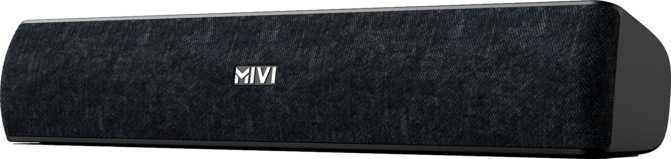
Mivi Hip Hop 500 Review: Strong Wireless Audio, Clear Trade-Offs
SoundbarsThe Mivi Hip Hop 500 is a 2.2-channel audio system that prioritises wireless audio fidelity over smart-home features. It supports aptX Adaptive and Bluetooth 5.3 — a combination rarely found at this price point — while staying deliberately simple on connectivity and ecosystem integration.
What the Mivi Hip Hop 500 Actually Is
The soundbar market is cluttered with products that promise cinema-grade audio but quietly bury the fine print in spec sheets nobody reads. The Mivi Hip Hop 500 takes a different approach: it is a 2.2-channel audio system that bets heavily on connection versatility and wireless audio quality rather than on smart-home integrations and streaming platform tie-ins.
Whether that trade-off works in your favour depends entirely on what you actually need from a speaker system sitting in your living room or bedroom. This review breaks down every relevant detail — the specs rewritten as real-world meaning, the honest shortcomings, and a direct answer to the central question: is this the right system for your money?
Design and Build: What to Expect Physically
The Hip Hop 500 ships with a physical control panel mounted directly on the unit itself — a practical choice that gets underappreciated. You are never dependent on a remote to adjust volume or switch inputs. For a bedroom setup or a desk arrangement where the speaker is within arm's reach, this matters more than most people expect until the day they misplace the remote.
A traditional remote control is included in the box, running on standard batteries rather than a rechargeable built-in unit. You will eventually need to replace those batteries — a minor inconvenience standard in this category.
The 2.2-Channel Configuration Explained
The "2" refers to two full-range audio drivers — left and right — delivering stereo separation. The ".2" refers to two dedicated bass drivers (subwoofers). This dual-woofer setup separates the Hip Hop 500 from basic 2.0 soundbars: you get genuine low-frequency reproduction from two points rather than one, creating more even bass distribution across a room rather than one localised bass "hot spot."
Connectivity: More Ports Than the Price Suggests
Bluetooth 5.3
The most current Bluetooth standard in consumer audio at this price tier. You get a more stable wireless connection, lower power drain on your source device, and significantly better interference resistance compared to older versions — no more dropouts when nearby devices compete for bandwidth.
aptX Adaptive
The headline audio feature. A dynamic codec that adjusts its bitrate in real time depending on wireless conditions — continuously balancing audio quality against connection stability. For audiophiles who have dismissed Bluetooth audio as inferior to wired, aptX Adaptive substantially narrows that gap.
Wired Trio
AUX input for universal analogue connections from laptops, older TVs, and handhelds. S/PDIF digital output bypasses your source device's own converter for higher-quality signal processing. HDMI output completes the set — though with an important limitation covered below.
Codec Support Breakdown
Three audio codecs are supported over Bluetooth. Understanding which one your device uses determines how much audio quality you actually get from this system.
| Codec | Best For | Quality Level | Notes |
|---|---|---|---|
| aptX Adaptive | Flagship Android devices | Highest | Dynamic bitrate; also includes low-latency gaming mode |
| aptX | Mid-range Android devices | High | CD-level quality; widely supported on Android |
| AAC | iPhone & iPad users | Good | Apple's native codec; significant step above SBC baseline |
The Hip Hop 500 includes an HDMI port, but it does not support HDMI ARC or eARC. Without ARC, your TV cannot send audio back through this cable to the soundbar — the standard way modern soundbars integrate with smart televisions. For TV connection, use the S/PDIF optical output or AUX input instead.
What the Hip Hop 500 Does Not Do
Honest reviews name the gaps directly. Here is everything that is absent from this system — stated plainly without apology.
Who Should Buy This — And Who Should Not
-
Music-first listeners with good source devices
If your phone supports aptX or aptX Adaptive, wireless audio quality here will exceed most similarly priced speakers. -
Desktop and PC audio setups
AUX and S/PDIF inputs mean plug-in-and-play with any PC or laptop. No account, no app, no configuration. -
Bedroom or mid-sized room audio
2.2-channel with dual bass drivers fills a medium room evenly without a separate subwoofer. -
Users who want simplicity over smart features
Button controls on the unit and an included remote — no apps, no ecosystem lock-in.
-
HDMI ARC TV integration
The standard plug-and-play TV soundbar connection via HDMI ARC is not available here. -
Smart home and voice assistant control
Google, Alexa, and Siri integration are all absent — no voice-triggered playback. -
Platform-native streaming (Spotify Connect, Chromecast)
These Wi-Fi streaming protocols are not supported. Bluetooth is your only wireless path. -
Cinematic surround sound
No Dolby Atmos, no rear channels. Stereo-plus-bass is the ceiling here.
Competitive Positioning
How the Mivi Hip Hop 500 stacks up against typical alternatives in the same price range.
| Feature | Mivi Hip Hop 500 | Typical Budget 2.0 Soundbar | Mid-Range Smart Soundbar |
|---|---|---|---|
| Channel Config | 2.2 (dual bass) | 2.0 | 2.0 or 3.0 |
| Bluetooth Version | 5.3 | 5.0–5.1 | 5.0–5.2 |
| aptX Adaptive | Occasional | ||
| AAC Codec | Sometimes | ||
| HDMI ARC | Sometimes | ||
| Wi-Fi / Platform Streaming | |||
| Voice Assistant | Often Yes | ||
| S/PDIF Output | Sometimes | ||
| Remote Control | Often No |
The Hip Hop 500 outperforms budget soundbars on wireless audio quality and input variety, but deliberately leaves out the smart features that define mid-range and premium competitors.
Strengths and Weaknesses in Plain Terms
The case for the Hip Hop 500 rests on its wireless audio credentials. aptX Adaptive is a codec that appears in systems costing significantly more, and having it here — alongside Bluetooth 5.3 — suggests Mivi is competing on audio fidelity rather than feature padding. For buyers who care about how music actually sounds over Bluetooth, this is the specification that warrants attention.
The 2.2-channel design with dual bass reproduction is a legitimate upgrade over standard 2.0 soundbars. Bass from two drivers distributes more evenly, which means people sitting at different positions in a room experience more consistent low-frequency levels — a common complaint with single-driver or no-subwoofer systems.
The wired input flexibility — AUX, HDMI out, and S/PDIF — means the Hip Hop 500 is not dependent on Bluetooth. If your phone battery is dead or you prefer a wired setup from a PC, the options are there without compromise.
On the other side: the absence of HDMI ARC is a genuine limitation for TV buyers. It is not a technical flaw — it is an intentional product decision — but it narrows the ideal use case significantly. The lack of any smart platform connectivity is also a real constraint in a market where Spotify Connect and Chromecast are increasingly expected even at modest price points. The Hip Hop 500 asks you to accept Bluetooth as your only wireless method, full stop.
Answers to Common Pre-Purchase Questions
The questions real buyers search before spending their money.
Final Verdict
The Mivi Hip Hop 500 is a focused product that does specific things well and does not pretend otherwise. Its wireless audio quality — anchored by aptX Adaptive and Bluetooth 5.3 — is the standout strength, and it puts the system ahead of most competitors in this price range on the one metric that matters most to music listeners: how good does it actually sound?
The dual-bass 2.2-channel configuration adds genuine low-end substance that single-driver soundbars cannot match. The wired connectivity options — AUX, S/PDIF, HDMI — cover enough ground to serve PC users, TV setups with optical outputs, and analogue sources without friction. Where it falls short is equally clear: this is not a smart speaker, not a TV home theatre soundbar in the traditional ARC sense, and not a voice-assistant-enabled device.
Buy it if:
You want high-quality Bluetooth audio from your phone or tablet, you are setting up a desktop or bedroom audio system, and you have no strong need for smart-home integration or HDMI ARC television connectivity.
Skip it if:
You want HDMI ARC TV integration, Alexa or Google Assistant control, Spotify Connect, or any form of Wi-Fi streaming. The Hip Hop 500 will not satisfy those requirements.