Mivi Fort H30 Full Review: Stereo Sound Without Smart Speaker Baggage
SoundbarsThe Mivi Fort H30 occupies an interesting space in the portable speaker market: a no-nonsense, Bluetooth-forward stereo speaker that skips smart-home integrations, voice assistants, and companion apps that bloat many competitors — betting everything on audio quality and connectivity fundamentals. For buyers tired of paying for ecosystem lock-in they will never use, that is a bet worth examining closely.
True Stereo
2-Channel Output
aptX Adaptive
High-Fidelity Wireless
AUX Input
Wired Backup Included
No App Required
On-Device Controls Only
Design and Build: Purposeful, Not Flashy
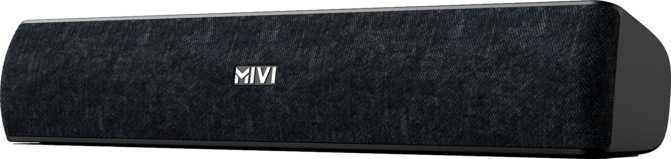
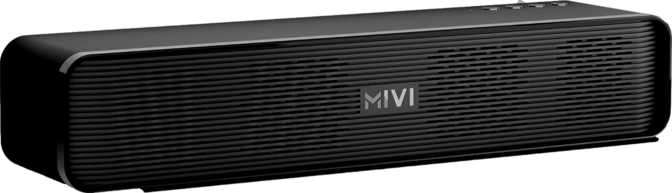
At 348 mm wide and 70 mm tall, the Fort H30 has a classic soundbar-adjacent silhouette — wider than it is tall, designed to sit flat on a desk, shelf, or tabletop rather than stand upright like a cylindrical Bluetooth speaker. Its 63 mm depth gives it enough internal volume to house proper speaker drivers without feeling like a toy, while staying compact enough to slip into a bag without taking over all available space.
The weight lands at 832 grams — roughly the same as a large water bottle filled to the top. That is heavy enough to feel premium and stay planted during playback, but light enough to carry between rooms or pack for a weekend away without resentment.
The control panel is built directly onto the device. There is no remote, no app, and no voice commands — every adjustment happens through physical buttons on the unit itself. For some, this feels like a limitation. For others who have grown weary of apps demanding accounts and permissions just to adjust bass, it is a genuine feature.
Width
348 mm
Horizontal form factor
Weight
832 g
Stays planted on surfaces
Depth
63 mm
Room for proper drivers
Audio Performance: Where the Spec Sheet Actually Matters
Stereo Output — Not a Mono Speaker in Disguise
The Fort H30 delivers true two-channel stereo output. Many portable speakers in this category use a single driver or two drivers firing in the same direction, creating an illusion of stereo that collapses the moment you move off-axis. With dedicated left and right channel output, the H30 produces proper stereo separation — instruments and vocals occupying distinct positions in the soundstage rather than blending into a single audio mass.
For music listening, this means noticeably more dimensional sound: guitar sitting to one side, vocals centered, hi-hats in the upper right. For movies and gaming audio streamed from a laptop or phone, the stereo field makes dialogue and effects feel more grounded and positional.
Bluetooth Codec Stack: Genuinely High-Quality Wireless Audio
The Fort H30 supports three wireless audio codecs — AAC, aptX, and aptX Adaptive. Understanding what each means in practice sets realistic expectations for every type of source device.
Connectivity: Focused and Functional
AUX Input — The Underrated Feature
Beyond Bluetooth, the Fort H30 includes a 3.5mm AUX input. If you are connecting to a device with a headphone jack — an older laptop, a desktop PC, a TV with analog output, a turntable with a preamp — you can bypass wireless entirely and get a direct, zero-latency, zero-compression wired connection. It also means the speaker works when Bluetooth pairing is inconvenient or when you simply want a stable connection that will not be interrupted.
What Is Not Here — and Why That Is a Deliberate Choice
The Fort H30 excludes Wi-Fi, Chromecast, AirPlay, Spotify Connect, and smart assistant integration. There is no smartphone app and no HDMI or digital optical input. This is not an oversight — it is a product philosophy.
Every one of those features adds cost, increases firmware complexity, and introduces potential points of failure — discontinued app support, broken integrations after OS updates. The Fort H30 sidesteps all of that. What you get on day one is what you will have in three years: a speaker that works with a button press, every time.
What Is Included
- Bluetooth with aptX Adaptive, aptX, and AAC
- 3.5mm AUX Input for wired connection
- Physical on-device control panel
Deliberately Excluded
- Wi-Fi, AirPlay, and Chromecast
- Google Assistant, Alexa, and Siri
- Companion smartphone app
- HDMI, optical, and microphone input
Real-World Usage: Who the Fort H30 Is Actually For
- Want a desk speaker for a work-from-home setup — connecting to a laptop via AUX or Bluetooth for music, video call audio output, or casual movie watching. Note: no microphone means playback only.
- Need quality stereo audio in a bedroom or living room without committing to a full smart speaker ecosystem.
- Plan to use it for weekend trips or outdoor gatherings where instant Bluetooth pairing without opening an app matters more than voice commands.
- Already have a smart display or TV handling voice control and just need quality audio output connected via AUX.
- A speakerphone or conference call device — there is no built-in microphone, so it handles audio output only.
- Multi-room audio — without Wi-Fi, AirPlay, or Chromecast, it cannot participate in a synchronized multi-speaker setup.
- Hands-free voice control for smart home devices — neither Google Assistant nor Alexa is supported.
- TV connectivity via HDMI ARC — there are no HDMI ports of any kind on this speaker.
How the Fort H30 Compares to Its Natural Competition
The Fort H30 sits at an interesting intersection. It out-specs budget Bluetooth speakers on audio codec quality by a significant margin, while trading ecosystem features for simplicity against smart speakers with Wi-Fi.
| Feature | Mivi Fort H30 | Typical Wi-Fi Smart Speaker | Typical Budget BT Speaker |
|---|---|---|---|
| Stereo Output | True 2-channel | Varies by model | Often mono or pseudo-stereo |
| aptX Adaptive | Yes | Rarely | No |
| AUX Input | Yes | Rarely | Sometimes |
| Smart Assistant | No | Yes (core feature) | No |
| Companion App Required | No | Usually mandatory | Sometimes |
| Wi-Fi Connectivity | No | Yes | No |
| Wired AUX Latency | Near-zero | N/A | Near-zero (if port exists) |
Honest Assessment: Strengths and Limitations
The Fort H30's greatest strength is coherence. Every decision — aptX Adaptive for high-fidelity wireless, a physical control panel instead of an app, AUX input for wired versatility, true stereo drivers in a sensibly sized enclosure — points in the same direction. This is a speaker designed for people who want to listen to music, not manage a connected device.
The codec support is genuinely impressive for its category. aptX Adaptive is a feature you typically find on speakers marketed at audiophile-adjacent buyers, and having it here alongside AAC means the Fort H30 is not artificially limiting the audio quality of good source devices. The absence of a built-in microphone is both a capability gap and — for privacy-conscious buyers in shared spaces — a quiet advantage.
What It Gets Right
- aptX Adaptive codec support is above category norms — a genuine advantage for Android users with compatible devices.
- True stereo separation delivers a soundstage most competing portable speakers at similar dimensions cannot match.
- No app dependency means zero friction on first use and zero risk of features disappearing after a software update.
- AUX input provides a reliable fallback with zero compression and zero latency when wireless is not ideal.
Where It Falls Short
- No remote control is the clearest daily friction point — at 348 mm wide, it will often sit across the room from you.
- No built-in microphone rules it out entirely for speakerphone or hands-free voice use cases.
- No Wi-Fi means complete isolation from multi-room audio ecosystems like Google Home or Apple AirPlay 2.
- The power source is not specified in the spec sheet — confirm whether mains-powered or rechargeable before purchasing.
Questions Buyers Ask Before Purchasing
Final Verdict
Mivi Fort H30 — Our Recommendation
The Mivi Fort H30 is a confident, well-scoped product that delivers meaningfully better wireless audio quality than most speakers in its class, thanks to a codec stack that treats Bluetooth as a high-fidelity medium rather than a convenience compromise.
Its refusal to include smart features, voice assistants, or companion apps is not a weakness — it is a conscious design posture that results in a speaker that works reliably, ages well, and does not depend on anyone's cloud infrastructure to function.
For straightforward, high-quality wireless listening from any device, the Mivi Fort H30 earns its place on the shortlist.