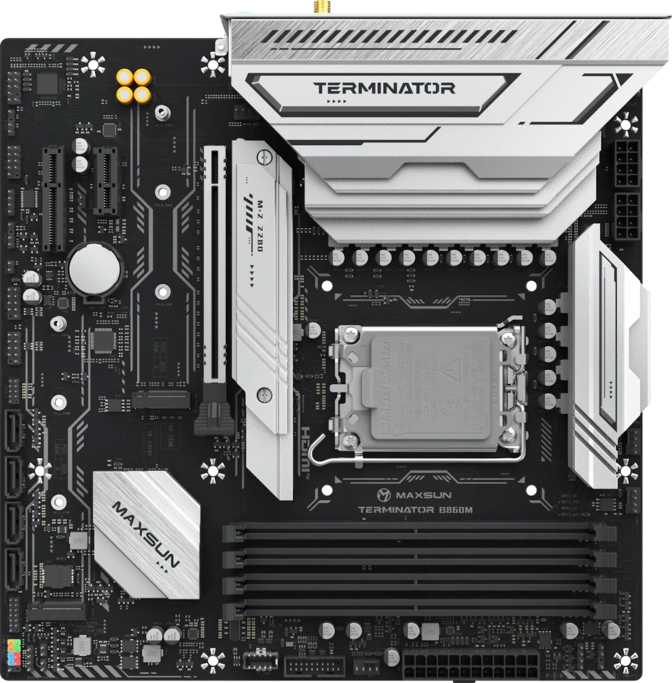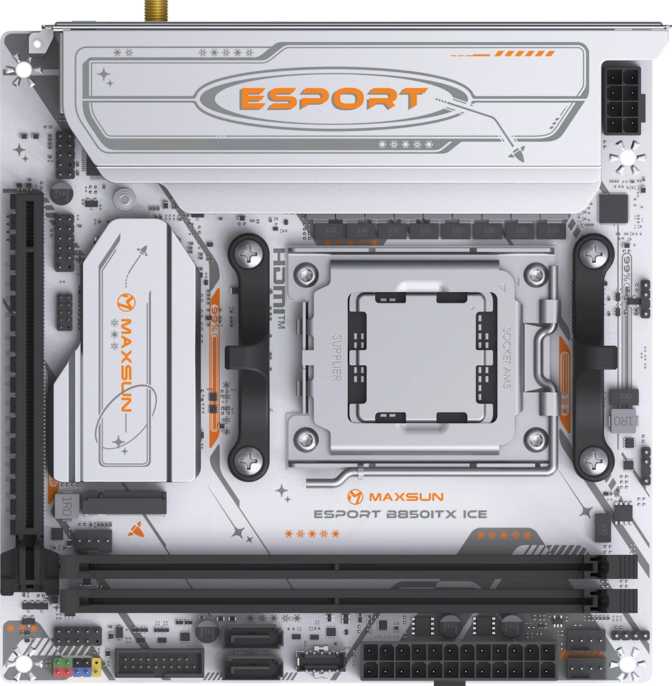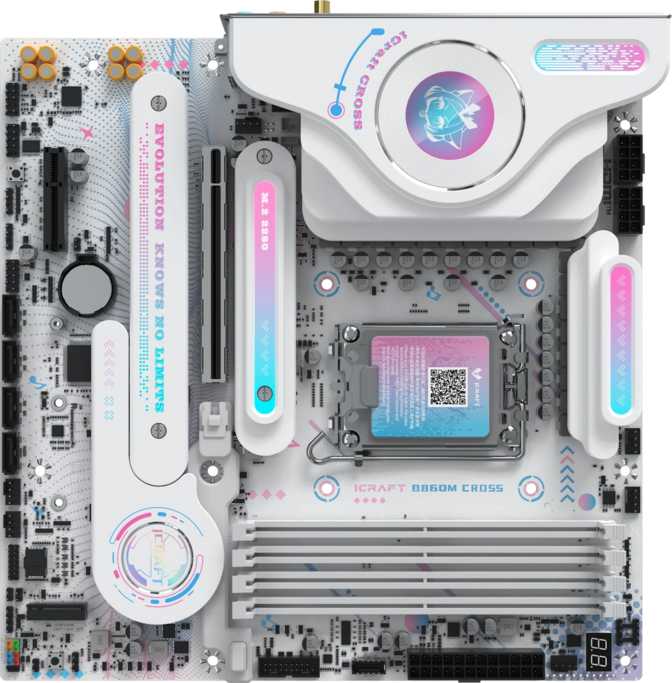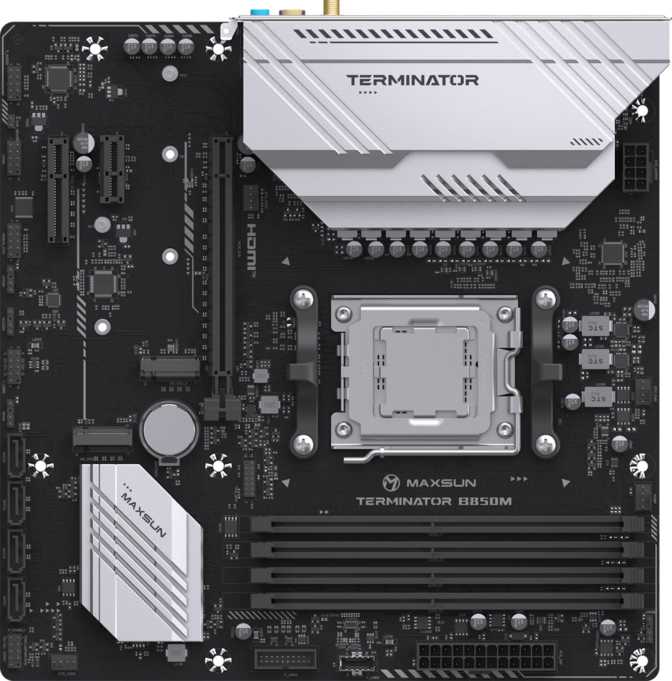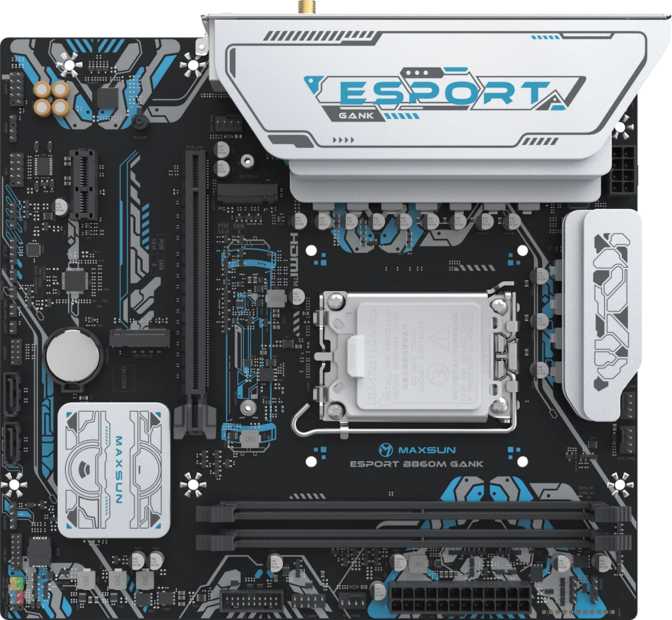
Building a gaming PC around Intel's newest LGA 1851 platform usually means choosing between two extremes: spend big on a flagship board loaded with features you'll never use, or settle for a stripped-down budget option that cuts corners where it hurts. The Maxsun eSport B860M Gank WiFi sits in the gap between those extremes — a Micro-ATX board that brings the current-generation Intel platform, DDR5 memory, integrated wireless networking, and genuine overclocking headroom into a footprint small enough for a compact build.
LGA 1851 / B860
Micro-ATX
Wi-Fi 6 Built-In
DDR5 up to 8600MHz
PCIe 5.0 x16
Dual BIOS
Design, Build Quality, and What It's Like to Work With
At 220mm tall and 235mm wide, this board sits comfortably within the standard Micro-ATX footprint, meaning it drops into the vast majority of mATX and ATX cases without any clearance surprises. That smaller size isn't a downgrade — it's a deliberate trade-off. You give up a couple of expansion slots and memory slots compared to a full ATX board, and in exchange you get a more compact, easier-to-cable system that still has room for a full-size graphics card and proper cooling.
The board carries built-in RGB lighting, which is a nice touch for anyone building inside a tempered-glass case, though as with most onboard lighting, its real value comes from how well it syncs with your case fans and other components rather than its standalone brightness.
Dual BIOS Protection
That's a feature you'll rarely think about — until a botched BIOS update or an aggressive overclock corrupts your firmware. On most budget boards, that scenario means a dead system and a returns process. Here, the board can fall back to a secondary BIOS chip and recover on its own, which is the kind of insurance that matters far more than it costs to include.
One-Touch Clear CMOS
A dedicated Clear CMOS function makes resetting BIOS settings straightforward if an overclock goes wrong or you inherit a system with an unknown configuration — no need to dig out the motherboard manual to find a jumper pin.
Platform Performance: What LGA 1851 and B860 Actually Mean
This board uses the LGA 1851 socket paired with Intel's B860 chipset, which places it squarely in Intel's current-generation desktop lineup, just below the flagship Z-series chipset in Intel's stack. In practical terms, B860 is the chipset built for people who want this generation's CPU performance, platform features, and I/O improvements without paying for the extra connectivity and tuning headroom that Z-series boards charge a premium for.
A single CPU socket confirms this is a standard desktop build — there's no dual-processor complexity here, just a straightforward path to a fast, modern single-CPU gaming or productivity rig.
Expansion Slots: One Strong Slot Beats Several Weak Ones
The board includes one full-length PCIe 5.0 x16 slot — the connection your graphics card will use — plus a single PCIe x1 slot for smaller add-in cards like capture cards or extra connectivity. There's no PCIe 4.0 or 3.0 x16 slot here, and that's by design rather than oversight: Micro-ATX boards in this segment typically dedicate their single full-length slot to the newest, fastest standard rather than splitting bandwidth across multiple slots most builders won't use anyway.
If your build plan involves a single graphics card, which is true for the vast majority of gaming PCs, this layout is exactly what you want. If you were hoping to run multiple expansion cards in full-length slots simultaneously, a Micro-ATX board was never going to be the right starting point.
Memory: DDR5 Speed Without the Four-Slot Compromise
This board supports up to 96GB of DDR5 memory across two memory slots, running in dual-channel mode. Two slots instead of four might initially look like a limitation, but it's actually a common trade-off enthusiasts intentionally choose: two-slot boards tend to reach higher stable memory speeds than their four-slot counterparts, because signal integrity is easier to manage with fewer modules on the bus.
That advantage shows clearly in the numbers here. Out of the box, the board officially supports memory speeds up to 6400MHz. With manual tuning or the board's overclocking tools, that climbs to 8600MHz — a meaningful jump that matters more than it might sound. Modern gaming performance, especially on CPU-bound titles and esports games, scales noticeably with memory bandwidth and latency.
Connectivity: Wireless, Wired, and the Ports You'll Actually Use
True to its name, the "WiFi" variant designation on this board isn't just branding — it ships with integrated Wi-Fi 6 wireless networking, with backward compatibility down through Wi-Fi 5 and Wi-Fi 4 for older routers. Wi-Fi 6 brings real-world benefits beyond peak speed: better performance in crowded wireless environments and lower latency under load, which matters if you're gaming wirelessly rather than wired.
Bluetooth 5.2 rounds out the wireless side, and the inclusion of aptX support is a genuine bonus — aptX delivers noticeably better wireless audio quality and lower latency than standard Bluetooth audio codecs, which matters if you're pairing wireless headphones or speakers for gaming or media.
For wired networking, there's a single RJ45 Ethernet port for a stable, low-latency wired connection — still the better choice over Wi-Fi for competitive gaming whenever it's available.
Rear Panel and USB Ports
| Port Type | Count | Real-World Use |
|---|---|---|
| USB 3.2 Gen 1 (Type-A) | 4 | Everyday peripherals, external drives, controllers |
| USB 2.0 | 2 | Keyboards, mice, low-bandwidth devices |
| USB Type-C | 1 | Modern peripherals with a reversible connector |
| HDMI 2.1 | 1 | High-refresh-rate, high-resolution display output |
| DisplayPort | 1 | Secondary display output |
| RJ45 (Ethernet) | 1 | Wired network connection |
The honest caveat: there's no USB 3.2 Gen 2 Type-A port, meaning the fastest USB-A transfer speeds aren't available here, and there's no Thunderbolt or USB4 connectivity either. For everyday use this won't be noticeable. If you regularly move large files via a high-speed external SSD over USB-A, this is the one connectivity area where a step-up board would serve you better.
Display Output: Know Before You Buy
The board itself doesn't include an onboard graphics chip — standard for modern motherboards, but it means the HDMI 2.1 and DisplayPort outputs on the rear panel only function if your CPU includes integrated graphics. Many CPUs on this platform do, but not all of them; some performance-focused SKUs ship without an integrated GPU specifically because they're intended to be paired with a discrete graphics card.
Storage and RAID: Flexible, With Real Limits Worth Knowing
Storage comes via two M.2 slots for high-speed NVMe SSDs and two SATA III connectors for traditional drives or additional SSDs. That's a modest but entirely workable setup for a gaming build: one M.2 drive for your operating system and frequently played games, a second M.2 or SATA drive for overflow storage, and the option to add more SATA drives down the line.
The board supports RAID 0, 1, 5, and 10 configurations. That's a respectable feature list, but it's worth setting expectations: RAID 5 and RAID 10 typically require a minimum of three and four drives respectively, so to actually use those modes you'll need to combine your SATA and M.2 drives carefully. For most gamers, RAID 0 or RAID 1 across two SATA drives is the realistic use case here.
A TPM (Trusted Platform Module) connector is also onboard, which matters more than it used to — it's a requirement for Windows 11 in most configurations and adds hardware-level security for disk encryption.
Audio: Built-In, Not an Afterthought
The board includes 7.1-channel audio output through three rear analog audio jacks, which is standard, capable performance for surround sound setups, gaming headsets, and everyday speaker connections. There's no S/PDIF digital audio output, so if your audio setup relies specifically on an optical digital connection to a receiver or soundbar, you'll need to route audio through HDMI or USB instead. For the large majority of gaming and desktop setups, this won't come up as a limitation.
Overclocking and Tuning: More Accessible Than You'd Expect
Maxsun built genuine overclocking accessibility into this board rather than treating it as a checkbox feature. The jump from 6400MHz stock memory support to an 8600MHz overclocked ceiling shows real tuning headroom, and the board's simplified overclocking tools are aimed at making that achievable without deep manual BIOS tuning. Combined with dual BIOS for safety and one-touch CMOS reset for recovery, this is a board that encourages experimentation rather than punishing it.
Who This Motherboard Is Actually For
Good Fit
- Gamers building a compact, current-generation Intel system who want Micro-ATX space savings without giving up the latest socket and chipset
- Builders who value wireless flexibility, with integrated Wi-Fi 6 and Bluetooth 5.2 with aptX
- Enthusiasts who want to tune memory speeds without four memory slots or flagship-chipset prices
- Anyone prioritizing a single strong GPU slot over multiple expansion slots they'd likely never use
Not a Good Fit
- Buyers who need multiple high-speed USB-A (10Gbps) ports or Thunderbolt for professional storage workflows
- Anyone planning a multi-GPU or multi-card-heavy build needing more than one full-length PCIe slot
- Workstation or NAS builders who need ECC memory or more than two SATA connectors
- Users planning to rely on onboard graphics without confirming their CPU has an integrated GPU
How It Stacks Up Against the Alternatives
| Consideration | Maxsun eSport B860M Gank WiFi | Typical Step-Down (No-WiFi) B860 Board | Typical Step-Up Z-Series Board |
|---|---|---|---|
| Wireless networking | Wi-Fi 6 + Bluetooth 5.2 (aptX) built in | Usually absent, requires add-in card | Often included, sometimes higher tier |
| Memory overclocking ceiling | Up to 8600MHz (with tuning) | Similar, chipset-dependent | Typically higher ceilings, more tuning options |
| PCIe 5.0 x16 slot | Yes (1) | Yes (1) | Yes, often with more slots overall |
| USB-A 10Gbps / Thunderbolt | Not included | Not included | Frequently included |
| Form factor flexibility | Micro-ATX | Micro-ATX | Usually full ATX |
| Price-to-feature balance | Strong for wireless + tuning headroom | Strong if wired-only is fine | Best for max connectivity, at a premium |
The clearest competitive edge is the built-in wireless package. Many boards in the same chipset tier skip Wi-Fi entirely, pushing that cost and complexity onto the buyer later. Against pricier Z-series boards, the trade-off is exactly what you'd expect: less ultimate I/O ceiling and tuning headroom, in exchange for real savings and a smaller footprint.
Strengths and Weaknesses, Stated Plainly
Where It Shines
The standout strength is how much current-generation platform access this board packs into a Micro-ATX shell without quietly cutting the features that matter most day to day. Integrated Wi-Fi 6 and Bluetooth 5.2 with aptX is a genuinely useful inclusion at this tier, dual BIOS adds real peace of mind during firmware updates and overclocking experiments, and the memory overclocking headroom up to 8600MHz gives enthusiasts a tangible performance lever without an expensive chipset upgrade.
Where It Falls Short
The weaknesses are concentrated almost entirely in high-speed wired connectivity. The absence of any USB 3.2 Gen 2 Type-A port or Thunderbolt support means this board isn't built for buyers who move large files over fast external storage regularly. Two SATA ports is workable but modest, and RAID 5/10 support is more theoretical than practical without supplementing your drive count carefully. None of these are dealbreakers for a gaming-focused build, but they're the clear ceiling of what this board is designed to do.
Questions Buyers Ask Before Purchasing
Final Verdict
The Maxsun eSport B860M Gank WiFi earns its place as a smart pick for anyone building a compact, current-generation Intel gaming PC who wants integrated wireless networking and real memory-overclocking headroom without stepping up to a more expensive Z-series board. It does what a focused Micro-ATX gaming board should do: one strong PCIe 5.0 slot for your graphics card, fast DDR5 memory support with genuine tuning room, dependable dual BIOS protection, and a wireless package that's genuinely useful rather than a marketing afterthought.
Where it falls short — limited high-speed USB connectivity, modest SATA storage, no ECC support — are the right trade-offs for its intended audience and price tier, not signs of corner-cutting in places that matter for gaming. If your build plan centers on a single graphics card, DDR5 performance tuning, and wireless flexibility in a smaller case, this board deserves a serious look. If your priorities lean toward maximum wired transfer speeds, multiple expansion slots, or workstation-grade storage redundancy, you'll be better served by a larger ATX board further up the lineup.