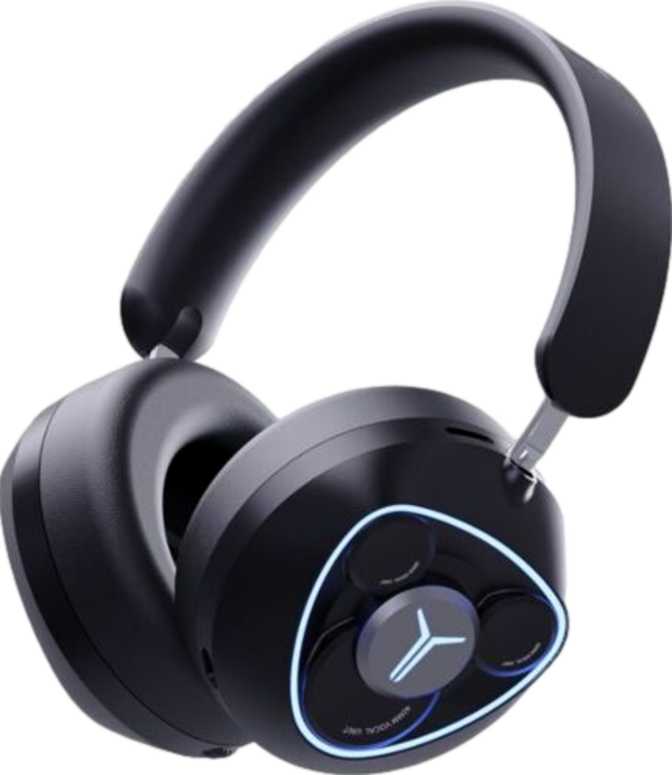
Lenovo Legion Y960 Review: A Six-Driver Wired Gaming Headset Examined
PC and Gaming HeadsetsThe gaming headset market is cluttered with products that prioritize flash over function or charge a premium for features most players never use. The Lenovo Legion Y960 takes a different approach — it leans hard into wired, multi-driver audio performance for players who want serious sound across multiple platforms without the complications of wireless connectivity or active processing. Whether that trade-off works in your favor depends entirely on how you play.
Overall Rating
4.5 / 5
Multi-Driver Wired Gaming Audio
Driver Config
6 Drivers Total
Connection
USB-C + 3.5mm
Platforms
PC, PS, Switch
Weight
346 g
Design and Build: Solid, Purposeful, and Unapologetically Gaming
Physical Presence
At 346 grams, the Y960 sits in the mid-weight category for over-ear gaming headsets. It is not ultralight, but it is far from the neck-straining heavyweights that plague the premium end of the market. Most players will find it comfortable across multi-hour sessions, though those sensitive to headset weight should try before committing.
The closed-back over-ear design is a deliberate choice. Unlike open-back headsets — which sacrifice isolation for a more naturalistic, airy sound — the Y960's sealed cups create a contained acoustic environment. You are not broadcasting your game audio to the room, and ambient noise is physically blocked out without any electronics involved. For players in shared households, offices, or anywhere background noise competes with gameplay, this is the right architecture.
Cable System
The Y960 uses a detachable, tangle-free cable — a detail that sounds minor until a fixed cable starts fraying at the connector. Detachable cables mean a worn-out cable is an inexpensive replacement, not a reason to buy new headphones. All controls sit on the headset body directly; there is no inline remote on the cable itself.
At a Glance
-
Over-ear closed-back fit
Passive noise isolation without electronics -
Detachable tangle-free cable
Replaceable without buying new headphones -
On-headset control panel
Volume and settings without cable fumbling -
RGB lighting
Designed for gaming ecosystem setups -
Non-folding, no carry case
Desk-only design — not built for travel
Audio Performance: Six Drivers, One Clear Goal
The Multi-Driver Architecture Explained
Most gaming headsets use a single driver per ear — one speaker handling all bass, midrange, and treble. The Y960 uses six drivers total, meaning three per ear working in a distributed array. This approach is more common in high-end in-ear monitors than gaming headsets, and it carries a significant implication: each driver can be tuned for a specific frequency range rather than compromising across the full spectrum.
In practical terms, bass does not bleed into the midrange where voice and footstep detail live, and high-frequency sounds — distant gunshots, atmospheric ambience, high-pitched audio cues — can be reproduced with more precision than a single-driver design typically allows.
| Drivers per ear | 3 dedicated drivers |
| Driver size | 40 mm |
| Frequency floor | 20 Hz (human hearing limit) |
| Frequency ceiling | 40,000 Hz (well above audible) |
Extended Frequency Range
The Y960's drivers reach up to 40,000 Hz — well beyond the approximately 20,000 Hz upper limit of typical human hearing. The practical value is subtle rather than dramatic. Headsets that strain to reproduce high frequencies up to their stated limit often introduce distortion at the top end, while those with genuine headroom above that limit tend to sound cleaner within the range you can actually hear. Think of it like a car engine that redlines at top speed versus one with comfortable power to spare — the latter simply feels more effortless.
Surround Sound Processing
The Y960 supports surround sound at the hardware level but does not claim the newer object-based spatial audio found on specific platform implementations. The surround processing is built into the headset rather than dependent on an external software layer. For shooters, open-world games, and any title where directional audio cues matter, this translates to meaningful positional information — footsteps to your left sound different from footsteps behind you, without requiring extra software configuration.
Passive Noise Reduction
Without active noise cancellation electronics, the Y960 relies on its closed-back construction to block ambient sound passively. This is a valid approach for stationary desktop use. You will not get the deep low-frequency rumble cancellation that ANC provides — AC units, traffic, and bass-heavy noise will still penetrate to some degree — but voice, mid-frequency distractions, and high-pitched ambient sounds are significantly attenuated. The trade-off is genuine: passive isolation requires no battery, generates no electronic hiss, and introduces zero audio latency. For a desk gaming setup, those are real advantages.
Microphone: Clear Communication, Fixed Position
The Y960 includes a single noise-canceling microphone built directly into the headset. The noise-canceling function here applies to the mic's input — it reduces background noise from your environment before your voice reaches teammates, which is entirely separate from the headset's ability to block sound reaching your own ears.
For the typical use case — in-game voice chat, Discord calls, or streaming commentary — a single noise-canceling microphone is fully sufficient. Most players will never need more.
The microphone is not removable. This matters for content creators or streamers who prefer using the headset as a pure listening device with a completely clean profile alongside a dedicated desk microphone. If a detachable boom mic is important to your workflow, the Y960 does not offer that flexibility.
Microphone Specs
- Noise-canceling input processing
- Single microphone configuration
- Usable as a headset for voice comms
- Not removable or detachable
Connectivity: Wired Across Three Platforms
Connection Options
The Y960 connects via both a standard 3.5mm headphone jack and USB Type-C. This dual-connection approach is one of its most practical features because it directly determines platform reach.
USB-C Connection
Enables full surround sound processing and control panel features. Recommended for PC and any USB-C audio-capable device.
3.5mm Analog Connection
Provides standard analog audio and maintains compatibility with devices that do not support USB audio — including controller connections on console.
Platform Compatibility
Confirmed
Confirmed
Confirmed
Wired-Only: A Feature, Not Just a Limitation
The Y960 has no wireless or Bluetooth capability. For some players this is a dealbreaker; for others it is an advantage. Wired connections carry zero latency — there is no delay between game action and what you hear — and you will never reach for a charger before a session. The tangle-free, detachable cable keeps the wired experience manageable at a desk, and the on-headset control panel means you are not fumbling along a cable to adjust volume mid-game.
Real-World Usage: Who the Y960 Is Built For
-
Dedicated PC and PlayStation gamers who play at a fixed desk and want audio quality that scales with the game's design — particularly in titles with complex, layered soundscapes.
-
Multi-platform players who move between PC and PlayStation (or include a Nintendo Switch) without wanting separate headsets for each system.
-
Players in shared or noisy environments who need physical sound isolation without the cost and complexity of active noise cancellation.
-
RGB enthusiasts with matching desk setups who want visual coherence alongside genuine audio performance.
-
Wireless-first players. If getting up from your desk means yanking a cable, the Y960 will frustrate you. There is no wireless option.
-
Xbox-primary players. Platform compatibility does not list Xbox — assuming compatibility without verification is a risk not worth taking.
-
Audiophile or studio use. Despite the extended frequency response, this is tuned for gaming. Closed-back design and surround processing are gaming-centric decisions that do not align with flat reference monitoring.
-
Travelers or LAN competitors. No fold, no carrying case, mid-range weight — this headset does not travel well and was never designed to.
How It Compares to the Competition
The Y960's main competitive differentiator is its multi-driver configuration at its price tier. Most competing headsets rely on a single, larger driver per ear and compensate through equalization rather than hardware frequency separation. The table below maps the Y960 against the two most common alternative categories buyers consider.
| Feature | Lenovo Legion Y960 | Typical Single-Driver Gaming Headset | Wireless Gaming Headset (Mid-Range) |
|---|---|---|---|
| Drivers per ear | 3 dedicated | 1 | 1–2 |
| Connection | USB-C + 3.5mm (wired) | USB or 3.5mm (wired) | Wireless + wired backup |
| Platform support | PC, PS, Switch | Usually PC-first | Often platform-specific |
| Active noise cancellation | No (passive only) | No | Sometimes |
| Surround sound | Hardware-level | Often software-only | Often software-only |
| Audio latency | Zero (wired) | Zero (wired) | Low to moderate |
| Mic removable | No | Varies | Varies |
| RGB lighting | Yes | Varies | Rarely |
| Travel-friendly | No | Sometimes | Sometimes |
Honest Assessment: Strengths and Limitations
Where the Y960 Delivers
The Y960's strengths concentrate in areas that matter most during actual gameplay. The six-driver audio architecture is a genuine engineering differentiator — three drivers per ear working in frequency-specific roles is a more sophisticated approach than most competitors offer at comparable prices. This is not a numbers game; it represents a fundamentally different philosophy in how the headset reproduces sound.
Multi-platform wired flexibility through dual USB-C and 3.5mm connections is a practical strength that many competing headsets fail to match without adapters. Covering PC, PlayStation, and Nintendo Switch from a single device removes the friction of platform switching.
Day-to-day usability features — detachable tangle-free cable, on-device controls, and passive noise isolation — reflect thoughtful design for long-term desk ownership rather than spec-sheet optimization.
Where It Falls Short
The lack of wireless is a structural choice, not an oversight, but it does restrict the headset's usefulness to desk-anchored setups. For players who value freedom of movement, this is a fundamental incompatibility that no amount of audio quality resolves.
The fixed microphone limits flexibility for content creators and streamers who prefer a clean headphone profile alongside a dedicated desk mic. Combined with the non-folding design and absent carry case, portability was clearly never part of the product brief.
One specification worth noting before purchasing: the driver data does not confirm neodymium magnet construction — the material most commonly associated with high-performance audio drivers. The multi-driver configuration may compensate through other engineering means, but it is a specification gap worth investigating if driver materials factor into your purchase criteria.
Common Questions Before You Buy
Final Verdict
Lenovo Legion Y960 — The Recommendation
The Lenovo Legion Y960 is a purpose-built gaming headset with a clear identity: wired, multi-platform, closed-back, and engineered around a six-driver audio system that sets it apart from most wired competition. For PC and PlayStation players who stay at their desks and want hardware-level audio performance without the compromises of wireless, it presents a compelling case.
It is not for everyone. Wireless devotees, Xbox players, and anyone who needs a travel-ready headset should look at other options. But for the player who values audio architecture, multi-platform flexibility across PC and PlayStation, and a no-nonsense wired connection, the Y960 delivers on its premise without padding the feature list with things that do not serve the core experience.
Buy it if:
You play PC or PlayStation at a fixed desk, want genuine multi-driver surround audio, and have no need for wireless connectivity.
Skip it if:
You prioritize wireless freedom, primarily game on Xbox, or need a headset that doubles as a portable travel companion.
Final Score