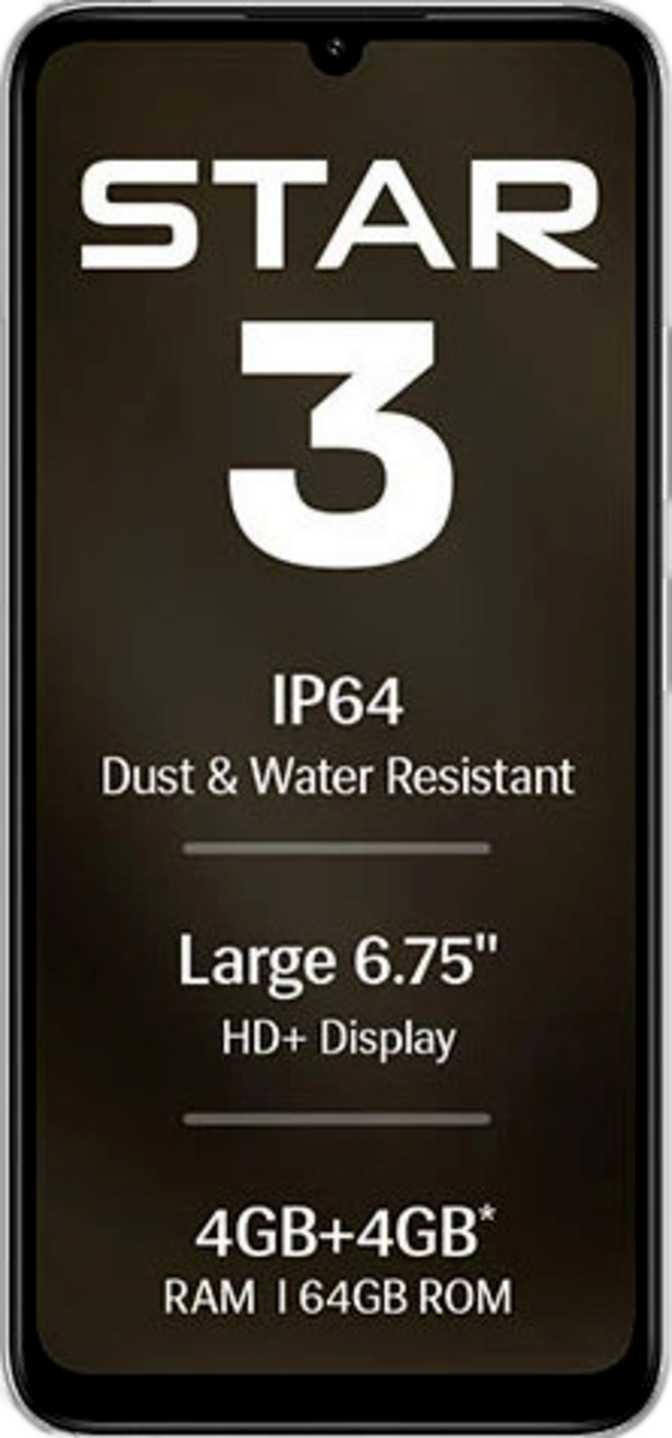
Lava Yuva Star 3 Full Review: Big Screen, Honest Trade-Offs
SmartphonesAt a Glance
Display
6.75" IPS · 90Hz
Processor
Octa-core · 28nm
RAM / Storage
4GB / 64GB + microSD
Main Camera
13MP · 1080p@30fps
Battery
Large · 10W Charging
Protection
IP64 · Dust + Splash
Design and Build Quality
A Phone Built for Bigger Hands
At 165mm tall and 76.1mm wide, the Yuva Star 3 is unmistakably a large-hand phone. Those coming from older, smaller devices will spend the first few days relearning the grip — reaching the top corner with one thumb without shifting your hold simply isn't possible. That said, the 8.5mm thickness keeps it from feeling like a brick, and the 193.7g weight sits at the heavier end of the budget category without crossing into uncomfortable territory.
For daily carry — in a pocket or a bag — it's manageable. If you're used to compact devices, this one will ask for some adjustment.
IP64 Protection: Genuinely Useful, Not Just a Sticker
One of the Yuva Star 3's more meaningful differentiators at this price point is its IP64 rating. The "6" means complete protection against dust — every grain, every particle. The "4" means it can handle water splashed from any direction without damage.
This is not waterproofing. Submerging it or taking it into the shower remains a risk. But if you work in dusty environments, cook in a kitchen, or simply live a life where phones get splashed, this is a real-world advantage that most competitors at this price skip entirely.
IP64 Explained
- 6Dust Protection
- Complete ingress protection — no dust enters the device under any conditions.
- 4Water Resistance
- Splash-proof from any direction. Not submersion-rated.
- What It Means
- Safe in kitchens, light rain, and dusty worksites. Not safe to submerge.
8.5mm
Thickness
193.7g
Weight
165mm
Height
76.1mm
Width
Display: Large Canvas, Honest Limitations
The Screen Size Advantage
The 6.75-inch IPS LCD panel is the most immediately impressive feature when you first hold the phone. Media consumption — YouTube, short-form content, e-books — all benefit from the extra real estate. Text is large and readable, and the screen-to-content ratio suits anyone who spends long hours reading or watching.
The 90Hz refresh rate is a genuine comfort upgrade over the 60Hz standard found on many budget rivals. Scrolling through social feeds, menus, and web pages feels noticeably smoother — and once you've lived with it, going back to 60Hz feels sluggish.
Where Honesty Demands a Pause
At 260 pixels per inch, the resolution sits in HD+ territory — and it's visible if you look for it. Text at small sizes shows slight softness compared to Full HD displays. For everyday use — messaging, news, standard video — most users won't be actively bothered. Those who edit photos or are migrating from a Full HD device will notice the step down.
No HDR. No damage-resistant glass.
The display does not support any HDR standard, and there is no branded damage-resistant glass. A screen protector should be treated as a day-one purchase.
| Type | IPS LCD |
| Size | 6.75 inches |
| Resolution | 720 × 1600 (HD+) |
| Pixel Density | 260 ppi |
| Refresh Rate | 90 Hz |
| HDR Support | None |
| Gorilla Glass | No |
| Always-On Display | No |
90Hz Scroll
6.75" Size
HD+ Only
Performance: Honest Power for Honest Tasks
What the Processor Actually Delivers
The Yuva Star 3 runs on a processor built on a 28-nanometer manufacturing process — an older fabrication node that is power-efficient at low loads, but not comparable to the 4–6nm chips found in mid-range competitors. The CPU pairs four performance cores at 1.6GHz with four efficiency cores at 1.2GHz, using a technique called big.LITTLE architecture to balance active tasks with battery conservation.
In practical terms: messaging apps, phone calls, social media, video streaming, and two-app multitasking all run without drama. The daily stack of a typical user is handled comfortably. Where it shows limits is under sustained load — graphics-intensive gaming, heavy video editing, or running multiple resource-hungry apps at once.
Benchmark Context
These results place the Yuva Star 3 firmly in entry-level performance territory. A mid-range chip from the same generation would score roughly three to five times higher in multi-core testing.
| CPU Config | 4×1.6 + 4×1.2 GHz |
| Architecture | big.LITTLE Octa-core |
| Process Node | 28nm |
| GPU | PowerVR GE8322 |
| RAM | 4GB LPDDR4 |
| Storage | 64GB eMMC 5.1 |
| Max RAM Support | Up to 6GB |
| 64-bit Support | Yes |
Handles Well
- WhatsApp, calls, messaging
- YouTube and video streaming
- Social media browsing
- Two-app multitasking
Struggles With
- Graphics-intensive gaming
- Heavy video editing
- Heavy simultaneous multitasking
Camera: Capable in Daylight, Honest in the Dark
Main Camera Performance
The 13-megapixel rear camera produces clean, usable images in good lighting — outdoors, near a window, or in a well-lit room. Phase-detection autofocus locks on subjects quickly, and continuous autofocus during video recording keeps walking subjects sharp without manual intervention.
The manual controls available in the camera app are a pleasant surprise at this price. ISO, exposure, white balance, and focus can all be dialed in manually. The built-in HDR mode improves highlight and shadow balance in tricky lighting situations and is worth keeping on by default.
Low Light and Video Limitations
Without optical image stabilization or a back-illuminated sensor, the camera relies on software processing in dim environments. Evening and night shots will require a steady hand and realistic expectations — detail loss and grain are normal results in low light.
Video tops out at 1080p at 30 frames per second. A slow-motion mode adds a creative option. There is no 4K recording capability.
| Main Camera | 13MP Dual-Lens |
| Front Camera | 5MP |
| Video (Main) | 1080p @ 30fps |
| Autofocus | Phase-Detection + Touch |
| OIS | No |
| BSI Sensor | No |
| HDR Mode | Yes |
| Slow Motion | Yes |
Manual Controls Available
Software: Android 15 Is a Real Advantage
Running Android 15 on a budget phone is more significant than it might initially seem. At this price tier, many competitors ship with older Android versions. The Yuva Star 3 starts with a current operating system — more recent security patches and a modern feature baseline from day one.
Privacy Controls
- Per-app camera access
- Microphone permissions
- Location privacy options
- Clipboard warnings
- App tracking controls
Productivity Features
- Split-screen multitasking
- Picture-in-Picture (PiP)
- Full-page screenshots
- Widget support
- Multi-user system
Personalization & Extras
- Dark mode
- Dynamic theming
- Offline voice recognition
- Battery health check
- Child lock / parental controls
Battery Life: A Genuine Strong Suit
Endurance That Earns Trust
The battery capacity is large enough to carry most users through a full day with meaningful headroom — even heavy users can typically make it from morning to evening without anxiety. For lighter users, two-day stretches between charges are realistic. This is not a phone that will leave you hunting for a charger by mid-afternoon.
The 10W charging speed is on the slower end of what's available today — filling from low to full takes a couple of hours. There is no wireless charging and no reverse wireless charging. The charger is included in the box, which is increasingly not a given across the industry, and worth acknowledging as a practical benefit.
The battery health check feature built into the software lets you monitor degradation over time, which helps with long-term upkeep planning.
5000
mAh Capacity
10W
Charging Speed
Charger Included
In the box
No Wireless Charging
Wired only
Connectivity: The Full Picture
What's Included
GPS + Galileo Navigation
Dual satellite system for reliable location accuracy
Fingerprint Scanner
Fast unlocking without face-detection dependency
Dual SIM + microSD Slot
Keep two numbers active and expand media storage
Wi-Fi 4 and Wi-Fi 5 (802.11ac)
Connects to modern routers at reasonable speeds
USB Type-C Port
No cable orientation frustration; charges and transfers data
4G LTE (up to 300Mbps download)
More than sufficient for streaming, browsing, and calls
Stereo Speakers
Elevates media watching and speakerphone quality
What's Missing
No NFC
No tap-to-pay, no contactless card emulation — a hard stop for digital wallet users
No 5G
4G LTE only — relevant in markets where 5G infrastructure is maturing
No 3.5mm Headphone Jack
Wired headphones require a USB-C adapter, not confirmed as included
No Gyroscope
Certain games, AR apps, and 360-degree content won't function correctly
Bluetooth 4.2 Only
Dated standard; no aptX, LDAC, or higher-quality wireless audio codecs supported
No Wireless Charging
Wired 10W only; no reverse wireless charging either
Who Should Buy the Lava Yuva Star 3?
- You're a first-time smartphone buyer or upgrading from a very old device
- You work in dusty or splash-prone environments and need IP-rated protection without paying mid-range prices
- Your daily use is messaging, social media, calls, and video streaming — and nothing more demanding
- You need a Dual SIM phone to keep two numbers active on one device
- Battery endurance is your top priority and you dislike mid-day charging anxiety
- You're in an area where 5G coverage is still years away from maturity
- You're a mobile gamer — graphically intensive titles will stutter and frustrate on this hardware
- You're a photography enthusiast who needs reliable low-light performance or 4K video
- You rely on NFC for payments or transit passes — there is no NFC hardware in this phone
- You're a power multitasker who keeps many apps open simultaneously
- You need 5G for future-proofing or current network coverage requirements
- You prefer wired audio and own a headphone collection built around a 3.5mm plug
How It Compares to Budget Rivals
The Yuva Star 3 holds its own in specific areas while falling short in others. Here's how it stacks up against typical alternatives at the same price point.
| Feature | Lava Yuva Star 3 | Budget Rival A | Budget Rival B |
|---|---|---|---|
| IP Rating | IP64 | IP52 or None | None |
| Display | 6.75" IPS · 90Hz | 6.5–6.7" · Often 60Hz | 6.5" · 60Hz or 90Hz |
| Resolution | HD+ (720p) | HD+ or FHD+ | HD+ |
| Storage Expansion | Varies | ||
| NFC | Sometimes | ||
| Android Version | Android 15 | Android 13–14 | Android 13–14 |
| Headphone Jack | Often yes | Sometimes | |
| Charger Included | Often not included | Varies | |
| 5G Support | Sometimes |
Honest Strengths and Weaknesses
The Yuva Star 3's most defensible strengths are its IP64 build protection, large smooth display, and the modern software it ships with. These three things combined create a daily-use foundation more solid than the price would suggest. The battery is another pillar — long days and light two-day stretches are achievable for typical users.
- IP64 dust and splash protection — rare at this price
- 6.75" 90Hz display delivers smooth, comfortable media experience
- Android 15 out of the box — ahead of most budget rivals
- All-day battery endurance with two-day potential for light users
- Manual camera controls (ISO, exposure, white balance) at a budget price
- Charger included in the box — a shrinking courtesy in the industry
Where the phone genuinely struggles is performance headroom. The processor is not a future-proof choice — as usage grows over 18–24 months, the hardware will show its age before the phone wears out physically. The missing headphone jack and absent NFC will be daily annoyances for users who need them.
- Entry-level processor limits long-term usability and gaming performance
- HD+ resolution — visible softness compared to Full HD displays
- No NFC closes the door on contactless payments and transit cards
- No 3.5mm headphone jack — daily friction for wired audio users
- 64GB base storage fills quickly; eMMC is slower than modern UFS storage
- No gyroscope limits certain games, AR apps, and 360-degree content
Frequently Asked Questions
Final Verdict
The Lava Yuva Star 3 is a phone that knows what it is — and mostly executes that identity well. It is a large-screen, long-battery, dust-and-splash-resistant everyday smartphone built for the user whose demands are real but not extreme. The Android 15 software, IP64 rating, and 90Hz display are meaningful wins that its price doesn't guarantee.
Android 15 + IP64
Wins above its price class
All-Day Battery
Two-day potential for light users
6.75" 90Hz Display
Large and smooth for media
Buy it if:
Your priorities are screen size, battery life, dust and splash protection, and up-to-date software — and your daily usage stays within messaging, streaming, and light social media.
Skip it if:
You need NFC payments, rely on wired headphones, or want a phone that holds up comfortably to gaming and intensive multitasking over several years.