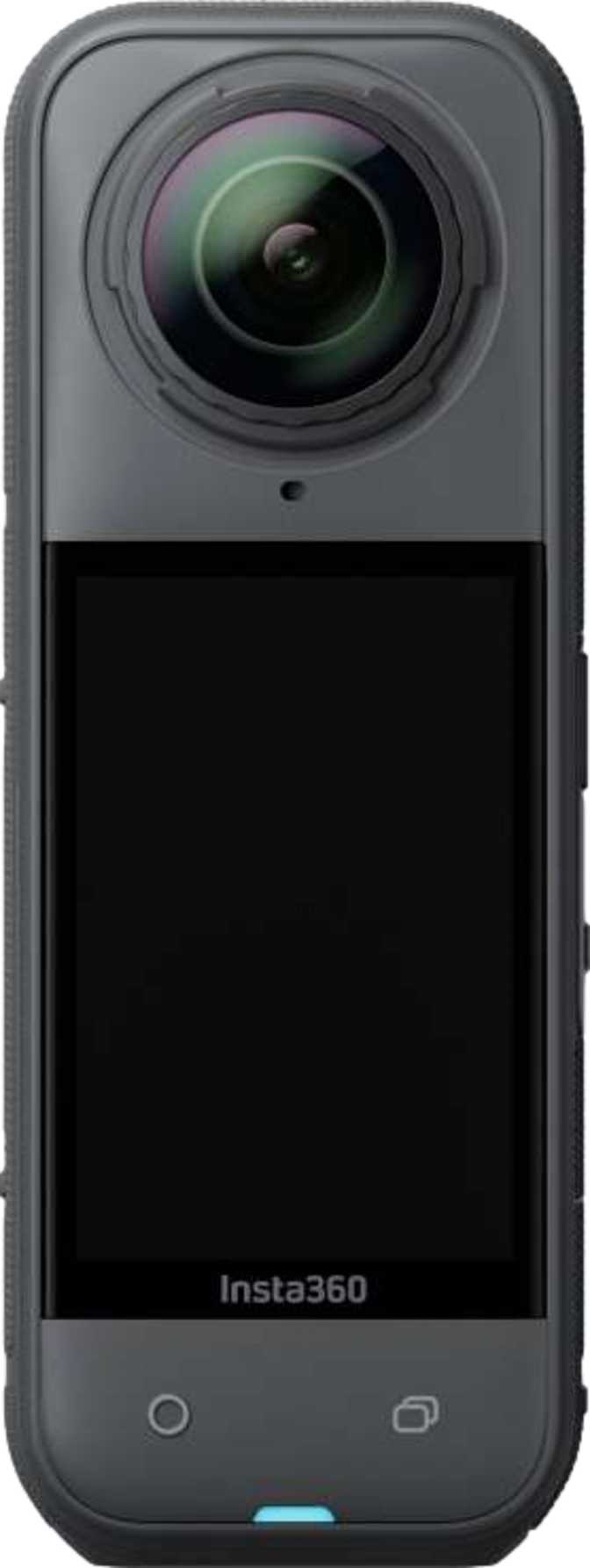
At a Glance
Category Ratings
What the Insta360 X5 Actually Delivers
The 360-degree camera category has always promised a lot: capture everything, miss nothing, fix your framing in post. For years, that promise came with real compromises — soft images, aggressive noise in low light, and editing workflows that felt more like punishment than creativity. The Insta360 X5 is a serious attempt to close that gap between the 360-capture idea and the 360-capture reality.
This is not an entry-level experiment or a casual travel toy. The X5 is built with deliberate choices — high-resolution optics, professional manual controls, a genuinely durable chassis, and an audio setup that treats sound as more than an afterthought. Understanding what those choices mean in practice is exactly what this review is here to do.
Build Quality and Physical Design
How it feels in hand, on a mount, and in the field.
Size, Weight & Handling
At 124.5mm tall, 46mm wide, and 38mm thick, the X5 fits the established physical language of action 360 cameras — narrow, elongated, and designed to disappear on a selfie stick without blocking the view. At 200 grams, it sits at the heavier end of its category. That weight correlates directly with larger sensor hardware and the battery inside. In hand, it feels purposeful rather than bloated, and slips into a jacket pocket without difficulty.
Display & Touch Interface
The 2.7-inch touchscreen handles framing, settings, and playback without requiring fiddly physical directional controls — which matters in gloves or wet conditions. There is no secondary front-facing screen or flip-out panel. For helmet mounts or blind-placement shots, you rely on the paired smartphone app or the onboard voice command system. An external memory card slot supports longer shoots without needing to tether to a phone for offloading.
Durability: Built for Real Conditions
The X5 carries an IP68 rating — the highest standard for dust and water ingress under IEC 60529. Practically: submersion to 15 meters in fresh water, no housing needed. That covers recreational snorkeling and shallow sport diving, not just rain protection.
Cold-weather operation is rated to -20°C — hard skiing, ski mountaineering, winter trail running, and most extreme-cold environments a consumer will encounter.
Optical Performance: The Core Argument for the X5
Sensor architecture, resolution, and manual controls examined.
That figure spans the entire 360-degree sphere across two lenses. Most mirrorless cameras considered high-resolution for professional photography sit between 24 and 45 megapixels across a single frame. With 360 content, viewers can look in any direction — so total resolution translates directly into sharpness in every viewing angle, and into reframe quality when extracting flat clips in post.
BSI CMOS Sensor
Back-illuminated architecture positions light-gathering elements to face incoming light directly, unobstructed by wiring layers. This improves collection efficiency in dim environments — indoor venues, overcast days, dusk — producing cleaner shadow detail and less noise at higher sensitivities than older sensor designs would yield.
f/2 Wide Aperture
A wide maximum aperture for a 360 camera admits substantially more light per unit of time, reducing the need to raise sensitivity and limiting noise. This is meaningful for anyone burned by grainy 360 footage under stage lighting or at dusk. Built-in HDR mode handles high-contrast scenes — bright skies against shaded interiors — automatically.
Full Manual Controls
Manual ISO, shutter speed up to 1/8000s, white balance, and exposure control are all available. That shutter ceiling is fast enough to freeze a cyclist mid-sprint or a breaking wave with no motion blur. For experienced photographers, these controls transform the X5 from a point-and-shoot device into one you can direct creatively.
RAW File Capture
RAW preserves all sensor data before in-camera processing, leaving white balance, noise reduction, sharpening, and tone mapping entirely under editor control in post. For color-graded or retouched editorial work, RAW is non-negotiable — and genuinely rare at this level of portability and form factor.
Video Capabilities: Resolution, Bitrate, and Intelligence
From 4K delivery to autofocus intelligence and cinema framing.
Video maxes out at 3840-pixel-wide resolution at 30fps — standard 4K delivery spec. The maximum recorded bitrate reaches 180 Mbps, a figure associated with professional-grade action cameras and mirrorless bodies. Higher bitrate means more data retained per second: better texture, sharper edges, cleaner motion. A 24p cinema mode is also available for those who want the motion cadence associated with film-style storytelling.
Accelerometer and gyroscope data feed the camera's stabilization system, which includes automatic horizon leveling. Footage shot while the camera is tilting, twisting, or imperfectly mounted will self-correct to keep the horizon horizontal. For skiing, cycling, or running, this is the difference between watchable and unwatchable footage — and it operates without any manual intervention.
Full Video Feature Set
Audio: Four Microphones and What That Means
The X5 uses four microphones arranged to capture stereo audio with spatial awareness. Quad-mic arrays in compact cameras serve two purposes: better directional audio capture, and more effective wind-noise reduction by comparing signals across multiple sources simultaneously.
The internal microphone setup is capable for a device of this size and form factor. For standard action, travel, and vlogging content it handles real-world conditions well. However, there are firm limits that audio-focused professionals will hit quickly, and they are worth knowing before you commit.
Audio at a Glance
- 4 microphones with stereo capture and spatial awareness
- Multi-source wind-noise reduction for outdoor recording
- Suitable for action, travel, and vlogging content
- No 3.5mm audio input — wired microphone attachment is not possible
- Documentary and interview workflows requiring lavalier or boom mics need an alternative approach or camera
Battery Life and Real-World Endurance
Under normal operating conditions on a single charge
Roughly three hours of continuous recording is the upper limit. In context, most intense action-camera sessions — a ski run, a surf, a hike, a day at an event — do not require uninterrupted three-hour recording. You are starting and stopping, reviewing clips, and adjusting settings throughout. Real-world session stamina is typically better than raw continuous-recording numbers suggest.
For a full-day outing, carrying a spare battery is advisable. USB-C charging means a portable power bank extends your day without specialized gear — the same cable you use for your phone works here. The camera displays a live battery indicator so you are never guessing at remaining capacity mid-session.
Cold temperatures reduce effective runtime — a known limitation of lithium-ion chemistry affecting all cameras in this category. At the rated -20°C operating floor, expect noticeably shorter sessions and keep spare batteries warm in an inner pocket to maintain effective capacity.
Connectivity and Ecosystem
What's Included
- Wi-Fi + Bluetooth 5.2Wi-Fi handles fast file transfers. Bluetooth 5.2 enables low-power, stable remote control from a paired smartphone without draining either device.
- USB-C PortStandard USB-C for both charging and wired data transfer. No proprietary cables or adaptors required.
- Android & iOS App ControlThe Insta360 app handles transfer, in-app editing, sharing, and remote camera control across both major mobile platforms.
- Native Live StreamingFirst-party live streaming support is built in — no third-party workaround or additional hardware required.
- Voice CommandsStart and stop recording, capture photos, and switch modes without touching the camera — essential for helmet mounts and hands-occupied action.
Notable Omissions
Location data is not recorded internally. GPS logging for route mapping, speed overlays, and geotagged content requires a compatible external accessory mount. Available as an add-on — but requiring a separate purchase for functionality some competitors include natively is a legitimate criticism.
Wired external microphone connection is not possible. This is a firm wall for professional audio workflows — see the audio section above for full context.
Contactless pairing with accessories is not available. Bluetooth 5.2 handles all wireless connections instead.
Who Should Buy the Insta360 X5
- Action sports participants — snowboarders, mountain bikers, surfers, paragliders — who want total scene coverage without worrying about camera direction
- Travel content creators who want immersive footage with the flexibility to reframe for multiple platforms in post
- Photographers and videographers who want manual control and RAW files from a 360-degree format
- Anyone who regularly shoots in water, rain, snow, or extreme cold and needs a camera that does not require babying in the field
- Content creators who want the floating-camera aesthetic only the invisible selfie stick effect produces
- Videographers who depend on wired external microphones — lavaliers, boom mics — for documentary or interview audio workflows
- Users who need GPS location logging embedded in footage by default without purchasing additional accessories
- Creators who primarily produce traditional flat video — a dedicated action camera delivers higher single-lens resolution and better telephoto reach for the same investment
- Anyone for whom ultra-compact carry weight is the primary criterion — lighter options exist in the category, with trade-offs elsewhere
- Budget-focused buyers — the X5 sits firmly at the premium end of the 360 camera market
How the X5 Compares to Its Natural Alternatives
Insta360 X5 measured against a typical 360 competitor and a traditional action camera.
| Feature | Insta360 X5 | Typical 360 Competitor | Traditional Action Camera |
|---|---|---|---|
| Capture Format | Full 360° sphere | Full 360° sphere | Single wide-angle lens |
| Still Resolution | 72MP combined | 50–66MP combined | 12–23MP |
| Native Waterproofing | 15m, no housing | 10m typical | 10–12m typical |
| RAW Photo Capture | Yes | Varies by model | Limited |
| Manual Controls | Full suite | Partial | Partial |
| Max Video Bitrate | 180 Mbps | 100–120 Mbps typical | 120–200 Mbps |
| Built-in GPS | No | Varies (some yes) | Often yes |
| External Mic Input | No | Some models, yes | Often yes |
| Invisible Selfie Stick | Yes | Yes (format-native) | No |
| Min. Operating Temp | -20°C | -10°C to -20°C | -10°C to -20°C |
Honest Assessment: Strengths and Limitations
Where It Excels
The X5 is technically accomplished in the areas it prioritizes. Sensor resolution is the highest in its class at this size, native waterproofing goes deeper than category norms, and the manual control set is comprehensive. At 180 Mbps, the video bitrate ceiling reflects serious engineering rather than a compromised-down spec — a figure that holds up in professional comparison.
The combination of RAW capture and full manual controls in a waterproof 360-degree body is genuinely unusual. Getting this capability set in a package that fits in a jacket pocket, rated to 15 meters, represents a convergence that competitors have not fully matched.
Cold-weather tolerance to -20°C, horizon leveling, phase-detection autofocus with subject tracking, and native live streaming address nearly every condition a serious action creator will encounter. This camera was designed by people who understand the actual use cases.
Where It Falls Short
The missing GPS will frustrate users who document travel with location data as a core output. It is not a dealbreaker for purely visual creators, but it is a real gap for anyone building geo-tagged trip summaries or route documentation. Requiring an accessory add-on for functionality some competitors include natively is a fair criticism.
The absence of a 3.5mm audio input is a firm wall for professional audio workflows. Documentary shooters and interviewers who depend on wired external microphones should factor this in seriously before purchasing.
Battery life in the three-hour range is workable for action use but less comfortable for extended event or expedition shooting where charging access is unpredictable. At 200 grams, the weight sits at the top of what this category typically offers — reasonable terms for what you get, but relevant for helmet or drone mounting where every gram registers.
Buyer Questions Answered
Final Verdict
The Insta360 X5 is the most capable native-waterproof 360 camera currently available for action and adventure use. It does not try to be the smallest or lightest option — it tries to be the most technically uncompromising one, and in most measurable respects, it succeeds.
The resolution, the bitrate, the depth rating, the cold-weather tolerance, and the full manual suite all point in the same direction: this is a camera built by people who understand what serious outdoor creators actually need, and who declined to trade off technical quality for compactness.
If GPS logging and external audio input are non-negotiable requirements for your work, those gaps push you toward either a competitor's 360 offering or a different camera category entirely. That is not a failure of the X5 — it is a matter of matching the right tool to the right workflow. For the audience this camera is built for, it is the right choice.