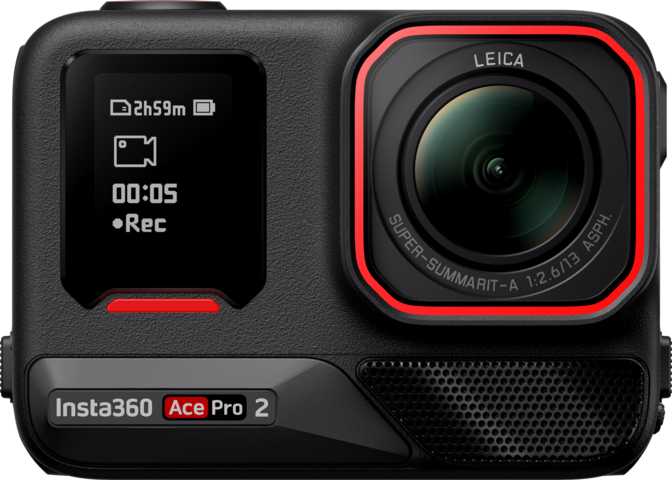
Action cameras have spent years improving incrementally in one direction while frustrating users in another. Resolution climbs, stabilization improves, and then you discover the screen is too small to use in sunlight, or realize the camera you thought was waterproof needs a housing before it goes near the ocean. The Insta360 Ace Pro 2 is a direct answer to those accumulated frustrations, built around native deep waterproofing, a large articulating display, a high-resolution imaging sensor with full manual control, and a video pipeline that belongs in a different product tier. Whether those solutions come with acceptable trade-offs depends entirely on how and where you shoot.
Design, Build Quality, and Physical Experience
At 177 grams, the Ace Pro 2 sits in a considered weight range for the category, substantial enough to feel planted and well-constructed in hand, light enough that helmet or chest harness mounting doesn't punish you over a long session. Its footprint keeps it genuinely jacket-pocket portable, which matters when you're moving between shooting situations and need the camera accessible without a dedicated bag.
Waterproofing: The Real-World Picture
The waterproofing is the build feature that demands immediate attention. IPX8 certification sits at the top of the standard waterproofing classification system, covering sustained, deep submersion rather than splash resistance or brief rain. The camera enters the water directly, without rituals of sealing a case or checking O-rings before each session.
IPX8 Rated
Top-tier ingress protection classification, built for sustained submersion, not just splashes.
12 Meters / 39 ft
Native waterproof depth with no housing or protective case required.
In practical terms, recreational scuba diving typically happens in the 10 to 18 meter range, most snorkelers rarely exceed 3 to 4 meters, and surfing or kayaking sit well inside this range. Competitors at this price tier sometimes require additional casings for serious aquatic use; this camera doesn't.
Temperature Range and Lens Considerations
The specifications list a minimum operating temperature of 20°C and a maximum of 45°C. For anyone planning cold-weather shooting, such as skiing, snowboarding, or winter mountain use, this is worth confirming against your intended environment before committing to purchase, since most action cameras in this class are rated to operate well below freezing.
The lens does not carry a branded, chemically hardened front glass coating. In environments with sand, grit, or trail debris, the front optic is more exposed to surface scratching than cameras that include this protection. A compatible protective filter is a practical first-day addition to the kit rather than an afterthought.
No dedicated bike mount ships in the box. Handlebar and seatpost mounting requires a separately purchased adapter, which is standard across the action camera category but worth confirming against your existing mount system.
The Two-Screen System: A Genuine Workflow Advantage
The most immediately distinctive design element of the Ace Pro 2 is its display configuration, and it's a functional differentiator rather than a cosmetic one.
Main Flip-Out Display
A 2.5-inch touchscreen at 329 pixels per inch flips out from the rear of the body, rendering sharply enough that checking focus and reviewing captures doesn't require squinting. Rotate it forward and you have an accurate live viewfinder for front-facing vlogging and self-capture, eliminating the perpetual uncertainty of whether your head made the frame.
Front Status Display
A secondary screen at the front of the body provides passive status information, battery level, recording mode, and current settings, without requiring you to rotate the camera or wake the main display. Useful for adjusting a mount or confirming the camera is actually recording without interrupting the moment.
Together, the two displays make the Ace Pro 2 one of the most self-aware action cameras to use as a solo shooting tool. For front-facing work especially, the gap between this and cameras with a single small rear screen is real and felt on every shoot.
Imaging Performance: What 50 Megapixels Actually Delivers
Sensor Architecture and Low-Light Capability
At 50 megapixels, cropping headroom is substantial. You can capture a wide-angle scene and isolate a specific subject from within it without losing the detail that makes the shot worth keeping, a real capability for photographers who reframe in post or shoot wide to capture chaotic moments and edit to precision.
The sensor uses back-illuminated CMOS architecture, or BSI, which physically rearranges the photodiode structure so more incoming light reaches the active pixel area rather than being partly blocked by the wiring layer. The practical result is meaningfully better low-light performance compared to conventional sensor layouts of equivalent size. Combined with a maximum sensitivity extending to a high ISO range, the camera produces usable results in dim conditions where earlier action camera sensors would deliver muddy, noise-dominated images.
The main lens aperture is wide enough for reasonable low-light exposure in cloudy, shaded, or dusk outdoor conditions, though cameras with notably faster optics will still outperform it in extreme low light.
Manual Control and RAW Output
Manual control is comprehensive, covering the full complement a serious photographer needs.
The fastest shutter speed reaches 1/8000 of a second, quick enough to freeze high-speed subjects cleanly, from spinning wheel spokes to water droplets in the air. Built-in HDR mode recovers detail across high-contrast scenes where highlights and shadows would otherwise be sacrificed.
The camera shoots RAW photo files. For anyone with a post-processing workflow, this matters: RAW contains uncompressed image data that gives editing software full latitude to adjust exposure, recover shadow and highlight detail, reduce noise, and grade color without the quality ceiling imposed by compressed formats. Burst mode enables sequential rapid captures for selecting the ideal frame from fast action.
There is no flash, so the camera relies entirely on ambient light. In outdoor daylight, the primary environment for an action camera, this is rarely a limitation; in caves, tunnels, or nighttime situations it constrains options. The field of view extends to 157 degrees at its widest, and crucially, that field of view is adjustable rather than fixed, with narrower modes available when wide-angle distortion is unwanted.
Video Performance: 8K, 180 Mbps, and a Complete Creative Toolkit
Resolution and Bitrate
The headline video capability is 8K recording at 30 frames per second. For editors delivering in 4K, or even 1080p, shooting at 8K creates overhead for reframing, cropping, applying stabilization in post, and still outputting full-quality results without sacrificing source material.
The 180 Mbps recording bitrate is where the video pipeline becomes technically significant. Bitrate determines how much image data is preserved per second of footage, meaning more color information retained, more fine detail in complex textures, and fewer compression artifacts in areas like water, foliage, or fast-moving fabric. At this data rate, the camera produces source material that holds up to aggressive color correction and grading without falling apart.
Stabilization, Autofocus, and Tracking
Autofocus for video uses phase-detection rather than the slower contrast-detection systems in older action cameras, locking on quickly and avoiding the hunting through blur that characterizes lower-end systems during recording. Continuous autofocus keeps the system active during capture, and AF tracking locks a specific subject and maintains focus as it moves across the frame, critical for action sports footage.
Horizon leveling compensates for camera tilt during recording, applying automatic correction so footage remains level even when the camera is mounted at an angle or your hand tilts through a rough section of trail, producing footage that reads as intentional rather than accidental.
Creative Modes and Formats
Slow Motion
Stretches fast action for detailed examination of brief moments real-time capture compresses.
24p Cinema Mode
Captures at the motion cadence audiences associate with professional film.
Timelapse
Condenses sunrises, crowds, or changing weather into short, viewable sequences.
Invisible Selfie Stick
Digitally removes the mounting pole, producing footage that appears to float without a visible support.
Live Streaming
Supported natively through the companion app, no external encoders required.
Battery Life and Power Management
~3 Hrs
Rated continuous runtime
<50 Min
Empty to full fast charge
Swappable
Removable battery cell
Three hours of continuous operation is the rated battery endurance. In practice, demanding workloads, such as sustained high-resolution recording, frequent screen use, and active wireless connections, will compress this figure, while lighter mixed use may extend it moderately.
The key design decision that addresses this ceiling is the removable battery. Unlike sealed-cell cameras that require you to stop, find a power source, and wait, the Ace Pro 2 allows hot-swapping: pull the depleted cell, insert a spare, and continue within seconds. For full-day field use, carrying one or two spare batteries is the practical answer.
Fast charging restores the battery from empty to full in under 50 minutes, a fast turnaround for the cell capacity involved. Charging and data transfer both use the USB-C port at USB 3.1 speeds, which matters for footage offload since bulk 8K files move to a laptop or external drive significantly faster than over older USB standards.
Wireless charging is not supported, so a cable is always required. A battery level indicator surfaces charge status without menu navigation, so you can assess remaining capacity quickly before a critical moment.
Audio: Three Microphones and One Hard Limit
The Ace Pro 2 uses three microphones to capture directional, stereo-width audio. Multi-mic arrays deliver meaningfully better results than single or dual-mic configurations, including improved ambient sound reconstruction, better wind noise management, and greater spatial character in the audio track. For vlogging, travel content, and sports footage, this is a real improvement over the audio capture typical of more basic action cameras.
Voice commands allow hands-free control of core camera functions, starting and stopping recording or triggering photo capture, without physical contact with the camera. When the camera is mounted and both hands are occupied with handlebars, paddles, or climbing gear, voice triggering provides a practical alternative.
No external audio input. There is no 3.5mm audio jack and no microphone input port of any kind. Lavalier and shotgun microphones cannot be connected. The three onboard microphones are the only audio capture option, full stop. For interview-style shooting or documentary work requiring controlled professional audio, this is an absolute limitation with no hardware workaround.
Connectivity: What Works and What's Missing
Bluetooth 5.2 handles pairing with phones and accessories, offering stable, efficient connections with lower latency and better range stability than older implementations. Wi-Fi coverage includes both Wi-Fi 4 and Wi-Fi 5, sufficient for live preview through the app and moderate-size wireless file transfers, though large 8K files are better offloaded via the USB-C connection.
The companion app supports both Android and iOS, enabling remote camera control from a smartphone at a distance: live preview, recording start and stop, settings adjustment, and file browsing. Gesture control allows the camera to respond to specific hand signals for hands-free triggering when voice commands aren't practical.
Notable Absences
No GPS
Location data isn't embedded in footage. Route tracking needs a separate GPS device and overlay workflow.
No HDMI Output
Limits direct connection to monitors without additional adapters.
No Internal Storage
A memory card is required for every session, with no fallback if it's forgotten or fails.
Who This Camera Is For — and Who It Isn't
The Right Fit
- Solo content creators and vloggers who need an accurate, large flip-out screen for self-framing.
- Water sports participants who want a camera that enters the water without preparation or housing.
- Videographers working in post-production who value high-bitrate source material for grading and reframing.
- Outdoor photographers who want a compact, rugged stills camera with RAW output and manual control.
- Creators whose audio needs are met by onboard mics, covering vlogging, sports, and travel content.
The Wrong Fit
- GPS-dependent athletes who want route data embedded directly in their footage.
- Professional creators requiring external microphone input, a hard constraint with no workaround.
- Cold-weather shooters, pending confirmation of the stated minimum operating temperature.
- Casual, occasional users who don't need 8K resolution or 50MP stills output.
- Anyone relying on an internal storage fallback, since none exists on this camera.
At a Glance: Key Specifications in Context
| Feature | Detail |
|---|---|
| Maximum Video | 8K at 30 frames per second |
| Still Resolution | 50 megapixels |
| Sensor | Back-illuminated CMOS (BSI) |
| Waterproofing | 12 meters, no housing required |
| Main Display | 2.5-inch flip-out touchscreen, 329 ppi |
| Secondary Display | Front status screen |
| Video Bitrate | 180 Mbps |
| Field of View | Up to 157° (adjustable) |
| Battery Duration | Approximately 3 hours (removable cell) |
| Charge Time | Under 50 minutes (fast charging, USB-C) |
| RAW Photo Output | Yes |
| Live Streaming | Yes, first-party |
| GPS | No |
| External Microphone Input | No |
| Internal Storage | None, card required |
| Horizon Leveling | Yes |
| Invisible Selfie Stick | Yes |
| Voice & Gesture Control | Yes |
| Operating Temperature | 20°C to 45°C (as specified) |
| Weight | 177 grams |
How the Ace Pro 2 Positions in the Action Camera Market
The combination of 8K video and 50MP stills in a compact IPX8-waterproofed body represents a relatively uncommon convergence in the action camera segment. Many cameras at this resolution tier sacrifice display functionality, waterproofing depth, or sensor capability somewhere in the package. The Ace Pro 2 resists several of those compromises simultaneously.
The articulating flip-out display is a feature the category has been slow to adopt at scale. For solo creators, this is a real product differentiator. The inability to accurately see yourself while shooting solo is one of the most consistent frustrations in action camera use, and most competing cameras haven't addressed it at the hardware level.
Where the competitive landscape consistently outperforms the Ace Pro 2 is in GPS integration and external audio connectivity, features that cameras across the action camera price spectrum include and which represent genuine functional advantages in specific workflows. Buyers who need either capability will find alternatives that offer them, though often with trade-offs in imaging resolution, display versatility, or waterproofing depth.
The 180 Mbps bitrate places the Ace Pro 2 in the upper tier for video data quality, a specification that matters primarily to editors and colorists working with the source files, but that sets a quality ceiling appropriate for professional and semi-professional content production.
Honest Assessment: Strengths and Weaknesses
Where It Shines
The imaging system earns its specification claims. A back-illuminated sensor at 50 megapixels, with comprehensive manual controls, RAW file output, and a sensitive ISO range, gives photographers tools that have historically been confined to dedicated camera systems.
The display configuration is arguably the most user-facing differentiator in the action camera market today. Two screens remove friction that has frustrated solo creators for years, letting you see what you're doing accurately rather than relying on guesswork.
The 12-meter native waterproofing without a housing removes both a cost burden and a preparation ritual from water shooting. Over repeated sessions, this compounds into a meaningful quality-of-life advantage over systems that require separate protective cases.
Fast charging from a removable cell answers the battery endurance limitation with the right solution. Under 50 minutes to full, combined with field-swappable cells, makes all-day shooting practical with modest preparation.
Where It Frustrates
No GPS and no external microphone input are real functional omissions that will send some buyers toward alternatives regardless of how the rest of the specification reads. These are hard limits, not gaps addressable through creative workarounds.
The minimum operating temperature noted in the specifications is worth independent verification for cold-weather use. An action camera limited in cold conditions is a notable constraint for a category so closely associated with outdoor adventure.
The absence of protective front glass coating on the lens leaves the optic exposed to the kind of surface damage that outdoor use produces. In sandy, gritty, or abrasive environments, a protective filter is practical insurance rather than an optional accessory.
No internal storage, even a small emergency allocation, means the memory card is a single point of failure. In demanding field conditions, this is a real risk worth managing through preparation rather than discovering at an inconvenient moment.
Common Buyer Questions Answered
Final Verdict
The Insta360 Ace Pro 2 is a camera with a sharp identity and sharply defined limitations. For creators who work in or around water, who shoot solo and need accurate self-framing, and who want genuine imaging quality from a pocketable body, it assembles a package that few direct competitors match across all three requirements simultaneously.
The high-resolution video with professional-grade bitrate, the 50-megapixel BSI sensor with RAW output and manual control, the 12-meter waterproofing without a housing, the flip-out display system, and the fast-charging removable battery form a coherent product, one where the features reinforce each other rather than arriving as independent checkboxes.
The gaps are real and not small. No GPS, no external microphone input, a high minimum operating temperature for an outdoor device, no internal storage fallback, and an unprotected front lens element are genuine limitations, not specification footnotes. They will direct some buyers toward alternatives regardless of what the rest of the spec sheet says.
Bottom Line
The right buyer for the Ace Pro 2 knows why high-bitrate 8K capture matters to their editing workflow, shoots in or near water regularly, creates solo content, and wants a stills camera that is actually serious alongside its video capability. For that buyer, the Ace Pro 2 is among the strongest options available in the action camera category. For buyers who need GPS, external audio, or cold-weather operation, the right choice lies elsewhere.