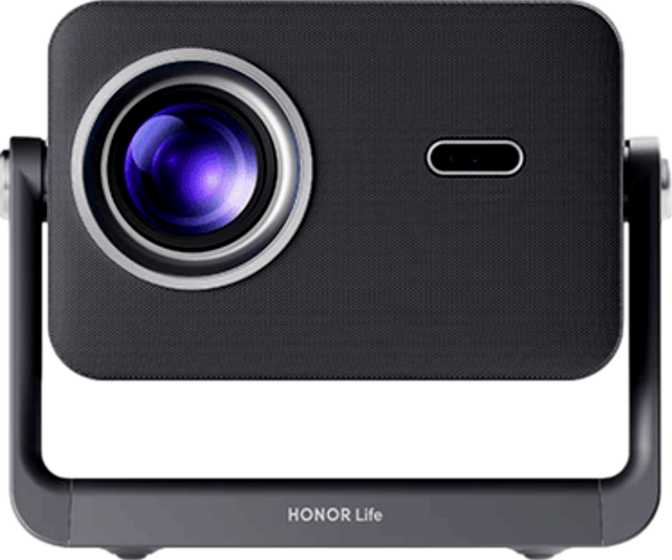
Honor AI Projector Pro Review: Portable Full-HD Smart Projector
ProjectorsThe Honor AI Projector Pro packs Full HD projection, HDR10+ support, and every major wireless casting protocol into a body lighter than most laptops. It is a strong pick for flexible, portable viewing — with a few honest trade-offs to weigh first.
Editor's Rating
4.0 / 5
Great portable projector with smart trade-offs
The living room projector market has spent years split between two camps: affordable but dim portable pucks, and sharp-but-stationary home theater units that cost as much as a used car. The Honor AI Projector Pro positions itself as a third path — a genuinely travel-friendly projector weighing barely more than a soda can, yet capable of filling a wall with a crisp 1080p image and running smart TV apps without a separate streaming stick. That is an ambitious promise. Whether it delivers depends on what you actually need.
Design and Build Quality
Physical experience and portability
At 550 grams, the Honor AI Projector Pro is light enough to carry in a backpack without noticing it — roughly the weight of a hardcover novel. This places it firmly in the portable category rather than the living-room-anchor category, which shapes every other judgment you make about it.
The physical footprint is compact and Honor has clearly prioritized portability over bulk. The trade-off for that slim profile is most apparent in the audio section, but from a pure handling and setup perspective, this is a projector you will actually bring out and use rather than leave stored in a cabinet.
-
550g — Genuinely Portable
Lighter than most tablets and easy to pack in a standard backpack.
-
Remote Control Included
Straightforward couch-to-screen control without requiring your phone for every interaction.
-
1-Year Warranty
Standard coverage for this category — not exceptional, but adequate for most buyers.
-
LED Light Source
Not laser-based. Performs best in dim or dark rooms — plan your viewing environment accordingly.
Projection Quality
Resolution, screen size, throw distance, and HDR performance
1080p Full HD
1,920 × 1,080 pixels — matches Blu-ray and the native format of all major streaming platforms. Sharp at normal viewing distances.
Up to 150 Inches
Over 12 feet wide — larger than any consumer TV at a comparable price. A full living-room wall within reach.
1.3m Min. Throw
Short enough for bedrooms and smaller apartments. No need for a dedicated screening room or 15 feet of open space.
HDR Support: What It Means in Practice
HDR10 & HDR10+ Supported
The most widely used high dynamic range formats across streaming platforms, Blu-ray, and gaming consoles. HDR10+ adds dynamic scene-by-scene tone mapping for noticeably better shadow detail and highlight rendering versus standard video.
Dolby Vision Not Supported
Dolby Vision — found on Apple TV+ and Netflix's premium streams — is absent. For most content libraries, HDR10+ coverage is sufficient. If you are deeply invested in Dolby Vision content, some precision will be lost.
No Lens Shift — Plan Your Setup
There is no vertical or horizontal lens shift. The projector must be placed on a precise axis relative to your screen. Off-center placement relies entirely on digital keystone correction, which involves a minor image quality trade-off. Buyers with awkward room configurations should account for this before purchasing.
Smart Features and Wireless Ecosystem
Built-in platform, voice control, and casting compatibility
Built-In Smart TV Platform
Netflix, YouTube, Disney+, and other streaming apps run directly on the projector — no Fire Stick, Chromecast dongle, or Roku required. Power on, open the app, stream. For renters, travelers, and anyone setting up in a new space, eliminating the dependency on extra hardware is a genuine quality-of-life improvement.
Voice commands are built in, letting you navigate menus, search for content, and control playback without reaching for the remote. Particularly useful when the projector is ceiling-mounted or placed where remote line-of-sight is difficult.
A companion smartphone app is also included, providing the same controls as the remote with the added convenience of easier text input for searching.
Wireless Casting: Full Protocol Coverage
-
AirPlay
Stream directly from iPhones, iPads, and Macs with no app or pairing setup.
-
Chromecast Built-In
Cast from Android phones, Chrome browsers, and any app with a cast button.
-
Miracast
Screen mirroring for Windows PCs and Android devices, even without a shared Wi-Fi network.
-
DLNA Certified
Stream media files from computers or NAS drives on the same local network.
No Ethernet port. All network connectivity is wireless only. Stable home Wi-Fi handles this without issue. For corporate AV environments where wired network reliability is mandatory, this is a genuine gap.
Physical Connectivity
Wired ports and audio output options
What Is Included
-
1 × HDMI Input
Connects a games console, laptop, or Blu-ray player directly.
-
2 × USB Ports
Power streaming sticks, read media from flash drives, or charge accessories.
-
3.5mm Audio Output
Route audio to external speakers, soundbars, or headphones via cable.
-
Bluetooth
Pair wireless speakers or headphones for private or higher-quality audio.
What Is Missing
-
No Second HDMI Port
Connecting both a games console and a laptop requires a separate HDMI switch.
-
No Ethernet / RJ45
Wired networking is unavailable. Wi-Fi only.
-
No S/PDIF Optical Output
Cannot connect to a home theater receiver via optical. Use 3.5mm or Bluetooth instead.
-
No Memory Card Slot
No microSD support. USB flash drives are the workaround for local media playback.
Audio Performance
Built-in speaker and external audio options
The built-in audio is a single 5-watt mono speaker. In quiet rooms and for close-range personal viewing, dialogue is clear and volume is sufficient to follow a film comfortably. In a larger room with ambient noise, or when projecting to a large screen with viewers seated well back, the volume ceiling and the absence of any stereo width become noticeable.
Dolby Atmos spatial audio is not supported. This is not a criticism unique to this projector — mono audio is typical for projectors in this weight class. The practical guidance is clear: treat the built-in speaker as a convenience fallback, not the intended listening experience.
Recommended upgrade: Pair a Bluetooth speaker from day one. The 3.5mm output and Bluetooth connectivity make this straightforward, and the improvement to the overall experience is substantial. Budget for a speaker if audio quality matters.
Audio Specification Summary
| Configuration | Mono (1 channel) |
| Output Power | 5 Watts |
| Stereo Speakers | No |
| Dolby Atmos | No |
| 3.5mm Audio Out | Yes |
| Bluetooth Audio | Yes |
| S/PDIF Optical | No |
Who Should Buy This — and Who Should Not
Real-world usage scenarios and buyer fit
Strong Fit
Apartment and small space dwellers who want a large-screen experience without a permanent TV installation.
Frequent travelers who bring entertainment setups to hotels or temporary accommodations.
Mixed-device households where guests use iPhones, Android phones, or Windows laptops — wireless casting coverage is exceptional.
Students wanting a bedroom projector for movies and casual gaming without a full home theater budget.
Office and meeting room use where wireless screen sharing from visitor devices is important.
Not the Right Tool
Home theater enthusiasts who need Dolby Vision, lens shift for precise installation, or stereo and Atmos audio.
Multi-console gamers who need more than one HDMI input connected simultaneously.
Corporate AV installations that require Ethernet connectivity for network reliability and IT compliance.
Audiophiles requiring S/PDIF optical output for a dedicated AV receiver connection.
How It Compares to the Alternatives
Competitive positioning across three projector tiers
| Feature | Honor AI Projector Pro | Typical Budget Portable | Typical Mid-Range Home |
|---|---|---|---|
| Resolution | 1080p Full HD | 720p or lower | 1080p |
| Weight | 550g | 300–600g | 2–4 kg |
| HDR Support | HDR10 + HDR10+ | Rarely | HDR10 common |
| Built-In Smart TV | Rarely | Sometimes | |
| AirPlay + Chromecast | Varies | ||
| Lens Shift | |||
| Speaker Output | 5W mono | 2–5W mono | 10–20W stereo |
| Ethernet | |||
| Dolby Vision | Rarely |
The Honor AI Projector Pro's clearest advantage over cheaper portables is wireless protocol coverage combined with a built-in smart TV. Its clearest disadvantage versus more expensive home units is the absence of lens shift, stereo audio, and Ethernet.
Honest Strengths and Weaknesses
The real picture — without the marketing gloss
Genuine Strengths
The wireless ecosystem is the standout achievement. Covering AirPlay, Chromecast, Miracast, and DLNA simultaneously is the kind of breadth typically found on dedicated streaming hardware, not a projector. For anyone who has sat in a meeting room fighting with a dongle, or tried to get an iPhone to cast to an Android-native projector, this coverage is immediately valuable.
The 1080p resolution with HDR10+ support is correctly matched to the content most people watch. And at 550 grams, portability is genuine — this projector will actually travel with you rather than gathering dust after the first setup.
Real Weaknesses
The mono 5W speaker is the single most impactful gap between what this projector offers and what a complete entertainment setup requires. Every other weakness is situational — this one affects everyone, every session.
The absence of lens shift means buyers with unusual room configurations face constrained setups. One HDMI port frustrates users with multiple input devices. The lack of Dolby Vision support is worth noting as more platforms prioritize that format. And a one-year warranty is adequate but not generous for a device used daily.
Common Buyer Questions Answered
What real buyers search for before purchasing
Final Verdict
Our clear, direct purchase recommendation
The Honor AI Projector Pro is a well-considered product for a specific buyer. If you want a compact, genuinely portable projector that delivers 1080p resolution with HDR10+ support, connects wirelessly to every device you are likely to own, and runs streaming apps without a separate stick, this delivers that combination in a form factor light enough to disappear into a backpack.
The compromises are not hidden. Mono audio, no lens shift, a single HDMI port, no Ethernet, and no Dolby Vision are real limitations. None of them are dealbreakers for the buyer this product is designed for — the traveler, the apartment dweller, the flexible casual viewer. They are dealbreakers for anyone who wants a permanent, high-fidelity home cinema setup.
If your primary use is a fixed living room installation and you are willing to trade portability for lens shift, stereo sound, and Ethernet, look at stationary 1080p projectors in the next weight class. But if you want to set up a 100-inch movie night wherever you happen to be, the Honor AI Projector Pro is a genuinely capable choice. Pair it with a Bluetooth speaker from day one — that single addition closes the most significant gap in the out-of-box experience.
Overall Score
4.0
out of 5.0
Wireless Ecosystem
Image Quality
Portability
Audio
Connectivity