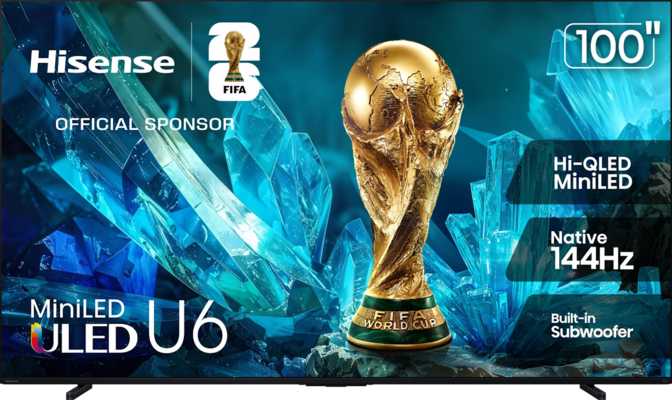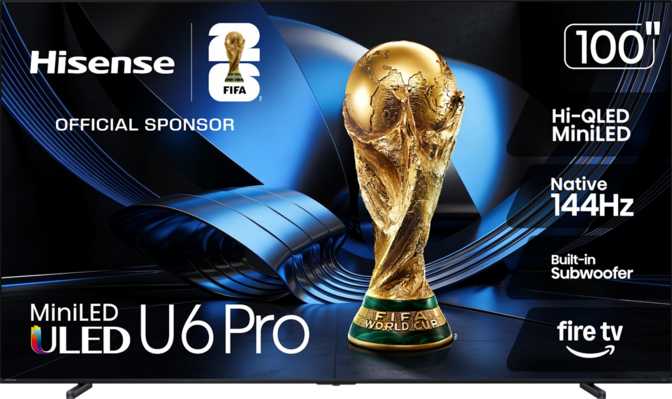
Hisense 100U6SF Pro 100-Inch TV Review: A Full Real-World Verdict
TVsThere is a threshold in home entertainment where a screen stops being a television and starts being an experience. The Hisense 100U6SF Pro crosses that threshold decisively. At a measured 99.5 inches corner to corner, this is not a TV you upgrade to — it is a TV you plan your room around. For anyone who has spent years watching 65- or 75-inch panels and wondered what going bigger actually feels like, the answer this set offers is transformative and more practical than most people expect. This review covers everything a serious buyer needs: the technology behind the picture, the audio system, the smart platform, the real-world trade-offs, and exactly which type of buyer this TV is built for.
At a Glance
Core specifications translated into what matters for your purchase decision
Editorial Performance Ratings
Based on specification analysis and feature assessment — not third-party benchmarks
Display Technology: What Mini-LED and QLED Actually Mean
The Panel Architecture
The 100U6SF Pro uses a layered display system where each component amplifies the one beneath it. At the foundation is an LCD panel — liquid-crystal technology that has powered flat screens for decades. What transforms it is the backlighting: instead of a small number of large LEDs illuminating the panel uniformly, this TV uses Mini-LED — thousands of tiny LEDs arranged in a dense grid that can be controlled in discrete brightness zones. Darker portions of the image receive dimmer backlight while bright highlights receive intense local illumination. The result is contrast depth that standard LED-backlit televisions cannot approach.
Layered above the backlight is a quantum dot film — the QLED component. This converts the LED light into a purer, wider spectrum of color. The TV renders over one billion distinct color shades at 10-bit depth, meaning the subtle gradations in a sunset, the fine detail in skin tones, and the richness of a neon-lit cityscape are reproduced with precision rather than approximation. Color does not just look saturated; it looks accurate.
Resolution and Screen Scale
The native 3840 by 2160 pixel resolution — standard 4K Ultra HD — is spread across a surface area that dwarfs anything in a typical living room. At this scale, a pixel density of approximately 44 pixels per inch produces a sharp, film-like image at normal viewing distances. That viewing distance is not a minor footnote: getting the room geometry right is what unlocks the full experience this panel is capable of.
For a 100-inch 4K display, the recommended viewing range is approximately 8 to 13 feet. At the closer end, the screen fills your peripheral vision the way a cinema screen does. At the far end, you have a commanding overview of the full image. Sitting closer than 8 feet is disorienting rather than immersive. Measuring your space before purchase is the single most important pre-purchase step for this TV.
HDR Format Coverage
Supporting all four active HDR standards means this TV never encounters content it cannot handle natively. Each format has a distinct role in the streaming and broadcast ecosystem:
Refresh Rate and Gaming Performance
The panel runs at 144Hz natively — faster than the 60Hz found in most televisions and even the 120Hz of many premium competitors. This produces visibly smoother motion in fast content: sports broadcasts, action sequences, and gaming all benefit. For dedicated gamers, this combines with AMD FreeSync Premium Pro certification — the highest FreeSync tier, which mandates low framerate compensation and HDR support alongside variable refresh rate. This is not a checkbox feature; it reflects a display engineered for high-performance gaming. All four HDMI ports are version 2.1, supporting 4K at 120Hz with full bandwidth for PlayStation 5 and Xbox Series X at their maximum capability.
Anti-Reflection Coating and Viewing Angles
An anti-reflection coating on the screen face reduces image washout from ambient light sources — windows, lamps, and overhead lighting. The ambient light sensor automates brightness adjustment as room conditions change throughout the day, removing the need for manual recalibration. Horizontal and vertical viewing angles both reach 178 degrees — effectively the maximum available on any flat panel. On a screen this wide, viewers seated toward the sides of the room sit at angles that would visibly degrade picture quality on narrower-angle panels. At 178 degrees, colour and contrast remain consistent well into the periphery of the viewing area.
Audio System: Built-In Sound That Matches the Screen
For a television that commands this much wall space, weak audio would be a serious imbalance. The 100U6SF Pro includes a stereo speaker array augmented by a dedicated subwoofer — an arrangement rarely found in television audio systems at any price point. The subwoofer handles low-frequency content that standard TV speakers simply cannot reproduce: the bass lines in music, the physical weight of an explosion, the full body of a film score. Sound does not just come from the screen — it occupies the room.
The system decodes both Dolby Atmos and DTS:X — the two dominant object-based surround sound formats used across streaming content, Blu-ray discs, and broadcast. Both formats place audio elements in three-dimensional space rather than confining them to left and right channels. Whether you use the built-in speakers or route audio externally, the TV processes both formats natively.
For external audio, the TV provides both HDMI ARC and HDMI eARC. ARC allows a soundbar to receive audio over the same HDMI cable used for video. eARC is the upgraded version, capable of passing lossless, uncompressed formats — including full Dolby Atmos — to a compatible soundbar or AV receiver. A 3.5mm headphone output is also present for private listening.
Audio Feature Summary
- Stereo speakers with dedicated subwoofer
- Dolby Atmos decoding
- DTS:X decoding
- Dolby Digital & Dolby Digital Plus
- HDMI ARC + HDMI eARC (lossless passthrough)
- Digital audio output
- 3.5mm headphone output
Smart TV Platform and Connectivity
Smart Features and Voice Control
The 100U6SF Pro runs a built-in smart TV platform with Chromecast and AirPlay integrated natively. Chromecast allows any app on an Android phone, tablet, or Chromebook to push content directly to the screen with a single tap — no menu navigation, no input switching. AirPlay extends the same convenience to iPhones, iPads, and Macs, mirroring or streaming content from Apple devices without extra hardware. Miracast adds a third wireless display option for Windows PCs and Android devices that do not use Chromecast. A built-in web browser covers content beyond installed apps without requiring an external streaming stick.
Voice assistant support covers both Google Assistant and Amazon Alexa — either ecosystem can change inputs, adjust volume, launch apps, and answer questions through the remote or a connected smart speaker. Apple HomeKit and Siri integration are absent. iPhone users can still stream via AirPlay, but the TV will not appear in the iOS Home app and cannot be controlled by Siri. For households fully committed to the Apple smart home ecosystem, this is a real limitation.
Physical Connections
| Port / Connection | Quantity | What It Means For You |
|---|---|---|
| HDMI 2.1 | 4 | Connect a games console, Blu-ray player, streaming stick, and AV receiver simultaneously at full bandwidth — no input swapping needed. |
| USB | 2 | Playback from flash drives and external drives; also supports USB recording of live broadcast television directly to an attached drive. |
| Ethernet (RJ45) | 1 | Wired network connection for maximum streaming stability — strongly recommended for sustained 4K HDR bandwidth at this screen size. |
| Wi-Fi | Wi-Fi 5 | Adequate for 4K streaming on a strong home network. Note: Wi-Fi 6 is not supported — congested networks benefit from the wired Ethernet port. |
| Bluetooth | v5.3 | Connect wireless headphones, keyboards, or compatible audio devices with current-generation Bluetooth stability. |
| 3.5mm Audio Jack | 1 | Private listening via wired headphones without an external adapter. |
Physical Reality: Installing a 100-Inch TV
Dimensions and Weight
- Width
- Approx. 2,229 mm (87.8 in)
- Height
- Approx. 1,282 mm (50.5 in)
- Depth
- 82 mm (3.2 in)
- Weight
- 63.5 kg (approx. 140 lbs)
- VESA Mount
- Supported
Installation Essentials
- At over 140 pounds, this is not a one-person installation. At least two people are required; a professional installer is strongly recommended.
- Wall and ceiling structures must be assessed for load-bearing capacity before any hardware is installed.
- VESA mount compatibility means standard wall brackets and articulating arms can be used — confirm the specific VESA pattern against your bracket before purchasing.
- Operating temperature range is 5°C to 35°C. Home theater rooms with limited ventilation should be considered carefully.
Power Consumption
At full operation, this TV draws 500 watts — comparable to a high-performance desktop PC under load, and significantly more than a 65- or 75-inch panel. On standby the draw drops to 0.5 watts, which is negligible. For households watching several hours of television daily, the operating figure is a real cost to factor into energy calculations. This is not a weakness specific to Hisense — any 100-inch Mini-LED display at this brightness level will draw power in this range — but it warrants honest acknowledgment before purchase.
Who This TV Is For — and Who Should Look Elsewhere
This TV Suits You If…
- You have a dedicated home theater room or large open-plan living space with at least 10–12 feet of viewing distance available
- You want cinema-scale immersion without a projector setup — this delivers bright, high-contrast images in normal room lighting that projectors cannot match
- You game seriously on PS5 or Xbox Series X and want a screen that makes full use of your console's capabilities without a separate monitor
- You watch a mix of streaming, live sports, and broadcast TV and need one device that handles all HDR formats without any gaps
- Your household uses both Android and Apple devices and needs Chromecast and AirPlay available simultaneously
This TV Is Not Right If…
- Your room cannot comfortably provide 10 feet or more of viewing distance — at shorter distances, 100 inches becomes disorienting rather than immersive
- You are an Apple HomeKit user who expects the TV to integrate with your smart home through Siri — it will not appear in the Home app
- Your budget for installation, mounting hardware, and room reconfiguration is limited — the purchase price is not the only cost of ownership
- You primarily game at a desk at close range — a dedicated gaming monitor serves that use case better at a fraction of the size and cost
How the 100U6SF Pro Compares to the Alternatives
The 100U6SF Pro competes against a small field: very few displays at this size offer the same combination of technologies. Here is how it stacks up against the most logical alternatives a buyer in this market would consider.
| Feature | Hisense 100U6SF Pro | Typical 85″ Mini-LED | 100″ OLED | UST Laser Projector |
|---|---|---|---|---|
| Screen Size | 100″ | 85″ | 100″ | 100″ (variable) |
| Display Type | Mini-LED QLED LCD | Mini-LED or QLED | OLED | Laser projection |
| HDR Formats | All 4 (DV, HDR10+, HDR10, HLG) | Varies by model | Dolby Vision, HDR10 | Limited |
| Refresh Rate | 144Hz | 120Hz typical | 120Hz typical | 60–120Hz |
| HDMI 2.1 Ports | 4 | 2–4 | 2–4 | 1–2 |
| Bright Room Performance | Strong (coating + sensor) | Moderate to strong | Moderate | Poor (needs dark room) |
| FreeSync Premium Pro | Yes | Rare at this tier | No | No |
| Built-in Subwoofer | Yes | Rare | Rare | No |
| Installation Complexity | High (weight + wall load) | Moderate | High | Moderate (short throw) |
| Operating Power | ~500W | ~300–400W | ~350–500W | ~200–300W |
The step from 85 to 100 inches represents a 39% increase in screen area — visible and meaningful, not a marginal upgrade. If the room accommodates it, the experiential gap is significant enough to justify the premium.
OLED delivers perfect per-pixel black levels, but 100-inch OLED panels are extremely rare and carry heavy price premiums. In a lit room, Mini-LED's peak brightness advantage is often the more practical consideration.
Ultra-short-throw projectors simplify installation in some rooms but require controlled ambient lighting, offer lower HDR peak brightness, and cannot match the connectivity flexibility of this TV.
Honest Assessment: Strengths and Weaknesses
Where It Excels
The 100U6SF Pro's strengths arrive as a coherent package rather than isolated wins. The combination of Mini-LED backlighting, QLED color, full HDR format coverage, and 144Hz at a 100-inch scale is rare at any price point. Most televisions of this size make a compromise in one of these areas — this set does not.
The FreeSync Premium Pro certification is a meaningful distinction for gamers. It indicates the display meets AMD's most stringent requirements for variable refresh rate, HDR, and low-latency operation all simultaneously — not just minimum compatibility. Four HDMI 2.1 ports running at full bandwidth eliminates the port conflicts that plague complex home theater setups.
The built-in subwoofer gives the audio system genuine low-end weight you feel in the room. Combined with Dolby Atmos and DTS:X decoding, the built-in system is meaningfully above average for a television — capable of satisfying everyday viewers without requiring an external audio purchase.
Where It Falls Short
The Wi-Fi implementation stops at Wi-Fi 5. For most buyers this is not a daily problem — 4K streaming fits comfortably within Wi-Fi 5 bandwidth on a well-managed network. It becomes relevant if your home network is modern and congested, or if you have invested in Wi-Fi 6 infrastructure. Wired Ethernet removes the issue entirely, but buyers expecting wireless-first reliability should note this ceiling.
Apple HomeKit and Siri are entirely absent. For Apple ecosystem households this is not a partial gap — it is a complete one. AirPlay covers content streaming from Apple devices, but the TV will not appear in the iOS Home app and Siri cannot control it under any configuration.
The remote control is not rechargeable — a persistent minor inconvenience at this price tier where a premium ownership experience is expected. The 500-watt operating draw is an honest cost that buyers with several hours of daily viewing should calculate against their electricity rates.
The weight and installation demands are not product defects. They are practical realities that affect total cost of ownership in ways buyers sometimes underestimate until after purchase.
Common Buyer Questions Answered
A Strong Recommendation — If Your Room Can Handle It
The Hisense 100U6SF Pro is one of the most complete arguments for 100-inch television ownership available today. It does not cut corners in the places that matter most: the display technology is genuinely advanced, the HDR coverage is complete, the gaming credentials are real, and the audio system is meaningfully better than what most televisions at any size offer.
The compromises — Wi-Fi 5 rather than Wi-Fi 6, no HomeKit support, a non-rechargeable remote, and the reality of 500W power draw — are real, but none of them undermine the core product. They are the trade-offs Hisense accepted to price a 100-inch Mini-LED QLED into a range where it becomes genuinely accessible to buyers who would otherwise consider the size completely out of reach.
If your room can handle it — and that single question is the one to answer before anything else — the 100U6SF Pro delivers an at-home cinematic experience that is difficult to match at this scale. For large-room viewers, serious console gamers, and families who want a screen that fills a space the way a screen this size deserves to, this TV earns a confident recommendation.