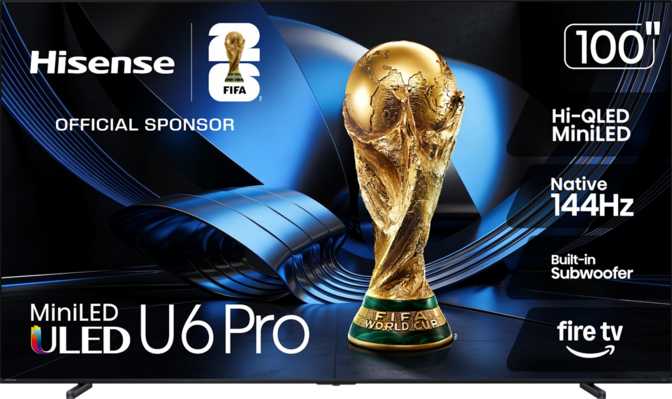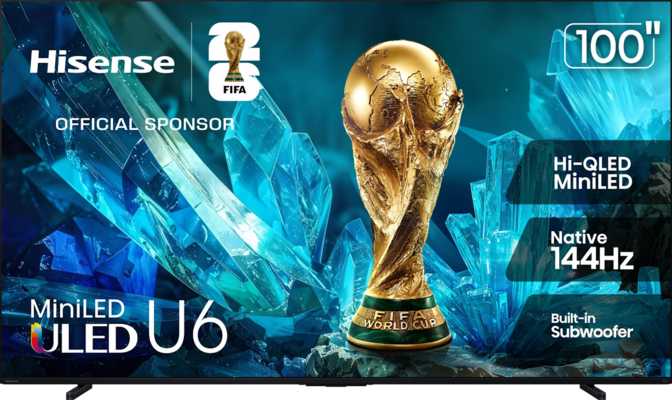
Hisense 100U6SF 100-Inch TV: An Honest Full Review
TVsThere is a threshold in home theater where a screen stops being a television and starts being an experience. For most people, 100 inches is that threshold. The Hisense 100U6SF arrives with a display technology stack that, until recently, was reserved for screens costing considerably more — and the result is a specification profile that competes meaningfully against significantly pricier alternatives.
Best-in-class gaming credentials, full HDR coverage, and picture quality that punches well above this price tier — with a few honest trade-offs worth understanding first.
Build Quality and Physical Presence
At over 2.2 meters wide, the 100U6SF demands genuine commitment — to your room, your wall, and your installation plan. Every physical detail flows from the reality of operating at this scale.
Installation Reality
At 57 kilograms spanning more than 2.2 meters horizontally, this is not a one-person installation. Plan for at least two people and seriously consider professional mounting for any wall installation. VESA mounting is supported, but the bracket must be rated significantly above 57kg — always apply a safety margin. The TV can stand on a media console provided the surface is wide enough and structurally rated for the load. Operating temperature is rated between 5°C and 35°C, covering all normal indoor environments without restriction.
Aesthetics and Room Integration
Hisense has applied a clean, restrained design language — slim bezels ensure the panel surface dominates attention from the first power-on. The depth of roughly 95mm is typical for Mini-LED LCD at this size. It does not press flat against the wall like an OLED, but neither does it protrude dramatically. In practice, the chassis recedes from attention almost immediately: your focus goes entirely to the picture, which is precisely the point of buying a 100-inch television.
The Display: Mini-LED and QLED Working Together
Two distinct technologies solve different problems here — understanding what each contributes explains why the 100U6SF's picture performs the way it does.
Mini-LED Backlighting
Traditional LED televisions use a modest number of large LEDs behind the panel. Mini-LED replaces them with thousands of far smaller LEDs, enabling the backlight to be controlled in much finer independent zones. When the picture shows a bright object against a dark background, Mini-LED dims the zones behind the shadows and intensifies the zones behind the highlights — producing deeper blacks and more controlled contrast than conventional LED panels can manage at any price point below OLED.
QLED Quantum Dot Color
Quantum dot technology adds a specialized filter layer that converts the Mini-LED backlight into purer, more saturated primary colors. The result is a wider color gamut — the range of distinct hues the screen can reproduce. Colors that standard LED panels render as muddy or undersaturated emerge with clarity and vividness. Sunset gradients resolve richer oranges, ocean scenes deeper blues, and skin tones more accurate warmth throughout.
Over a Billion Colors at 10-Bit Depth
The panel renders over one billion distinct colors at 10-bit depth. For comparison, older 8-bit displays produce roughly 16 million colors. The jump to 10-bit means gradients — sunsets, skin tones, deep skies — transition fluidly rather than stepping between visible bands. This is most apparent on HDR content and most noticeable precisely when a cheaper panel would produce a step-banding artifact.
178-Degree Viewing Angles
The rated 178-degree horizontal and vertical viewing angle confirms a wide-angle panel type, not the narrow-angle VA configuration found in budget sets. Anyone seated across a wide sofa or off-center in the room will see a consistent image without the color shift or brightness rolloff that narrower-angle panels produce — an important spec when 100 inches invites distributed seating.
HDR Format Coverage
All four major HDR standards are supported. Different platforms use different formats — having every one means no content ever performs below its potential.
- HDR10 — baseline standard across all 4K Blu-ray and most streaming services
- HDR10+ — dynamic metadata format used primarily by Amazon Prime Video
- Dolby Vision — premium format across Netflix, Apple TV+, Disney+, and Vudu
- HLG — broadcast standard for 4K live television and sports
144Hz Refresh Rate and Gaming Performance
Standard televisions refresh the image 60 times per second. At 144Hz, the 100U6SF updates more than twice as fast — a difference immediately visible during fast-panning sports, action sequences, and gaming, where motion resolves sharply instead of blurring across frames.
AMD FreeSync Premium Pro is the highest certification tier in AMD's adaptive sync programme. The TV dynamically matches its refresh rate to the frame output of a connected gaming PC or compatible console, eliminating screen tearing and reducing stutter. At 100 inches, this improvement is as perceptible as at any smaller screen — and the credentials of running FreeSync Premium Pro at this scale are unmatched at this price point.
Audio: A Built-in Subwoofer Changes the Equation
Many televisions at this price tier offer mediocre flat-panel audio and rely on the buyer to add a soundbar. The 100U6SF takes a different approach — and it shows in the bass register where most televisions fall completely flat.
Built-in Subwoofer
The dedicated subwoofer driver adds genuine low-frequency response that standard two-channel flat-panel configurations cannot produce. Explosions carry weight, music has a foundation, and live sports gain atmosphere. For everyday viewing, this is a complete audio solution without a soundbar.
Dolby Atmos Processing
Dolby Atmos positions sound elements as objects in a three-dimensional space rather than fixed channels. Combined with the subwoofer, Atmos-encoded streaming content delivers a soundstage that standard TV audio cannot approach. Every Netflix and Disney+ original mixed in Atmos plays with genuine spatial dimension.
HDMI ARC and eARC
Both ARC and the upgraded eARC are supported. eARC carries lossless formats — Dolby TrueHD, DTS:X — at full quality over a single HDMI cable. For buyers who invest in premium soundbar hardware, the 100U6SF's external audio connection is fully future-proofed from day one.
For critical listening: An external soundbar or AV receiver will still outperform any built-in TV speaker system. But the 100U6SF's internal audio — with a physical subwoofer and Dolby Atmos — stands well above the competition at this size and price. Supported formats also include Dolby Audio, Dolby Digital, Dolby Digital Plus, and digital audio output for connecting external systems.
Connectivity: Four HDMI 2.1 Ports Is the Right Answer
Port specifications define the long-term ceiling of a television's capability. The 100U6SF sets that ceiling correctly — full-bandwidth HDMI 2.1 on every input, wired and wireless networking, and wireless casting across all three major ecosystems.
Physical Connections
| Connection | Specification | What It Means |
|---|---|---|
| HDMI 2.1 | 4 Ports | 48 Gbps per port — 4K@144Hz, 8K, and VRR on every input |
| USB | 2 Ports | External storage, peripherals, and live USB recording |
| Ethernet | 1 × RJ45 | Wired connection eliminates wireless variability for 4K streaming |
| 3.5mm Audio | 1 Jack | Headphone output or analog audio to external devices |
| HDMI eARC | Supported | Lossless audio passthrough to external soundbar or receiver |
Wireless Connectivity
-
Wi-Fi 5 (802.11ac) — Dual-BandSufficient bandwidth for the most data-heavy 4K HDR streams. Dual-band 2.4GHz/5GHz support allows use of whichever band is least congested. One generation behind the current Wi-Fi 6/6E standard — use the Ethernet port if your router is nearby.
-
Bluetooth 5.3Current-generation wireless for headphones, keyboards, and audio devices. Lower latency and more stable pairing than older Bluetooth versions.
-
Chromecast Built-InCast directly from any Android device or Chrome browser tab without extra hardware or configuration.
-
AirPlayiPhones, iPads, and Macs stream or mirror content wirelessly without an Apple TV device or any additional hardware.
-
MiracastDirect screen mirroring from Windows PCs and non-Google Android devices. Three wireless protocols covering every major ecosystem — no adapters needed for any of them.
Smart TV Features, Voice Control and Running Costs
Smart Platform and Voice Assistants
The built-in smart TV platform includes access to streaming applications, a web browser, and integrated voice command support. Google Assistant and Amazon Alexa are both natively supported — either major voice ecosystem works without additional hardware or configuration.
- Google Assistant — voice search, smart home control, and content discovery
- Amazon Alexa — full Alexa skills, smart home integration, and automation routines
- Smartphone Remote App — phone-based control and text entry when the remote is out of reach
- USB Recording & Sleep Timer — broadcast recording to external drive and automatic shutoff
- Apple Siri / HomeKit — not supported; AirPlay functions but the TV cannot join HomeKit automations
The physical remote uses standard replaceable batteries rather than a rechargeable unit — a minor but honest limitation compared to some competitors at this tier.
Power Consumption
Running a 100-inch Mini-LED television carries a real energy cost that deserves consideration alongside the purchase price.
At 450 watts under normal operation — roughly equivalent to running a large desktop PC — daily usage adds measurably to electricity bills. Standby consumption at 0.5 watts is negligible. Buyers who leave the television running for extended periods each day should factor this into total cost of ownership alongside the purchase price. The ambient light sensor helps by moderating brightness automatically in lower-light conditions.
Who Should Buy the 100U6SF — and Who Should Not
A 100-inch television is not a universal upgrade. Room geometry, seating distance, and intended use case determine whether this TV delivers on its potential or simply overwhelms a space that cannot accommodate it.
Ideal For These Buyers
Large-room home theater enthusiasts who can maintain a seating distance of roughly 1.9 to 3.2 meters. At this range, 4K resolution resolves at full quality and the 100-inch scale becomes genuinely immersive rather than uncomfortably large.
Serious gamers seeking the maximum display size without sacrificing performance. 144Hz, AMD FreeSync Premium Pro, and four full-bandwidth HDMI 2.1 ports make this one of the most capable large-format gaming displays currently available at this price tier.
Sports and live event viewers who want the broadcast-room experience at home. The wide-angle panel, 144Hz motion clarity, and HLG broadcast HDR support collectively produce sports content as it was intended to be seen.
Commercial environments — conference rooms, sports bars, showrooms — where visibility across a large space and impact are the primary requirements.
Consider an Alternative If
Your room cannot support the viewing distance. Sitting too close to a 100-inch screen makes pixel structure visible and the experience physically uncomfortable. A 65- or 75-inch television serves a smaller room far better — do not force the size.
Absolute black levels are your priority. Mini-LED delivers very good blacks for an LCD. They are not OLED blacks. The pixel-level independent dimming that OLED provides cannot be replicated by any LCD technology. Buyers migrating from OLED should calibrate their expectations accordingly and explicitly.
You rely on Apple HomeKit automation. AirPlay works, but Siri voice control and HomeKit scene integration are absent. The TV cannot be registered as a controllable HomeKit accessory.
Wi-Fi 6 or 6E is a requirement for your future-forward smart home network. Wi-Fi 5 handles 4K streaming without issue, but it is one generation behind the current wireless standard.
How the 100U6SF Compares at 100 Inches
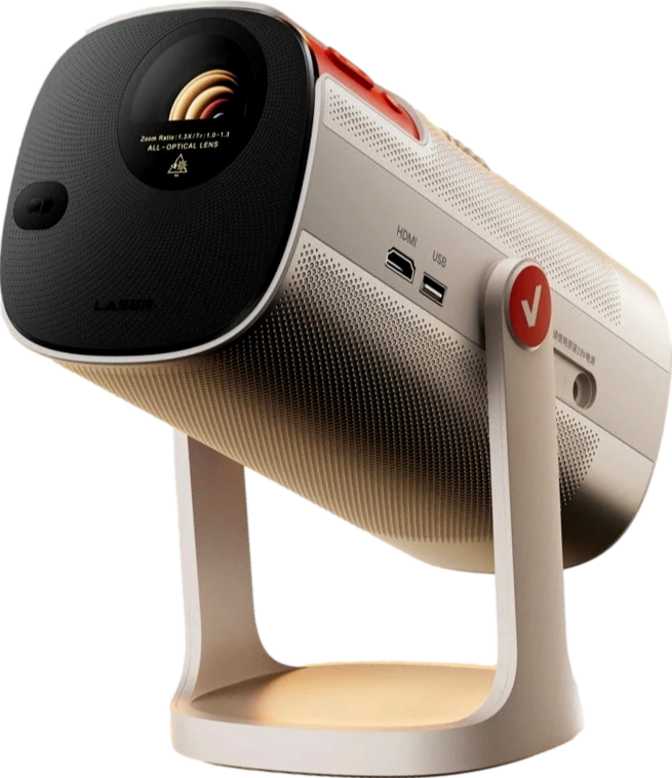
The 100-inch competitive set is narrow — most manufacturers produce far fewer models at this size than at 65 or 75 inches. Relevant alternatives fall into two categories: other LCD-based 100-inch panels, and laser projector systems targeting the same screen size.
| Feature | Hisense 100U6SF | Typical 100-inch LCD | Laser Projector (100-inch) |
|---|---|---|---|
| Display Technology | Mini-LED QLED | Standard DLED | Laser DLP / 3LCD |
| Native Refresh Rate | 144Hz | 60–120Hz | 60Hz typical |
| HDR Format Support | All 4 formats | Usually 2 formats | HDR10 typically |
| Full-Bandwidth HDMI 2.1 | 4 ports | 1–2 ports | 1 port typically |
| Bright Room Performance | Good | Variable | Requires dark room |
| Built-in Audio | Above avg (subwoofer) | Average | Below average |
| Installation Approach | Wall mount or stand | Wall mount or stand | Ceiling mount or shelf |
Strengths and Honest Weaknesses
Where the 100U6SF Excels
The 100U6SF's strongest credentials are its display technology combination and its gaming feature set. Mini-LED with QLED at 100 inches, paired with a native 144Hz refresh rate and AMD FreeSync Premium Pro certification, is not a configuration commonly found at this price point. Full HDR format support means no content is ever left performing below its potential — whether from streaming, physical media, or broadcast.
Four HDMI 2.1 ports running at full bandwidth on every input is a meaningful differentiator. Many competing televisions reserve full-bandwidth capability to just one or two ports. Here, the fourth port is as capable as the first. Connect a gaming PC, two consoles, and a media streamer simultaneously — no port becomes the bottleneck.
The audio package outperforms expectations at this price tier. The built-in subwoofer elevates bass response well above what standard flat panels deliver, and Dolby Atmos processing gives streaming content a genuine spatial dimension. For most buyers, an external soundbar becomes an optional enhancement rather than a necessity.
Limitations Worth Knowing
Mini-LED, despite being a significant step above standard LED, cannot fully eliminate backlight bloom — the faint glow that appears around very bright objects on dark backgrounds. This is visible during title cards and starfield scenes. It is a physical characteristic of LCD technology, not a flaw specific to this model, but buyers who have experienced OLED's pixel-level dimming should calibrate their expectations before purchase.
Wi-Fi 5 is one generation behind the current Wi-Fi 6 and 6E standards. For most buyers, Wi-Fi 5 handles 4K streaming entirely adequately — but those building future-forward smart home networks will find the TV is not on the wireless leading edge. The Ethernet port effectively neutralizes this concern for anyone who can run a cable from the router.
The one-year warranty is on the shorter end for a major television purchase at this scale and price. Extended warranty options through the retailer deserve serious consideration — for a product of this investment level, extended coverage is a worthwhile addition rather than an optional luxury.
Questions Real Buyers Ask Before Purchasing
Direct answers to the searches that brought you here.
The Recommendation
The Hisense 100U6SF makes a genuinely compelling case for itself in a category where most alternatives involve significant trade-offs. The combination of Mini-LED backlighting, QLED color, a 144Hz native refresh rate, and complete HDMI 2.1 port allocation gives it a specification profile that outpaces direct competitors and holds its own against televisions at considerably higher price points.
For buyers who have the room to use it properly — and that qualifier matters more here than with any other consumer television — the 100U6SF delivers cinematic scale with enough technical sophistication to justify the size. Built for large-room family viewing, immersive sports, and serious gaming in equal measure. The trade-offs are real but expected for this technology and price tier: Mini-LED blacks fall short of OLED, Wi-Fi 5 is not the latest standard, and the one-year warranty demands attention. None of these are dealbreakers for a buyer who understands what they are purchasing.